From the Desk of CLASSICKONG
Good morning, music lovers, and welcome back to WTSG-DB’s This Day in Music History.
Before we turn up the volume, we send our continued thanks and respect to the men and women of the United States Armed Forces — past and present. Wherever you are today, thank you for your service and sacrifice. 🇺🇸
And before we dive into today’s music history, let’s see what else we’re celebrating on September 22.
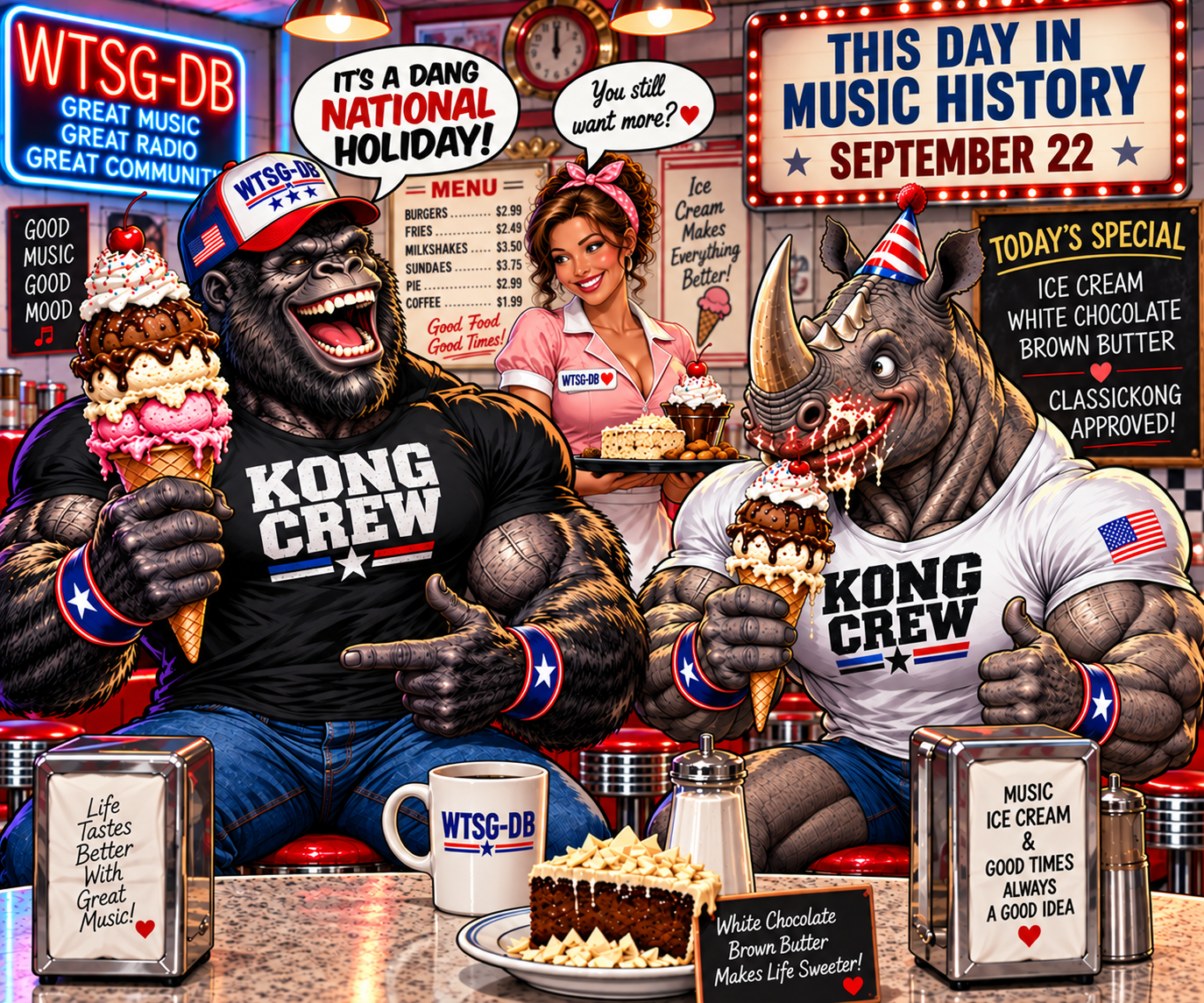
We’ve got National Ice Cream Cone Day, celebrating that wonderful edible delivery system that makes ice cream even better. Waffle cone, sugar cone or cake cone — CLASSICKONG isn’t here to judge. Just keep ’em coming. 🍦
It’s also National Brown Butter Day. Take ordinary butter, cook it until those milk solids brown, and suddenly you’ve got that rich, nutty flavor that makes everything smell like somebody in the kitchen knows exactly what they’re doing.
Then there’s National White Chocolate Day — cocoa butter, sugar and milk coming together in the name of satisfying our collective sweet tooth.
So basically, September 22 is already trying to destroy CLASSICKONG’s diet.
But wait.
There’s one more.
WORLD RHINO DAY! 🦏
Oh, you’ve GOT to be kidding me.
September 22 celebrates all five species of rhinoceros — and later in today’s show we’re going to be talking about Adrian Belew.
The same Adrian Belew whose 1982 debut solo album was called…
Lone Rhino.
ROFLMAO!
Buddy, we couldn’t have planned that if we’d tried.
Apparently the rhino knew he was going to be on the show before we did.
So happy World Rhino Day to our big, horned friends — and somewhere out there, Adrian Belew should probably be wondering why his ears are burning. 🦏🎸😂
Now that we’ve got ice cream, brown butter, white chocolate and a rhinoceros roaming around the studio, I suppose we should probably get to the music.
And September 22 is one of those dates where the deeper you dig, the better it gets.
We’ve got a historic gathering of musicians helping America’s family farmers, birthdays for genuine rock-and-roll originals, Alice Cooper returning with a monster, KISS inviting us back into the circus, King Crimson reinventing itself, Wes Montgomery showing us why individuality matters, and one of America’s greatest songwriters leaving behind a catalog almost impossible to comprehend.
But there’s something connecting these stories.
A road.
Not necessarily the easiest road. Not always the road everyone expected them to take.
Their road.
Let’s get moving.
Farm Aid Begins — And Eddie Meets Sammy on Stage
On September 22, 1985, the first Farm Aid concert was held at Memorial Stadium in Champaign, Illinois.
Willie Nelson, John Mellencamp and Neil Young organized the benefit during a devastating period for America’s family farmers. Around 80,000 people packed the stadium, and the inaugural concert raised more than $9 million.
And what a lineup.
Johnny Cash. Waylon Jennings. George Jones. Loretta Lynn. Merle Haggard. John Denver. Glen Campbell. Roy Orbison. B.B. King. Bonnie Raitt. Tom Petty and the Heartbreakers. Foreigner. Billy Joel. John Fogerty. Don Henley. Alabama. Kris Kristofferson. Huey Lewis. Brian Setzer.
And plenty more.
But buried inside that enormous day of music was a little piece of hard-rock history.
Sammy Hagar and Eddie Van Halen took the stage together and ripped through Led Zeppelin’s “Rock and Roll.”
It was their first public performance together after Hagar joined Van Halen.
Think about that.
Before 5150. Before “Why Can’t This Be Love.” Before “Dreams.” Before the next great chapter of Van Halen had really begun, Eddie and Sammy were standing together on a stage in Illinois playing Zeppelin for a cause bigger than themselves.
Sometimes history doesn’t announce itself.
Sometimes somebody just plugs in a guitar.
Happy 75th Birthday, David Coverdale
Born September 22, 1951, David Coverdale turns 75 today.
And what a voice.
Coverdale first reached an international audience after joining Deep Purple in 1973. His Purple years gave us Burn (1974), Stormbringer (1974) and Come Taste the Band (1975).
He later released the solo albums White Snake (1977) and Northwinds (1978) before building the band that would carry the Whitesnake name forward.
By 1987, Whitesnake had exploded in America with Whitesnake, powered by songs including “Still of the Night,” “Here I Go Again,” “Is This Love” and “Give Me All Your Love.”
But part of the Whitesnake story has always been the extraordinary guitar talent that passed through Coverdale’s orbit.
Micky Moody. Bernie Marsden. John Sykes. Adrian Vandenberg. Vivian Campbell. Steve Vai. Doug Aldrich. Reb Beach.
Good grief.
Different eras. Different guitar combinations. Different shades of hard rock and blues.
But standing in the center was that unmistakable David Coverdale voice.
And there’s one Whitesnake song that has always meant something special to me.
“Sailing Ships.”
It’s the beautiful closing track from Slip of the Tongue (1989), the album featuring the extraordinary Steve Vai on guitar.
I was overseas when I first heard that album.
And I fell in love with it.
“Sailing Ships” was one of those more reflective Whitesnake songs that allowed Coverdale’s voice to soar in a different way. He has always sung with tremendous feeling — whether he’s tearing into a hard rocker, singing the blues, delivering a power ballad or taking us somewhere quieter and more introspective.
And all these years later, “Sailing Ships” can still take me right back there.
CLASSICKONG’s Must-Have Coverdale
Deep Purple — Burn (1974, Purple Records)
Whitesnake — Ready an’ Willing (1980, United Artists)
Whitesnake — Come an’ Get It (1981, Liberty)
Whitesnake — Slide It In (1984, Liberty/Geffen)
Whitesnake — Whitesnake (1987, Geffen)
Whitesnake — Slip of the Tongue (1989, Geffen)
Coverdale•Page — Coverdale•Page (1993, Geffen)
I’ve loved this man’s voice for years.
David Coverdale and Whitesnake gave us a mountain of great songs, great records and great guitar playing.
Today we give David his roses.
Happy 75th, sir. 🌹
Happy Birthday, Joan Jett — Do It Your Way
Also celebrating a birthday today is Joan Jett, born September 22, 1958.
And if today’s theme is finding your own road, Joan belongs right near the front.
She came out of The Runaways, went solo, encountered record-company rejection and, with Kenny Laguna, helped create Blackheart Records rather than waiting around for somebody else’s permission.
Now THAT’S rock and roll.
Joan was huge in the ’80s.
“I Love Rock ‘n Roll.”
“Do You Wanna Touch Me (Oh Yeah).”
“Crimson and Clover.”
“Bad Reputation.”
“I Hate Myself for Loving You.”
There was always something wonderfully rebellious about Joan Jett.
Not rebellion manufactured by somebody in a marketing office.
More like:
This is who I am. This is what I play. Turn the damn guitar up.
I loved it then and I love it now.
And here’s one I’d almost forgotten.
In 1987, Joan starred alongside Michael J. Fox and Gena Rowlands in Light of Day. Joan and Fox played Patti and Joe Rasnick, brother and sister and members of a working Cleveland rock band called The Barbusters.
Bruce Springsteen wrote the title song, and Joan performed it with the Barbusters.
I remember seeing that movie decades ago.
Apparently CLASSICKONG’s memory banks still work after all. It just takes Jarvis occasionally kicking the side of the cabinet. 😂
Joan didn’t need rock and roll to become respectable.
She needed rock and roll to ROCK.
Much respect, Joan.
Happy birthday. 🌹🤘
Alice Cooper Unleashes Constrictor
On September 22, 1986, Alice Cooper released Constrictor on MCA Records, produced by Beau Hill.
The album marked Alice’s return to recording after a roughly three-year hiatus following DaDa. It featured Kane Roberts on guitar, Kip Winger on bass and David Rosenberg on drums.
And Alice came back swinging.
“Teenage Frankenstein.”
“Give It Up.”
“Thrill My Gorilla.”
“The World Needs Guts.”
“He’s Back (The Man Behind the Mask).”
“Teenage Frankenstein” and “Thrill My Gorilla” are flat-out ROCKERS.
And speaking of “Thrill My Gorilla”…
WTSG-DB would like to announce that we are currently in negotiations with Alice Cooper for the rights to use “Thrill My Gorilla” as CLASSICKONG’s official theme song.
Unfortunately, for reasons we cannot understand, Alice refuses to return our calls.
Come on, Alice!
Have your people call our people! 🦍😂
“He’s Back (The Man Behind the Mask)” was written in connection with Friday the 13th Part VI: Jason Lives.
And with Halloween getting closer, rest assured you’re going to be hearing some Alice Cooper around WTSG-DB — including some of these songs and plenty of other appropriately spooky rock-and-roll favorites.
I’ve got Constrictor on CD. In fact, I may have just about everything Alice has released on CD.
What can I say?
Alice Cooper is legend.
Detroit rocker. Showman. Survivor. And one of the hardest-working men in rock and roll.
All these years later, Alice is still giving us reasons to turn the stereo up.
CLASSICKONG’s Constrictor Picks
“Teenage Frankenstein”
“Thrill My Gorilla”
“He’s Back (The Man Behind the Mask)”
CRANK ‘EM.
KISS Opens the Psycho Circus
“YOU WANTED THE BEST! YOU GOT THE BEST! THE HOTTEST BAND IN THE LAND… KISS!”
OH YEAH, BABY!
On September 22, 1998, KISS released Psycho Circus in the United States on Mercury Records.
Paul Stanley.
Gene Simmons.
Ace Frehley.
Peter Criss.
For those of us who grew up in the KISS Army, simply seeing those four faces together again on a new studio album meant something.
And that album cover?
I’ve always loved it.
The title track kicks the door open, Ace gets his moment with “Into the Void,” and the album also gave us “Within,” “I Pledge Allegiance to the State of Rock and Roll,” “We Are One” and “You Wanted the Best.”
The actual recording involved additional musicians, so it wasn’t quite the complete four-man studio reunion some fans might have expected.
Would it have been nice to have Ace and Peter playing throughout every song?
Sure.
But sometimes things simply don’t work out exactly the way we’d like.
And I’m certainly not here to take cheap shots at KISS.
Let’s face it:
KISS was — and still is — my favorite rock-and-roll band of all time.
They’re the band that started my love affair with rock and roll.
The makeup. The characters. The stage show. The explosions. The costumes. The albums. The merchandise.
And most importantly, those songs.
For a kid discovering rock and roll, there was simply nothing else like them.
They were the originators.
There have been plenty of imitators.
But there has only ever been one KISS.
They didn’t merely join the circus.
They built their own.
CLASSICKONG’s Psycho Circus Picks
“Psycho Circus”
“Into the Void”
“You Wanted the Best”
“We Are One”
KISS Army forever. 🤘
The Band Releases the “Brown Album”
On September 22, 1969, The Band released its self-titled second album, The Band, on Capitol Records.
Often called the “Brown Album,” it contained songs including:
“Across the Great Divide”
“Rag Mama Rag”
“Up on Cripple Creek”
“Whispering Pines”
“The Night They Drove Old Dixie Down”
That last song deserves a little extra attention.
Robbie Robertson wrote “The Night They Drove Old Dixie Down,” and Levon Helm delivered the lead vocal.
The song tells its story through the fictional Virgil Caine, an ordinary Southerner experiencing the upheaval and hardship surrounding the closing period of the American Civil War.
Over the years, the song has sparked plenty of discussion about perspective, history and interpretation.
I’m not here to debate that today.
What fascinates me is how differently we sometimes hear music as children.
I remember hearing “The Night They Drove Old Dixie Down” on the radio during the 1970s.
I knew the song.
I heard the words.
But as a kid, I didn’t really understand the historical story those words were telling.
Years later, you hear the same recording with adult ears and realize there was an entire world inside a song you thought you already knew.
That’s one of the beautiful things about music.
Sometimes the record doesn’t change.
We do.
King Crimson Chooses a Different Road — Discipline
On September 22, 1981, King Crimson released Discipline in the UK on E.G. Records.
Seven years had passed since Red.
Robert Fripp could have tried to rebuild yesterday’s King Crimson.
He didn’t.
Instead, the new quartet was:
Robert Fripp — guitar
Adrian Belew — guitar and vocals
Tony Levin — bass and Chapman Stick
Bill Bruford — drums and percussion
And Discipline sounded like a band discovering a new musical language.
“Elephant Talk.”
“Frame by Frame.”
“Matte Kudasai.”
“Indiscipline.”
“Thela Hun Ginjeet.”
“The Sheltering Sky.”
“Discipline.”
The interlocking guitars, Levin’s Chapman Stick, Bruford’s rhythmic imagination and Belew’s completely individual approach made this a very different Crimson.
And Adrian Belew has always been one of those musicians who sounds like…Adrian Belew.
I loved his work — Lone Rhino, “Big Electric Cat,” Twang Bar King, later Mr. Music Head and so much more.
Years ago, while I was serving overseas in the military, I decided to write Adrian.
I wasn’t asking for anything.
I simply told him I was overseas, that we enjoyed his music, and thanked him for making it.
I never expected anything back.
He sent us a postcard.
I’ve never forgotten that.
It was a small gesture from his side of the mailbox.
But on mine?
It meant something.
So today, Adrian, wherever this finds you:
Thank you again.
We’re still listening. 🌹
And considering that today also happens to be World Rhino Day, it looks like the universe decided Lone Rhino deserved a little extra recognition today, too. 🦏🎸
Wes Montgomery — “Unit 7” and the Sound of One Man’s Hands
Now this one is personal.
On September 22, 1965, guitarist Wes Montgomery recorded “Unit 7” with one extraordinary rhythm section:
Wynton Kelly — piano
Paul Chambers — bass
Jimmy Cobb — drums
Those names alone ought to make a jazz fan sit up straight.
And then there’s Wes.
That thumb.
Those octaves.
That SOUND.
Wes Montgomery is one of those guitarists musicians study. Jazz guitarists especially continue to look toward him because his musical vocabulary became part of the language of the instrument.
But there’s another reason Wes means something to me.
My dad loved Wes Montgomery.
Dad was a guitarist and singer, and he worked his tail off. He worked day jobs and still played music at night.
Wes knew something about that kind of life himself. Before the wider recognition came, he worked regular jobs in Indianapolis while supporting his family, then played music at night.
I understand that kind of work ethic because I watched my father live it.
And no guitarist could ever replace my dad for me.
He was simply my guy.
He could play anything. Any style.
So if my dad listened to Wes Montgomery, learned from Wes and respected his playing?
Buddy, that tells me everything I need to know.
We spend a lot of time talking about influences in music.
Sometimes influence is more than learning somebody’s lick.
Sometimes one generation listens to another, learns something from it, and then passes something of its own down to the next.
Dad heard Wes.
I heard Dad.
And the road keeps going.
CLASSICKONG’s Wes Montgomery Must-Haves
The Incredible Jazz Guitar of Wes Montgomery (1960, Riverside)
Full House (1962, Riverside)
Smokin’ at the Half Note (1965, Verve)
A Day in the Life (1967, A&M)
Give Wes his roses. 🌹
And Dad?
These are for you, too. ❤️🌹
Happy Birthday, Marlena Shaw
Also celebrating a September 22 birthday is jazz and soul vocalist Marlena Shaw.
Shaw moved comfortably through jazz, soul, blues and R&B across a career that included recordings for Cadet, Blue Note, Columbia and Verve.
One recording that enjoyed a particularly long life is her version of “California Soul.”
There’s also “Woman of the Ghetto,” another performance closely associated with Shaw and one that continued finding new audiences decades later.
And yes, if the title “Touch Me in the Morning” immediately makes you think of Diana Ross, you’re thinking correctly. Ross made the song famous in 1973; Shaw later recorded it as well.
Marlena died on January 19, 2024.
She may not be the first name every casual listener recognizes, but her music continued reaching new generations long after those original records were made.
And that’s one of the reasons we love doing this every day.
Sometimes we get to celebrate the household names.
Other times, we get to give an extraordinary artist her roses and introduce her music to somebody who may be hearing her name for the first time. 🌹
CLASSICKONG’s Marlena Shaw Must-Haves
Out of Different Bags (1967, Cadet)
The Spice of Life (1969, Cadet)
Marlena (1972, Blue Note)
Who Is This Bitch, Anyway? (1975, Blue Note)
And if Marlena Shaw is new to you, start with “California Soul.”
Then let that voice lead you further into her catalog.
John Lennon Takes a Chance on a New Label
On September 22, 1980, John Lennon and Yoko Ono signed with the newly established Geffen Records as Lennon prepared his return to record-making with Double Fantasy.
The remarkable part of the story is that David Geffen agreed to the deal without first hearing the album.
And that album wasn’t far away.
Double Fantasy was released November 17, 1980, on Geffen Records, in both the United States and United Kingdom.
It marked Lennon’s return to a full-fledged recording career after roughly five years away from the business and included:
“(Just Like) Starting Over”
“Watching the Wheels”
“Beautiful Boy (Darling Boy)”
“Woman”
Just look at those songs.
If anybody ever wonders why John Lennon remains such a legendary songwriter, sit down and really listen to them.
I think most of us fathers who have a son understand exactly where “Beautiful Boy (Darling Boy)” is coming from. Beneath the fame and everything that came with being John Lennon, there’s a father singing about the love, hopes and fears that come with watching your boy grow up.
And then there’s “Woman.”
There’s something beautifully direct about that song. I think a lot of us guys understand the feeling behind it when we’re fortunate enough to find the woman who completes us — the person who becomes our partner and such an important part of who we are.
Those aren’t feelings that belong to 1980.
They’re human feelings.
And that’s why songs like these continue speaking to people decades later.
Sometimes a career-changing business decision begins with hearing the music.
In this case, David Geffen apparently didn’t need to.
He believed in the artists.
And Lennon gave him Double Fantasy.
Irving Berlin — An American Treasure
On September 22, 1989, Irving Berlin died in New York City at age 101.
Where do you even begin?
Calling Irving Berlin a great songwriter almost seems inadequate.
Irving Berlin was an American treasure.
He wrote more than 1,200 songs, and an extraordinary number of them became woven into the fabric of American life.
Just look at a few titles:
“Alexander’s Ragtime Band”
“Always”
“Blue Skies”
“Puttin’ on the Ritz”
“Cheek to Cheek”
“How Deep Is the Ocean?”
“There’s No Business Like Show Business”
“White Christmas”
“God Bless America”
That’s not merely a list of songs.
That’s part of America’s musical history.
Berlin came to America from the Russian Empire as a child. He later served in the U.S. Army during World War I, wrote for Broadway and Hollywood, and created music that crossed generations of singers and listeners.
And “God Bless America” has an extraordinary history of its own.
Berlin originally wrote it while serving in the Army in 1918, set it aside, and returned to it twenty years later. Kate Smith introduced the revised song on radio in 1938.
Then there’s “White Christmas.”
Bing Crosby’s recording helped turn Berlin’s melody into a song that generations of families would hear year after year.
Think about that legacy.
Bing Crosby sang Irving Berlin.
Fred Astaire sang Irving Berlin.
Ella Fitzgerald sang Irving Berlin.
Frank Sinatra sang Irving Berlin.
Sarah Vaughan sang Irving Berlin.
Tony Bennett sang Irving Berlin.
Willie Nelson sang Irving Berlin.
Different generations.
Different voices.
Different musical worlds.
But they kept coming back to those songs.
CLASSICKONG’s Irving Berlin Must-Haves
Bing Crosby & Fred Astaire — Song Hits from Holiday Inn (1942, Decca)
Berlin’s Holiday Inn songs, including the immortal “White Christmas.”
Original Broadway Cast — Annie Get Your Gun (1946, Decca)
Featuring Ethel Merman and Berlin classics including “There’s No Business Like Show Business,” “They Say It’s Wonderful,” “I Got the Sun in the Morning” and “Anything You Can Do.”
Ella Fitzgerald — Ella Fitzgerald Sings the Irving Berlin Song Book (1958, Verve)
If you want to hear one American treasure interpret another, here’s your record. Ella takes on Berlin across a magnificent collection that includes “Let’s Face the Music and Dance,” “Puttin’ on the Ritz,” “Cheek to Cheek,” “Blue Skies” and many more.
That last one may be my favorite recommendation of the bunch.
Ella Fitzgerald singing Irving Berlin.
Good grief.
Styles changed.
Technology changed.
America changed.
But people kept singing Irving Berlin.
More than a century after some of those songs were written, we’re still talking about them.
That’s not merely success.
That’s legacy.
Give this American treasure his roses. 🌹
Final Spin — The Road We Choose
There’s an old Robert Frost poem I’ve loved for years called “The Road Not Taken.”
Near the end comes one of the most familiar lines in American poetry:
“I took the one less traveled by.”
Maybe that’s why it feels right today.
Wes Montgomery found his voice with his thumb, his octaves and years of work.
Joan Jett didn’t wait forever for somebody else’s approval.
Alice Cooper turned rock and roll into his own theater.
KISS dreamed bigger than four musicians standing underneath stage lights.
David Coverdale kept moving forward while keeping that unmistakable voice at the center.
King Crimson could have tried to recreate its past. Instead, Discipline opened another road.
Adrian Belew picked up a guitar and found sounds most of us wouldn’t have known were hiding inside one.
Irving Berlin traveled an extraordinary road from immigrant child to one of the defining songwriters of American music.
And then I think about my dad.
He worked.
He played.
He came home tired and kept going.
He listened to musicians like Wes Montgomery because a real musician never stops learning.
And no matter how many extraordinary guitar players I’ve heard in my lifetime, nobody replaces Dad.
He was my guy.
That’s the thing about influences.
We don’t honor our heroes by becoming copies of them.
We listen.
We learn.
We carry something forward.
Then eventually we arrive at our own fork in the road.
Maybe years later we’ll look back and wonder about the other path. Maybe we’ll remember our choices differently than they felt when we actually made them.
That’s life.
But sooner or later, you’ve still got to choose.
So learn from the people who traveled before you.
Remember the people who helped you along the way.
Do the work.
Find your voice.
And when you know which road is yours…
walk it.
That’s our Final Spin, and that’s gonna do it for today.
Thanks for spending a little time with us, and we hope you’ve enjoyed today’s stories.
And before you go, don’t forget — today is an AMAZING day for the sweet tooth!
Grab yourself an ice cream cone. 🍦
Treat yourself to some delicious white chocolate.
Heck, find something made with brown butter while you’re at it.
And if anybody asks why you’re walking around eating dessert in the middle of the day, just look ’em straight in the eye and tell ’em:
“IT’S A DANG NATIONAL HOLIDAY!” 😂
And besides…
IT’S CLASSICKONG APPROVED! 🦍👍🍦
So enjoy yourself, enjoy the music, and maybe raise an ice cream cone to our rhino friends while you’re at it. 🦏
From all of us here at WTSG-DB, have a great day, take care of yourselves and each other, and we’ll see you next time.
Listen to Today’s Broadcast
Hear the spoken-word edition of This Day in Music History right here on WTSG-DB.
And a special welcome to everyone listening through Spotify. Thanks for joining the WTSG-DB family. If you enjoy the show, follow us there so you don’t miss the next episode.
Join the WTSG-DB Community
Music has always been better when we share it.
Have a memory connected to one of today’s artists or records? Maybe your parents introduced you to Wes Montgomery. Maybe you were in the KISS Army. Maybe Joan Jett or Whitesnake was blasting out of your car stereo in the ’80s.
Sign in and leave us a note in the WTSG-DB Guestbook.
We’d love to hear your story.
Great Music. Great Radio. Great Community.
WTSG-DB