From the Desk of CLASSICKONG
Before we drop the needle today, a heartfelt thank-you to the men and women of the United States Armed Forces — past and present — and to the families who stand beside them.
Now, before we get into this ridiculously loaded day in music history, September 23 is also National Great American Pot Pie Day.
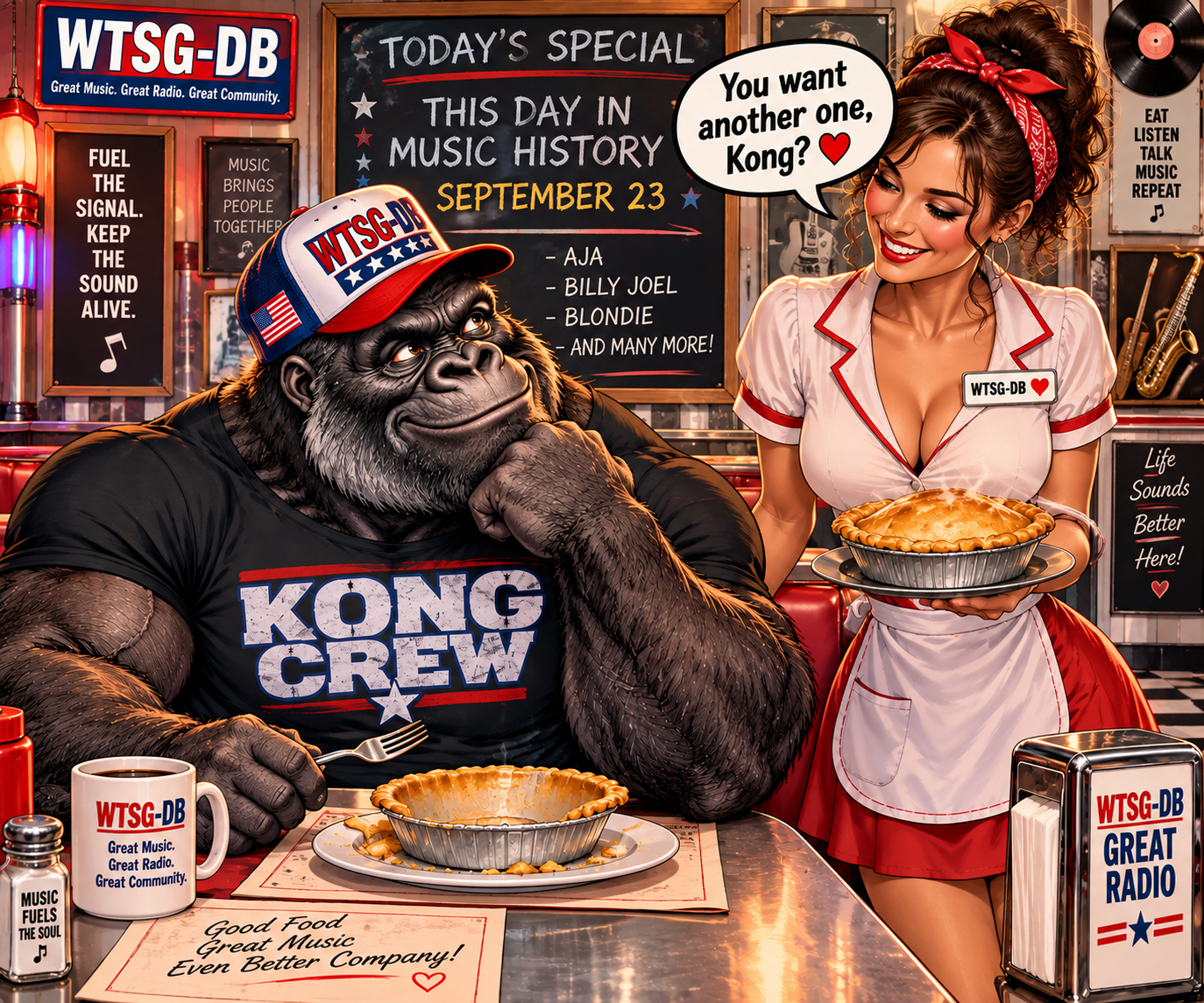
Which apparently explains why the waitress just walked back over to CLASSICKONG’s booth, looked at the empty dish and asked:
“You want another one, Kong?”
…
Ma’am, we’re going to be here awhile. You already know the answer.
Bring that pot pie over here and let’s get to work.
Because, folks, September 23 is absolutely LOADED.
Normally we like to grab a great story and dig beneath the surface. Today, if we did that with everything sitting on the calendar, we’d end up writing the musical version of War and Peace.
So let’s establish something right out of the gate:
We are not ranking today’s stories.
We list them as we find them unless something extraordinary naturally demands Top Story treatment. Coltrane isn’t competing with Blondie. Ray Charles isn’t battling Dream Theater. Billy Joel doesn’t have to defeat Boston.
They’re all fantastic stories.
We’ll systematically work our way through as many as we can, give them the attention they deserve, and if something makes you say, “Kong, I want MORE of that,” write in and tell us.
We’ve got a lot of ground to cover.
And apparently another pot pie.
Let’s roll.
1970 — The Allman Brothers Band Release Idlewild South
Album: Idlewild South
Year: 1970
Label: Atco / Capricorn
Producer: Tom Dowd on most of the album; Joel Dorn on “Please Call Home”
On September 23, 1970, the Allman Brothers Band released their second studio album, Idlewild South.
And just look at the songs:
“Revival.”
“Don’t Keep Me Wonderin’.”
“Midnight Rider.”
“In Memory of Elizabeth Reed.”
“Hoochie Coochie Man.”
“Please Call Home.”
“Leave My Blues at Home.”
Then look at the band:
Gregg Allman — vocals, organ and piano
Duane Allman — guitar and slide guitar
Dickey Betts — guitar
Berry Oakley — bass
Butch Trucks — drums
Jai Johanny “Jaimoe” Johanson — drums and percussion
This was a band discovering just how wide its musical vocabulary could become.
Blues. Rock. Jazz. Gospel. Improvisation.
And Dickey Betts’ instrumental “In Memory of Elizabeth Reed” was already pointing toward what would happen when the Allmans stretched this music out onstage.
Their next major statement would be the monumental At Fillmore East.
Here’s something even better: the Allman Brothers were actually playing the Fillmore East on September 23, 1970, the very day Idlewild South was released.
“In Memory of Elizabeth Reed” was in the set.
Now THAT is a day at the office.
Must-Have Allman Brothers Band
- The Allman Brothers Band — 1969 — Atco
- Idlewild South — 1970 — Atco/Capricorn
- At Fillmore East — 1971 — Capricorn
- Eat a Peach — 1972 — Capricorn
1977 — Steely Dan Release Aja
Album: Aja
Year: 1977
Label: ABC Records
Producer: Gary Katz
Now we’re entering one of CLASSICKONG’s favorite neighborhoods.
Aja.
Seven songs:
“Black Cow.”
“Aja.”
“Deacon Blues.”
“Peg.”
“Home at Last.”
“I Got the News.”
“Josie.”
That’s it.
But Walter Becker and Donald Fagen surrounded those seven songs with an extraordinary collection of studio musicians and an almost obsessive attention to detail.
Steely Dan themselves have described how the changing versatility of top session musicians during this period began influencing what Becker and Fagen could write. Suddenly they could call players who were equally comfortable in jazz and R&B and build the music around those possibilities.
That’s craftsmanship.
And here’s something I learned while preparing today’s show that somehow escaped me all these years:
Joe Sample played on Aja.
Yes — THAT Joe Sample, the magnificent keyboard player from the Crusaders whose work we’ve celebrated before.
Sample appears on “Black Cow” and the title track.
Then consider the other musicians scattered across this record.
Steve Gadd. Bernard Purdie. Chuck Rainey. Larry Carlton. Wayne Shorter. Michael Omartian. Victor Feldman.
Good grief.
I’ve known about Gadd forever.
Larry Carlton? Absolutely.
Bernard “Pretty” Purdie? You better believe it.
But discovering Joe Sample inside an album I’ve loved for years gives me another reason to hold Aja in such high esteem.
Great records do that.
You can know them for decades and still discover another musician, another texture, another little piece of the puzzle.
CLASSICKONG SUPERHERO STAT CARD — STEELY DAN
Commanders: Donald Fagen & Walter Becker
Primary Weapon: Songcraft
Special Power: Finding exactly the right musician for exactly the right moment
Secret Laboratory: The recording studio
Power Album: Aja — 1977 — ABC
Weakness: Apparently accepting “good enough”
Must-Have Steely Dan
- Can’t Buy a Thrill — 1972 — ABC
- Pretzel Logic — 1974 — ABC
- The Royal Scam — 1976 — ABC
- Aja — 1977 — ABC
And don’t forget Aja.
We’re coming back to it.
1978 — Blondie Draws the Parallel Lines
Album: Parallel Lines
Year: 1978
Label: Chrysalis
Producer: Mike Chapman
Parallel Lines gave us:
“Hanging on the Telephone.”
“One Way or Another.”
“Picture This.”
“Sunday Girl.”
“Heart of Glass.”
And Buddy Holly’s “I’m Gonna Love You Too.”
Producer Mike Chapman helped sharpen Blondie’s sound without sanding away what made the band Blondie.
And standing out front was the lovely and extraordinarily talented Debbie Harry.
Debbie wasn’t simply somebody who happened to front a successful band.
She became an icon.
The look was unmistakable.
The voice was unmistakable.
The attitude was unmistakable.
But never let the image distract you from the records.
Blondie could move between punk, new wave, rock, pop and disco without sounding as though they needed anybody’s permission.
CLASSICKONG SUPERHERO STAT CARD — BLONDIE
Frontwoman: Debbie Harry
Weapons: Voice • Style • Attitude
Special Power: Crossing musical boundaries without losing identity
Battle Zones: Punk • New Wave • Rock • Pop • Disco
Power Album: Parallel Lines — 1978 — Chrysalis
Signature Attack: “Heart of Glass”
CLASSICKONG STATUS: ICON
Must-Have Blondie
- Blondie — 1976 — Private Stock
- Plastic Letters — 1977 — Chrysalis
- Parallel Lines — 1978 — Chrysalis
- Eat to the Beat — 1979 — Chrysalis
- Autoamerican — 1980 — Chrysalis
Who doesn’t love Blondie?
1980 — Bob Marley Plays His Final Concert
On September 23, 1980, Bob Marley & the Wailers performed at the Stanley Theatre in Pittsburgh.
It became Bob Marley’s final concert.
The set included songs such as “Natural Mystic,” “No Woman, No Cry,” “Jamming,” “Exodus,” “Redemption Song,” “Could You Be Loved” and “Is This Love.”
The final song Marley performed before a concert audience was “Get Up, Stand Up.”
Bob Marley died on May 11, 1981.
He was only 36.
We don’t need to turn that into trivia.
Sometimes history deserves a moment simply to stand on its own.
1982 — Billy Joel Raises The Nylon Curtain
Album: The Nylon Curtain
Year: 1982
Label: Columbia
Producer: Phil Ramone
And before somebody asks:
No. Phil Ramone was not a member of the Ramones.
Different Ramone.
Moving along. 😂
On September 23, 1982, Billy Joel released The Nylon Curtain.
And I’ll say this right up front:
For me, this may be Billy Joel’s finest work.
Now before somebody starts throwing copies of The Stranger and Glass Houses at my head — relax.
I can make a pretty convincing argument for either one of those too.
Truthfully?
I love ’em all.
As Dalton said in Road House:
“Opinions vary.”
But the songwriting on The Nylon Curtain is simply off the charts.
“Allentown” examines a community watching the future it was promised disappear.
“Pressure” feels almost claustrophobic.
“Goodnight Saigon” is powerful and haunting.
“Laura” cuts deep.
“Scandinavian Skies” takes the album somewhere darker and stranger.
And then Billy closes everything with “Where’s the Orchestra?”
That’s the one that gets me.
Billy uses the language of theater to ask something much larger about expectations, disappointment and discovering that life may not have been the production we thought we bought a ticket to see.
And musically, Billy was stretching too.
The Nylon Curtain feels like an album.
Nine songs.
One complete statement.
Must-Have Billy Joel
Good luck keeping THIS short.
- The Stranger — 1977 — Columbia
- 52nd Street — 1978 — Columbia
- Glass Houses — 1980 — Columbia
- The Nylon Curtain — 1982 — Columbia
- An Innocent Man — 1983 — Columbia
Ask me tomorrow and I may rearrange the whole thing.
Opinions vary.
1986 — Boston Finally Reaches the Third Stage
Album: Third Stage
Year: 1986
Label: MCA
Eight years.
That’s how long Boston fans waited after Don’t Look Back for another studio album.
Then Tom Scholz finally delivered Third Stage.
“Amanda.”
“We’re Ready.”
“Cool the Engines.”
“Can’tcha Say (You Believe in Me)/Still in Love.”
“Hollyann.”
I’ve always felt Third Stage picks up the Boston story right where Don’t Look Back left it.
It took a while.
Boy, did it take a while.
But the instant “Amanda” begins, there is absolutely no question who’s coming through those speakers.
That’s Boston.
That’s Tom Scholz.
That enormous layered guitar sound, Brad Delp’s beautiful voice, those harmonies and Scholz’s relentless attention to detail were all still there.
Sometimes craftsmanship takes time.
In this case?
Worth the wait.
CLASSICKONG SUPERHERO STAT CARD — TOM SCHOLZ
Weapons: Guitar • Keyboards • Recording studio
Special Power: Building enormous sounds one painstaking layer at a time
Secret Lair: Hideaway Studio
Power Album: Boston — 1976 — Epic
Patience Meter: EIGHT YEARS
Must-Have Boston
- Boston — 1976 — Epic
- Don’t Look Back — 1978 — Epic
- Third Stage — 1986 — MCA
Three albums.
Plenty of firepower.
1986 — The Pretenders Say “Don’t Get Me Wrong”
We’ve also got room for a quick spin from one of my favorite voices.
The Pretenders — “Don’t Get Me Wrong.”
Written by Chrissie Hynde, the song would appear on Get Close.
And Chrissie is one of those singers who needs about three seconds before you know exactly who’s standing at the microphone.
Tough.
Cool.
Vulnerable.
Completely herself.
What a talent.
1997 — Dream Theater Falls Into Infinity
Album: Falling into Infinity
Year: 1997
Label: EastWest
Producer: Kevin Shirley
On September 23, 1997, Dream Theater released their fourth studio album, Falling into Infinity.
It’s also the band’s only studio album featuring keyboardist Derek Sherinian.
The lineup:
James LaBrie — vocals
John Petrucci — guitar
John Myung — bass
Derek Sherinian — keyboards
Mike Portnoy — drums
What makes this album particularly interesting is what was happening behind the scenes.
Dream Theater was dealing with outside pressure toward shorter, more commercially accessible material — something that created considerable creative frustration, particularly for Mike Portnoy.
Yet listen to what survived:
“New Millennium.”
“Peruvian Skies.”
“Hollow Years.”
“Lines in the Sand.”
“Trial of Tears.”
There’s still plenty of Dream Theater in those grooves.
And Mike Portnoy behind the kit.
You already know where I stand.
Must-Have Dream Theater
- Images and Words — 1992 — Atco
- Awake — 1994 — EastWest
- Falling into Infinity — 1997 — EastWest
- Metropolis Pt. 2: Scenes from a Memory — 1999 — Elektra
- Six Degrees of Inner Turbulence — 2002 — Elektra
Hank Williams, Chet Atkins and Four Songs for the Ages
This may be my favorite historical discovery from today’s research.
On September 23, 1952, Hank Williams entered Castle Studio in Nashville for what became his final recording session.
During that session Hank recorded:
“Your Cheatin’ Heart”
“Kaw-Liga”
“Take These Chains from My Heart”
“I Could Never Be Ashamed of You”
Now look who’s playing electric guitar.
Chet Atkins.
Yep.
My man Chet.
Also participating were Don Helms on steel guitar, Tommy Jackson on fiddle and Floyd “Lightnin’” Chance on bass.
Nobody in that room could have known they were witnessing Hank Williams’ final recording session.
Hank died January 1, 1953.
He was only 29.
And here’s one of those connections that makes digging through music history worthwhile:
On the exact day Hank recorded those songs, Ray Charles was celebrating his 22nd birthday.
Ray would later record “Take These Chains from My Heart.”
Two stories.
Two musical worlds.
One September 23.
And eventually they meet.
CLASSICKONG SUPERHERO STAT CARD — CHET ATKINS
Weapon: Guitar
Special Power: Making impossible playing sound effortless
Battle Style: Country • Jazz • Pop • Fingerstyle
Nickname: Mr. Guitar
September 23 Mission: Electric guitar behind Hank Williams
CLASSICKONG STATUS: LEGEND
That’s why we dig.
September 23 Birthdays
John Coltrane — September 23, 1926 – July 17, 1967
TRANE.
John Coltrane wasn’t merely an extraordinary saxophonist.
His music could be searching, restless, beautiful, challenging and deeply spiritual.
Before leading his own groundbreaking groups, Coltrane traveled through musical worlds that included Dizzy Gillespie, Miles Davis and Thelonious Monk.
And behind all that extraordinary ability was something decidedly human:
work.
Practice.
Study.
Curiosity.
An almost relentless desire to keep developing.
The Smithsonian marks September 23 as Coltrane’s birthday alongside another musician we’ll meet in just a moment: Ray Charles.
CLASSICKONG SUPERHERO STAT CARD — JOHN COLTRANE
Weapons: Tenor & Soprano Saxophone
Special Power: Harmonic exploration
Training Grounds: Dizzy Gillespie • Miles Davis • Thelonious Monk
Power Album: A Love Supreme
Mission: Keep searching
Power Meter: OFF THE CHART
Must-Have Coltrane
- Blue Train — 1957 — Blue Note
- Traneing In — 1958 — Prestige
- Giant Steps — 1960 — Atlantic
- My Favorite Things — 1961 — Atlantic
- A Love Supreme — 1965 — Impulse!
And yes, I intentionally included Traneing In.
That’s one I personally love.
Give Trane his roses.
Ray Charles — September 23, 1930 – June 10, 2004
The Genius.
And that nickname wasn’t thrown around casually.
Ray Charles absorbed gospel, blues, jazz, R&B, country and pop and somehow made every one of those ingredients sound unmistakably like Ray Charles.
“I’ve Got a Woman.”
“What’d I Say.”
“Georgia on My Mind.”
“Hit the Road Jack.”
“Unchain My Heart.”
And then Ray could turn around and make country music completely his own.
CLASSICKONG SUPERHERO STAT CARD — RAY CHARLES
Weapons: Piano • Voice
Special Power: Making musical boundaries disappear
Battle Zones: Gospel • Blues • Jazz • R&B • Country • Pop
Power Album: Modern Sounds in Country and Western Music
Alias: The Genius
Must-Have Ray Charles
- Ray Charles — 1957 — Atlantic
- The Genius of Ray Charles — 1959 — Atlantic
- Modern Sounds in Country and Western Music — 1962 — ABC-Paramount
- Ingredients in a Recipe for Soul — 1963 — ABC-Paramount
There was only one Ray.
Les McCann — September 23, 1935 – December 29, 2023
Pianist, vocalist and one of the great voices of soul-jazz.
If you need an entrance ramp, go directly to Les McCann & Eddie Harris — Swiss Movement and “Compared to What.”
Then keep going.
McCann could groove, swing and bring gospel and soul directly into jazz without sacrificing any of the music’s sophistication.
Give him his roses.
Roy Buchanan — September 23, 1939 – August 14, 1988
Here’s one for the guitar players.
Roy Buchanan never needed walls of effects or theatrical tricks to make a Telecaster speak.
His touch, volume control, harmonics, bends and command of dynamics gave him an immediately identifiable voice.
If Roy Buchanan isn’t in your guitar vocabulary yet, fix that.
Must-Have Roy Buchanan
- Roy Buchanan — 1972 — Polydor
- Second Album — 1973 — Polydor
- That’s What I Am Here For — 1973 — Polydor
- Loading Zone — 1977 — Atlantic
Ron Bushy — September 23, 1945 – August 29, 2021
DRUMMER ALERT.
Ron Bushy was the drummer for Iron Butterfly.
Which means we have to say it:
“In-A-Gadda-Da-Vida.”
Bushy’s extended drum solo became part of one of the defining heavy psychedelic recordings of the late 1960s.
Drummers know.
Don Grolnick — September 23, 1947 – June 1, 1996
Here’s another musician whose name casual listeners may not immediately recognize — until you start reading the credits.
Pianist, keyboardist, composer and arranger Don Grolnick worked in musical worlds involving the Brecker Brothers, Michael Brecker, David Sanborn, James Taylor, Linda Ronstadt and other first-class musicians.
This is why we read liner notes.
Sometimes the musicians who helped create the soundtrack of your life aren’t the names printed largest on the cover.
Neal Smith — Born September 23, 1947
Another DRUMMER ALERT.
Neal Smith was a founding member and the drummer of the classic Alice Cooper band, as well as one of the group’s contributing songwriters.
That original band had chemistry, attitude, muscle and menace — and Neal Smith’s drums were a major part of that sound.
Give the drummer his roses.
Much better.
Jerry Corbetta — September 23, 1947 – September 16, 2016
Ohhhhh, buddy.
Sugarloaf.
Jerry Corbetta was the singer and keyboardist behind one of those records that needs about five seconds to grab me:
“Green-Eyed Lady.”
That organ.
That bass line.
That groove.
And if you’ve only heard the shortened radio version, do yourself a favor and find the long album version and let the musicians stretch out.
Then we get:
“Don’t Call Us, We’ll Call You.”
Now THAT’S a song title.
Sugarloaf had already tasted major success with “Green-Eyed Lady,” but after subsequent struggles, the band channeled some of its music-business frustration into the sarcasm of “Don’t Call Us, We’ll Call You.”
And it became another hit.
AllMusic’s history of the group traces that path from the 1970 debut through Spaceship Earth, I Got a Song and the later success of “Don’t Call Us, We’ll Call You.”
I can relate to that song.
Here at WTSG-DB, we do our level best every day to create something that’s both informative and entertaining.
It takes research.
It takes time.
It takes work.
We’re not the biggest operation in the world, and we’ve never pretended to be.
Our hope is simply that when you spend a little of your time with us, you enjoy what we’ve created — and maybe learn something along the way.
So I understand that old “you’re really not important enough” treatment that independent musicians, broadcasters and creators sometimes encounter.
That’s why I tip my hat to Sugarloaf.
They took that frustration and made a record out of it.
And there’s an old saying worth remembering:
Be careful how you treat the people you pass on the way up, because you may pass them again on the way down.
Somebody else’s opinion of your importance doesn’t determine the value of your work.
Hats off to Jerry Corbetta and Sugarloaf.
Must-Have Sugarloaf
- Sugarloaf — 1970 — Liberty — featuring “Green-Eyed Lady”
- Spaceship Earth — 1971 — Liberty
- I Got a Song — 1973 — Brut
- Don’t Call Us — We’ll Call You — 1975 — featuring “Don’t Call Us, We’ll Call You”
The band’s core discography really is that compact four-album journey.
And buddy…
those records ROCK.
Bruce Springsteen — Born September 23, 1949
Bruce Springsteen also celebrates a birthday today.
For CLASSICKONG, the early catalog is where the strongest musical connection lives — records like Born to Run, Darkness on the Edge of Town and The River.
Whatever chapter of Springsteen’s enormous catalog happens to be yours, September 23 marks the birthday of one of American rock’s most enduring songwriters and performers.
One More Spin — The Box Tops
On September 23, 1967, the Box Tops were sitting at No. 1 in America with “The Letter.”
And what a vocal.
Alex Chilton was only 16 years old when he recorded it.
Listen to that voice and then try wrapping your head around sixteen.
The entire record barely clears two minutes.
Sometimes that’s all you need.
Final Spin
Today’s artists couldn’t sound more different.
Coltrane. Ray Charles. Hank Williams. Blondie. Boston. Billy Joel. Dream Theater. Steely Dan.
But beneath all those different sounds is something unmistakably human.
These artists worked at their craft until they created something another person could carry with them.
We run to music when we’re happy.
We run to it when we’re hurting.
We run to it for strength, hope, love and memories.
There’s a simple thought in Steely Dan’s “Aja”:
“I run to you.”
Maybe that’s what we’ve been doing all along.
Many of the artists we celebrated today are gone.
But we still run to them.
So today we give them their roses and simply say:
Thank you for the songs. Thank you for the memories. And thank you for giving us somewhere to run.
That’s today’s Final Spin.
— CLASSICKONG
Listen to Today’s Broadcast
Prefer to hear CLASSICKONG tell the stories?
Fire up today’s WTSG-DB This Day in Music History broadcast and come along for the ride.
And remember what we said at the beginning: September 23 gave us far more music history than we could possibly explore completely in one edition.
So if one of today’s stories deserves a deeper dive in your book, tell us.
Drop us a line or sign the WTSG-DB Guestbook and tell CLASSICKONG where you’d like us to dig next.
We do our level best every day to make this little corner of the music world informative, entertaining and worth your time.
Thanks for spending some of that time with us.
Great Music. Great Radio. Great Community.
WTSG-DB
References
The Allman Brothers Band — Idlewild South
Official Allman Brothers Band archive — September 23, 1970 Fillmore East performance
Allman Brothers Band — September 23, 1970
AllMusic — Idlewild South album information and credits
AllMusic — Idlewild South
Steely Dan — Aja
Official Steely Dan — historical liner notes and recording discussion
Steely Dan — Official Site
Blondie — Parallel Lines
Blondie archival site — Parallel Lines, September 23, 1978
Blondie — Parallel Lines Archive
Official Charts — Parallel Lines chart history
Official Charts — Parallel Lines
Bob Marley — Final Concert, September 23, 1980
Official Bob Marley history
Bob Marley — Official History
Bob Marley official store — Live Forever: The Stanley Theatre, Pittsburgh, PA, September 23, 1980
Bob Marley — Live Forever
Billy Joel — The Nylon Curtain
Official Billy Joel discography — album information, track listing and September 23, 1982 release date
Billy Joel — The Nylon Curtain
Boston — Third Stage
Official Boston discography — album information, recording history and September 23, 1986 release date
Boston — Third Stage
Dream Theater — Falling into Infinity
Official Dream Theater discography — album history, personnel and September 23, 1997 release date
Dream Theater — Falling into Infinity
Hank Williams — Final Recording Session
PBS American Masters — Hank Williams timeline and September 23, 1952 final recording session
PBS American Masters — Hank Williams Timeline
John Coltrane
Official John Coltrane biography
John Coltrane — Official Biography
Smithsonian National Museum of American History — September 23 jazz birthdays
Smithsonian — Today in Jazz History
Ray Charles
Official Ray Charles biography
Ray Charles — Official Biography
Neal Smith — Alice Cooper
Official Neal Smith biography — original Alice Cooper group, drums and songwriting
Neal Smith — Official Biography
Jerry Corbetta / Sugarloaf
AllMusic — Sugarloaf biography, albums and recording history
AllMusic — Sugarloaf Biography
National Great American Pot Pie Day — September 23
National Day Calendar
National Great American Pot Pie Day