From the Desk of CLASSICKONG | WTSG-DB Digital Broadcasting
Good morning, friends, and welcome to another edition of This Day in Music History!
Today we’re traveling back 137 years to celebrate an invention that changed how people enjoyed recorded music: the jukebox!
We’ve also got some wonderful musical birthdays, a little country music history, and enough hard rock to shake the dishes right off the counter at the Diner!
So grab your coffee, get comfortable, and let’s see what November 23 has waiting for us.
Salute to Service
Before we begin, a heartfelt salute to the brave men and women serving in our United States Armed Forces, our veterans, and the military families who stand beside them.
As Thanksgiving approaches, we’re especially grateful for those spending the holiday far from home and the people they love.
Thank you for your service, your sacrifices, and your dedication to our country.
God bless you all. 🇺🇸
National Days — November 23
Today we’re celebrating National Espresso Day, National Cashew Day, and National Eat a Cranberry Day!
Now there’s an interesting breakfast combination!
An espresso to wake you up, some cashews to keep you going, and a cranberry to remind you that Thanksgiving is just around the corner.
Personally, I think I’ll stick with the coffee and let somebody else handle the cranberries!
The Main Feature — The Birth of the Commercial Jukebox (1889)
Imagine walking into a San Francisco saloon on November 23, 1889.
There’s a strange wooden machine sitting inside. It looks like something out of a science laboratory, and people are gathering around it with nickels in their hands.
What you’re witnessing is one of the earliest and most important developments in the history of recorded musical entertainment.
On this date in 1889, businessman Louis T. Glass, working with William S. Arnold, introduced a coin-operated Edison phonograph at the Palais Royal Saloon in San Francisco, California.
It was an Edison Class M electric phonograph equipped with a coin mechanism.
And here’s where things get interesting.
Unlike the jukeboxes we remember from diners, restaurants, and neighborhood hangouts, this machine didn’t have a colorful display, a stack of 45 RPM records, or a selection of hundreds of songs.
It played wax cylinders.
There weren’t even loudspeakers!
Instead, the machine featured four listening tubes, allowing customers to hear the recording through individual earpieces.
And the price?
Five cents!
That’s right, friends. A nickel bought you a little recorded entertainment.
And people loved it.
By May 1890, Glass and Arnold had reportedly built 15 machines that collectively earned approximately $4,000.
It was an extraordinary demonstration that people were willing to pay for the pleasure of listening to recorded music.
Over the following decades, the technology evolved.
Wax cylinders eventually gave way to records. Mechanical amplification improved, electrical systems arrived, and machines capable of holding multiple selections became increasingly popular.
By the 1930s and 1940s, companies such as Wurlitzer were producing the beautifully illuminated jukeboxes that would become fixtures of American popular culture.
And by the 1950s, those machines were practically part of the furniture in diners, restaurants, and soda shops.
The glowing lights, the colorful selection cards, the unmistakable sound of a record dropping into place…
What memories!
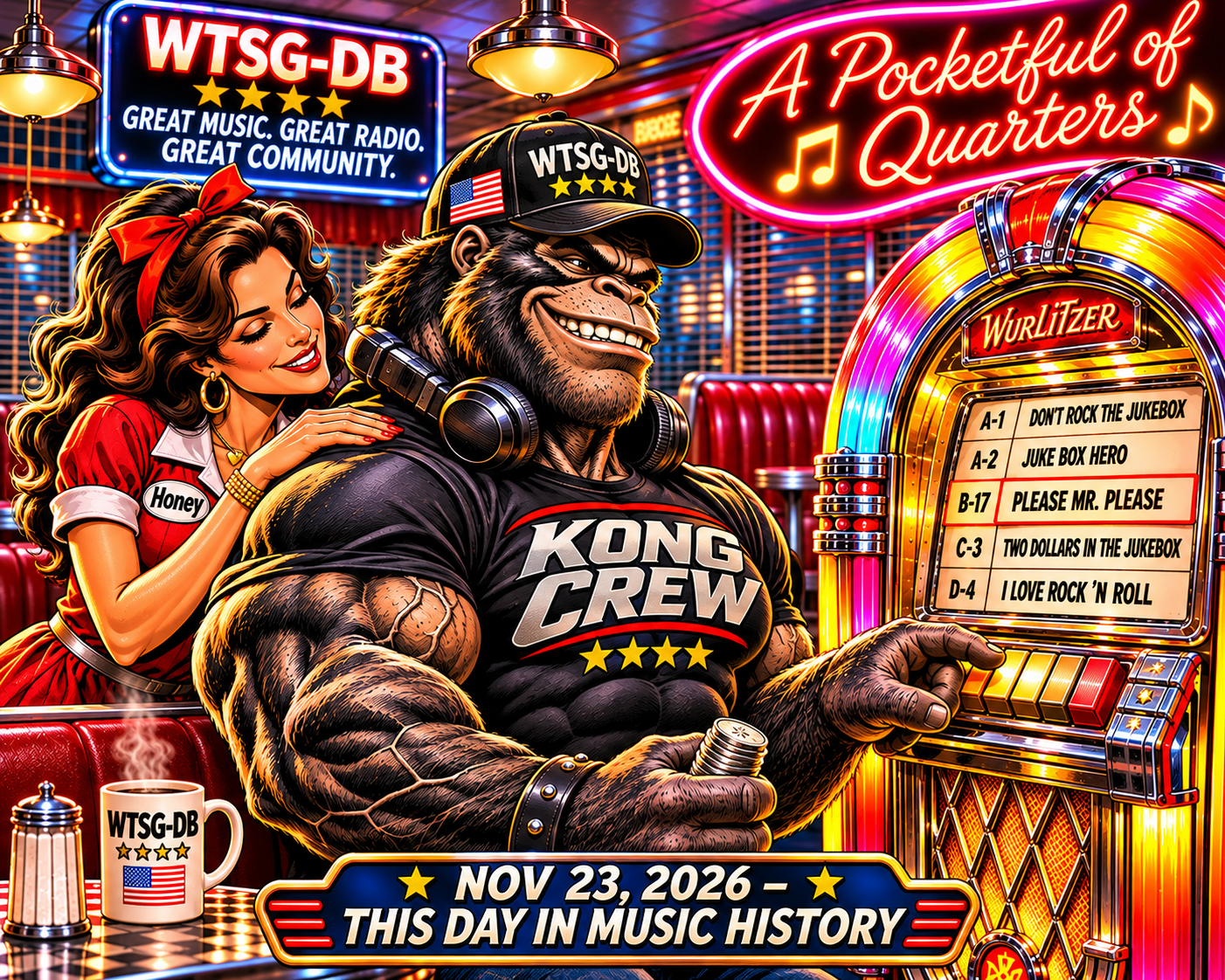
A Pocketful of Quarters and a Lifetime of Songs
I remember being a kid and dropping plenty of quarters into those old jukeboxes.
And I wasn’t just playing anything.
I wanted to hear my favorites!
There was something wonderful about standing in front of that machine, studying the selections, finding the songs you loved, and pressing those little buttons.
Sometimes you’d play several songs in a row.
And sometimes you’d play the same favorite again because once just wasn’t enough!
But here’s something else worth remembering.
The jukebox became such an important part of American musical culture that songwriters started writing songs about the machine itself.
Consider these classics.
Alan Jackson — “Don’t Rock the Jukebox” (1991)
Sometimes a fellow with a broken heart doesn’t want rock and roll. He wants a little George Jones to help him through the evening.
And the story behind the song is almost as entertaining as the record itself. The title was inspired by an incident involving a jukebox that was physically rocking because of a problem with one of its legs!
Foreigner — “Juke Box Hero” (1981)
A young man hears a guitar from outside a concert and dreams of becoming a musician himself.
What a tremendous rock anthem about inspiration, ambition, and chasing a dream!
The song appeared on Foreigner’s magnificent 1981 album 4.
Olivia Newton-John — “Please Mr. Please” (1975)
Here’s a wonderful recording from Olivia Newton-John’s album Have You Never Been Mellow.
In the song, Olivia tells the story of a woman sitting in a bar, hoping nobody selects B-17 on the jukebox. That particular record reminds her of a love she’d rather forget.
It’s a beautifully delivered performance about how one familiar song can bring back an entire chapter of someone’s life.
And I have to tell you, friends, if Olivia Newton-John had ever walked up to me and politely asked that I not play B-17, I would’ve been more than happy to oblige!
In fact, I probably would’ve handed her my quarters and said, “Miss Newton-John, the jukebox is all yours!”
HAHAHAHA!
Eddie Rabbitt — “Two Dollars in the Jukebox” (1976)
Another wonderful country recording that finds a lonely fellow looking for a little comfort in familiar music.
And what a tremendous talent Eddie Rabbitt was, both as a songwriter and performer.
Joan Jett & the Blackhearts — “I Love Rock ‘n Roll” (1981)
One of rock’s most recognizable jukebox references, with the machine providing the soundtrack to a chance encounter.
Originally recorded by the Arrows in 1975, the song became an enormous international hit for Joan Jett & the Blackhearts.
From heartbreak to happiness, from country to hard rock, the jukebox found its way into countless musical stories.
And it all traces back to those early coin-operated phonographs.
One hundred and thirty-seven years later, we celebrate the little machine that gave generations of music lovers the opportunity to choose their own soundtrack.
Must-Have Discogs:
- Alan Jackson — Don’t Rock the Jukebox (1991, Arista Nashville)
- Foreigner — 4 (1981, Atlantic Records)
- Olivia Newton-John — Have You Never Been Mellow (1975, MCA Records)
- Eddie Rabbitt — Rocky Mountain Music (1976, Elektra Records)
- Joan Jett & the Blackhearts — I Love Rock ‘n Roll (1981, Boardwalk Records)
Musical Birthdays — November 23
Today we’re celebrating four talented musicians whose contributions stretch across rock, jazz, soul, and heavy metal.
Bruce Hornsby — Born November 23, 1954
Happy 72nd birthday to the extraordinary American pianist, singer, and songwriter Bruce Hornsby!
Born in Williamsburg, Virginia, Hornsby became one of the most distinctive musical voices of the 1980s.
With his band, Bruce Hornsby and the Range, he introduced audiences to a wonderful combination of rock, pop, jazz, folk, and American roots music.
Their 1986 debut album, The Way It Is, produced several unforgettable recordings.
The title track reached No. 1 on the Billboard Hot 100 and featured some of the most recognizable piano playing of the decade.
And then there’s “Mandolin Rain.”
What an absolutely beautiful song.
There’s something almost cinematic about Hornsby’s piano playing. The melodies seem to paint landscapes, bringing images of open roads, changing seasons, and distant memories to life.
Another favorite, “Every Little Kiss,” demonstrates Hornsby’s ability to combine a memorable pop melody with sophisticated musicianship.
But his musical interests extended far beyond his early radio success.
Hornsby collaborated with artists including Bonnie Raitt, Don Henley, and the Grateful Dead, and continued exploring jazz, bluegrass, classical influences, and improvisation throughout his career.
A truly remarkable musician whose piano playing deserves to be appreciated as much as his songwriting.
Must-Have Discogs:
- Bruce Hornsby and the Range — The Way It Is (1986, RCA Records)
- Bruce Hornsby and the Range — Scenes from the Southside (1988, RCA Records)
- Bruce Hornsby — Harbor Lights (1993, RCA Records)
Johnny Mandel — Born November 23, 1925
Today we remember one of America’s most gifted composers and arrangers, Johnny Mandel, born on this date in 1925.
Mandel possessed extraordinary musical gifts, including perfect pitch, which was recognized when he was still a young child.
His career took him through jazz orchestras, popular recordings, television, and motion pictures.
He worked with some of the finest musicians and vocalists of the twentieth century.
But one composition stands among his most beautiful achievements.
“The Shadow of Your Smile.”
Written with lyricist Paul Francis Webster for the 1965 motion picture The Sandpiper, the composition earned the Academy Award for Best Original Song.
Its haunting melody has been interpreted by some of the finest musicians and vocalists in the world.
Tony Bennett delivered a magnificent vocal interpretation, including the recording featured on his 1966 album The Movie Song Album.
Frank Sinatra also recorded the composition, bringing his unmistakable phrasing and interpretive gifts to Mandel’s beautiful melody.
Other wonderful interpretations came from artists including Ella Fitzgerald, Astrud Gilberto, and jazz guitarist Wes Montgomery.
But one interpretation particularly worth hearing belongs to the magnificent Canadian jazz pianist Oscar Peterson.
Peterson recorded the composition on May 4, 1966, accompanied by bassist Sam Jones and drummer Louis Hayes.
The performance appeared on his album Blues Etude, released by Limelight Records that same year.
And what a beautiful example of jazz piano artistry!
Peterson’s remarkable touch, improvisational imagination, and effortless command of the keyboard brought another dimension to Mandel’s already extraordinary composition.
It’s fascinating to hear how a gifted pianist can take a melody originally associated with a motion picture and transform it into a beautiful vehicle for jazz improvisation without losing the emotional character of the original work.
That’s the magic of great composition.
A beautiful melody can travel from a movie soundtrack to a vocalist’s microphone, then into the hands of a jazz pianist, and somehow retain its unmistakable identity.
Mandel also composed the music for “Suicide Is Painless,” the theme associated with MASH*, with lyrics written by Michael Altman.
He received numerous honors throughout his remarkable career, including recognition as a National Endowment for the Arts Jazz Master.
Johnny Mandel passed away June 29, 2020, at the age of 94.
Today, on the 101st anniversary of his birth, we celebrate a musician whose melodies continue to touch hearts around the world.
Must-Have Discogs:
- Oscar Peterson — Blues Etude (1966, Limelight Records)
- Tony Bennett — The Movie Song Album (1966, Columbia Records)
- Frank Sinatra — My Kind of Broadway (1965, Reprise Records)
- Wes Montgomery — Tequila (1966, Verve Records)
Betty Everett — Born November 23, 1939
Born in Greenwood, Mississippi, Betty Everett became one of the memorable voices of 1960s soul and rhythm and blues.
Her biggest pop success came with the infectious 1964 recording “The Shoop Shoop Song (It’s in His Kiss).”
What a terrific record!
That unmistakable melody, Everett’s expressive vocals, and the playful arrangement helped make the song a lasting favorite.
She also recorded “Let It Be Me” with Jerry Butler, creating one of the beautiful soul duets of the era.
Everett passed away August 19, 2001, at the age of 61.
Today we remember her on what would have been her 87th birthday.
Must-Have Discogs:
- Betty Everett — It’s in His Kiss (1964, Vee-Jay Records)
- Jerry Butler and Betty Everett — Delicious Together (1964, Vee-Jay Records)
Chris Adler — Born November 23, 1972
And for our heavy metal friends, happy 54th birthday to drummer Chris Adler!
A founding member and former drummer of Lamb of God, Adler helped establish one of modern heavy metal’s most recognizable rhythmic signatures.
And one of the most fascinating parts of his musical story is the partnership he shared with his brother, guitarist Willie Adler.
Together, the Adler brothers helped create a tremendous combination of intricate guitar riffs and powerful, technically sophisticated drumming.
Listen to recordings such as “Laid to Rest,” “Redneck,” or “Walk with Me in Hell.”
Willie’s twisting, aggressive guitar arrangements and Chris’s remarkable rhythmic precision helped give those recordings their distinctive character.
Chris wasn’t simply keeping time behind the drum kit.
His unusual rhythmic patterns, double-bass technique, and carefully placed accents became an essential part of the music itself.
And here’s an interesting detail.
Before becoming a professional drummer, Chris studied several instruments, including piano, saxophone, guitar, and bass.
That broad musical background helped shape his approach to rhythm and composition.
He also performed on Megadeth’s 2016 album Dystopia, bringing his remarkable precision and rhythmic intensity to the legendary thrash metal band.
Chris and Lamb of God parted ways in 2019, with Art Cruz becoming the band’s permanent drummer.
Although his time with Lamb of God came to an end, the musical contributions he made alongside his brother Willie remain an important part of the band’s history.
And for those of us who appreciate the musicianship behind heavy metal, the Adler brothers created some truly remarkable music together.
Happy birthday, Chris!
Must-Have Discogs:
- Lamb of God — Ashes of the Wake (2004, Epic Records)
- Lamb of God — Sacrament (2006, Epic Records)
- Lamb of God — Wrath (2009, Epic Records)
- Megadeth — Dystopia (2016, Tradecraft / Universal Music Enterprises)
Black Sabbath — The Eternal Idol (1987)
November 1987 marked an important new chapter in Black Sabbath’s remarkable history with the release of The Eternal Idol.
This was the first Black Sabbath studio album to feature vocalist Tony Martin.
And the circumstances surrounding its creation were anything but ordinary.
The album had originally been recorded with vocalist Ray Gillen, who had joined the band following Glenn Hughes’ departure.
However, Gillen left before the project was completed.
Tony Martin was subsequently brought in to record new lead vocals.
The album featured Tony Iommi on guitar, Bob Daisley on bass, Eric Singer on drums, and Geoff Nicholls on keyboards.
Songs including “The Shining,” “Ancient Warrior,” and the title track demonstrated that Iommi’s unmistakable guitar sound remained central to Black Sabbath’s identity.
The record combined dark, powerful riffs with a more melodic vocal approach.
Interestingly, the original Ray Gillen recordings eventually became available as part of the album’s 2010 deluxe edition, allowing listeners to hear an earlier version of the project.
For fans interested in Black Sabbath’s musical evolution, The Eternal Idol offers a fascinating look at a period when the band was searching for stability while continuing to create new music.
And Tony Martin would go on to become an important part of Sabbath’s later history.
Must-Have Discogs:
- Black Sabbath — The Eternal Idol (1987, Vertigo / Warner Bros. Records)
- Black Sabbath — Headless Cross (1989, I.R.S. Records)
Metallica — Creeping Death (1984)
On November 23, 1984, Metallica released the single “Creeping Death,” taken from their second studio album, Ride the Lightning.
Released earlier that year, Ride the Lightning represented an important step forward in Metallica’s musical development.
“Creeping Death” was inspired by the biblical account of the plagues of Egypt, particularly the death of the firstborn.
Musically, the recording combined the band’s trademark thrash metal intensity with dramatic changes in rhythm and arrangement.
The single also featured two cover recordings: Diamond Head’s “Am I Evil?” and Blitzkrieg’s “Blitzkrieg.”
Those selections reflected the enormous influence of the New Wave of British Heavy Metal on Metallica’s early sound.
The recording featured James Hetfield on rhythm guitar and vocals, Kirk Hammett on lead guitar, Cliff Burton on bass, and Lars Ulrich on drums.
More than four decades later, “Creeping Death” remains one of the band’s most recognizable concert favorites.
Must-Have Discogs:
- Metallica — Ride the Lightning (1984, Megaforce Records)
- Metallica — Creeping Death (1984, Music for Nations)
Remembering Roy Acuff — The King of Country Music (1992)
On November 23, 1992, country music lost one of its most influential pioneers when Roy Acuff passed away at the age of 89.
Born September 15, 1903, in Maynardville, Tennessee, Acuff became one of the defining personalities of the Grand Ole Opry.
He joined the Opry in 1938 and helped bring traditional country music to audiences throughout the United States.
His recordings of “The Great Speckled Bird,” “Wabash Cannonball,” and “Wreck on the Highway” became enduring classics.
But Acuff’s contributions extended well beyond performing.
In 1942, he joined songwriter Fred Rose in establishing Acuff-Rose Music, a publishing company that would become enormously important to Nashville’s music industry.
The company helped promote and preserve the work of numerous songwriters, including Hank Williams.
In 1962, Acuff became the first living performer inducted into the Country Music Hall of Fame.
And in 1972, he participated in the Nitty Gritty Dirt Band’s landmark album Will the Circle Be Unbroken, helping connect generations of traditional country, bluegrass, and folk musicians.
Roy Acuff’s career was about more than hit records.
He helped establish the foundations of the country music industry and preserved musical traditions that continue to influence performers today.
Thirty-four years after his passing, his legacy remains an important part of American musical history.
Must-Have Discogs:
- Roy Acuff — The Great Speckled Bird (1960, Harmony Records)
- Nitty Gritty Dirt Band — Will the Circle Be Unbroken (1972, United Artists Records)
The Final Spin — A Pocketful of Quarters
You know, friends, when I was a kid, I dropped plenty of quarters into those old jukeboxes.
And every one of those quarters bought more than a few minutes of music. It bought a little piece of happiness.
Sometimes we wanted to be that “Juke Box Hero,” dreaming of something bigger than the world we knew.
Sometimes we were like Bruce Hornsby, treasuring “Every Little Kiss,” or remembering someone special whenever we heard “Mandolin Rain.”
And sometimes, like Olivia Newton-John, there was that one record we’d rather nobody played, because the memories were just a little too much.
But you know, friends, sometimes…”That’s Just the Way It Is.”
We grow older. The jukeboxes disappear. And the quarters we once carried in our pockets become memories of their own.
But the songs? Somehow, they stay with us.
And when it’s all said and done, maybe the greatest thing we can hope for isn’t that somebody remembers every song we played…
But that somewhere, in somebody’s heart, they’ll always remember…
“The Shadow of Your Smile.”
Listen to Today’s Broadcast
References — November 23, 2026
Great Music. Great Radio. Great Community.
WTSG-DB Digital Broadcasting
❤️🤘🦍