From the Desk of CLASSICKONG
Good morning, music lovers, and welcome back to another trip through the records, musicians and stories that built the soundtrack of our lives.
Before we drop the needle, WTSG-DB proudly sends our thanks to the men and women of the United States Armed Forces—past and present. Your service and sacrifice are never forgotten.
September 21 brings the thunder.
We’ve got AC/DC, Thin Lizzy, Cheap Trick, Scorpions, Dire Straits and Bachman-Turner Overdrive. Barry White brings the romance. Herbie Hancock refuses to stay inside anybody’s musical box. And we’ll remember a bass player who didn’t merely master his instrument—he changed what generations of musicians believed the instrument could do.
We’re also going deeper.
Who exactly were the Swampers?
For that matter, what in the world is Muscle Shoals?
Why did Chris Slade make only one studio album with AC/DC?
Who played those fantastic REAL horns on Swing Out Sister’s “Breakout”?
And why should more people know the name Don Preston?
We’ve got some digging to do.
But first…
National Pecan Cookie Day
Before we turn up the amplifiers, September 21 is National Pecan Cookie Day.
No complicated history lesson required here.
Find yourself a pecan cookie.
Eat it.
If anybody asks why, tell them:
CLASSICKONG said it was historically necessary.
Now that we’ve handled today’s most important nutritional requirement…
THUN-DER!
AC/DC — Thunderstruck…and Meet Chris Slade
THUN-DER!
One word.
Then comes the riff.
And everybody knows what’s about to happen.
In September 1990, AC/DC unleashed The Razors Edge, produced by Bruce Fairbairn and featuring Brian Johnson on vocals, Angus Young on lead guitar, Malcolm Young on rhythm guitar, Cliff Williams on bass—and a new drummer behind the kit named Chris Slade.
Release documentation for The Razors Edge varies by territory and format. September 21 appears in some documentation, while AC/DC’s official history identifies September 25 as the U.S. Atco release.
Whatever date appeared on the receipt, what came roaring through the speakers was unmistakable:
“Thunderstruck.”
“Fire Your Guns.”
“Moneytalks.”
“The Razors Edge.”
“Are You Ready.”
And if Chris Slade was the new guy in AC/DC, he certainly wasn’t new to the business.
Not even close.
Before AC/DC, the Welsh drummer had already worked with Tom Jones, helped form Manfred Mann’s Earth Band, played with Uriah Heep, toured with David Gilmour, joined Jimmy Page and Paul Rodgers in The Firm, and worked with Gary Moore.
That’s not a résumé.
That’s a road map through rock history.
And here’s a connection we especially love around here.
Among the drummers Slade has named as major influences is the incomparable Tony Williams—another drummer appearing in today’s story.
Buddy Rich.
Tony Williams.
John Bonham.
Chris Slade had been listening to some serious cats.
Slade brought a different personality to the AC/DC drum chair. Powerful, energetic and visually unmistakable behind the kit, he became part of one of AC/DC’s biggest eras.
Yet The Razors Edge became his only AC/DC studio album during his original tenure.
So what happened?
It wasn’t simply a case of the new drummer failing to work out.
As AC/DC began preparing what eventually became Ballbreaker, the band wanted to explore reuniting with longtime drummer Phil Rudd, whose deceptively simple, deep-pocket groove had been such an important ingredient in the classic AC/DC sound.
Slade later explained that the band initially wanted him to remain available while they determined whether the reunion with Rudd would work.
Slade chose not to wait around.
And really, who could blame him?
He was an accomplished professional musician with decades of experience and an extraordinary résumé. Rather than remain in limbo while AC/DC decided whether its former drummer was coming back permanently, Slade moved on.
Years later, when AC/DC needed him again during the Rock or Bust touring era, Chris Slade answered the call.
So the next time “Thunderstruck” comes blasting through the speakers, listen beyond that immortal opening guitar figure.
There’s one seriously well-traveled drummer driving the train.
Chris Slade wasn’t simply AC/DC’s “new guy.”
He’d already lived several musical lives before he ever got there.
Must-Have AC/DC
- High Voltage — 1976 — Atlantic
- Let There Be Rock — 1977 — Atlantic
- Powerage — 1978 — Atlantic
- Highway to Hell — 1979 — Atlantic
- Back in Black — 1980 — Atlantic
- For Those About to Rock We Salute You — 1981 — Atlantic
- The Razors Edge — 1990 — Atco/Albert
Thin Lizzy — Vagabonds of the Western World
On September 21, 1973, Thin Lizzy released their third studio album, Vagabonds of the Western World, in the UK on Decca Records.
It became their final studio album with original guitarist Eric Bell and therefore the last studio record made by the original trio of Bell, drummer Brian Downey and the incomparable Phil Lynott.
And that’s a little bittersweet.
What a trio.
And what an album cover.
Artist Jim Fitzpatrick created the striking artwork, beginning a visual association with Thin Lizzy that would become an important part of the band’s identity.
Then you drop the needle.
“Mama Nature Said.”
“The Hero and the Madman.”
“Slow Blues.”
And, of course…
“The Rocker.”
Phil Lynott straps on the battle-axe.
He’s a rocker.
He’s a roller too, baby.
There was something unique about Lynott. He could swagger like the toughest guy in the room and then turn around and write something vulnerable, poetic and deeply human.
And underneath it all was Brian Downey—one of those drummers whose musicality deserves far more attention than it sometimes receives.
It’s sad knowing Vagabonds was the original trio’s final studio statement.
But what a statement to leave behind.
Must-Have Thin Lizzy
- Vagabonds of the Western World — 1973 — Decca
- Nightlife — 1974 — Vertigo
- Fighting — 1975 — Vertigo
- Jailbreak — 1976 — Vertigo
- Johnny the Fox — 1976 — Vertigo
- Bad Reputation — 1977 — Vertigo
- Live and Dangerous — 1978 — Vertigo
- Black Rose: A Rock Legend — 1979 — Vertigo
And yes—the Jim Fitzpatrick artwork on Vagabonds belongs right alongside the music.
Cheap Trick — The Dream Police Are Watching
September 21, 1979.
Epic Records.
Cheap Trick releases its fourth studio album:
Dream Police.
Produced by Tom Werman, the album arrived during an extraordinary period for the boys from Illinois.
Cheap Trick had spent years doing it the old-fashioned way.
Clubs.
Theaters.
Road miles.
One audience at a time.
Then Cheap Trick at Budokan exploded.
Suddenly the hardworking American rock band was an international phenomenon.
And Dream Police was ready.
“Dream Police.”
“Way of the World.”
“Voices.”
And the sprawling “Gonna Raise Hell.”
Rick Nielsen brought the riffs.
The songs.
The humor.
The outrageous guitars.
And, of course…
that amazingly insane checkerboard!
Nielsen didn’t merely look like a rock star.
He looked like somebody had opened a toy box, a guitar shop and a checkerboard factory simultaneously and said:
GO!
Robin Zander supplied one of rock’s great voices. Tom Petersson brought that distinctive 12-string bass attack.
And behind the kit sat Bun E. Carlos—looking like he might remind you that your taxes are due while absolutely laying down the law.
From clubs and garages to packed arenas.
Cheap Trick built an identity that nobody could mistake for anybody else.
Must-Have Cheap Trick
- Cheap Trick — 1977 — Epic
- In Color — 1977 — Epic
- Heaven Tonight — 1978 — Epic
- Cheap Trick at Budokan — 1978/1979 — Epic
- Dream Police — 1979 — Epic
The Dream Police?
They’re still living inside our heads.
Scorpions — Face the Heat
On September 21, 1993, Scorpions released Face the Heat on Mercury.
Produced by Bruce Fairbairn with the band, the album featured Klaus Meine, Rudolf Schenker, Matthias Jabs, Ralph Rieckermann and Herman Rarebell.
And they didn’t exactly sneak into the room.
“Alien Nation.”
Then came “No Pain No Gain,” “Under the Same Sun,” “Ship of Fools” and “Lonely Nights.”
There’s also a neat connection sitting on today’s turntable.
Bruce Fairbairn produced both Face the Heat and AC/DC’s The Razors Edge.
Different bands.
Different records.
Same producer.
Fairbairn knew how to make hard rock sound enormous without sanding away the guitars that gave it teeth.
And with Klaus Meine behind the microphone?
That voice takes care of the rest.
Must-Have Scorpions
- In Trance — 1975 — RCA
- Virgin Killer — 1976 — RCA
- Taken by Force — 1977 — RCA
- Lovedrive — 1979 — Harvest/Mercury
- Blackout — 1982 — Harvest/Mercury
- Love at First Sting — 1984 — Harvest/Mercury
- Crazy World — 1990 — Mercury
- Face the Heat — 1993 — Mercury
Dire Straits — Sometimes the Song Finds You
On the UK Albums Chart dated September 21, 1991, Dire Straits’ On Every Street entered at No. 1 on Vertigo.
And if this title sounds familiar to regular WTSG-DB readers and listeners, there’s a reason.
We talked about this song recently.
We talked about love and loss.
We talked about the strange power music possesses to imitate life—and sometimes to explain pieces of our lives that we didn’t completely understand when we first heard the song.
“On Every Street” doesn’t shout.
It searches.
And that led us to something worth repeating:
A great song can take us back—or, even better, find us.
Sometimes you discover a record when you’re young and carry it with you.
Other times, life happens first.
You love.
You lose.
You change.
Years later, an old song comes through the speakers.
Same recording.
Same words.
Same melody.
But suddenly you hear something that wasn’t there before.
Except it was there all along.
You simply hadn’t lived enough life to hear it yet.
Bachman-Turner Overdrive — Baby, You Ain’t Seen Nothin’ Yet
On the Billboard Hot 100 dated September 21, 1974, Bachman-Turner Overdrive’s “You Ain’t Seen Nothin’ Yet” made its chart debut at No. 65.
Seven weeks later?
No. 1.
Written by Randy Bachman and appearing on Not Fragile, the song became BTO’s only No. 1 single on the U.S. Hot 100.
That riff.
That hook.
That wonderfully loose groove.
Baby…
You ain’t seen nothin’ yet.
Must-Have BTO
- Bachman-Turner Overdrive — 1973 — Mercury
- Bachman-Turner Overdrive II — 1973 — Mercury
- Not Fragile — 1974 — Mercury
- Four Wheel Drive — 1975 — Mercury
- Head On — 1975 — Mercury
- Best of B.T.O. (So Far) — 1976 — Mercury
Sometimes rock and roll doesn’t require an instruction manual.
Plug in.
Count it off.
Let it rip.
Barry White — Can’t Get Enough
And who was sitting at the very top of that same September 21, 1974 Billboard Hot 100?
Barry White.
“Can’t Get Enough of Your Love, Babe” was No. 1.
But whenever we talk about Barry White, we need to remember that the voice was only part of the story.
Barry was a songwriter.
Producer.
Arranger.
And musical architect.
And then there was the magnificent Love Unlimited Orchestra.
Barry created the large, string-laden ensemble initially to support Love Unlimited, and the orchestra soon became an essential part of his musical universe.
Those lush strings.
The rhythm section.
The sweeping arrangements.
And then came:
“Love’s Theme.”
Written and produced by Barry, the instrumental reached No. 1 on the Billboard Hot 100 in 1974.
Think about that.
An orchestral instrumental sitting on top of America’s pop chart.
Barry White wasn’t merely standing in front of an orchestra singing love songs.
He was helping design the entire sonic world surrounding that voice.
Must-Have Barry White
- I’ve Got So Much to Give — 1973 — 20th Century
- Stone Gon’ — 1973 — 20th Century
- Can’t Get Enough — 1974 — 20th Century
- Just Another Way to Say I Love You — 1975 — 20th Century
- Let the Music Play — 1976 — 20th Century
- The Icon Is Love — 1994 — A&M
Don’t Forget the Love Unlimited Orchestra
- Rhapsody in White — 1974 — 20th Century
- Together Brothers — 1974 — 20th Century
- White Gold — 1974 — 20th Century
- Music Maestro Please — 1975 — 20th Century
- My Sweet Summer Suite — 1976 — 20th Century
If you want to understand the whole Barry White universe, don’t stop with the voice.
Listen to the orchestra.
Herbie Hancock — Don’t Put This Man in a Box
On September 21, 1979, CBS/Sony Japan released V.S.O.P.’s Live Under the Sky, recorded in Tokyo that July.
And look at this lineup:
Herbie Hancock — piano
Freddie Hubbard — trumpet and flugelhorn
Wayne Shorter — tenor saxophone
Ron Carter — bass
Tony Williams — drums
Good grief.
That’s an assembly of giants.
But let’s be careful about putting Herbie Hancock into a box marked simply:
JAZZ.
Herbie certainly stands among the great jazz pianists.
But that’s only part of the story.
He embraced funk.
Electric keyboards.
Synthesizers.
R&B.
Electronic music.
Turntablism.
Pop crossover.
In 1973, Head Hunters and “Chameleon” helped bring jazz and funk together for an enormous new audience.
Then a decade later came Future Shock and a record that sounded like somebody had opened a window into tomorrow:
“Rockit.”
Turntables.
Synthesizers.
Drum machines.
Scratching.
Technology meeting musicianship.
And Herbie standing right in the middle of it.
That’s Herbie Hancock.
Put up a musical wall and he’ll probably find a door you didn’t know was there.
And behind the kit on Live Under the Sky?
Tony Williams.
For anyone who knows Tony’s Believe It or Angel Street, you already understand.
Tony didn’t merely accompany a band.
He could propel one.
Power.
Touch.
Imagination.
Independence.
Dynamics.
A FORCE behind the kit.
Must-Have Herbie Hancock
- Empyrean Isles — 1964 — Blue Note
- Maiden Voyage — 1965 — Blue Note
- Head Hunters — 1973 — Columbia
- Thrust — 1974 — Columbia
- V.S.O.P. — 1977 — Columbia
- Future Shock — 1983 — Columbia
- Sound-System — 1984 — Columbia
Jazz?
Absolutely.
But Herbie Hancock’s musical universe is much bigger than one word.
Jaco Pastorius — There Was Only One
There are bass players.
And then there was Jaco Pastorius.
Many musicians have followed the trail he opened.
Many have borrowed pieces of his vocabulary.
And imitation may indeed be the highest form of flattery.
But there was only one Jaco.
At his peak, he sounded light-years ahead of his time.
The fretless tone.
The harmonics.
The phrasing.
The speed.
The groove.
The ability to make an electric bass sing like a human voice one moment and explode rhythmically the next.
Jaco didn’t simply play bass extraordinarily well.
He changed people’s understanding of what an electric bass could be.
Weather Report.
Joni Mitchell.
Pat Metheny.
His own groundbreaking solo work.
His 1976 self-titled debut announced that something different had arrived.
And if you’ve never understood why bassists speak his name with such reverence, start with:
“Portrait of Tracy.”
Listen closely.
Then remind yourself:
That’s an electric bass guitar.
Tragically, we lost Jaco on September 21, 1987.
He was only 35.
But we’re not going to allow the end of his life to define his story.
Because if you’ve heard generations of bassists using harmonics, fretless phrasing and a melodic vocabulary that reminds you of Jaco…
There’s a reason.
Must-Have Jaco
- Jaco Pastorius — 1976 — Epic
- Pat Metheny — Bright Size Life — 1976 — ECM
- Joni Mitchell — Hejira — 1976 — Asylum
- Weather Report — Black Market — 1976 — Columbia
- Weather Report — Heavy Weather — 1977 — Columbia
- Weather Report — 8:30 — 1979 — Columbia
- Word of Mouth — 1981 — Warner Bros.
Many followed.
There was only one Jaco.
David Hood — What IS Muscle Shoals, and Who Are the Swampers?
Happy birthday to bassist David Hood, born September 21, 1943, in Sheffield, Alabama.
David’s birthday gives us the perfect excuse to finally explain something many music fans have probably heard about for years without completely understanding.
First question:
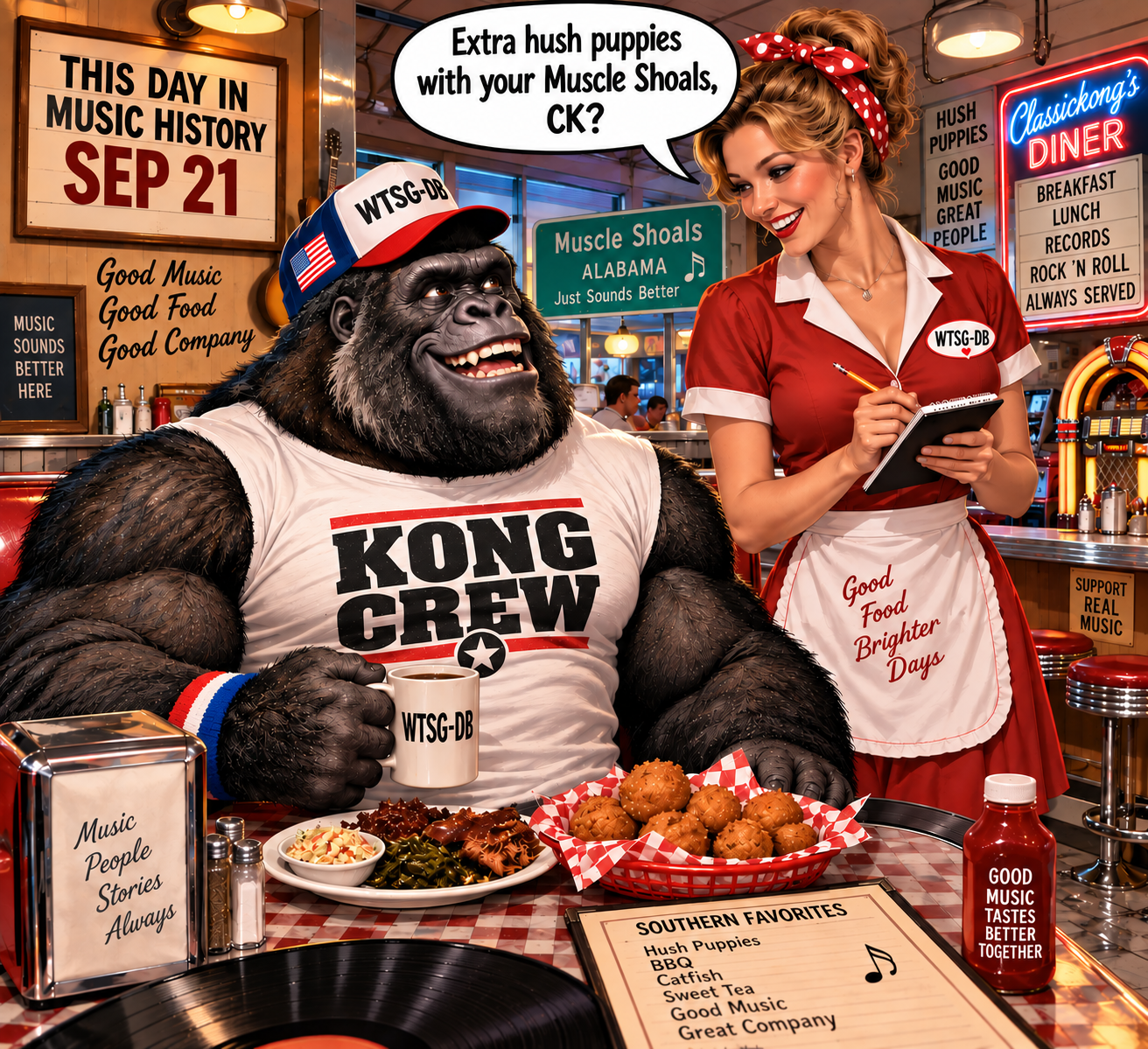
What the heck is Muscle Shoals?
No, it’s not something you order with hush puppies.
Muscle Shoals is an actual city in northwestern Alabama, sitting near the Tennessee River.
And even the unusual name has a little mystery attached to it.
The exact origin isn’t certain. Explanations have connected it to freshwater mussels once found around the river shoals, the physical appearance of the shoals, and even the strength once required to navigate the river.
Whatever the origin, something happened there during the 20th century that gave Muscle Shoals another meaning entirely.
It became a musical destination.
Producer Rick Hall’s FAME Studios helped establish the area’s reputation through remarkable soul and R&B recordings.
And working within that musical community was a group of musicians who developed a reputation of their own.
So Who Were the Swampers?
The classic Muscle Shoals Rhythm Section consisted of:
David Hood — bass
Roger Hawkins — drums
Jimmy Johnson — guitar
Barry Beckett — keyboards
They became known as:
the Swampers.
They weren’t stars standing at the front of the stage.
They were the musicians behind the artist.
And artists began wanting what they could do.
That pocket.
That restraint.
That Southern mixture of soul, R&B, country, blues and rock.
Then, in 1969, Hood, Hawkins, Johnson and Beckett left FAME and established their own studio at:
3614 Jackson Highway.
They called it Muscle Shoals Sound Studio.
And here’s the wonderfully confusing part:
It wasn’t actually in the city of Muscle Shoals.
It was across the river in neighboring Sheffield, Alabama.
The four musicians became equal partners in the studio.
Session players owning the place where the sessions happened.
Now let’s put some actual records behind all these names.
Hear the Muscle Shoals Sound
The Staple Singers — “I’ll Take You There” — 1972 — Stax
This is one of the clearest demonstrations of the Swampers at work. David Hood’s bass anchors the famous groove, with Roger Hawkins on drums, Barry Beckett on keyboards and Jimmy Johnson among the Muscle Shoals players surrounding the Staple Singers.
Listen to the space.
Nobody is trying to win a contest.
Everybody is serving the groove.
The Staple Singers — “Respect Yourself” — 1971 — Stax
Another essential piece of the Muscle Shoals story and another example of Southern rhythm meeting gospel and soul.
Paul Simon — There Goes Rhymin’ Simon — 1973 — Columbia
Simon traveled south and worked with the Muscle Shoals musicians on material including “Kodachrome” and “Loves Me Like a Rock.”
Think about that.
Paul Simon could have recorded virtually anywhere.
He wanted that feel.
The Rolling Stones — “Brown Sugar” and “Wild Horses”
The Stones came to Muscle Shoals Sound in December 1969 and recorded these future classics during their famous Alabama sessions.
“Brown Sugar” would appear on Sticky Fingers in 1971, while “Wild Horses” also became part of that landmark album.
And there’s another important piece of the story.
Before the four-man Swampers partnership officially existed, musicians from this same Muscle Shoals community were already making historic records at FAME.
Aretha Franklin’s “I Never Loved a Man (The Way I Love You)” in 1967 is part of that earlier chapter.
So there’s an evolution here.
Muscle Shoals — the place.
FAME — Rick Hall’s legendary studio.
The Muscle Shoals Rhythm Section — the musicians.
The Swampers — their nickname.
Muscle Shoals Sound Studio — the studio those musicians eventually owned themselves.
And the Muscle Shoals sound — the musical identity that made artists travel to Alabama looking for something they couldn’t quite get anywhere else.
Now go back to Lynyrd Skynyrd.
When Ronnie Van Zant sings:
“Now Muscle Shoals has got the Swampers…”
Now you know exactly who he’s talking about.
David Hood.
Roger Hawkins.
Jimmy Johnson.
Barry Beckett.
And suddenly a lyric you’ve heard your whole life opens another door.
That’s why we dig.
Happy birthday, David Hood.
Don Preston — Know This Name
Keyboardist, composer and electronic-music pioneer Don Preston was born September 21, 1932, in Flint, Michigan.
Happy 94th birthday, Don!
And today we’re giving Don the room he deserves.
Yes, Preston is closely associated with Frank Zappa and the Mothers of Invention.
But don’t reduce him to simply:
“Zappa’s keyboard player.”
Preston was experimenting with synthesizers and electronic sound when electronic instruments weren’t convenient software packages sitting inside a laptop.
You explored.
You experimented.
You patched things together.
You learned what these strange machines could do.
And Don was one of the musicians out there pushing.
His musical world crossed jazz, rock, electronics, avant-garde composition, improvisation and film work.
Start Here with Don Preston
- The Mothers of Invention — We’re Only in It for the Money — 1968 — Verve
- The Mothers of Invention — Uncle Meat — 1969 — Bizarre/Reprise
- The Mothers of Invention — Burnt Weeny Sandwich — 1970 — Bizarre/Reprise
- The Mothers of Invention — Weasels Ripped My Flesh — 1970 — Bizarre/Reprise
- Frank Zappa/The Mothers — Fillmore East – June 1971 — 1971 — Bizarre/Reprise
- Frank Zappa — Waka/Jawaka — 1972 — Bizarre/Reprise
And if you’d like to hear Don outside the Zappa universe, keep digging into his own experimental and electronic recordings.
Some musicians from later Zappa lineups may receive more attention today.
That’s okay.
But don’t overlook one of the adventurous musicians who was exploring this territory early.
Don Preston was there.
Happy 94th, Don.
Don Felder — Gainesville to Hotel California and Beyond
Happy birthday to Don Felder, born September 21, 1947, in Gainesville, Florida.
Most people immediately connect Felder with the Eagles.
Understandably.
He co-wrote “Hotel California” and traded those legendary guitar lines with Joe Walsh.
But Felder’s story runs deeper.
As a teenager in Gainesville, he played in the Continentals with another young musician who was going places:
Stephen Stills.
Another musician in that remarkable Gainesville orbit was future Eagle Bernie Leadon.
And then there was another kid coming up around Gainesville:
Tom Petty.
Felder has recalled giving the young Petty guitar lessons, while Petty later remembered Felder’s influence from those early days somewhat differently.
Either way, what an extraordinary little musical ecosystem Gainesville produced.
Felder joined the Eagles in 1974 and became an important part of the increasingly guitar-driven sound that followed.
But his story didn’t end there.
One essential solo stop is:
“Heavy Metal (Takin’ a Ride)” — 1981 — from the Heavy Metal soundtrack.
Don Felder — Beyond the Eagles
- Airborne — 1983 — Asylum
- Road to Forever — 2012
- American Rock ‘n’ Roll — 2019 — BMG
- The Vault – Fifty Years of Music — 2025
Different decades.
Same guitar player.
Happy birthday, Don.
Corinne Drewery — And Those Are REAL Horns
Singer Corinne Drewery of Swing Out Sister was born September 21, 1959, in Nottingham, England.
If the name doesn’t immediately ring the bell, here’s your clue:
“Breakout.”
There it is.
That wonderfully infectious 1986 Swing Out Sister single became a major international hit.
But go back and listen closely.
There’s a LOT happening inside that arrangement.
And one thing needs to be emphasized:
Those horns are REAL.
Among the brass players on those sessions were:
Gary Barnacle — saxophone
John Thirkell — trumpet
Luke Tunney — trumpet
Peter Thoms — trombone
Not a keyboard patch pretending to be a brass section.
Musicians.
Breath.
Brass.
And a human attack that helps give “Breakout” that bright, sophisticated punch jumping out of the speakers.
Start Here — Swing Out Sister
It’s Better to Travel — 1987 — Mercury
Featuring:
- “Breakout”
- “Twilight World”
- “Surrender”
- “Fooled by a Smile”
Then keep exploring:
- Kaleidoscope World — 1989 — Fontana
- Get in Touch with Yourself — 1992 — Fontana
Sometimes the catchiest pop records contain considerably more musicianship than we notice during the first hundred listens.
Happy birthday, Corinne.
And turn those horns up.
Phil “Philthy Animal” Taylor — Motörhead to Fastway
Born September 21, 1954, drummer Phil “Philthy Animal” Taylor helped provide the thunder behind one of rock’s most gloriously dangerous trios.
Motörhead.
Lemmy.
“Fast” Eddie Clarke.
Philthy Animal.
That’s enough to rattle the windows.
Taylor’s drumming powered classic Motörhead recordings including Overkill (1979), Bomber (1979), Ace of Spades (1980) and the legendary live album No Sleep ’til Hammersmith (1981).
And speaking of Fast Eddie…
After Motörhead, guitarist Eddie Clarke formed Fastway with former UFO bassist Pete Way—hence:
FAST + WAY.
Pete ultimately departed before the debut album was completed, but Eddie carried Fastway forward with vocalist Dave King.
If you’ve never heard them, start here:
“Say What You Will” — from Fastway — 1983 — CBS/Columbia.
Crank it.
Some of us around here happen to own four Fastway CDs.
Ahem.
Just saying.
Happy birthday in remembrance to Phil Taylor, who died November 12, 2015, at age 61.
Philthy Animal indeed.
Faith Hill — Something Special Happens When Tim Joins In
Happy birthday to Faith Hill, born September 21, 1967.
Faith has given country and pop audiences an extraordinary collection of records:
“This Kiss.”
“Breathe.”
“The Way You Love Me.”
“There You’ll Be.”
She’s enormously talented, with a voice capable of moving from country warmth to full-scale pop power.
And yes…
She’s a beautiful lady.
But there’s something particularly special when Faith sings with her husband, Tim McGraw.
Tim is one heck of a songsmith and storyteller in his own right.
Put the two together?
There’s a chemistry you can’t manufacture.
“It’s Your Love.”
“Let’s Make Love.”
“Like We Never Loved at All.”
“Speak to a Girl.”
Two voices.
Two successful careers.
One musical partnership.
Sometimes a duet sounds like two stars who happened to be assigned to the same microphone.
With Faith and Tim, you hear something else.
You hear the relationship.
Happy birthday, Faith.
More September 21 Birthdays
Leonard Cohen — born September 21, 1934; died November 7, 2016. Singer, songwriter, poet and author whose extraordinary catalog includes “Suzanne,” “Bird on the Wire” and “Hallelujah.”
Liam Gallagher — born September 21, 1972. The unmistakable voice of Oasis during the band’s original rise, heard on albums including Definitely Maybe (1994) and (What’s the Story) Morning Glory? (1995).
Final Spin — Find Your Sound
Maybe September 21 has been telling us the same story all along.
Find your sound.
Chris Slade was already a world-class drummer when he joined AC/DC. He had played with everybody from Manfred Mann’s Earth Band to Jimmy Page and Paul Rodgers.
Yet AC/DC eventually went looking for Phil Rudd again.
Not because Chris Slade suddenly forgot how to play drums.
Because Phil Rudd brought a particular feel.
That pocket had become part of AC/DC’s identity.
And that’s an important distinction.
Sometimes music isn’t about who can play the most notes, hit the hardest or demonstrate the most technique.
Sometimes it’s about the person whose hands make the music sound like itself.
Thin Lizzy’s original trio had that identity.
Rick Nielsen can strike a chord, Robin Zander can sing a line and Bun E. Carlos can hit the pocket—and somehow you immediately know it’s Cheap Trick.
Klaus Meine barely needs a verse.
Mark Knopfler doesn’t need twenty notes.
And Barry White?
Barry probably doesn’t need twenty syllables.
You know.
Herbie Hancock gives us another side of the same idea.
Finding your sound doesn’t mean you’re required to make the same record for the rest of your life.
Herbie could move from acoustic jazz to funk, electric keyboards, synthesizers and “Rockit” without losing the curiosity that made him Herbie Hancock.
His musical identity included change itself.
Then there’s Jaco.
You can buy a fretless bass.
You can study the harmonics.
You can transcribe the lines.
You can learn every note of “Portrait of Tracy.”
But learning Jaco’s vocabulary doesn’t make you Jaco.
There was only one.
And perhaps today’s greatest example isn’t one musician at all.
It’s a place in Alabama.
Artists traveled to Muscle Shoals because David Hood, Roger Hawkins, Jimmy Johnson, Barry Beckett and the other musicians surrounding that scene had developed something people could recognize.
A pocket.
A feel.
A musical personality.
Paul Simon wanted it.
The Staple Singers used it.
The Rolling Stones traveled to Alabama looking for it.
Eventually the place itself became part of the vocabulary:
The Muscle Shoals sound.
Think about that.
Four musicians can play together long enough, listen closely enough and understand one another deeply enough that eventually their geography becomes a musical adjective.
That’s special.
And maybe that’s the lesson hiding inside today’s records.
Technique matters.
Practice matters.
Knowing your instrument matters.
But eventually every great musician faces another question:
What do I sound like?
Not my hero.
Not the hottest player in town.
Not whatever happens to be popular this year.
Me.
Learning to play teaches you the language.
Finding your own sound gives you something to say.
Until tomorrow, keep listening, keep discovering and keep the music alive.
Great Music. Great Radio. Great Community.
— CLASSICKONG
WTSG-DB
Listen to Today’s Broadcast
Prefer to hear the stories instead?
Listen to today’s spoken-word edition of This Day in Music History right here on WTSG-DB.
And while you’re visiting, stop by the WTSG-DB Guestbook and say hello. We always enjoy hearing from the people keeping great music alive with us.
Welcome to our Spotify listeners, and thanks for being part of the WTSG-DB community.
References
AC/DC — The Razors Edge
https://www.acdc.com/music/the-razors-edge/
Chris Slade — Official Website / Biography
https://chrisslade.com/
Scorpions — Face the Heat
https://www.the-scorpions.com/album/face-the-heat/
Official Charts Company — Dire Straits, On Every Street
https://www.officialcharts.com/albums/dire-straits-on-every-street/
Herbie Hancock — V.S.O.P., Live Under the Sky
https://www.herbiehancock.com/music/discography/album/v-s-o-p-live-under-the-sky/
Jaco Pastorius — The Life of Jaco
https://jacopastorius.com/life/
Muscle Shoals Sound Studio — History of the Swampers and 3614 Jackson Highway
https://muscleshoalssoundstudio.org/pages/history
Muscle Shoals Sound Studio — Recording History
https://muscleshoalssoundstudio.org/pages/recording
Encyclopedia of Alabama — Muscle Shoals
https://encyclopediaofalabama.org/article/muscle-shoals/
Don Felder — Official Biography
https://www.donfelder.com/about
Don Felder — Official Music Page
https://www.donfelder.com/music
Swing Out Sister — It’s Better to Travel
https://swingoutsister.com/albums/its-better-to-travel
Swing Out Sister — Official Album Discography
https://swingoutsister.com/albums