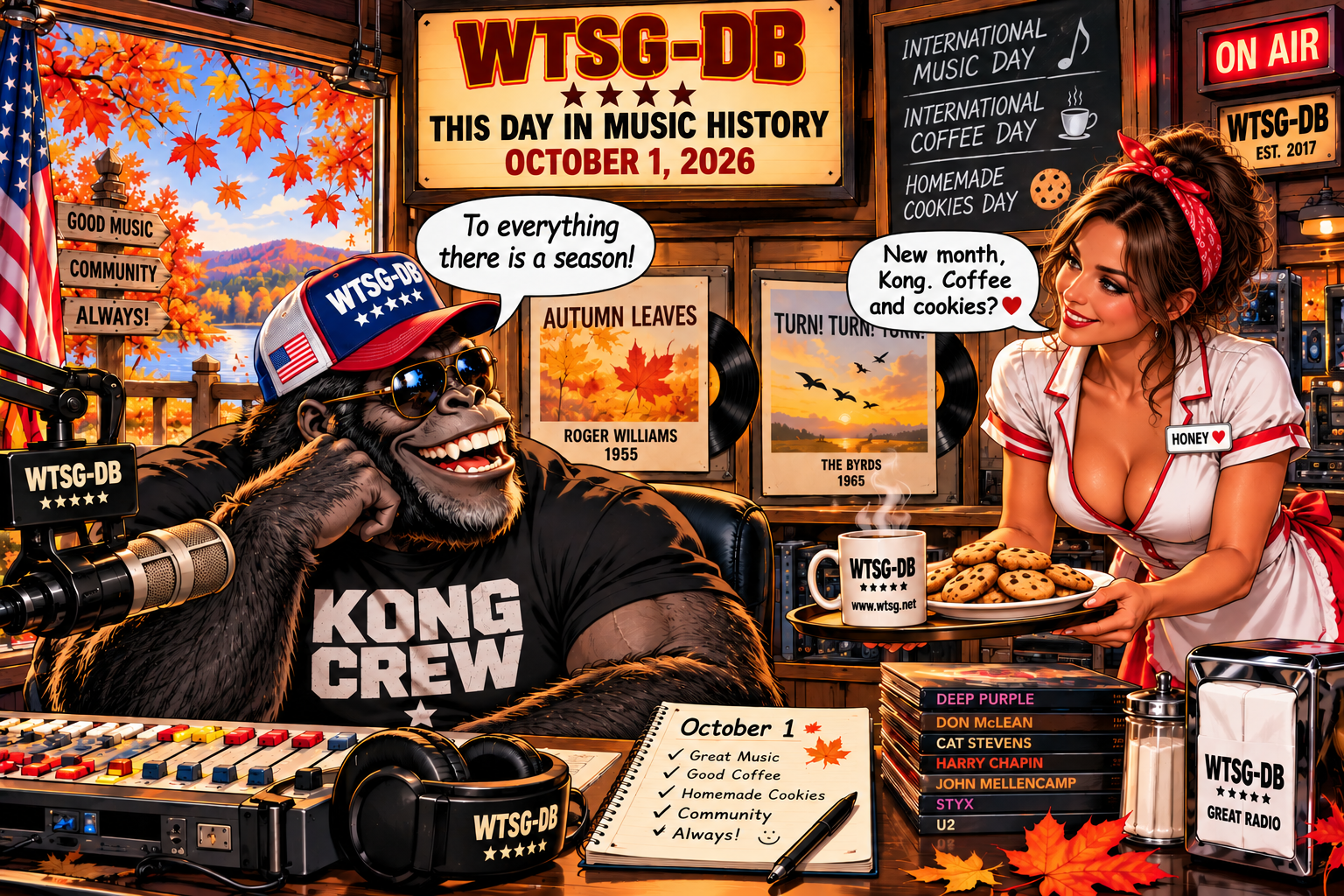
From the Desk of CLASSICKONG
Welcome back, music lovers, and welcome to October.
September has slipped into the rearview mirror, the days are getting shorter, the air is changing, and autumn is beginning to settle in around us.
Before we spin the first record, WTSG-DB proudly sends our thanks to the men and women of the United States Armed Forces—past and present—and to the families who stand beside them. Your service and sacrifice are never forgotten.
October 1 couldn’t have been designed much better for us here at WTSG-DB.
Today is International Music Day, an observance established by the International Music Council and first celebrated in 1975.
It’s also International Coffee Day.
And just in case CLASSICKONG needed something to go with that coffee, October 1 is National Homemade Cookies Day.
Music. Coffee. Homemade cookies.
Somewhere in the WTSG-DB studio, Honey just walked through the door carrying a tray and said, “You boys really do have it made.”
Yes, Honey.
Yes, we do.
But there’s something else happening today.
The seasons are turning.
And strangely enough, the music history of October 1 seems to know it.
Roger Williams — Autumn Leaves
Born October 1, 1924
If we’re going to welcome October, there may be no better place to begin.
Roger Williams became one of America’s most successful popular pianists, and his signature recording was the 1955 instrumental “Autumn Leaves” — Kapp Records.
It went all the way to No. 1.
But long before that success, Williams was a young piano student at Drake University—and apparently some people weren’t quite ready for what was going on inside his musical head.
Williams was reportedly thrown out of the music department after he was caught in a practice room playing a jazz interpretation of “Smoke Gets in Your Eyes.”
Think about that for a second.
A young musician was in a university practice room…
practicing music…
and somebody essentially decided he wasn’t practicing it correctly.
Apparently somebody forgot to tell Roger Williams that getting kicked out was supposed to discourage him.
He went on to record more than 100 albums, perform for presidents and build a remarkable career around the very musical individuality that once got him into trouble.
And his most famous recording?
“Autumn Leaves.”
On October 1.
You really can’t make this stuff up.
Williams died on October 8, 2011, at age 87.
CLASSICKONG Must Haves — Roger Williams
Autumn Leaves — 1955 — Kapp Records
Songs of the Fabulous Fifties — 1957 — Kapp Records
Till — 1958 — Kapp Records
Songs of the Soaring ’60s — 1961 — Kapp Records
Born Free — 1966 — Kapp Records
The Byrds — Turn! Turn! Turn!
October 1, 1965 — Columbia Records
And just like that, Roger Williams hands the baton to the Byrds.
On October 1, 1965, the Byrds released “Turn! Turn! Turn! (To Everything There Is a Season)”, backed with “She Don’t Care About Time.”
Pete Seeger had written the song using words drawn largely from the third chapter of Ecclesiastes:
There is a time…
and there is a season.
The Byrds transformed it with those glorious harmonies and Roger McGuinn’s ringing 12-string Rickenbacker, and the record eventually reached No. 1 in America.
Reportedly, getting there wasn’t easy.
The Byrds spent days working through dozens upon dozens of takes before arriving at the master.
But listen to that record today.
It sounds effortless.
And on the first day of October, as summer disappears behind us and autumn begins taking over, those words hit a little differently.
Seasons change.
That’s true outside our windows.
It’s also true in our lives.
And as we’re going to discover today, it’s true throughout music.
The Beach Boys — Surfin’ Safari
October 1, 1962 — Capitol Records
Three years earlier, another great American group was just beginning its journey.
The Beach Boys released their debut album, Surfin’ Safari.
Brian Wilson, Dennis Wilson, Carl Wilson, Mike Love and David Marks were still near the beginning of a story that would eventually produce some of the most ambitious and beautiful American pop music ever recorded.
The album included “Surfin’ Safari,” “409,” “Surfin’,” “Heads You Win—Tails I Lose” and “Cuckoo Clock.”
This wasn’t Pet Sounds yet.
It wasn’t “Good Vibrations.”
It was a young band finding its identity.
Another season beginning.
CLASSICKONG Must Haves — The Beach Boys
Surfin’ Safari — 1962 — Capitol Records
Surfer Girl — 1963 — Capitol Records
All Summer Long — 1964 — Capitol Records
The Beach Boys Today! — 1965 — Capitol Records
Pet Sounds — 1966 — Capitol Records
Surf’s Up — 1971 — Brother/Reprise Records
Deep Purple — The Book of Taliesyn
October 1968 — Tetragrammaton Records
October 1968 found Deep Purple in an interesting place.
This was Mark I Deep Purple:
Rod Evans.
Ritchie Blackmore.
Jon Lord.
Nick Simper.
Ian Paice.
Their second album, The Book of Taliesyn, sounds like a band searching for the road that would eventually lead to the Deep Purple most of us recognize immediately.
There are psychedelic sounds, progressive ideas, classical influences, hard rock and some remarkably adventurous arrangements.
The record includes “Listen, Learn, Read On,” “Wring That Neck,” “Kentucky Woman,” “Anthem” and ambitious interpretations of “We Can Work It Out” and “River Deep, Mountain High.”
Jon Lord’s keyboards are already becoming a major part of the landscape.
Ritchie Blackmore is unmistakably Ritchie Blackmore.
And behind them, Ian Paice is already demonstrating why he would become one of rock’s most respected drummers.
Deep Purple hadn’t completely become Deep Purple yet.
They were changing.
There’s that word again.
Don McLean — Tapestry
October 1970 — Mediarts Records
Before American Pie turned Don McLean into a household name, there was Tapestry.
His debut album introduced a thoughtful songwriter whose music could be remarkably simple on the surface and devastatingly effective underneath.
And sitting on that first album was one of his most beautiful compositions:
“And I Love You So.”
What an incredible piece of music.
It would later be recorded by numerous artists, including Perry Como and Elvis Presley, but the song began with McLean.
Sometimes you don’t need pyrotechnics.
You don’t need a wall of amplifiers.
You just need a melody, the right words and somebody who means them.
CLASSICKONG Must Haves — Don McLean
Tapestry — 1970 — Mediarts Records
American Pie — 1971 — United Artists Records
Don McLean — 1972 — United Artists Records
Playin’ Favorites — 1973 — United Artists Records
Homeless Brother — 1974 — United Artists Records
Curtis Mayfield — A New Season Begins
October 1, 1970
After years with the Impressions, Curtis Mayfield stepped away from the group and entered the next chapter of his career.
And what a chapter it became.
Mayfield’s solo work would give us music including “Move On Up,” “Freddie’s Dead” and “Superfly.”
His songwriting had already helped define soul music, but going solo gave Mayfield another canvas.
Sometimes leaving something successful isn’t the end of the story.
Sometimes it’s simply time for another season.
CLASSICKONG Must Haves — Curtis Mayfield
Curtis — 1970 — Curtom Records
Roots — 1971 — Curtom Records
Super Fly — 1972 — Curtom Records
Back to the World — 1973 — Curtom Records
There’s No Place Like America Today — 1975 — Curtom Records
Cat Stevens — Teaser and the Firecat
October 1, 1971 — Island Records / A&M Records
Cat Stevens released Teaser and the Firecat, and this one takes me straight back to the radio of the 1970s.
His music seemed to be everywhere.
The album gave us “Moonshadow,” “Peace Train” and one song I’ve always loved:
“Morning Has Broken.”
There’s something timeless about that record.
The melody itself was much older, and Stevens’ recording—featuring Rick Wakeman’s beautiful piano work—gave it new life for another generation.
Another old song entering another season.
CLASSICKONG Must Haves — Cat Stevens
Tea for the Tillerman — 1970 — Island/A&M Records
Teaser and the Firecat — 1971 — Island/A&M Records
Catch Bull at Four — 1972 — Island/A&M Records
Foreigner — 1973 — Island/A&M Records
Buddha and the Chocolate Box — 1974 — Island/A&M Records
Harry Chapin — Cat’s in the Cradle
October 1, 1974 — Elektra Records
This one is personal.
My uncle turned me on to Harry Chapin’s music years ago, and I became a huge fan myself.
On October 1, 1974, “Cat’s in the Cradle” was released.
Harry didn’t write the original poem behind the song. His wife, Sandy Chapin, did.
Harry turned those words into something generations of fathers and sons would understand.
When we’re young, time seems unlimited.
Then we become fathers.
Our sons are little boys.
We’re working.
We’re busy.
Tomorrow always seems like it will be there.
Then one day you look around and that little boy is a grown man with a life of his own.
As fathers, we understand this song differently as the years go by.
We can’t stop the clock.
We can’t stop our children from growing.
And we wouldn’t really want to.
But sometimes we sure wish we could slow it down.
To everything there is a season.
Harry Chapin understood that.
CLASSICKONG Must Haves — Harry Chapin
Heads & Tales — 1972 — Elektra Records
Sniper and Other Love Songs — 1972 — Elektra Records
Short Stories — 1973 — Elektra Records
Verities & Balderdash — 1974 — Elektra Records
Greatest Stories Live — 1976 — Elektra Records
Remembering Al Jackson Jr.
November 27, 1935 – October 1, 1975
We lost one of the great drummers far too young on this date.
Al Jackson Jr. was only 39 years old when he was murdered at his Memphis home.
The circumstances were terrible.
But that’s not where we’re going to leave Al Jackson.
We’re going to the records.
Jackson was the drummer for Booker T. & the M.G.’s, alongside Booker T. Jones, Steve Cropper and Donald “Duck” Dunn.
The M.G.’s were far more than the band behind “Green Onions.”
They were part of the heartbeat of Stax Records.
Jackson’s playing can be heard across an extraordinary body of soul music, and his career connected him with artists including Otis Redding, Sam & Dave, Albert King, Carla Thomas, Rufus Thomas, Wilson Pickett, Al Green and many others.
Jackson also co-wrote Al Green classics including “Let’s Stay Together” and “I’m Still in Love with You.”
As a drummer myself, what I love about players like Al Jackson is that they remind us of something important:
You don’t have to fill every hole.
Find the pocket.
Serve the song.
Make everybody around you sound better.
That’s what you’re supposed to do.
Al Jackson Jr. did it as well as anybody.
CLASSICKONG Must Haves — Booker T. & the M.G.’s
Green Onions — 1962 — Stax Records
Soul Dressing — 1965 — Stax Records
And Now! — 1966 — Stax Records
Hip Hug-Her — 1967 — Stax Records
Doin’ Our Thing — 1968 — Stax Records
McLemore Avenue — 1970 — Stax Records
John Mellencamp — From Johnny Cougar to American Fool
Here’s one for us Indiana boys.
In 1976, Mellencamp released his debut album, Chestnut Street Incident, under the name Johnny Cougar.
That wasn’t exactly his idea.
His manager, Tony DeFries, had decided that “Mellencamp” wasn’t marketable enough and changed the young singer’s name.
Imagine finishing your record and discovering somebody has essentially renamed you.
But here’s where the story gets good.
Six years later, in 1982, American Fool was sitting at No. 1 while “Jack & Diane” was also ruling the singles chart.
Johnny Cougar had survived.
John Mellencamp was emerging.
And for those of us who grew up around Indiana and the Midwest, those records hit differently.
“Ain’t Even Done with the Night” — Nothin’ Matters and What If It Did, 1980, Riva Records.
“Jack & Diane” — American Fool, 1982, Riva Records.
“Lonely Ol’ Night” — Scarecrow, 1985, Riva Records.
Those songs bring back places.
People.
Cars.
Nights.
Friends.
Different seasons of our own lives.
That’s one of the greatest things music can do.
CLASSICKONG Must Haves — John Mellencamp
Nothin’ Matters and What If It Did — 1980 — Riva Records
American Fool — 1982 — Riva Records
Uh-Huh — 1983 — Riva Records
Scarecrow — 1985 — Riva Records
The Lonesome Jubilee — 1987 — Mercury Records
Styx — Crystal Ball
1976 — A&M Records
Now we’re talking.
Crystal Ball marked Tommy Shaw’s first album with Styx.
And for a Styx fan?
This is where things get REALLY interesting.
Shaw joined Dennis DeYoung, James Young, Chuck Panozzo and John Panozzo and immediately brought another powerful songwriter, singer and guitarist into the equation.
The album includes “Mademoiselle,” “Jennifer,” “Shooz,” “This Old Man” and that magnificent title track:
“Crystal Ball.”
The chemistry was changing.
The next several years would bring The Grand Illusion, Pieces of Eight, Cornerstone and Paradise Theatre.
Talk about entering a new season.
CLASSICKONG Must Haves — Styx
Equinox — 1975 — A&M Records
Crystal Ball — 1976 — A&M Records
The Grand Illusion — 1977 — A&M Records
Pieces of Eight — 1978 — A&M Records
Cornerstone — 1979 — A&M Records
Paradise Theatre — 1981 — A&M Records
Meco Takes Star Wars to the Disco
October 1, 1977
Only in the 1970s.
And I mean that lovingly.
On this date, Meco’s “Star Wars Theme/Cantina Band” — Millennium Records reached No. 1 in America.
A disco version of Star Wars.
At No. 1.
Apparently Meco saw Star Wars repeatedly—accounts say as many as 11 times—while developing his idea of combining John Williams’ music with a disco beat.
Ridiculous?
Maybe.
Fantastic?
Absolutely.
The Force was apparently wearing platform shoes in 1977.
The Compact Disc Changes Everything
October 1, 1982
Here’s some genuine technology history.
Sony introduced the CDP-101, the first commercially released compact-disc player, in Japan.
Alongside the new hardware came the first wave of commercially available compact discs.
Among them was Billy Joel’s 52nd Street — originally released in 1978 on Columbia Records—and its Japanese CD edition became one of the recordings forever associated with the birth of the commercial CD era.
For those of us who lived through records, eight-tracks, cassettes and eventually CDs, this was a massive change.
Suddenly there was this little silver disc.
No rewinding.
No flipping sides.
Track access at the push of a button.
And everybody told us they were practically indestructible.
Yeah…
about that.
HAHAHAHA!
Still, October 1, 1982 marks an enormous change in how generations of people bought, collected and listened to recorded music.
Another season.
U2 — The Unforgettable Fire
October 1, 1984 — Island Records
U2 changed direction too.
After War, the band could easily have kept chasing the huge sound that had brought them success.
Instead, Bono, The Edge, Adam Clayton and Larry Mullen Jr. brought in Brian Eno and Daniel Lanois and went exploring.
The result was The Unforgettable Fire.
“A Sort of Homecoming.”
“Pride (In the Name of Love).”
“The Unforgettable Fire.”
“Bad.”
This was U2 stretching beyond straightforward rock and discovering atmosphere, texture and space.
And Brian Eno?
There he is again.
Where in the world ISN’T Brian Eno?
CLASSICKONG Must Haves — U2
Boy — 1980 — Island Records
War — 1983 — Island Records
The Unforgettable Fire — 1984 — Island Records
The Joshua Tree — 1987 — Island Records
Achtung Baby — 1991 — Island Records
Birthday Spotlight — Julie Andrews
Born October 1, 1935
Julie Andrews is sometimes remembered first as an actress.
Don’t overlook the singer.
She possessed extraordinary range, pitch and vocal control and was already performing remarkably difficult material as a child.
Broadway gave us Julie in My Fair Lady and Camelot.
Then came Mary Poppins.
Then The Sound of Music.
Beautiful, graceful and incredibly talented, Julie Andrews possessed one of those voices that seemed capable of making difficult music sound completely natural.
She wasn’t merely a movie star who happened to sing.
Julie Andrews was a serious vocalist.
CLASSICKONG Must Haves — Julie Andrews
My Fair Lady — Original Broadway Cast Recording — 1956 — Columbia Records
The Lass with the Delicate Air — 1957 — RCA Victor
Julie Andrews Sings — 1958 — RCA Victor
Camelot — Original Broadway Cast Recording — 1961 — Columbia Records
Mary Poppins — Original Motion Picture Soundtrack — 1964 — Buena Vista Records
The Sound of Music — Original Soundtrack Recording — 1965 — RCA Victor
A Christmas Treasure — 1967 — RCA Victor
Birthday Spotlight — Donny Hathaway
October 1, 1945 – January 13, 1979
What a voice.
What a musician.
And what a heartbreaking loss at only 33.
Donny Hathaway gave us “The Ghetto,” “Someday We’ll All Be Free,” “A Song for You” and, with Roberta Flack, “Where Is the Love.”
His life contained struggles that we don’t need to dwell upon today.
I’d rather talk about what survived.
Because years later, his daughter Lalah Hathaway carried that extraordinary musical gift forward.
And in 1999 she joined the great pianist Joe Sample for The Song Lives On — PRA Records.
I own that CD.
And it is an incredible gift of music.
Even the title fits today:
The Song Lives On.
Donny’s season ended far too soon.
But the music didn’t.
CLASSICKONG Must Haves — Donny Hathaway
Everything Is Everything — 1970 — Atco Records
Donny Hathaway — 1971 — Atco Records
Live — 1972 — Atco Records
Roberta Flack & Donny Hathaway — 1972 — Atlantic Records
Extension of a Man — 1973 — Atco Records
The Song Lives On — Joe Sample & Lalah Hathaway — 1999 — PRA Records
Birthday Spotlight — Brian Greenway
Born October 1, 1951
Brian Greenway became an important part of one of Canada’s great rock bands:
April Wine.
Greenway joined the band in the late 1970s, adding guitar, vocals and another dimension to an already powerful lineup.
And when I hear April Wine, there’s one song that immediately takes me somewhere:
“Just Between You and Me” — The Nature of the Beast, 1981, Aquarius/Capitol Records.
Some records somehow sound like a season.
I can’t explain it.
That one sounds like fall to me.
Cool air.
Nighttime.
Memories.
Sometimes that’s all a song needs to do.
CLASSICKONG Must Haves — April Wine
First Glance — 1978 — Aquarius/Capitol Records
Harder…Faster — 1979 — Aquarius/Capitol Records
The Nature of the Beast — 1981 — Aquarius/Capitol Records
Power Play — 1982 — Aquarius/Capitol Records
Birthday Spotlight — Earl Slick
Born October 1, 1952
His real name is Frank Madeloni.
But let’s face it:
Earl Slick is one cool-ass rock-and-roll name.
Slick stepped into an intimidating situation while still a young guitarist when he entered David Bowie’s world following the Mick Ronson era.
He played on Bowie records including Young Americans and Station to Station and would return to work with Bowie decades later.
Then Slick became part of another historic chapter.
He played on John Lennon and Yoko Ono’s Double Fantasy sessions and can also be heard on material later released on Milk and Honey.
Think about that musical intersection.
David Bowie.
John Lennon.
Different artists.
Different worlds.
Same guitarist.
CLASSICKONG Must Haves — Featuring Earl Slick
David Bowie — Young Americans — 1975 — RCA Records
David Bowie — Station to Station — 1976 — RCA Records
John Lennon & Yoko Ono — Double Fantasy — 1980 — Geffen Records
John Lennon & Yoko Ono — Milk and Honey — 1984 — Polydor Records
David Bowie — Heathen — 2002 — ISO/Columbia Records
David Bowie — Reality — 2003 — ISO/Columbia Records
Birthday Spotlight — Albert Collins
October 1, 1932 – November 24, 1993
THE ICEMAN COMETH!
Albert Collins wasn’t called the Master of the Telecaster for nothing.
He developed an instantly recognizable guitar sound using his fingers rather than a pick, unusual tunings, a capo and an aggressive attack that could cut through a room like a knife.
And apparently the stage couldn’t always contain him.
Collins became famous for heading directly into the audience while continuing to play, sometimes using an enormous guitar cable.
One account describes him wandering right out into a parking lot while the crowd followed along behind him.
HAHAHAHA!
That’s not a guitar solo.
That’s a field trip.
CLASSICKONG Must Haves — Albert Collins
The Cool Sound of Albert Collins — 1965 — TCF Hall Records
Ice Pickin’ — 1978 — Alligator Records
Frostbite — 1980 — Alligator Records
Don’t Lose Your Cool — 1983 — Alligator Records
Showdown! — Albert Collins, Robert Cray & Johnny Copeland — 1985 — Alligator Records
Birthday Spotlight — Cub Koda
October 1, 1948 – July 1, 2000
First of all…
Cub Koda.
Now THAT is a name.
Koda was the guitarist and singer with Brownsville Station and co-wrote their 1973 smash “Smokin’ in the Boys Room” — Yeah!, Big Tree Records.
But Cub Koda wasn’t simply a guy who had a big rock-and-roll hit.
He was one of us.
He loved records.
He studied records.
He collected records.
He wrote the “Vinyl Junkie” column for Goldmine, worked on reissues, wrote liner notes and became a respected music historian and critic.
When Cub wasn’t making music, he was telling other people why old music mattered.
I can respect the hell out of that.
Final Spin
October arrived today carrying a pretty powerful message.
Roger Williams gave us “Autumn Leaves.”
The Byrds reminded us that to everything there is a season.
And everywhere we looked, music history seemed to prove them right.
The leaves change.
Careers change.
Children grow up.
We grow older.
September becomes October.
We can’t stop any of it.
Maybe we’re not supposed to.
What we can do is appreciate the season we’re standing in while it’s here—and keep the songs from the seasons we’ve already traveled through close by.
Because sometimes all it takes is an old record to bring one of them back.
So pour another cup of coffee, grab one of those homemade cookies before CLASSICKONG eats the whole damn plate, and put on something you haven’t heard in a while.
Welcome to October, my friends.
The leaves are changing.
The music keeps playing.
And we’ll keep listening.
Listen to Today’s Broadcast/Podcast
Want to hear today’s stories the way they were meant to be told?
Join CLASSICKONG for the October 1 edition of This Day in Music History on WTSG-DB as we welcome the new month with Roger Williams, the Byrds, the Beach Boys, Deep Purple, Don McLean, Cat Stevens, Harry Chapin, Al Jackson Jr., John Mellencamp, Styx, U2 and many more.
Great music.
Great stories.
And today, apparently, plenty of coffee and homemade cookies.
Turn it up and come spend a little time with us.
References
International Music Council — International Music Day
https://imc-cim.org/international-music-day/
The Beach Boys Official Site
https://thebeachboys.com/
Deep Purple Official Site
https://deeppurple.com/
Stax Records — Booker T. & the M.G.’s
https://staxrecords.com/spotlight/booker-t-the-m-g-s/
U2 — The Unforgettable Fire
https://www.u2.com/music/albums/4006
Earl Slick — Official Discography
https://earlslick.net/discography/
Rhino — “Cat’s in the Cradle” 50th Anniversary
https://media.rhino.com/press-release/cats-cradle-50th-anniversary
Roger Williams — Official Site
https://rogerwilliamsmusic.com/
Julie Andrews Online — Discography
https://www.julieandrewsonline.com/2015/juliepedia-discography.html
AllMusic
https://www.allmusic.com/
MusicBrainz
https://musicbrainz.org/
Discogs
https://www.discogs.com/