From the Desk of CLASSICKONG
Welcome back, music lovers, to another trip through the records, artists and moments that built the soundtrack of our lives.
Before we spin the first record, WTSG-DB proudly sends our thanks to the men and women of the United States Armed Forces—past and present—and to the families who stand beside them. Your service and sacrifice are never forgotten.
And welcome to fall!
The calendar officially turned the page to autumn last week, even if the thermometer around here occasionally still thinks it has unfinished business with summer. October is almost here, the nights are getting longer, and September 28 has somehow handed us a couple of stories perfectly suited for the season.
One involves Paul Rodgers, a microphone, a field and a full moon.
Another involves a guitarist called Mr. Scary.
Yeah. October is definitely coming.
Today we’ve also got the Beatles beginning an extraordinary nine-week stay at No. 1, the Temptations stretching the possibilities of Motown, Bad Company reaching the top of America, Dire Straits ruling the MTV era, Garth Brooks making country-music history and Miles Davis leaving us one final reminder of why nobody could ever put that man into one musical box.
And because apparently somebody knew CLASSICKONG was coming…
We’ve got pie.
Let’s spin some records.
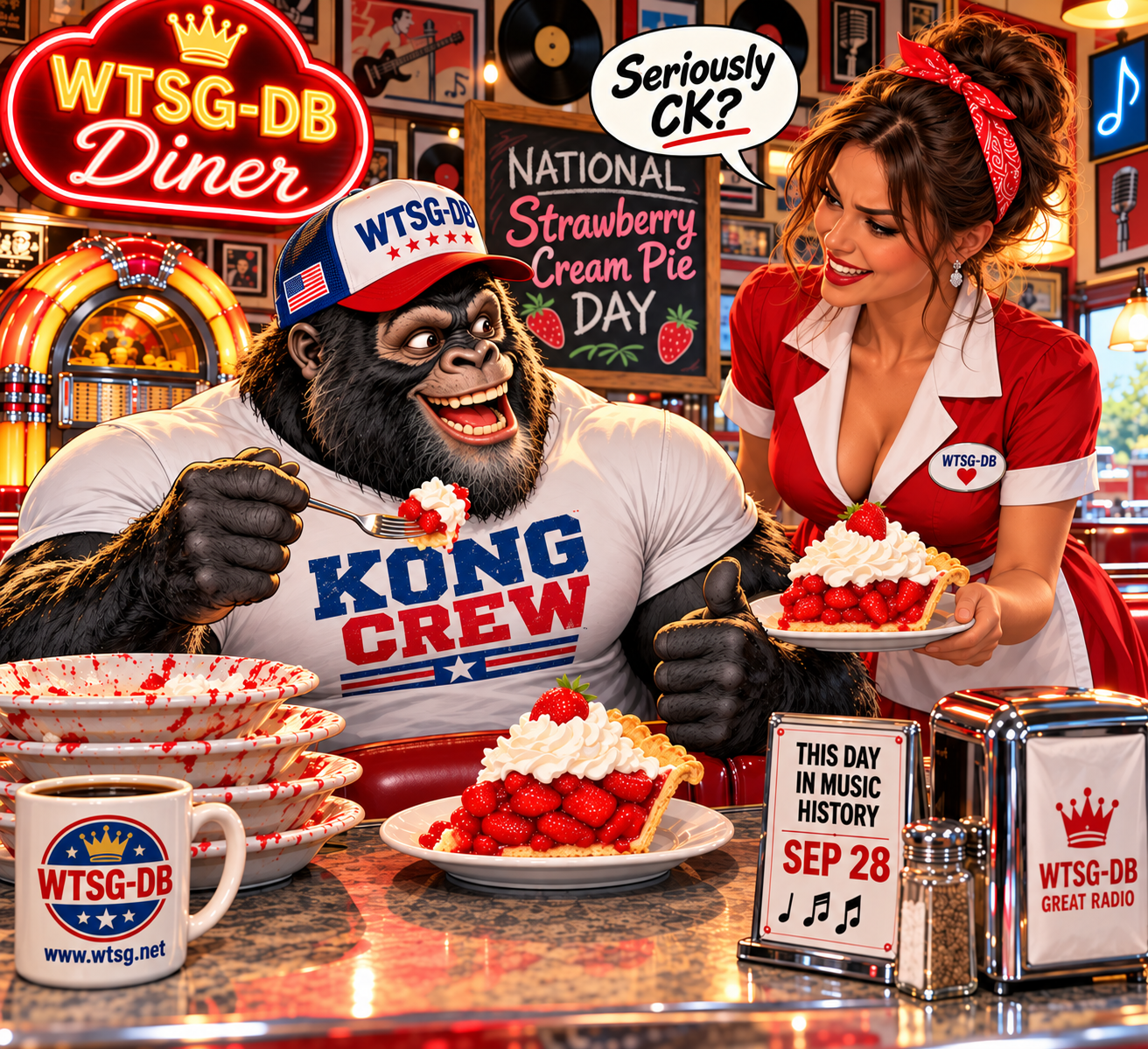
National Strawberry Cream Pie Day
Now THIS is a National Day we can work with.
September 28 is National Strawberry Cream Pie Day, celebrating that wonderful combination of strawberries, cream and pie crust.
I’m not sure who decides these things, but whoever put this one on the calendar deserves a raise.
CLASSICKONG will take one slice.
Okay, two.
Fine.
Just leave the pie.
1968 – The Beatles: “Hey Jude” Begins Nine Weeks at No. 1
On September 28, 1968, the Beatles reached No. 1 on the Billboard Hot 100 with “Hey Jude.”
And they weren’t leaving anytime soon.
The song remained at No. 1 for nine consecutive weeks—the longest chart-topping run of any Beatles single in America.
We’ve talked about the story behind “Hey Jude” before here at WTSG-DB. Paul McCartney originally began the song as “Hey Jules,” an attempt to offer some encouragement to John Lennon’s young son Julian while John’s marriage to Cynthia Lennon was breaking apart.
So rather than retell the entire story today, let’s concentrate on what happened once the world heard it.
Released in 1968 on Apple Records, “Hey Jude” was backed with “Revolution” and became the first Beatles single released on their new Apple label.
The song wasn’t originally included on a standard Beatles studio album. It later became the title track of the 1970 Apple Records compilation Hey Jude, which gathered several Beatles singles and other tracks that had not previously appeared on Capitol’s U.S. albums.
And then there’s that ending.
Musicians call it a coda—basically, a special closing section added to bring a piece of music to its conclusion.
In “Hey Jude,” that closing section becomes an event of its own: the famous repeated “na-na-na” refrain gradually building around McCartney’s increasingly passionate vocal.
The whole recording runs more than seven minutes, an unusually long single for 1968.
And somehow it never feels too long.
There are songs that become hits.
Then there are songs that become part of the language of popular music.
“Hey Jude” became the latter.
1972 – The Temptations: “Papa Was a Rollin’ Stone”
September 28, 1972 brought one of the most dramatic recordings ever released by the Temptations.
“Papa Was a Rollin’ Stone.”
Written by Norman Whitfield and Barrett Strong and produced by Whitfield, the Temptations’ version appeared on All Directions, released in 1972 on Gordy Records.
The full album performance runs nearly 12 minutes, building slowly through bass, wah-wah guitar, strings, trumpet and an almost cinematic atmosphere before the vocals finally arrive.
And when they do, this isn’t exactly a cheerful story.
It’s a son trying to understand the truth about a father he barely knew.
The Temptations could sing beautiful love songs with the best of them, but “Papa Was a Rollin’ Stone” was something else entirely—funky, spacious, experimental and downright menacing in places.
Bad ass.
The single would eventually reach No. 1 on the Billboard Hot 100 and earn three Grammy Awards.
More than half a century later, that opening groove still sounds dangerous.
1974 – Bad Company: No. 1 in America
On the Billboard album chart dated September 28, 1974, Bad Company reached No. 1 in America.
Released in 1974 on Swan Song Records, the album introduced one serious rock band:
Paul Rodgers.
Mick Ralphs.
Boz Burrell.
Simon Kirke.
Bad Company was also the first act signed to Led Zeppelin’s Swan Song label, with Zeppelin manager Peter Grant helping guide the band’s career.
The debut gave us “Can’t Get Enough,” “Rock Steady,” “Ready for Love,” “Movin’ On,” “Seagull” and, of course, “Bad Company.”
But here’s where our first little taste of Halloween enters the room.
The album was recorded at Headley Grange using Ronnie Lane’s mobile studio—the same old English house where Led Zeppelin had previously made some legendary recordings.
Paul Rodgers has recalled how they experimented with different parts of the property to find the right natural atmosphere.
And then came “Bad Company.”
Rodgers wanted something different.
At midnight, beneath a full moon, the microphone was taken outside into a field.
That’s where Paul Rodgers recorded the vocal.
Think about that the next time you hear “Bad Company.”
One of rock’s great voices.
Outside in the darkness.
Standing in a field.
Midnight.
A full moon overhead.
Buddy, you couldn’t hand us a much better story with October knocking on the door.
There’s another great piece of history behind “Can’t Get Enough.”
Mick Ralphs originally wrote it while he was still in Mott the Hoople, but the song didn’t suit Ian Hunter’s vocal range.
Paul Rodgers heard it and knew he could sing it.
I’d say that worked out pretty well.
Bad Company became one of the defining hard-rock debuts of the 1970s.
But from now on, whenever I hear that title track, I think I’m going to picture that field.
And that full moon.
1985 – Dire Straits: “Money for Nothing” Rules the MTV Era
Moving ahead to 1985, Dire Straits had the biggest single in America.
On September 28, “Money for Nothing” sat at No. 1 on the Billboard Hot 100.
The song appeared on Brothers in Arms, released in 1985 on Warner Bros. Records in the United States and Vertigo Records internationally.
What a record.
And what a moment in music television.
The opening build from Sting’s unmistakable vocal into Mark Knopfler’s monstrous guitar riff still sounds enormous.
“Money for Nothing” also became inseparable from MTV itself. Its groundbreaking computer-animated video seemed to be everywhere, and for those of us who lived through that era, those opening seconds can immediately transport you back to a time when music television actually meant music television.
I’ve always loved Dire Straits, and Mark Knopfler has one of those guitar sounds where you don’t need anybody to tell you who’s playing.
A few notes will do it.
1991 – Garth Brooks Makes Country-Music History
From rock and MTV, let’s head over to country music.
The Billboard chart dated September 28, 1991 carried a piece of history.
Garth Brooks’ third studio album, Ropin’ the Wind, debuted at No. 1 on the Billboard 200 while also topping Billboard’s country album chart.
It became the first album ever to debut at No. 1 on both charts.
Released September 10, 1991 on Capitol Nashville and produced by Allen Reynolds, Ropin’ the Wind included “Rodeo,” “What She’s Doing Now,” “Papa Loved Mama,” “The River” and Garth’s version of “Shameless.”
And there’s a connection we’ve got to mention.
Billy Joel wrote “Shameless” and originally recorded it for Storm Front, released in 1989 on Columbia Records.
Garth heard the song, loved it and turned his version into a No. 1 country hit.
That’s quite a bridge between two artists who might appear to occupy completely different musical neighborhoods.
Garth Brooks became an absolute phenomenon.
But my favorite Garth song remains “The Dance,” from his self-titled 1989 Capitol Nashville debut.
That one doesn’t need fireworks.
It just needs the song.
1991 – Miles Davis: Impossible to Pigeonhole
And now we come to a musician who spent his entire career refusing to stand still.
Miles Davis died on September 28, 1991, at age 65.
Born May 26, 1926, Miles spent a lifetime refusing to remain wherever the musical world thought it had finally figured him out.
Bebop.
Cool jazz.
Hard bop.
Modal jazz.
Electric music.
Fusion.
Funk.
And near the end of his life?
Hip-hop.
Only weeks before his death, Miles had been working with producer Easy Mo Bee on recordings that would eventually become Doo-Bop, released posthumously in 1992 on Warner Bros. Records.
And it gets even more interesting.
According to Miles Davis’ official site, the project had originally been envisioned as something larger—potentially a double album—with one portion possibly fulfilling the long-discussed idea of a collaboration with Prince.
Think about that.
After everything Miles Davis had already done to change jazz, the man was 65 years old and still looking forward.
Still listening.
Still experimenting.
Still wondering what was around the next corner.
That’s why I’ve always felt you simply cannot pigeonhole Miles Davis.
My favorite is probably still Kind of Blue.
Released in 1959 on Columbia Records, the album brought together Miles Davis, John Coltrane, Cannonball Adderley, Bill Evans, Wynton Kelly, Paul Chambers and Jimmy Cobb.
That’s some lineup.
And remarkably, nearly all of the performances on Kind of Blue were captured on the first complete take.
Sometimes history doesn’t announce itself while it’s happening.
A group of musicians walks into a studio.
They play.
And decades later, we’re still listening.
RIP Miles Davis
May 26, 1926 – September 28, 1991
1999 – September 28 Was a Serious Record-Store Day
Now let’s jump to September 28, 1999.
If you walked into a record store that Tuesday, you had some decisions to make.
Sting released Brand New Day on A&M Records.
The album gave us “Desert Rose,” “After the Rain Has Fallen” and “Brand New Day.”
And there’s a great connection on that title track.
The harmonica?
Stevie Wonder.
Yep.
Sting and Stevie Wonder on the same record.
Alan Parsons released The Time Machine in 1999 on Miramar Records, with an impressive guest list that included Tony Hadley of Spandau Ballet, Colin Blunstone of the Zombies, Máire Brennan of Clannad and Beverly Craven.
Yes also delivered The Ladder, released in 1999 on Eagle Records, bringing Jon Anderson, Steve Howe, Chris Squire, Alan White, Billy Sherwood and Igor Khoroshev together for an album that found the progressive-rock veterans moving forward yet again.
And then there was ZZ Top.
XXX arrived on RCA Records.
The title celebrated the band’s 30th anniversary, and the album combined new studio recordings with live material.
We’ve talked about Frank Beard here before, especially after we lost him in August.
At the time, I called Frank the engine of ZZ Top.
Always in the pocket.
Traditional, baby.
I also told you about seeing ZZ Top at Roberts Stadium here in Evansville in 1982—the green strobes during “Cheap Sunglasses” and getting to see Frank sitting behind that kit in person.
So we’re not going to repeat the tribute we’ve already given him.
But when XXX brings ZZ Top back into our story today, we’re certainly going to remember Frank and Dusty Hill.
Those two men formed one of rock’s most recognizable rhythm sections, providing the foundation beneath Billy Gibbons’ guitar for decades.
Dusty left us in 2021.
Frank followed in August 2026.
Put on a ZZ Top record, though, and there they are.
That groove doesn’t disappear.
RIP Dusty Hill
May 19, 1949 – July 28, 2021
RIP Frank Beard
June 11, 1949 – August 17, 2026
Birthday Roll Call
Ben E. King
Born September 28, 1938 – Died April 30, 2015
What a voice.
Before his solo career, King sang lead with the Drifters on classics including “There Goes My Baby,” “This Magic Moment” and “Save the Last Dance for Me.”
Then came “Spanish Harlem.”
And, of course, “Stand by Me.”
“Stand by Me” appeared on King’s 1962 Atco Records album Don’t Play That Song!, although the single itself had originally been released in 1961.
I’ve always loved that song.
Some records belong to an era.
“Stand by Me” seems to belong to everybody.
RIP Ben E. King.
Paul Burgess
Born September 28, 1950
Happy 76th birthday to drummer Paul Burgess.
10cc fans know the name well. Burgess first toured with the band in the 1970s and became an important part of their story following the departure of Kevin Godley and Lol Creme.
He played on Deceptive Bends, released in 1977 on Mercury Records, the album containing “The Things We Do for Love,” and continued his long association with 10cc for decades.
Burgess has also worked with Camel, Jethro Tull, The Icicle Works and others.
After more than half a century of touring with 10cc, Burgess stepped away from their touring lineup following the band’s 2025 U.S. dates.
Importantly, he didn’t retire from playing drums.
After decades of airports, buses, hotels and life on the road, he simply decided it was time to keep making music at a pace that suited him better.
Happy birthday, Paul.
And keep playing.
George Lynch
Born September 28, 1954
Now here’s a birthday perfectly timed for the beginning of fall.
Happy 72nd birthday to George Lynch.
Dokken.
Lynch Mob.
Sacred Groove.
And one of the most recognizable guitar players to emerge from the 1980s hard-rock scene.
Lynch could absolutely shred, but there was always personality in his playing. You knew when George Lynch was in the room.
And since October is almost here, we have to mention two things.
“Mr. Scary.”
And “Dream Warriors.”
Both appeared on Dokken’s Back for the Attack, released in 1987 on Elektra Records, although “Dream Warriors” had first appeared earlier that year in connection with the movie A Nightmare on Elm Street 3: Dream Warriors.
Lynch’s instrumental “Mr. Scary” became one of his signature showcases.
He even carried the name into Mr. Scary Guitars.
Come on.
It’s September 28.
Fall has arrived.
Halloween is coming.
How could we NOT put George Lynch in today’s show?
Happy birthday, Mr. Scary.
Must-Have Discogs
The Beatles – The Beatles 1967–1970
1973 – Apple Records
If “Hey Jude” is today’s reason for pulling out a Beatles record, the famous Blue Album remains one of the great gateways into their later years. “Hey Jude” sits among an astonishing collection of songs demonstrating just how much musical ground the Beatles covered in a remarkably short period.
The Temptations – All Directions
1972 – Gordy Records
Essential for “Papa Was a Rollin’ Stone” alone, but there’s much more here. Norman Whitfield was pushing the Temptations into ambitious, experimental soul and funk territory, and All Directions captures a fascinating period in the group’s evolution.
Bad Company – Bad Company
1974 – Swan Song Records
“Can’t Get Enough.” “Rock Steady.” “Ready for Love.” “Bad Company.” “Movin’ On.” “Seagull.”
Enough said.
If you’re building a serious classic-rock collection, this belongs in it.
Dire Straits – Brothers in Arms
1985 – Warner Bros. Records / Vertigo Records
“Money for Nothing,” “Walk of Life,” “So Far Away,” “Your Latest Trick” and the beautiful title track.
It was also one of the albums that helped make the compact disc feel like the future.
Miles Davis – Kind of Blue
1959 – Columbia Records
Miles Davis. John Coltrane. Cannonball Adderley. Bill Evans. Wynton Kelly. Paul Chambers. Jimmy Cobb.
There are records you recommend.
Then there are records that should simply be part of a music collection.
This is one of those.
Garth Brooks – Ropin’ the Wind
1991 – Capitol Nashville
A landmark country album featuring “Rodeo,” “Shameless,” “The River,” “What She’s Doing Now” and “Papa Loved Mama.”
Even if country isn’t normally your first stop, this is an important record from an artist operating at an extraordinary commercial peak.
ZZ Top – XXX
1999 – RCA Records
Not the first ZZ Top album I’d hand somebody discovering the band—that honor probably belongs to one of the earlier classics—but XXX matters as a snapshot of Billy, Dusty and Frank celebrating three decades together.
For collectors and longtime ZZ Top fans, that’s reason enough to give it a place on the shelf.
George Lynch – Sacred Groove
1993 – Elektra Records
George Lynch outside the normal Dokken framework, surrounded by guests and given room to stretch out.
For guitar fans—and especially Lynch fans—this one deserves a spin.
Super-Hero Trading Cards
PAUL RODGERS
Power: The Voice
Special Ability: Can turn a moonlit field into a recording booth
Signature Move: Soulful rock vocals that can go from a whisper to a roar
Essential Weapon: “Bad Company”
Super-Hero Rating: 10/10
MILES DAVIS
Power: Reinvention
Special Ability: Changes musical direction before everybody else catches up
Signature Move: Refusing to stand still
Essential Weapon: The trumpet
Super-Hero Rating: 10/10
GEORGE LYNCH
Power: Mr. Scary
Special Ability: Turns six strings into controlled chaos
Signature Move: Razor-edged riffs and unmistakable lead tone
Essential Weapon: Guitar
Super-Hero Rating: 9.5/10
BEN E. KING
Power: Timeless Soul
Special Ability: Makes a simple message of loyalty feel universal
Signature Move: That warm, unmistakable voice
Essential Weapon: A great song delivered honestly
Super-Hero Rating: 10/10
FRANK BEARD
Power: The Pocket
Special Ability: Makes complicated things sound effortless
Signature Move: The Texas backbeat
Essential Weapon: Groove
Super-Hero Rating: 10/10
Final Spin
Maybe the real lesson of September 28 is that lasting music rarely comes from standing still.
The Beatles kept stretching what a pop single could be. The Temptations and Norman Whitfield took the Motown sound into bold new musical territory. Miles Davis spent an entire lifetime reinventing himself and, even near the end, was still listening for whatever might come next.
That’s something worth remembering.
The musicians who endure are often the ones who keep moving forward—learning, experimenting, taking chances and refusing to settle for average. Reinvention doesn’t mean abandoning who you are. Sometimes it means understanding who you are well enough to discover what else you’re capable of becoming.
Maybe that’s why these records are still here.
They weren’t made by people standing still.
Keep moving forward.
And keep the music playing.
— CLASSICKONG
WTSG-DB
Listen to Today’s Podcast
Want to hear today’s stories instead?
Join CLASSICKONG for the spoken-word edition of This Day in Music History, where our spoken-word show becomes the guided tour through today’s stories while the written blog gives you the deeper dive.
Listen to today’s WTSG-DB podcast and come along for the ride.
References
The Beatles – “Hey Jude” chart history and Beatles milestones
The Temptations – “Papa Was a Rollin’ Stone,” Gordy G 7121F
Bad Company Official Biography – Headley Grange, Swan Song and the “Bad Company” recording
Garth Brooks Official – Ropin’ the Wind
Miles Davis Official – Doo-Bop and the Easy Mo Bee sessions
Miles Davis Official – Kind of Blue
Sting Official – Brand New Day
10cc Official – Paul Burgess Steps Back
George Lynch – Official Biography
National Day Calendar – National Strawberry Cream Pie Day