From the Desk of CLASSICKONG
Welcome back, music lovers, to another trip through the records, artists and moments that built the soundtrack of our lives.
Before we spin the first record, WTSG-DB proudly sends our thanks to the men and women of the United States Armed Forces—past and present—and to the families who stand beside them. Your service and sacrifice are never forgotten.
September 26 is one of those days where the stories almost seem to have been waiting for each other.
We’ve got George Gershwin bringing jazz into the concert hall. Elvis coming home to Tupelo. Roy Orbison walking straight to No. 1. Duke Ellington sitting down with John Coltrane. The Beatles releasing Abbey Road. John Lennon building Walls and Bridges. Tiran Porter bringing the low end to the Doobie Brothers. Olivia Newton-John reminding us how beautiful a human voice can be. Robert Palmer refusing to stay inside one musical box. David Bowie and Brian Eno heading Outside. AC/DC welcoming Phil Rudd back behind the drums.
And MY MAIN MAN BRUCE!
We’ll get there.
But first…
NATIONAL PANCAKE DAY
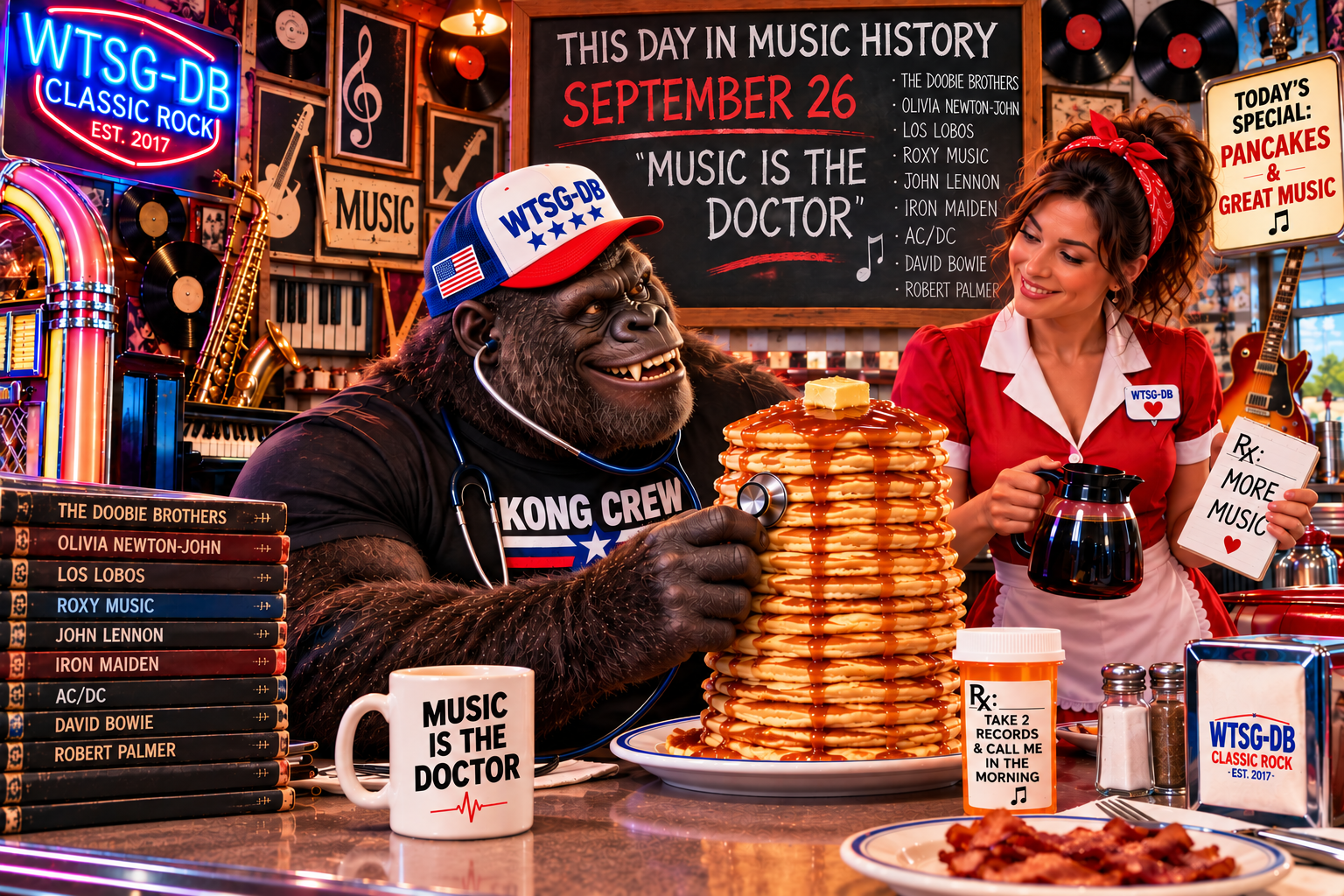
September 26 is National Pancake Day, which means somebody has apparently given CLASSICKONG official permission to consume a stack of pancakes roughly the height of a Marshall amplifier.
National Day Calendar recognizes September 26 as National Pancake Day, celebrating the old-fashioned griddle cake in all its butter-and-syrup glory.
So pull up a chair.
KONG’s got the pancakes.
And because we’re also heading back to Tupelo today, he may already be practicing his Elvis:
“Hey baby…wanna pass dem mash taters?”
Wrong food, KONG.
“Pass dem pancakes, baby.”
Much better.
Now turn up the music.
Because today’s lesson is simple:
Music is the Doctor.
HAPPY BIRTHDAY, GEORGE GERSHWIN
George Gershwin — September 26, 1898 – July 11, 1937
Only 38 years.
That’s almost impossible to comprehend when you consider how much music George Gershwin left behind.
Gershwin occupied a space that few composers ever could. He could live in Tin Pan Alley and Broadway, then walk into a concert hall and bring jazz vocabulary with him without treating either world as somehow beneath the other.
On February 12, 1924, Rhapsody in Blue premiered at Aeolian Hall in New York with Paul Whiteman’s orchestra and Gershwin himself at the piano. Four years later came An American in Paris. Then came Porgy and Bess, along with songs like “Summertime,” “I Got Rhythm,” “Embraceable You” and “Fascinating Rhythm.”
Gershwin understood something we still believe around here:
Good music doesn’t need permission to cross boundaries.
Jazz. Classical. Broadway. Popular song.
Forget the labels for a minute.
Does it move you?
That’s what matters.
Must-Have Gershwin
For collectors, Rhapsody in Blue is essential in virtually any historically significant performance you can find, while An American in Paris and Porgy and Bess belong in the collection of anyone wanting to understand Gershwin’s extraordinary reach.
George Gershwin didn’t live nearly long enough.
But the music certainly did.
1956 — ELVIS PRESLEY COMES HOME
September 26, 1956 was proclaimed Elvis Presley Day in Tupelo, Mississippi, and this wasn’t simply another tour stop.
Elvis was coming home.
He returned with his parents to the town where he’d been born and performed two shows at the Mississippi-Alabama Fair and Dairy Show—the same fair where he’d performed as a 10-year-old boy.
Only this time, that little kid had become Elvis Presley.
The afternoon and evening performances included material such as “Heartbreak Hotel,” “I Was the One,” “I Got a Woman,” “Don’t Be Cruel,” “Blue Suede Shoes,” “Love Me Tender” and “Hound Dog.”
Talk about coming full circle.
A kid leaves Tupelo.
The world discovers him.
Then he comes home.
And his hometown gives him his own day.
CLASSICKONG would now like to commemorate this touching moment:
“Thankyouverramuch…now pass dem pancakes, baby.”
KONG!
Moving on.
1962 — DUKE ELLINGTON MEETS JOHN COLTRANE
Oh buddy.
Turn the lights down for this one.
On September 26, 1962, Duke Ellington and John Coltrane entered Rudy Van Gelder’s studio in Englewood Cliffs, New Jersey, for a session produced by Bob Thiele.
What happened that day became the album Duke Ellington & John Coltrane, released by Impulse! Records in 1963.
And the personnel alone tells the story.
Ellington brought bassist Aaron Bell and drummer Sam Woodyard from his world. Coltrane brought bassist Jimmy Garrison and drummer Elvin Jones from his.
Two musical worlds meeting in the middle.
Seven titles came from the session: “In a Sentimental Mood,” “Take the Coltrane,” “Big Nick,” “Stevie,” “My Little Brown Book,” “Angelica” and “The Feeling of Jazz.”
And “In a Sentimental Mood”?
Whew.
I’ve talked before about how much I love Duke’s Ellington Indigos. There’s something about that side of Ellington—the atmosphere, the space, the beauty—that can stop me in my tracks.
Now put John Coltrane beside him.
That’s not two legends trying to prove who’s the bigger legend.
That’s two masters listening.
And that’s the magic.
Must-Have Discogs — Duke & Trane
Duke Ellington & John Coltrane — 1963 — Impulse! Records, A-30. Recorded September 26, 1962 at Van Gelder Studio.
If you’re building a serious jazz collection, this isn’t optional.
This is one of those records where music really is the Doctor.
Put it on.
Turn everything else off.
And listen.
1964 — ROY ORBISON WALKS TO NO. 1
On September 26, 1964, Roy Orbison’s “Oh, Pretty Woman” began a three-week run at No. 1 on the Billboard Hot 100.
Released on Monument Records, written by Orbison and Bill Dees, that opening guitar figure remains instantly recognizable more than six decades later.
And then there’s Roy’s voice.
My goodness.
Orbison could sound powerful and vulnerable at the same time. “Only the Lonely,” “Crying,” “In Dreams,” “Running Scared”—this was a singer who didn’t need to pretend heartbreak couldn’t hurt a man.
Roy was born April 23, 1936, and died December 6, 1988, only 52 years old. His late-career resurgence with the Traveling Wilburys and Mystery Girl reminded everybody just how special he was.
But on September 26, 1964, “Oh, Pretty Woman” was sitting right where it belonged—at the top of the Billboard Hot 100.
Mercy!
Must-Have Discogs — Roy Orbison
Lonely and Blue — 1961 — Monument Records
Crying — 1962 — Monument Records
In Dreams — 1963 — Monument Records
Mystery Girl — 1989 — Virgin Records
Four records that show why Roy Orbison remains one of the truly distinctive voices in rock and roll history.
1969 — ABBEY ROAD
September 26, 1969.
Abbey Road.
The Beatles — Apple Records — produced by George Martin.
Here’s the bittersweet part.
Abbey Road wasn’t the final Beatles album released—that would be Let It Be in 1970—but it was the final album John Lennon, Paul McCartney, George Harrison and Ringo Starr recorded together as a band.
Think about what’s on this record:
“Come Together.”
“Something.”
“Maxwell’s Silver Hammer.”
“Oh! Darling.”
“Octopus’s Garden.”
“Here Comes the Sun.”
And that remarkable Side Two medley carrying us toward “The End.”
Then there’s the cover.
No giant title.
No band name plastered across it.
Just four Beatles crossing Abbey Road outside EMI Studios. Photographer Iain Macmillan took only six photographs during that famous August 8, 1969 crossing, with the fifth chosen for the cover.
One of the simplest album covers ever made became one of the most recognizable images in popular culture.
And knowing what was coming makes the record even more powerful.
The Beatles were nearing the end of their road together.
Yet they still managed to make Abbey Road.
Must-Have Discogs
Abbey Road — 1969 — Apple Records, PCS 7088 (UK original). The original U.S. Apple pressing followed in October as SO-383.
It’s history.
HAPPY BIRTHDAY, TIRAN PORTER — AND A STORY CLOSE TO HOME
Tiran Porter — born September 26, 1948
Now this one is personal.
Tiran joined the Doobie Brothers during the Toulouse Street era and became a vital part of that classic Doobies rhythm section. His run included The Captain and Me, What Were Once Vices Are Now Habits, Stampede, Takin’ It to the Streets, Livin’ on the Fault Line, Minute by Minute and One Step Closer.
He left in 1980, then returned when the band reunited in the late ’80s, appearing on Cycles and Brotherhood.
He wasn’t simply holding down root notes, either.
Tiran could PLAY.
He wrote and sang “For Someone Special” on Takin’ It to the Streets and “Need a Lady” on Livin’ on the Fault Line.
And that brings me to my mom.
Years ago, my mother was playing bass with The Gloria Glore Four at The Executive Inn in Evansville, Indiana.
Tiran Porter walked up to the band, addressed my mom specifically, and told her how much he liked her playing.
Think about that.
I already knew my mom was an impressive bass player.
But finding out that Tiran Porter of the Doobie Brothers had heard her and thought enough of her playing to walk over and tell her?
Man, I was stoked!
And it also told me something about Tiran.
He didn’t have to do that.
One musician heard another musician doing something good and took a moment to acknowledge it.
Classy.
I’ve always respected Tiran, and I hated seeing him leave the Doobies.
Livin’ on the Fault Line
Here’s another great wrinkle.
Jeff “Skunk” Baxter has called Livin’ on the Fault Line his favorite Doobie Brothers album, describing it as an exploratory record where the group was stretching musically. Baxter also encouraged the Doobies to work as a rhythm section behind other artists, bringing a session-musician discipline into the band.
As a drummer, I LOVE that mentality.
You show up prepared.
You listen.
You do what’s right for the record.
Serve the song.
That’s what you’re supposed to do.
Must-Have Discogs — Tiran Porter/Doobies
Toulouse Street — 1972 — Warner Bros.
The Captain and Me — 1973 — Warner Bros.
Takin’ It to the Streets — 1976 — Warner Bros.
Livin’ on the Fault Line — 1977 — Warner Bros.
Minute by Minute — 1978 — Warner Bros.
Cycles — 1989 — Capitol Records
Cycles
The Doobies reunited and released Cycles in 1989 on Capitol Records, with Tiran back on bass.
“The Doctor” reached No. 9 on the Billboard Hot 100 and No. 1 on Billboard’s Album Rock Tracks chart. The album also contains “Need a Little Taste of Love,” “South of the Border,” “Take Me to the Highway” and the Doobies’ version of “One Chain (Don’t Make No Prison).”
Some critics weren’t particularly kind to Cycles.
Me?
I thought it was then—and still think it is—OUTSTANDING. PERIOD!
ONE PUNCH DON’T MAKE NO FIGHT, BABY!
And since September 26 happens to be National Pancake Day, CLASSICKONG would like to make one thing perfectly clear:
Any music critic who doesn’t like Cycles can shove it straight up their pie-hole!
Pass the syrup.
Next record.
HAPPY BIRTHDAY, OLIVIA
Olivia Newton-John — September 26, 1948 – August 8, 2022
This one still hurts.
My wife and I always loved Olivia Newton-John.
And yes, she had the records, the movies, the awards, Grease, Xanadu, “Physical,” “Magic,” “Hopelessly Devoted to You,” “You’re the One That I Want” and all the rest.
But for me, it starts with that voice.
There are plenty of great singers.
Then there are a handful of voices that seem to exist on another level entirely—voices so pure and comforting that they can stop you right where you are.
Olivia Newton-John.
Karen Carpenter.
Those are two of those voices for me.
Not because they sounded alike.
They didn’t.
It’s that almost angelic quality—the warmth, clarity and purity that somehow makes the world seem a little quieter while they’re singing.
Listen to “I Honestly Love You.”
“Have You Never Been Mellow.”
“Please Mr. Please.”
“Sam.”
“A Little More Love.”
“Magic.”
That voice could soothe you.
And that’s only part of why we miss Olivia.
After her own experience with cancer, she devoted enormous energy to helping others. Her fundraising efforts helped establish the Olivia Newton-John Cancer and Wellness Centre in Melbourne, which opened in 2012 and combines treatment, research and wellness services.
That’s a legacy beyond record sales.
A magnificent voice.
A beautiful soul.
And somebody we still miss very much.
Must-Have Discogs — Olivia Newton-John
If You Love Me, Let Me Know — 1974 — MCA
Have You Never Been Mellow — 1975 — MCA
Totally Hot — 1978 — MCA
Xanadu — Original Motion Picture Soundtrack — 1980 — MCA in the U.S./Jet internationally
Physical — 1981 — MCA
Thank you, Olivia.
For the music.
For that voice.
And for the kindness you put back into the world.
HAPPY BIRTHDAY, CESAR ROSAS
Cesar Rosas — born September 26, 1954
LOS LOBOS, BABY!
Singer, songwriter and left-handed guitarist Cesar Rosas helped Los Lobos create one of the most distinctive blends in American roots music—rock and roll, blues, R&B, Tex-Mex, traditional Mexican music and Chicano rock all living under the same roof.
Yes, everybody knows their version of “La Bamba.”
But Los Lobos goes WAY beyond “La Bamba.”
How Will the Wolf Survive? from 1984 is the record I’d hand somebody who wants to understand what this band can really do.
Then jump ahead to the adventurous Kiko in 1992.
Must-Have Discogs
How Will the Wolf Survive? — 1984 — Slash Records
Kiko — 1992 — Slash Records
Los Lobos.
Still one hell of an American band.
HAPPY BIRTHDAY, BRYAN FERRY
Bryan Ferry — born September 26, 1945
Ferry is the singer, principal songwriter and creative force behind Roxy Music, the British art-rock group whose sound evolved dramatically across the 1970s and early ’80s.
Their early lineup included a fellow named Brian Eno.
Remember that name.
Roxy’s catalog gives us “Love Is the Drug,” “More Than This,” “Avalon” and their beautiful version of John Lennon’s “Jealous Guy,” while Ferry’s solo career includes “Slave to Love” and “Let’s Stick Together.”
Must-Have Discogs
Roxy Music — 1972 — Island/E.G.
Siren — 1975 — Island/E.G.
Avalon — 1982 — E.G., with U.S. editions through Warner Bros.
Bryan Ferry, Boys and Girls — 1985 — E.G.
And keep Brian Eno in your pocket.
We’re going to need him again shortly.
1974 — JOHN LENNON BUILDS WALLS AND BRIDGES
Five years after Abbey Road, September 26 gave us another fascinating Beatles connection.
On September 26, 1974, John Lennon released Walls and Bridges in the United States on Apple Records.
And sitting on that album is one of my favorite Lennon singles:
“Whatever Gets You Thru the Night.”
Elton John plays piano and organ and sings harmony on the track. The song went on to become Lennon’s only U.S. solo No. 1 during his lifetime.
Think about that title for a second.
“Whatever Gets You Thru the Night.”
And look at the album title:
Walls and Bridges.
Today we’ve been talking about what music does for people.
Sometimes it helps tear down a wall.
Sometimes it builds a bridge.
Sometimes it simply gets you through the night.
Must-Have Discogs
John Lennon — Walls and Bridges — 1974 — Apple Records
And if you’ve somehow forgotten how good “Whatever Gets You Thru the Night” is…
Doctor’s orders.
Go play it.
LOUD.
1981 — MY MAIN MAN BRUCE!
ROFLMAO!
Here we go.
On September 26, 1981, the British music press announced Bruce Dickinson as the new singer of Iron Maiden.
Dickinson had been singing with Samson. After that band’s appearance at the Reading Festival in August, he spoke with Maiden bassist Steve Harris and manager Rod Smallwood, auditioned, and the announcement appeared in Sounds on September 26.
And what happened next?
Oh, not much.
Just:
The Number of the Beast.
Piece of Mind.
Powerslave.
Somewhere in Time.
Seventh Son of a Seventh Son.
You know.
A quiet little run of records.
ROFLMAO!
Dickinson’s first Maiden studio album, The Number of the Beast, arrived in 1982 and became the band’s first U.K. No. 1 album.
SUPER-HERO TRADING CARD — BRUCE DICKINSON
REAL NAME: Paul Bruce Dickinson
POWER: Air-raid-siren vocals
WEAPON: Microphone
SPECIAL ATTACK: Sustained high note from somewhere in another ZIP code
TEAM: Iron Maiden
FIRST MAIDEN ALBUM: The Number of the Beast — 1982 — EMI
ESSENTIAL FOLLOW-UPS: Piece of Mind — 1983 — EMI; Powerslave — 1984 — EMI
CLASSICKONG RATING: MY MAIN MAN BRUCE!
‘Nuff said.
1995 — AC/DC BREAKS THE BALL
Earlier this week we talked about Chris Slade and the thunder he brought to AC/DC on The Razors Edge.
Now comes the next chapter.
September 26, 1995 was the official U.S. release date of AC/DC’s Ballbreaker.
That’s important because other territories received the record on different dates, which explains why you’ll sometimes see conflicting release information. But AC/DC’s own official site marks September 26 as the U.S. release date for both Ballbreaker and “Hard as a Rock.”
And behind the drums?
Phil Rudd was back.
Rudd’s return restored the rhythm section associated with AC/DC’s classic era, while Rick Rubin produced the album.
That’s what makes this such a great continuation of our Chris Slade story.
Slade did an excellent job.
Then AC/DC went back to Phil Rudd—and Phil’s feel—no pun intended—is unmistakable.
ROFLMAO!
No unnecessary gymnastics.
No showing off.
Just that huge pocket.
Once again:
Serve the song.
Must-Have Discogs
AC/DC — Ballbreaker — 1995 — EastWest Records America (U.S.) / Albert Productions (Australia)
Key cuts: “Hard as a Rock,” “Hail Caesar,” “Cover You in Oil” and the title track.
Welcome back, Phil.
1995 — BOWIE GOES OUTSIDE
And here’s one of the strangest connections of the entire day.
Remember birthday boy Bryan Ferry?
Remember early Roxy Music member Brian Eno?
Well, Eno eventually became one of David Bowie’s most important collaborators.
And on September 26, 1995, Bowie’s 1. Outside received its U.S. release.
Bowie’s official site confirms the album came out September 25 elsewhere and September 26 in the United States. It was produced by David Bowie, Brian Eno and David Richards.
This isn’t Let’s Dance Bowie.
It’s dark.
Experimental.
Industrial.
Ambient.
Strange.
Built partly around a narrative involving fictional detective Nathan Adler and a dystopian art world.
Songs include “The Hearts Filthy Lesson,” “Hallo Spaceboy,” “I’m Deranged” and “Strangers When We Meet.”
Must-Have Discogs
David Bowie — 1. Outside: The Nathan Adler Diaries: A Hyper Cycle — 1995 — Virgin Records (U.S.)
So our birthday boy Bryan Ferry gives us Roxy Music.
Roxy gives us Brian Eno.
Eno takes us to Bowie.
And Bowie lands right back on September 26.
I LOVE when the musical family tree does this.
REMEMBERING ROBERT PALMER
Robert Palmer — January 19, 1949 – September 26, 2003
Man, Robert Palmer was cool.
Seriously.
The suit.
The voice.
The attitude.
But if your knowledge of Robert Palmer begins and ends with the MTV videos for “Addicted to Love” and “Simply Irresistible,” you’re missing an enormous part of the story.
Before MTV, Palmer was already swimming through funk, R&B, New Orleans soul, reggae, rock and pop.
His 1974 solo debut Sneakin’ Sally Through the Alley featured musicians from The Meters along with Lowell George of Little Feat.
Then came Pressure Drop in 1975, where Palmer worked with Little Feat musicians and legendary Motown bassist James Jamerson appears on the record.
Those grooves.
Those HORNS.
Man.
Then Palmer kept evolving.
Clues brought a new-wave edge.
The Power Station put him alongside members of Duran Duran and Chic drummer Tony Thompson.
Then Riptide exploded with “Addicted to Love” and “I Didn’t Mean to Turn You On.”
Robert Palmer never seemed interested in staying in one lane.
He died suddenly of a heart attack in Paris on September 26, 2003.
He was only 54 years old.
Way too young.
Must-Have Discogs — Robert Palmer
Sneakin’ Sally Through the Alley — 1974 — Island Records
Pressure Drop — 1975 — Island Records
Clues — 1980 — Island Records
Riptide — 1985 — Island Records
Don’t just remember the videos.
Remember the musician.
Robert Palmer was one cool cat.
And we miss him.
THE FINAL SPIN — MUSIC IS THE DOCTOR
Some days the common thread doesn’t reveal itself until we’ve gone through all the records.
September 26 practically handed us the prescription.
Music is the Doctor.
George Gershwin showed us that music doesn’t have to respect boundaries.
Duke Ellington and John Coltrane showed us what happens when two giants listen to each other instead of competing with each other.
Roy Orbison showed us that heartbreak can become something beautiful.
The Beatles somehow created Abbey Road while their own road together was nearing its end.
John Lennon gave us Walls and Bridges and reminded us that sometimes we’re simply looking for whatever gets us through the night.
Tiran Porter once walked across a room at the Executive Inn in Evansville, Indiana, approached The Gloria Glore Four, and took the time to tell my mom that he liked her bass playing.
One musician acknowledging another.
I’ll never forget that story.
Olivia Newton-John had one of those rare voices that could make everything feel a little calmer for a few minutes. My wife and I loved her, and we still miss her.
Robert Palmer spent his career absorbing sounds from everywhere and turning them into something uniquely his own.
AC/DC reminds us of something else: sometimes you don’t need to overthink it. A monster guitar riff, a great groove and Phil Rudd sitting deep in the pocket can be pretty good medicine all by itself.
And Bruce?
Well…
Sometimes the Doctor prescribes IRON MAIDEN!
Music can’t fix everything.
It can’t erase every loss.
It can’t solve every problem waiting for us tomorrow morning.
But sometimes the right record, the right song, the right musician—or simply the right voice at exactly the right moment—can reach us in a way nothing else can.
It can lift us up.
It can settle us down.
It can remind us of where we’ve been, who we’ve loved, and just how much those moments still mean to us.
That’s why we keep spinning these records.
That’s why these stories still matter.
And that’s why, around here…
MUSIC IS THE DOCTOR.
Now if you’ll excuse CLASSICKONG, he has a medical emergency involving approximately fourteen pancakes.
ONE PUNCH DON’T MAKE NO FIGHT, BABY!
Pass the syrup.
Listen to This Podcast
Want to hear today’s musical history come to life? Join CLASSICKONG for the spoken-word edition of This Day in Music History — September 26, as we revisit the stories behind George Gershwin, Elvis Presley, Duke Ellington and John Coltrane, Roy Orbison, Abbey Road, Tiran Porter, Olivia Newton-John, Bruce Dickinson, AC/DC, David Bowie, Robert Palmer and more.
The spoken-word edition is our guided tour, with a little extra CLASSICKONG personality along the way. Hit play, turn it up, and spend a few minutes with us—because today, MUSIC IS THE DOCTOR!
🎙️ Listen to the September 26 Podcast Below
References
George and Ira Gershwin — Official Gershwin Timeline
Elvis Presley — 1956 Tupelo Biography
John Coltrane Discography — Duke Ellington & John Coltrane
Roy Orbison — Official Biography
Roy Orbison — “Oh, Pretty Woman” at No. 1
The Beatles — Abbey Road Anniversary and Cover History
The Doobie Brothers — Official Releases
Jeff “Skunk” Baxter — Livin’ on the Fault Line and the Doobie Brothers
Olivia Newton-John — Official Biography
Olivia Newton-John Cancer Wellness & Research Centre
Bryan Ferry — Official Biography
John Lennon — Walls and Bridges
AC/DC — September 26, 1995 U.S. Release
David Bowie — Outside Release History
Robert Palmer — Official Biography
National Day Calendar — September 26