From the Desk of CLASSICKONG | WTSG-DB Digital Broadcasting
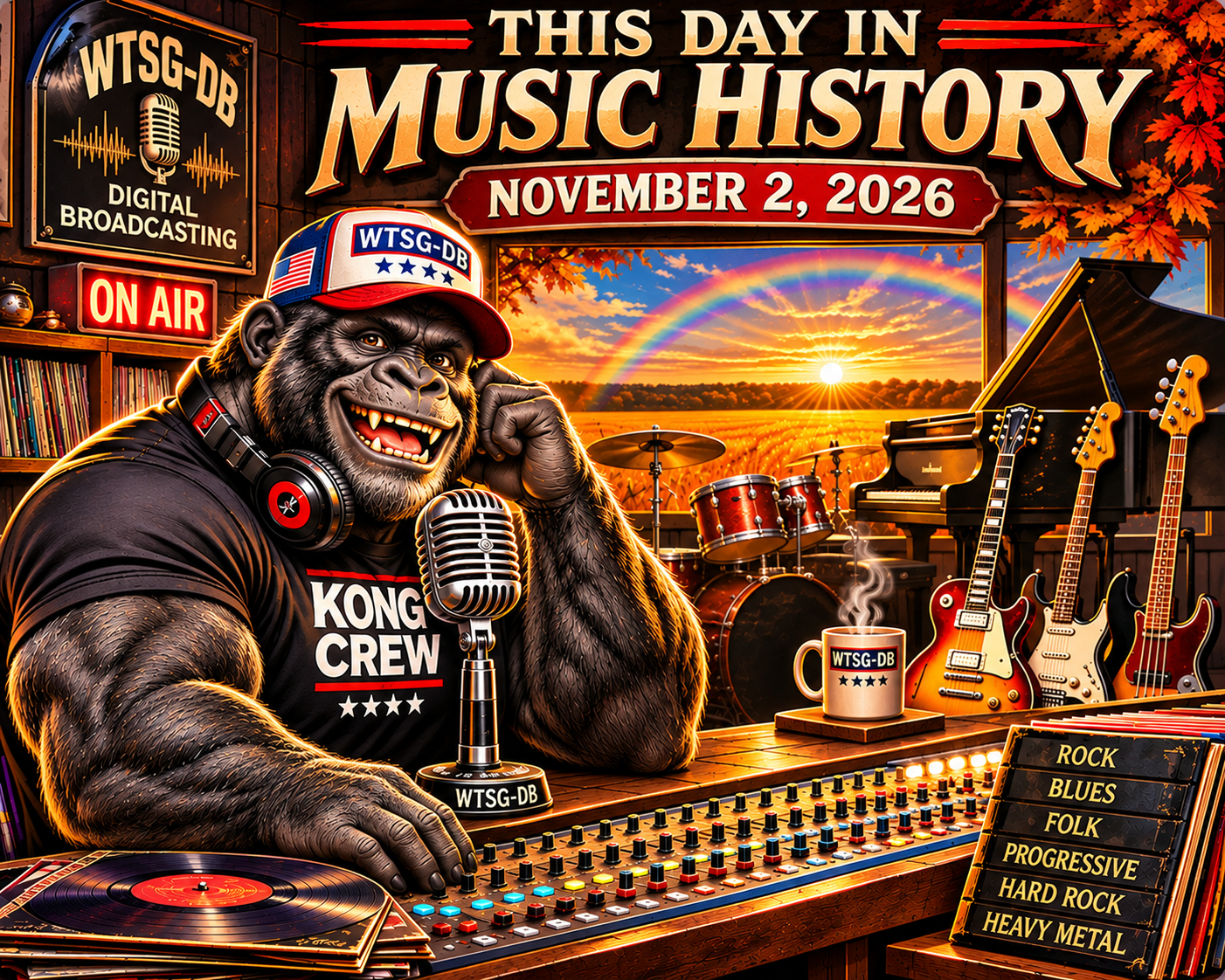
Good morning, friends, and welcome to another edition of This Day in Music History, right here on WTSG-DB Digital Broadcasting!
It’s Monday, November 2, 2026, and November is officially underway.
Halloween has packed up its ghosts and goblins. The jack-o’-lanterns are heading for retirement. And somewhere, a vampire is probably wondering why the neighborhood took down all the decorations.
But the music? Oh, buddy, the music never takes a day off!
Today, we’re taking quite a journey.
We’ll remember an extraordinary singer whose voice continues to touch hearts thirty years after her passing. We’ll celebrate legendary guitarists, keyboard wizards, gifted songwriters, and musicians who helped shape the sounds of several generations.
We’ve got everything from Cream and Creedence Clearwater Revival to Tom Petty, Dokken, Iced Earth, and Foo Fighters.
And somewhere along the way, we’ll discover that great music has a wonderful way of bringing the past right back into the present.
So grab that coffee, turn up the volume, and let’s get rolling!
Salute to Service
Before we begin, WTSG-DB proudly salutes the brave men and women of the United States Armed Forces, our veterans, first responders, and their families.
Thank you for your service, your sacrifices, and your dedication to our country and our communities.
We appreciate you, and we never take your service for granted.
National Days and Observances
National Broadcast Traffic Professional’s Day
Well, would you look at this!
November 2 is National Broadcast Traffic Professional’s Day, honoring the folks behind the scenes who help keep radio and television programming running smoothly.
And there’s a good reason this date is special to broadcasters.
On November 2, 1920, Pittsburgh radio station KDKA made its historic election-night broadcast. It became one of the great milestones in the early history of commercial radio.
Think about how far we’ve come!
From vacuum tubes and enormous transmitters to digital streaming and worldwide audiences, broadcasting has changed tremendously.
But one thing hasn’t changed.
Somebody still has to make sure the right programming gets on the air!
Here at WTSG-DB, we salute the professionals who keep the wheels turning and the signal alive.
National Deviled Egg Day
Now here’s one I can get behind!
November 2 is National Deviled Egg Day.
Apparently, Halloween is over, but the devil is still hanging around the kitchen!
Personally, I think somebody needs to investigate why such a delicious little snack ended up with such a suspicious name.
And if there’s a plate of them sitting on the table, you might want to keep an eye on it.
Those things have a habit of disappearing!
Cookie Monster Day
And finally, it’s Cookie Monster Day!
That’s right, friends. Today we celebrate that lovable blue cookie enthusiast from Sesame Street.
Now there’s a fellow who knows exactly what he wants out of life.
Cookies!
No complicated plans. No unnecessary drama. Just a great big smile and another chocolate chip cookie.
Although I have to admit, I’ve always wondered how that guy manages to eat so many cookies without gaining a pound.
Must be all that exercise chasing the cookie jar!
All right, friends. Enough about food. Let’s get to the music!
Remembering Eva Cassidy – Thirty Years Later
<text>November 2, 1996</text>
Thirty years ago today, the world lost one of the most beautiful voices popular music has ever known.
Eva Cassidy passed away on November 2, 1996, at just 33 years old.
Born February 2, 1963, in Washington, D.C., Eva grew up in a musical environment. She developed a remarkable ability to move between jazz, blues, folk, gospel, and popular standards.
But trying to place Eva Cassidy into one musical category was never easy.
And perhaps that’s because she wasn’t interested in fitting neatly into one.
She simply loved good songs.
And when she found one, she made it her own.
Listen to her interpretation of Sting’s “Fields of Gold.”
There’s a tenderness in that performance that’s difficult to describe. She doesn’t overpower the song. She allows the melody and the words to speak for themselves.
Then there’s “Over the Rainbow.”
A song that countless wonderful singers have performed over the years.
But when Eva sings it, there’s something almost breathtaking about the simplicity and emotion in her voice.
And her interpretation of “What a Wonderful World” is another reminder of just how special she was.
Eva performed regularly around the Washington, D.C., area. Among her most celebrated recordings were performances captured at Blues Alley, a jazz club in Georgetown.
During her lifetime, she never achieved the widespread international recognition her talent deserved.
That recognition came later.
Her recordings gradually found new audiences, particularly in the United Kingdom. The compilation album Songbird, released in 1998, helped introduce her extraordinary voice to millions of listeners.
And isn’t that remarkable?
Thirty years after her passing, people are still discovering Eva Cassidy.
They’re still hearing “Fields of Gold” for the first time.
They’re still listening to “Over the Rainbow” and wondering how someone could bring so much feeling to a familiar song.
That’s an extraordinary musical legacy.
Today, we remember Eva for the beauty she gave us, the songs she loved, and the voice that continues to find its way into people’s hearts.
God rest your soul, Eva.
And thank you for the music.
Must-Have Discogs: Eva Cassidy – Songbird (1998, Blix Street Records)
1967 – Cream Releases Disraeli Gears
On November 2, 1967, Cream released their second studio album, Disraeli Gears.
And friends, what a magnificent piece of rock-and-roll history!
Featuring Eric Clapton on guitar, Jack Bruce on bass and vocals, and Ginger Baker on drums, Cream brought together three extraordinary musical personalities.
They were musicians with deep roots in the blues. But they weren’t afraid to experiment.
The result was a powerful combination of blues, psychedelic rock, and some seriously adventurous playing.
The album included “Strange Brew,” “Sunshine of Your Love,” and “Tales of Brave Ulysses.”
And that riff from “Sunshine of Your Love”?
Oh, come on!
You hear those opening notes, and you know exactly what’s coming.
The album was produced by Felix Pappalardi, who later became a founding member of Mountain.
Yes, THAT Mountain!
The band that gave us the mighty “Mississippi Queen.”
Now there’s a connection worth remembering!
The colorful psychedelic cover artwork also helped make Disraeli Gears one of the most recognizable albums of the 1960s.
Nearly sixty years later, its influence can still be heard in rock music.
Three musicians. One remarkable album. And a sound that helped change the direction of rock and roll.
Must-Have Discogs: Cream – Disraeli Gears (1967, Reaction/Atco Records)
1968 – Glen Campbell and Wichita Lineman
On November 2, 1968, Glen Campbell’s “Wichita Lineman” made its debut on the Billboard Hot 100.
And friends, we’re talking about one of the finest songs ever written.
Composed by the brilliant Jimmy Webb, “Wichita Lineman” tells the story of a man working alone along the telephone lines.
He’s doing his job. He’s surrounded by wide-open country. And his thoughts keep returning to someone he loves.
It’s a simple idea.
But what Jimmy Webb did with that idea was extraordinary.
The melody, the lyrics, and the arrangement come together in a way that’s almost impossible to improve upon.
And Glen Campbell?
What a performance!
Campbell had already established himself as an outstanding guitarist and session musician. His work with the legendary Wrecking Crew placed him among some of the finest players in the recording business.
But he also possessed a wonderful singing voice.
Warm. Natural. Expressive.
And he knew exactly how to deliver a song without getting in its way.
“Wichita Lineman” became one of his signature recordings.
Some people have called it a perfect song.
You know something, friends?
I think they might be right.
Must-Have Discogs: Glen Campbell – Wichita Lineman (1968, Capitol Records)
1969 – Creedence Clearwater Revival Releases Willy and the Poor Boys
On November 2, 1969, Creedence Clearwater Revival released their fourth studio album, Willy and the Poor Boys, on Fantasy Records.
And here’s something remarkable.
This was CCR’s THIRD studio album of 1969!
That’s right!
Bayou Country, Green River, and Willy and the Poor Boys all arrived during the same year.
Talk about being on a roll!
Led by singer, songwriter, and guitarist John Fogerty, CCR developed a sound that was immediately recognizable.
They didn’t need elaborate arrangements or flashy stage tricks.
They had great songs.
And they knew how to play them.
Willy and the Poor Boys gave us “Down on the Corner,” “Fortunate Son,” and a wonderful version of “Cotton Fields.”
“Down on the Corner” tells the story of a fictional little band making music on a street corner.
It’s cheerful. It’s catchy. And it has one of those rhythms that makes sitting still nearly impossible.
That’s part of the magic of CCR.
Their music has a timeless quality.
You can hear one of their records on the radio today, and it sounds just as fresh and exciting as it did more than half a century ago.
And when John Fogerty starts singing?
There’s no mistaking that voice!
Must-Have Discogs: Creedence Clearwater Revival – Willy and the Poor Boys (1969, Fantasy Records)
1978 – The Police Release Outlandos d’Amour
November 2 is commonly cited as the release date of Outlandos d’Amour, the 1978 debut album from The Police.
And what an introduction to a remarkable band!
Featuring Sting on bass and vocals, Andy Summers on guitar, and Stewart Copeland on drums, The Police brought a fresh sound to the late-1970s music scene.
They combined rock, punk, reggae, and pop.
And somehow, they made it all sound completely natural.
The album featured “Roxanne,” “Can’t Stand Losing You,” and “So Lonely.”
Each member brought something special to the music.
Sting’s distinctive voice and melodic bass lines were immediately recognizable.
Andy Summers brought atmosphere and imagination to the guitar.
And Stewart Copeland?
What a drummer!
His inventive rhythms and sharp, energetic playing gave the band an unmistakable personality.
The Police would eventually become one of the biggest bands in the world.
But you can already hear the ingredients of that success on their very first album.
Three talented musicians who weren’t afraid to sound different.
And thank goodness they did!
Must-Have Discogs: The Police – Outlandos d’Amour (1978, A&M Records)
1982 – Tom Petty and the Heartbreakers Release Long After Dark
On November 2, 1982, Tom Petty and the Heartbreakers released their fifth studio album, Long After Dark, on Backstreet Records.
Now THERE’S an album title that fits November perfectly!
The nights are getting longer. The air is getting cooler. And Tom Petty has just the soundtrack.
The album featured “You Got Lucky,” “Change of Heart,” and “Straight Into Darkness.”
And I’ve got to tell you, friends.
“You Got Lucky” is one of my personal favorites.
That opening synthesizer sets the mood immediately.
Then you’ve got Mike Campbell’s wonderful guitar work, the Heartbreakers’ tight rhythm section, and Tom Petty delivering another one of those unforgettable vocals.
The song also had a terrific music video.
With its futuristic setting and mysterious atmosphere, it became a memorable part of MTV’s early years.
Long After Dark also marked bassist Howie Epstein’s first studio album with the Heartbreakers.
The record sometimes gets overshadowed by the band’s bigger commercial successes.
But there’s some outstanding music here.
And that’s one of the joys of having a good record collection.
Every once in a while, you pull out an album you haven’t heard in years.
You put it on.
And suddenly, you remember why you loved it in the first place.
Must-Have Discogs: Tom Petty and the Heartbreakers – Long After Dark (1982, Backstreet Records)
1987 – Dokken Releases Back for the Attack
On November 2, 1987, Dokken released their fourth studio album, Back for the Attack, on Elektra Records.
All right, friends!
Time to crank up those amplifiers!
The classic lineup featured Don Dokken on vocals, George Lynch on guitar, Jeff Pilson on bass, and Mick Brown on drums.
And these guys could PLAY!
The album featured “Kiss of Death,” “Heaven Sent,” “Burning Like a Flame,” and “Dream Warriors.”
George Lynch was one of the most exciting guitarists of the 1980s.
His playing combined powerful riffs, unusual phrasing, and some absolutely blistering solos.
And then there’s “Dream Warriors.”
You horror movie fans already know where we’re going with this!
The song was originally recorded for A Nightmare on Elm Street 3: Dream Warriors, released earlier in 1987.
That’s right.
Freddy Krueger and Dokken!
Now there’s a combination that could keep the neighbors awake!
The music video featured the band alongside scenes inspired by the movie.
And although Halloween is behind us, I’m pretty sure Freddy hasn’t retired for the season.
Back for the Attack remains one of Dokken’s most celebrated records.
A terrific reminder of just how much musical talent came out of the 1980s hard rock scene.
Must-Have Discogs: Dokken – Back for the Attack (1987, Elektra Records)
November 1990 – Iced Earth Releases Its Debut Album
November 1990 marked the arrival of the self-titled debut album from Iced Earth, released in Europe through Century Media Records.
The exact release day isn’t firmly established, but its 36th anniversary gives us a great reason to revisit the band’s beginnings.
And friends, this is a band with quite a history!
Iced Earth was founded by guitarist Jon Schaffer, who grew up in Indiana before moving to Florida.
Schaffer developed a love for heavy metal at an early age.
Among his influences were bands such as KISS, Black Sabbath, and Iron Maiden.
He started building his own musical project in the 1980s.
The group was first known as The Rose and later Purgatory.
Eventually, the name became Iced Earth.
And the music?
Heavy!
The band combined the galloping rhythms and melodic influences of British heavy metal with the aggression of American thrash.
Their debut featured Gene Adam on vocals, Randall Shawver on lead guitar, Dave Abell on bass, Mike McGill on drums, and Schaffer on rhythm guitar.
The album was recorded at the legendary Morrisound Recording studio in Tampa, Florida.
Over the years, Iced Earth developed a distinctive musical identity.
Their albums frequently explored history, fantasy, mythology, and darker themes.
The Dark Saga, released in 1996, drew inspiration from Todd McFarlane’s comic-book character Spawn.
Something Wicked This Way Comes, released in 1998, expanded the band’s reputation for ambitious storytelling.
And then came Horror Show in 2001.
Now, friends, THAT’S an album worth discussing!
With songs inspired by Dracula, Frankenstein, the Wolf Man, and other famous horror characters, Horror Show is a wonderful combination of heavy metal and classic monster mythology.
It’s also a personal favorite.
The band worked with several notable singers over the years, including Matt Barlow, Tim “Ripper” Owens, and Stu Block.
And yes, that’s the same Tim Owens who stepped in for Rob Halford during his years with Judas Priest.
Iced Earth’s most recent studio album is Incorruptible, released in 2017.
From their early underground beginnings to their ambitious concept albums, Iced Earth created a musical legacy that continues to interest heavy metal fans.
Must-Have Discogs: Iced Earth – Iced Earth (1990, Century Media Records)
Also Worth Exploring: Iced Earth – Horror Show (2001, Century Media Records)
1999 – Foo Fighters Release There Is Nothing Left to Lose
On November 2, 1999, Foo Fighters released their third studio album, There Is Nothing Left to Lose, through Roswell and RCA Records.
And what a terrific album!
Featuring “Learn to Fly,” “Breakout,” and “Next Year,” the record showed a band growing increasingly confident in its musical identity.
Dave Grohl and his bandmates recorded much of the album in a home-studio environment in Virginia.
The setting gave them room to experiment and concentrate on the songs.
And the results speak for themselves.
“Learn to Fly” is one of those songs that just makes you feel good.
It’s melodic. It’s energetic. And it has a chorus that practically begs you to sing along.
And that music video?
HILARIOUS!
The band members portray several different characters aboard an airplane.
It’s one of those rare videos that’s just as entertaining today as it was when it first appeared.
The album also marked Taylor Hawkins’ first studio appearance as the Foo Fighters’ drummer.
And it went on to win the Grammy Award for Best Rock Album.
Not too shabby, friends!
Nearly three decades later, “Learn to Fly” still sounds fantastic.
And sometimes that’s all you need.
A great song, a good set of speakers, and a reason to smile.
Must-Have Discogs: Foo Fighters – There Is Nothing Left to Lose (1999, Roswell/RCA Records)
Birthday Salute – Keith Emerson
Born November 2, 1944, in Todmorden, England, Keith Emerson would have celebrated his 82nd birthday today.
And what an extraordinary musician he was.
Emerson became one of the most influential keyboard players in progressive rock.
He first gained widespread attention with The Nice.
Then, in 1970, he joined Greg Lake and Carl Palmer to form the legendary Emerson, Lake & Palmer.
And progressive rock would never be quite the same.
Emerson was a remarkable pianist and organist.
He also became one of the great pioneers of the Moog synthesizer in rock music.
His classical training and adventurous imagination allowed him to move effortlessly between musical styles.
Classical music. Jazz. Blues. Rock.
He brought them all together.
Albums such as Tarkus, Trilogy, Brain Salad Surgery, and Pictures at an Exhibition demonstrated just how far the boundaries of rock music could be pushed.
And his live performances were legendary.
While the guitar players were showing off their instruments, Keith Emerson was making sure the keyboard players got their share of the spotlight!
But behind all the theatrical excitement was a genuinely gifted musician.
Someone who loved his instrument and spent his career exploring its possibilities.
Keith Emerson passed away on March 10, 2016, at age 71.
Today, we celebrate his extraordinary musicianship and the influence he continues to have on keyboard players around the world.
Happy heavenly birthday, Keith.
Must-Have Discogs: Emerson, Lake & Palmer – Brain Salad Surgery (1973, Manticore Records)
Birthday Salute – Maxine Nightingale
Born November 2, 1952, in London, England, Maxine Nightingale celebrates her 74th birthday today!
And friends, here’s a birthday that deserves a little dancing!
Remember “Right Back Where We Started From”?
OH, YEAH!
Originally released in 1975, the song became a major international hit.
In 1976, it reached number two on the Billboard Hot 100 in the United States.
And it’s easy to understand why.
That rhythm!
That melody!
And Maxine’s wonderful, joyful delivery!
It’s one of those songs that can brighten an entire room.
You don’t have to analyze it.
You don’t have to study it.
You just enjoy it!
Maxine also enjoyed success with “Lead Me On,” another beautiful recording from the late 1970s.
Her music reminds us that sometimes a great song doesn’t need to be complicated.
Sometimes all it takes is an unforgettable melody and a singer who knows how to bring it to life.
Happy birthday, Maxine!
And thank you for giving us a song that still makes people smile.
Must-Have Discogs: Maxine Nightingale – Right Back Where We Started From (1976, United Artists Records)
Birthday Salute – Dave Pegg
Born November 2, 1947, in Birmingham, England, Dave Pegg celebrates his 79th birthday today.
And this gentleman has contributed to some absolutely wonderful music!
Pegg is best known for his work with Fairport Convention and Jethro Tull.
Two very different bands.
But both benefited tremendously from his musicianship.
With Fairport Convention, Pegg helped develop the band’s distinctive blend of British folk music and rock.
He also became an important member of Jethro Tull, joining the group in 1979.
And here’s where things get especially interesting for this old music lover.
Pegg played bass on The Broadsword and the Beast, released in 1982.
One of my all-time favorite Jethro Tull albums!
Now THAT’S what I’m talking about!
The album features wonderful songs such as “Beastie,” “Clasp,” “Pussy Willow,” and the magnificent title track, “Broadsword.”
There’s something special about the atmosphere of that record.
It blends Ian Anderson’s distinctive songwriting and flute playing with powerful rock arrangements and touches of British folk tradition.
And Dave Pegg’s bass work helps hold it all together.
He’s the kind of musician who understands that great playing isn’t always about drawing attention to yourself.
Sometimes it’s about knowing exactly what the song needs.
Pegg also contributed to other Jethro Tull albums, including A and Crest of a Knave.
His musical career has included work with artists such as Nick Drake, John Martyn, and Richard Thompson.
That’s quite a résumé!
Happy birthday, Dave!
And thank you for helping make The Broadsword and the Beast such a wonderful album.
Must-Have Discogs: Jethro Tull – The Broadsword and the Beast (1982, Chrysalis Records)
Final Spin
You know, friends, what a remarkable journey through music we’ve had today.
We’ve heard about musicians who could make a guitar roar, keyboard players who could make an instrument sound like an entire orchestra, and songwriters who could tell a lifetime’s story in just a few minutes.
We’ve celebrated the music that makes us want to turn up the volume, the songs that make us get up and dance, and those quieter moments when a beautiful voice can bring the whole world to a standstill.
And that’s what strikes me about today’s stories.
These musicians didn’t all sound alike. They didn’t come from the same backgrounds, follow the same paths, or even measure success the same way.
But each of them gave us something that only they could give.
And then there’s Eva Cassidy.
Thirty years after her passing, her beautiful interpretations of “Fields of Gold” and “Over the Rainbow” remind us that sometimes the greatest musical moments aren’t about how loudly we play, how fast our fingers move, or how many records we sell.
They’re about what we leave in somebody’s heart.
And whether it’s a thunderous guitar, a beautiful melody, an irresistible rhythm, or a voice that seems to reach right into your soul, every one of those gifts matters.
Because somewhere along the way, these musicians gave us more than songs.
They gave us memories. They gave us moments. And in some cases, they gave us a little comfort when we needed it most.
And isn’t it wonderful that, no matter how many years go by, we can still find those things waiting for us whenever the music begins?
And that’s gonna do it for today, friends. Hopefully I’ve maybe put a smile on your face, and a song in your heart. Take care of yourselves, help others when you can, and always, always, keep the music playing.
Listen to Today’s Broadcast/Podcast
WTSG-DB – This Day in Music History | November 2, 2026
Enjoy today’s broadcast, and don’t forget to follow our podcast on Spotify for more great music history, wonderful memories, and stories worth sharing.
GREAT MUSIC. GREAT RADIO. GREAT COMMUNITY.
References and Further Listening
- Eva Cassidy – Official Website
- This Day in Music – November 2
- National Day Calendar
- Discogs – Music Releases and Recording Credits
- AllMusic – Artist Biographies, Albums, and Reviews
- Billboard – Music Charts and History
- Emerson, Lake & Palmer – Official Website
- Jethro Tull – Official Website
- Foo Fighters – Official Website
WTSG-DB Digital Broadcasting
Great Music. Great Radio. Great Community.