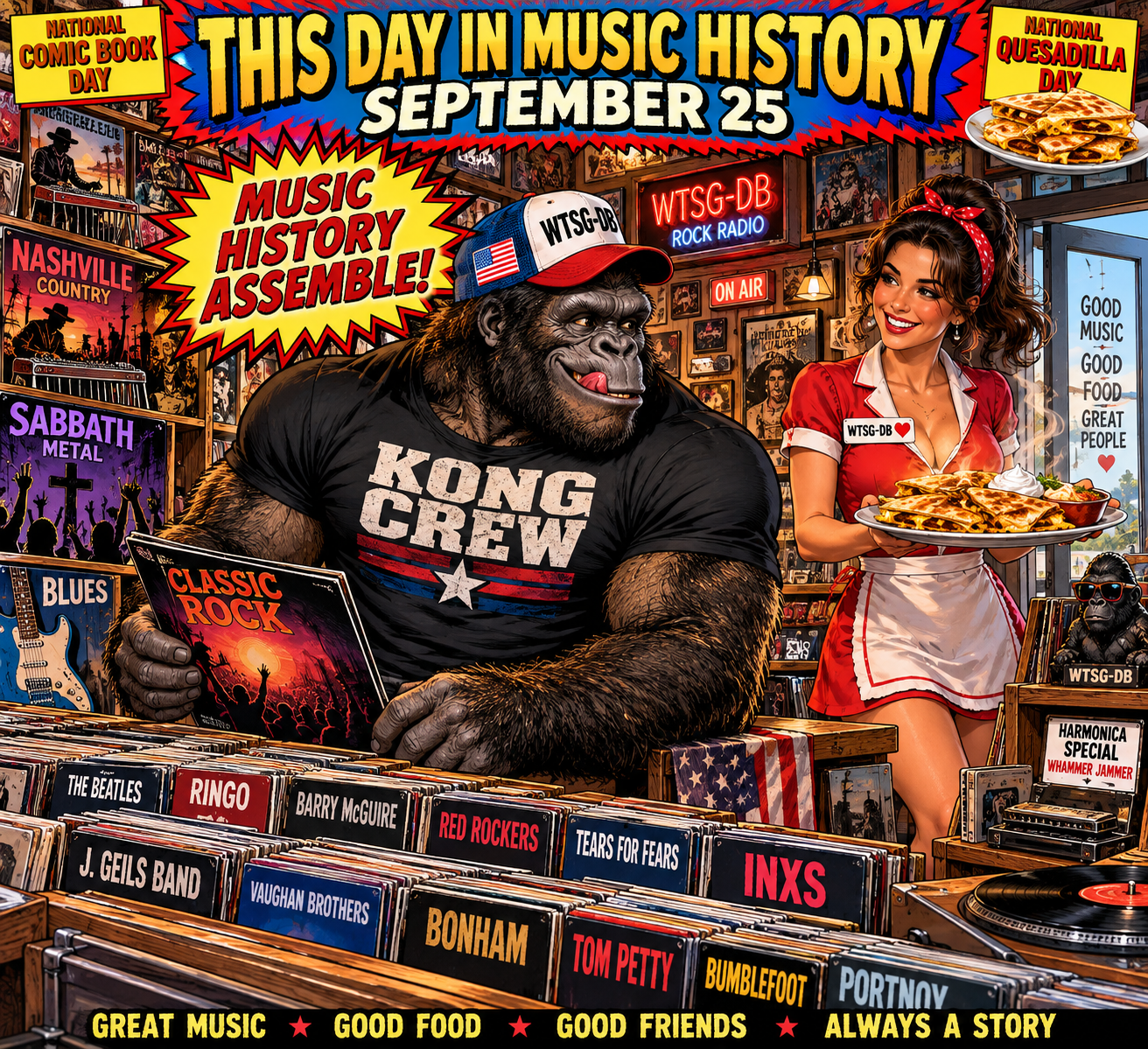
From the Desk of CLASSICKONG
Welcome back, music lovers, to another trip through the records, artists and moments that built the soundtrack of our lives.
September 25 is absolutely packed.
We’ve got The Beatles becoming Saturday-morning cartoons, Barry McGuire landing at Number One with a song that still has something to say, Ringo Starr heading straight into Nashville, two Black Sabbath albums, The J. Geils Band reminding us that rock and roll is supposed to be a good time, Tears for Fears, INXS, the Vaughan Brothers, some terrific birthdays, and remembrances for John Bonham and Tom Petty.
But before we spin the first record…
WTSG-DB proudly sends our thanks to the men and women of the United States Armed Forces—past and present—and to the families who stand beside them.
Your service and sacrifice are never forgotten.
NATIONAL DAYS
First up—and especially appropriate for a music-history site—September 25 is National One-Hit Wonder Day.
And we’ve got an absolutely perfect record for that one coming up.
It’s also National Quesadilla Day, which CLASSICKONG apparently considers an essential part of music history.
And finally, it’s National Comic Book Day.
Now THIS one was practically custom-made for CLASSICKONG!
So grab a quesadilla and let’s get into September 25.
THE BEATLES BECOME SATURDAY-MORNING CARTOONS
On September 25, 1965, The Beatles animated television series premiered on ABC.
Think about where Beatlemania was at this point.
The Beatles weren’t merely selling records. They had become characters in popular culture—and now they were literally cartoon characters.
The series eventually ran for 39 episodes over three seasons.
Here’s something interesting: John, Paul, George and Ringo didn’t provide their own speaking voices.
Paul Frees voiced John and George, while Lance Percival handled Paul and Ringo.
The premiere featured stories built around “A Hard Day’s Night” and “I Want to Hold Your Hand.”
And producer Al Brodax would later become involved with another major piece of Beatles animation history: Yellow Submarine.
For collectors, unfortunately there isn’t currently an authorized complete-series DVD or Blu-ray set sitting on store shelves. Legitimate home-video releases existed years ago, including editions from MPI Home Video, so vintage copies occasionally surface.
That’s one I’d love to have in the collection.
💿 MUST-HAVE DISCOGS
Help! — 1965 • Capitol/Parlophone
Rubber Soul — 1965 • Capitol/Parlophone
Revolver — 1966 • Capitol/Parlophone
BARRY McGUIRE — “EVE OF DESTRUCTION”
On the Billboard Hot 100 dated September 25, 1965, Barry McGuire’s “Eve of Destruction” hit Number One.
Written by P.F. Sloan and released on Dunhill Records, it became McGuire’s only solo Top 40 hit in America.
That makes it one heck of a National One-Hit Wonder Day selection.
But this wasn’t some novelty record.
“Eve of Destruction” was looking directly at the anxieties of 1965—war, nuclear destruction, racial and social conflict, and political contradictions of the period.
And here’s what struck me while preparing today’s story.
More than sixty years later, some of those broad concerns still resonate with listeners. The circumstances aren’t identical, but that gives the song an eerie ability to keep finding new audiences in different generations.
And listen to the musicians behind it.
Hal Blaine on drums. Larry Knechtel on bass.
There’s that Wrecking Crew connection again.
But this story took me somewhere I wasn’t expecting.
While researching McGuire’s original, I remembered hearing an ’80s version of “Eve of Destruction.”
At first I couldn’t remember who did it.
For some reason The Clash was floating around in my head.
Then it hit me.
RED ROCKERS!
They recorded “Eve of Destruction” for their 1984 album Schizophrenic Circus.
And I went back and listened to it again.
Buddy…that’s REALLY good.
Actually, I think I like it more now than I did when I originally heard it.
Red Rockers started with punk and Clash influences, toured with The Clash, and later broadened their sound. Their 1983 album Good as Gold gave us “China,” and then Schizophrenic Circus arrived the following year.
That album also includes “Blood from a Stone,” written by Rob Hyman and Eric Bazilian of The Hooters.
So now I’ve got another rabbit hole to go down.
I’m going after the Red Rockers CDs and exploring all three of their studio albums.
That’s one of the things I love most about doing this.
Sometimes music history doesn’t just remind you of something you already loved.
Sometimes it sends you back to discover something all over again.
💿 MUST-HAVE DISCOGS
Barry McGuire — Eve of Destruction — 1965 • Dunhill
Red Rockers — Good as Gold — 1983 • 415/Columbia
Red Rockers — Schizophrenic Circus — 1984 • 415/Columbia
RINGO GOES TO NASHVILLE
September 25, 1970 brought the UK release of Ringo Starr’s second solo studio album, Beaucoups of Blues, on Apple Records.
And when I first saw “Ringo makes a country album,” my question was:
Why?
Well, there’s actually a great answer.
Ringo loved country music going all the way back to his youth in Liverpool.
Those American records made their way into a port city like Liverpool, and that music became part of his musical DNA.
You can hear country throughout his Beatles years.
He sang Buck Owens’ “Act Naturally.”
He wrote “Don’t Pass Me By.”
Country music wasn’t some strange left turn for Ringo.
Then pedal-steel legend Pete Drake entered the picture.
Drake was in England working with George Harrison during the All Things Must Pass sessions.
Ringo sent a car to Heathrow to pick him up, and Drake noticed the country music Ringo had in the car.
That helped start the conversation.
Why not come to Nashville and make a country album?
Ringo initially thought making an album there would take weeks.
Pete Drake essentially told him: that’s not necessarily how Nashville works.
They could move quickly.
And they did.
Ringo went to Nashville and recorded Beaucoups of Blues at Music City Recorders in an incredibly concentrated series of sessions, with Pete Drake producing.
And look at some of the musicians around him:
Charlie Daniels. Ben Keith. Charlie McCoy. Buddy Harman. D.J. Fontana.
That’s not Ringo pretending to be country.
That’s Ringo walking straight into Nashville and recording with people who knew exactly how that music should feel.
And THAT explanation makes the album far more interesting to me.
💿 MUST-HAVE DISCOGS
Beaucoups of Blues — 1970 • Apple
Ringo — 1973 • Apple
Goodnight Vienna — 1974 • Apple
BLACK SABBATH — TIMES TWO
September 25 gives us not one, but two Black Sabbath albums.
First, Vol. 4, released in 1972 on Warner Bros.
This thing is loaded:
“Wheels of Confusion.” “Changes.” “Supernaut.” “Snowblind.” “Laguna Sunrise.” “Under the Sun.”
Sabbath were expanding what they could do without losing that enormous sound underneath it.
Then four years later, on September 25, 1976, Technical Ecstasy arrived in the United States.
Different record.
Different period.
Still Sabbath.
You’ve got “Back Street Kids,” “You Won’t Change Me,” “Rock ‘n’ Roll Doctor” and “Dirty Women.”
And drummer Bill Ward steps up to sing lead on “It’s Alright.”
I love when musicians inside a great band reveal another side of themselves.
And Bill Ward was such an important part of the Sabbath machine.
As a drummer myself, that’s something I always listen for.
The drummer doesn’t need to spend every second screaming, “LOOK AT ME!”
That’s what a drummer is supposed to do.
Serve the song. Drive the machine!
💿 MUST-HAVE DISCOGS
Vol. 4 — 1972 • Warner Bros.
Technical Ecstasy — 1976 • Warner Bros.
THE J. GEILS BAND: THEY MADE ROCK & ROLL A GOOD TIME
September 25, 1974 gave us Nightmares…and Other Tales from the Vinyl Jungle by The J. Geils Band, released on Atlantic Records and produced by Bill Szymczyk.
And from that album came “Must of Got Lost,” which reached Number 12 on the Billboard Hot 100.
I absolutely love this band.
J. Geils was one of those groups that could play, had great hooks, understood rhythm and blues, and still remembered something very important:
Rock and roll could be FUN.
They made it a good time.
And that doesn’t mean the music was shallow.
Not even close.
I think about bands from that general era like J. Geils, The Knack, Golden Earring, Sniff ‘n’ the Tears, Greg Kihn Band—and now we’re rediscovering Red Rockers today.
These bands knew how to write songs that sounded great coming out of a radio.
J. Geils himself—John Warren Geils Jr.—was the guitarist.
He was born February 20, 1946, and died April 11, 2017, at age 71.
I never met the man.
But when I heard that J. Geils had died, it hit me with enormous sadness.
And I think that’s something music lovers completely understand.
An artist doesn’t have to know you personally to become part of your life.
Those records were there.
Those songs were there.
Those memories were there.
So today we give J. his roses.
He earned them.
And before we move on, we’ve got to mention another member of the band.
Richard Salwitz.
Better known as…
Magic Dick.
Yes.
That was his stage name.
Magic Dick was the harmonica player for The J. Geils Band, and one of his signature showcases was…
“Whammer Jammer.”
Folks, I promise you this is still a music-history blog.
We’re talking about a harmonica.
Let’s keep moving before I get myself in trouble.
🦸 SUPER-HERO TRADING CARD: J. GEILS
REAL NAME: John Warren Geils Jr.
BORN: February 20, 1946 — New York City
DIED: April 11, 2017 — Groton, Massachusetts
WEAPON OF CHOICE: Guitar
SUPERPOWER: Turning blues, R&B, soul and rock & roll into a full-throttle live experience
SUPERWEAPON: THE ROCK & ROLL FUN GUN!
SECRET WEAPON: A band built to bring the party to the stage
ALLIES: Peter Wolf • Magic Dick • Seth Justman • Danny Klein • Stephen Jo Bladd
BATTLE CRIES: “Must of Got Lost” • “Give It to Me” • “Love Stinks” • “Freeze-Frame” • “Centerfold”
CLASSICKONG RATING: LEGEND
💿 MUST-HAVE DISCOGS
“Live” Full House — 1972 • Atlantic
Nightmares…and Other Tales from the Vinyl Jungle — 1974 • Atlantic
Love Stinks — 1980 • EMI America
Freeze-Frame — 1981 • EMI America
And if you want to hear just how powerful this band could be live, find “Live” Full House.
TEARS FOR FEARS — FROM “SHOUT” TO THE SEEDS OF LOVE
September 25, 1989 brought Tears for Fears’ The Seeds of Love on Fontana/Mercury.
What a band.
You’ve got “Sowing the Seeds of Love,” “Woman in Chains,” with the incredible Oleta Adams, and “Advice for the Young at Heart.”
But while we’re talking Tears for Fears, I’ve got to mention one of my absolute favorites:
“Shout.”
That’s from Songs from the Big Chair in 1985.
Roland Orzabal has described “Shout” as a protest song, and it emerged from a period filled with Cold War and nuclear anxieties.
That makes an interesting connection with where we started today.
Barry McGuire gave us “Eve of Destruction.”
Twenty years later, Tears for Fears told us to “Shout.”
Different generations.
Different records.
But music once again responding to the world around it.
💿 MUST-HAVE DISCOGS
Songs from the Big Chair — 1985 • Mercury
The Seeds of Love — 1989 • Fontana/Mercury
INXS — THEY WERE HUGE
September 25, 1990 gave us INXS and X.
And let’s make something clear.
INXS wasn’t just successful.
INXS WAS HUGE.
Listen Like Thieves had already given America “What You Need.”
Then Kick exploded.
“Need You Tonight.”
“Devil Inside.”
“New Sensation.”
“Never Tear Us Apart.”
Michael Hutchence became one of the most recognizable frontmen in rock.
So when X arrived in 1990, this was a major band following one of the biggest albums of the decade.
The title X marked ten years since the band’s debut.
Produced by Chris Thomas, the album gave us “Suicide Blonde,” “Disappear,” “By My Side” and “Bitter Tears.”
💿 MUST-HAVE DISCOGS
Listen Like Thieves — 1985 • Atlantic
Kick — 1987 • Atlantic
X — 1990 • Atlantic
THE VAUGHAN BROTHERS — FAMILY STYLE
Also released September 25, 1990 was The Vaughan Brothers’ Family Style on Epic Records.
Stevie Ray Vaughan and his brother Jimmie had finally made an album together.
I bought this CD when it came out.
And because Stevie had died only weeks before the album’s scheduled release, listening to it carried a weight nobody could have anticipated while they were making it.
The album was already completed.
The release was already planned.
This wasn’t conceived as a farewell.
It was two brothers finally making their record together.
And one song especially hit differently afterward:
“Tick Tock.”
A song about time moving and hoping for something better ahead.
After Stevie was suddenly gone, those words took on an entirely different emotional weight for me.
And here’s another name that showed up in the writing credits:
Nile Rodgers.
At this point, buddy, I think we need a recurring segment:
WHERE IN THE WORLD IS NILE RODGERS?
Answer:
EVERYWHERE.
The man keeps showing up!
💿 MUST-HAVE DISCOGS
The Vaughan Brothers — Family Style — 1990 • Epic
Stevie Ray Vaughan and Double Trouble — Texas Flood — 1983 • Epic
Stevie Ray Vaughan and Double Trouble — Couldn’t Stand the Weather — 1984 • Epic
The Fabulous Thunderbirds — Tuff Enuff — 1986 • CBS Associated
TODAY’S BIRTHDAYS
Sam Rivers — Born September 25, 1923
The jazz saxophonist, flutist, composer and multi-instrumentalist became an important voice in adventurous jazz and recorded for Blue Note.
And here’s the connection that immediately got my attention:
Tony Williams.
One of my favorite drummers of all time.
Sam Rivers died December 26, 2011, at age 88.
💿 MUST-HAVE DISCOGS
Fuchsia Swing Song — 1965 • Blue Note
Contours — 1967 • Blue Note
Shel Silverstein — Born September 25, 1930
Most people know the books.
But this man could write SONGS.
He wrote Johnny Cash’s “A Boy Named Sue,” which became a massive hit.
So if you only know Shel Silverstein from the bookshelf, there’s another side waiting for you in the record collection.
Silverstein died May 10, 1999, at age 68.
💿 MUST-HAVE DISCOG
Johnny Cash — At San Quentin — 1969 • Columbia
Burleigh Drummond — Born September 25, 1951
The Ambrosia drummer, percussionist, vocalist and founding member.
Now there’s one I love.
“Holdin’ on to Yesterday.”
“How Much I Feel.”
“Biggest Part of Me.”
“You’re the Only Woman.”
Beautiful records.
And again, listen to the drumming.
Serving the song and driving the machine.
💿 MUST-HAVE DISCOGS
Ambrosia — 1975 • 20th Century
Life Beyond L.A. — 1978 • Warner Bros.
One Eighty — 1980 • Warner Bros.
Ron “Bumblefoot” Thal — Born September 25, 1969
Bumblefoot joined Guns N’ Roses in 2006 after Buckethead’s departure and contributed guitar—including fretless guitar—to the finished Chinese Democracy album.
One clarification worth making: Bumblefoot wasn’t Slash’s direct replacement and never played alongside Slash in Guns N’ Roses.
Slash had left the band years earlier.
Bumblefoot specifically came aboard following Buckethead’s departure.
And later he joined a band that definitely gets my attention:
Sons of Apollo.
Bumblefoot.
Billy Sheehan.
Derek Sherinian.
Jeff Scott Soto.
And my main man…
MIKE PORTNOY.
Portnoy and Bumblefoot in the same band?
Yeah. I’m listening.
💿 MUST-HAVE DISCOGS
Bumblefoot — Normal — 2005 • Bumblefoot Music
Guns N’ Roses — Chinese Democracy — 2008 • Geffen
Sons of Apollo — Psychotic Symphony — 2017 • Inside Out Music
Sons of Apollo — Live with the Plovdiv Psychotic Symphony — 2019 • Inside Out Music
Sons of Apollo — MMXX — 2020 • Inside Out Music
REMEMBERING JOHN BONHAM
September 25, 1980 was the day rock lost John Bonham at only 32 years old.
Born May 31, 1948, Bonham became one of the most influential drummers in rock history.
I’m not going to dwell on the circumstances.
I’d rather talk about the drummer.
Power. Groove. Feel. Sound. And SPACE.
Bonham could hit with unbelievable authority, but listen carefully and you’ll hear that the magic wasn’t simply about playing loud.
It was where he put the notes.
That right foot.
That Ludwig kit.
That enormous pocket.
“Good Times Bad Times.”
“When the Levee Breaks.”
“Rock and Roll.”
“Kashmir.”
“Fool in the Rain.”
Those recordings became textbooks for generations of drummers.
If you’re learning rock drums, sooner or later you meet John Bonham.
And when you do, you realize something:
Power isn’t about playing everything.
Sometimes power comes from knowing exactly what NOT to play.
💿 MUST-HAVE DISCOGS
Led Zeppelin II — 1969 • Atlantic
Led Zeppelin IV — 1971 • Atlantic
Physical Graffiti — 1975 • Swan Song
TOM PETTY — ONE LAST “AMERICAN GIRL”
September 25, 2017.
Tom Petty and the Heartbreakers walked onto the stage at the Hollywood Bowl for the final night of their 40th Anniversary Tour.
Nobody knew it would become Tom Petty’s final concert.
The set included “I Won’t Back Down,” “Free Fallin’,” “Breakdown,” “Learning to Fly,” “Refugee” and “Runnin’ Down a Dream.”
Then came the encore.
“You Wreck Me.”
And finally…
“American Girl.”
What a song to finish with.
Tom Petty died one week later, on October 2, 2017, at age 66.
But today I’d rather remember that stage.
The Heartbreakers.
The songs.
And one last “American Girl” ringing out across the Hollywood Bowl.
Tom Petty has always been one of my favorites.
And those songs aren’t going anywhere.
💿 MUST-HAVE DISCOGS
Tom Petty and the Heartbreakers — 1976 • Shelter
Damn the Torpedoes — 1979 • Backstreet/MCA
Full Moon Fever — 1989 • MCA
THE FINAL SPIN
Funny how today’s music started talking to itself.
Barry McGuire looked around and warned of an “Eve of Destruction.”
Years later, Tears for Fears told us to “Shout.”
Then INXS stepped in and asked:
“What You Need?”
And somewhere across the room, The J. Geils Band immediately yelled:
“GIVE IT TO ME!”
Yeah.
That sounds about right.
But then the Vaughan Brothers brought us back to something a little deeper:
“Tick Tock.”
Because through all the noise, uncertainty, laughter, loss, rediscovery and great records, one thing never changes.
Time keeps moving.
And maybe that’s one reason these old records can mean even more to us as the years go by.
They don’t just remind us of songs.
They remind us where we were. Who we were with. What we were doing. And sometimes even who we were becoming.
Today we rediscovered Red Rockers.
We learned why Ringo Starr went to Nashville.
We got two doses of Black Sabbath.
We remembered why J. Geils made rock and roll such a good time.
We found Bumblefoot standing alongside Mike Portnoy.
We remembered the power of John Bonham.
And we stood at the Hollywood Bowl one more time with Tom Petty and the Heartbreakers.
That’s why I love doing this.
The dates tell us when.
The music reminds us why we still care.
So turn it up.
Rediscover something you haven’t heard in years.
And maybe find a record you’ve never heard before.
Because if somebody asks…
“What You Need?”
Well…
maybe J. Geils already gave us the answer.
“GIVE IT TO ME!”
Until tomorrow, keep those records spinning.
LISTEN TO TODAY’S BROADCAST
Prefer to listen? We’ve got you covered!
Join CLASSICKONG for the spoken-word edition of This Day in Music History — September 25, 2026, as we take a guided tour through today’s records, artists, birthdays and unforgettable moments.
From The Beatles and Barry McGuire to Ringo Starr, Black Sabbath, The J. Geils Band, Tears for Fears, INXS, the Vaughan Brothers, John Bonham and Tom Petty—there’s a lot of music history packed into today’s show.
Press play below and come along for the ride!
REFERENCES
The Beatles Animated Series
https://www.beatlesbible.com/1965/09/25/beatles-cartoon-series-begins-united-states/
Barry McGuire — “Eve of Destruction”
https://www.billboard.com/
Ringo Starr / Country Music History
https://www.ringostarr.com/
Black Sabbath — Official Discography
https://www.blacksabbath.com/
The J. Geils Band / J. Geils
https://www.allmusic.com/artist/the-j-geils-band-mn0000071207
Tears for Fears
https://tearsforfears.com/
INXS — Official Site
https://www.inxs.com/
Stevie Ray Vaughan / The Vaughan Brothers
https://srvarchive.com/
Bumblefoot — Official Biography
https://bumblefoot.com/
Sons of Apollo
https://www.sonsofapollo.com/
Sam Rivers — Blue Note Records
https://www.bluenote.com/
Tom Petty — Official Site
https://www.tompetty.com/