From the Desk of CLASSICKONG 🦍🎙️
Good Wednesday morning from all of us at WTSG-DB*, where the music never stops and the memories are always welcome.*
Before we turn up the music this morning, we want to take a moment to thank the men and women of the United States Armed Forces—past and present. Your service, sacrifice, and dedication to our country will never be forgotten.
As I looked through the stories for August 26, I began to notice something connecting them.
What we leave behind.
Sometimes it’s a building where generations of musicians will continue creating.
Sometimes it’s a song originally written to comfort one person that eventually touches millions.
Sometimes it’s a voice nobody else could ever duplicate, a mystery nobody can quite solve, or simply the determination to keep making music year after year.
And sometimes it’s opening a door wide enough for somebody else to walk through.
Today we’re traveling from a dream studio in Greenwich Village to one of the biggest Beatles singles ever made. We’ll revisit a turning point for Cheap Trick, crank up one of my favorite summer radio records, cross that mysterious Tallahatchie Bridge one more time, remember the incomparable voice of Roy Orbison, salute Warren Zevon, and celebrate the birthday of one-half of one of the greatest songwriting teams in American popular music.
Along the way, we’ll also celebrate Women’s Equality Day by remembering some of the extraordinary women whose voices, songs and musicianship helped create the soundtrack of our lives.
So grab your coffee, turn up the radio, and let’s find out what August 26 left behind.
Jimi Hendrix Celebrates Electric Lady Studios — 1970
On August 26, 1970, a party was held in New York City celebrating the opening of Electric Lady Studios, the recording studio Jimi Hendrix had dreamed of creating.
And what a dream it was.
Rather than continually paying enormous studio bills elsewhere, Hendrix wanted a place of his own—a creative home where musicians could work without constantly watching the clock. Architect and acoustician John Storyk helped transform the Greenwich Village space into something far different from the sterile recording rooms of the era.
Electric Lady was colorful, atmospheric and unmistakably connected to Hendrix’s imagination.
Unfortunately, Jimi would have almost no time to enjoy it.
Shortly after the opening celebration, Hendrix traveled to England for the Isle of Wight Festival. Less than a month later, on September 18, 1970, Jimi Hendrix died at only 27 years old.
The tragedy is difficult to separate from the story. Hendrix finally had the studio he envisioned, yet never got the years he deserved to spend creating music there.
But his dream survived.
Electric Lady Studios became one of the most famous recording facilities in the world, hosting generations of musicians long after Jimi was gone.
And here at WTSG-DB, there’s another part of Jimi’s story we never want overlooked.
Before Jimi Hendrix became the guitar hero and legend we all know and love, he served his country in the United States Army. 🇺🇸
Then came the music that changed the electric guitar forever.
CLASSICKONG’s Must-Have Jimi Hendrix Collection
- Are You Experienced (1967) — The staggering debut that gave us “Purple Haze,” “Foxey Lady,” “Fire” and “The Wind Cries Mary.”
- Axis: Bold as Love (1967) — Home to “Little Wing,” “Castles Made of Sand” and some of Hendrix’s most beautiful playing.
- Electric Ladyland (1968) — Hendrix stretching the studio itself into an instrument, with “Crosstown Traffic,” “All Along the Watchtower” and “Voodoo Child (Slight Return).”
- Band of Gypsys (1970) — Hendrix with Billy Cox and Buddy Miles, including the extraordinary “Machine Gun.”
Four records, four different views of an artist whose influence remains almost impossible to measure.
Jimi may not have had much time inside Electric Lady Studios, but more than half a century later, musicians are still walking through the doors of the dream he left behind.
The Beatles Release “Hey Jude” and “Revolution” — 1968
On August 26, 1968, The Beatles released “Hey Jude” backed with “Revolution” in the United States, one of the most remarkable two-sided singles of their career.
Paul McCartney originally began writing “Hey Jude” as “Hey Jules,” inspired by John Lennon’s young son Julian during the breakup of John and Cynthia Lennon’s marriage.
Paul was thinking about what Julian was going through and trying, in his own way, to offer some encouragement.
But that leaves a question I’ve wondered about myself:
Why did “Jules” become “Jude”?
It wasn’t a reference to St. Jude.
McCartney ultimately preferred “Jude” because he felt it sounded better when sung. What began as a song for Julian Lennon gradually became something broader and more universal.
And maybe that’s part of the magic.
“Hey Jude” builds slowly before reaching that enormous extended na-na-na finale that seems designed for an entire stadium to sing together.
The song eventually spent nine weeks at No. 1 on the Billboard Hot 100.
Then flip the record over.
“Revolution.”
Suddenly the guitars are dirty, distorted and aggressive.
It’s hard to believe those two recordings lived on opposite sides of the same piece of vinyl.
The single was also historically important because it was among the first releases on the Beatles’ new Apple Records label.
More than half a century later, “Hey Jude” remains one of those songs that barely needs an introduction.
Someone plays those opening piano chords…
and everybody knows what’s coming.
Tom Petersson Leaves Cheap Trick — 1980
On August 26, 1980, bassist Tom Petersson left Cheap Trick during one of the most successful periods of the band’s career.
For another group, losing a member with such an identifiable sound might have been devastating.
But Cheap Trick kept moving.
Petersson had already established himself as something far beyond the guy standing behind Robin Zander and Rick Nielsen. His use of the 12-string bass became one of the distinctive ingredients in Cheap Trick’s sound.
The classic lineup remains one of rock’s great combinations:
Robin Zander — lead vocals
Rick Nielsen — guitar
Tom Petersson — bass
Bun E. Carlos — drums
Petersson eventually returned to Cheap Trick in the late 1980s, beginning another long chapter in the band’s history.
And here’s what I love about this story.
Cheap Trick never became a museum piece.
More than five decades after forming, they’re still out there playing rock and roll.
In November 2025, Cheap Trick released another studio album, All Washed Up.
There’s something wonderfully funny about Cheap Trick calling an album All Washed Up when the band continues proving precisely the opposite.
And they still sound great.
For anyone building a Cheap Trick collection, you can’t go wrong starting with albums such as Cheap Trick (1977), In Color (1977), Heaven Tonight (1978), Cheap Trick at Budokan (1979), Dream Police (1979) and Lap of Luxury (1988).
Cheap Trick has weathered lineup changes, musical trends, MTV, grunge, streaming and just about everything else the music business could throw at them.
And they’re still standing.
Sometimes what you leave behind isn’t finished yet.
Sometimes you’re still adding to it.
Turn it up.
Frankie Valli Takes “Grease” to No. 1 — 1978
Oh yes.
Grease is the word!
On August 26, 1978, Frankie Valli’s “Grease,” the title song from the enormously successful movie and soundtrack, reached the top of the American charts.
I’ve loved this record for as long as I can remember.
Put “Grease” on during the summertime, turn it up and leave it alone.
That’s my jam.
And those horns!
Man, those horns get me every time.
The groove, the backing vocals, the rhythm section and Frankie Valli’s unmistakable voice combine into one of those records that simply sounds like summer radio.
But there’s another great piece of the story.
“Grease” was written by Barry Gibb of the Bee Gees.
Once you know that, you can hear some of that Gibb songwriting DNA underneath the record.
And then we have to talk about the movie itself.
Grease starred John Travolta and the lovely and enormously talented Olivia Newton-John, and its soundtrack became one of the defining pop-culture artifacts of the late 1970s.
Olivia was much more than simply Travolta’s co-star.
She was already an accomplished recording artist with one of the clearest and most beautiful voices in popular music. Then Grease showed audiences another side of her and helped make her an international pop-culture icon.
Her performance of “Hopelessly Devoted to You” remains one of the soundtrack’s most beautiful moments.
Add “You’re the One That I Want,” “Summer Nights,” “Greased Lightnin’” and the rest, and you have one incredible soundtrack.
But Frankie Valli’s title track has always had something special of its own.
It’s funky.
It’s joyful.
It’s loaded with horns.
And nearly fifty years later…
Grease is STILL the word.
Bobbie Gentry and the Mystery of “Ode to Billie Joe” — 1967
On August 26, 1967, Bobbie Gentry’s “Ode to Billie Joe” sat at No. 1 on the Billboard Hot 100.
We’ve traveled down this road before here at WTSG-DB, so I won’t retell the entire mystery today.
But I can’t pass the anniversary without asking the question again:
What in the world did they throw off the Tallahatchie Bridge?
That’s part of the brilliance of the song.
Bobbie Gentry never handed listeners a neat explanation that solved everything. Instead, she created a Southern Gothic story filled with ordinary family conversation while something tragic—and unexplained—hangs over the entire scene.
And then there’s Bobbie herself.
After becoming one of the most fascinating singer-songwriters of her generation, Gentry eventually withdrew from public life.
She didn’t spend the following decades constantly returning for farewell tours, documentaries and television appearances.
She simply stepped away.
That has only added another layer of mystery around the woman who gave us one of popular music’s greatest mysteries.
All these years later, we’re still listening.
And we’re still wondering what went over that bridge.
Some mysteries become part of the legacy too.
Roy Orbison Gives the World “Oh, Pretty Woman” — 1964
On August 26, 1964, Roy Orbison released “Oh, Pretty Woman.”
And what a record.
That opening guitar riff is instantly recognizable, but then comes the real instrument:
Roy Orbison’s voice.
There simply weren’t many singers like him.
Orbison could move from quiet vulnerability to an enormous operatic climax while somehow making everything sound effortless.
His catalog includes classics such as “Only the Lonely,” “Crying,” “Running Scared,” “In Dreams” and, of course, “Oh, Pretty Woman.”
CLASSICKONG’s Must-Have Roy Orbison Collection
- Lonely and Blue (1961) — Featuring “Only the Lonely” and “Blue Angel.”
- Crying (1962) — Essential early Orbison built around one of his signature recordings.
- In Dreams (1963) — Another cornerstone of the Monument years.
- Mystery Girl (1989) — Roy’s magnificent late-career comeback album, released posthumously, featuring “You Got It” and “She’s a Mystery to Me.”
And for anyone who wants a broad trip through Roy’s career, The Ultimate Collection is an excellent way to hear material stretching from his early recordings through his late-’80s comeback.
Then came one of the great late-career chapters in rock history.
Roy became Lefty Wilbury in the Traveling Wilburys alongside George Harrison, Bob Dylan, Tom Petty and Jeff Lynne.
Think about that lineup.
Five enormously distinctive artists somehow came together and sounded like a bunch of old friends having fun making records.
And if you want the Traveling Wilburys studio collection, this might be the easiest discography you’ll ever complete:
The Traveling Wilburys Studio Albums
- Traveling Wilburys Vol. 1 (1988)
- Traveling Wilburys Vol. 3 (1990)
And no, you didn’t miss one.
There was no Vol. 2.
That was part of the Wilburys’ humor.
Sadly, Roy Orbison died on December 6, 1988, at only 52 years old, shortly after the first Traveling Wilburys album arrived.
His voice, however, remains unmistakable.
You can hear only a few seconds of Roy Orbison and know exactly who is singing.
That’s a gift very few performers ever possess.
And that’s a voice the world will never forget.
Warren Zevon Releases His Final Album, The Wind — 2003
On August 26, 2003, Warren Zevon released The Wind, the final studio album of an extraordinary career.
Zevon had been diagnosed with terminal mesothelioma, and he knew time was running short.
Instead of disappearing, he made another record.
Friends came to help, including musicians such as Bruce Springsteen, Tom Petty, Jackson Browne and others.
The resulting album wasn’t simply a farewell. It was another Warren Zevon record—smart, funny, literate, occasionally dark and deeply human.
Zevon died on September 7, 2003, only days after The Wind was released.
But when many of us think about Warren Zevon, there’s another record that immediately comes howling through the speakers.
“Werewolves of London.”
That piano.
That groove.
That wonderfully strange sense of humor.
And yes…
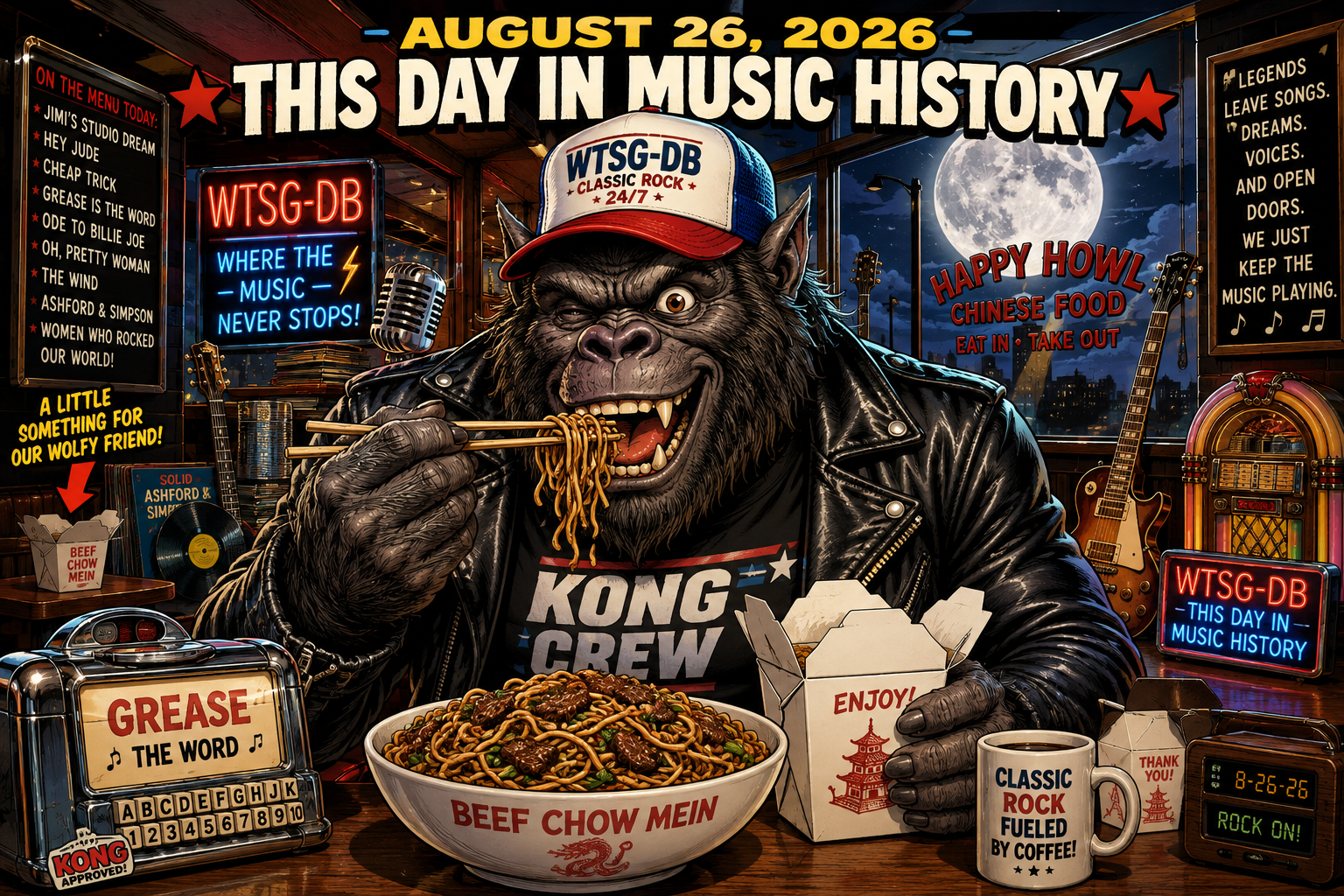
Every time I hear the line about a werewolf eating beef chow mein, I can picture the scene perfectly.
Somewhere out there, a very well-dressed werewolf is enjoying his dinner while Warren Zevon plays in the background.
Aaooooo! 🐺
Warren Zevon was one of a kind.
And when he knew there weren’t many pages left to write, he gave us one more album.
We still miss him.
Happy Birthday, Valerie Simpson — Ashford & Simpson
Born August 26, 1946, Valerie Simpson became one-half of one of the greatest songwriting and performing partnerships in American popular music.
Valerie Simpson and Nickolas Ashford weren’t simply a successful husband-and-wife performing duo.
Together, they helped write part of the soundtrack of our lives.
Their songwriting credits include classics associated with Marvin Gaye and Tammi Terrell such as “Ain’t No Mountain High Enough,” “Your Precious Love,” “Ain’t Nothing Like the Real Thing” and “You’re All I Need to Get By.”
They also wrote “Reach Out and Touch (Somebody’s Hand),” famously recorded by Diana Ross.
And then there was Ashford & Simpson as performers.
For me, “Solid” says it all.
Solid as a rock.
What a great record—and what a perfect description of the partnership Nick and Valerie shared both personally and musically.
If you’re discovering Ashford & Simpson or simply want to revisit them, here’s a great place to start:
CLASSICKONG’s Must-Have Ashford & Simpson Collection
- Send It (1977)
- Is It Still Good to Ya (1978)
- Stay Free (1979)
- Street Opera (1982)
- Solid (1984)
And don’t stop with the records carrying their own names. Follow the songs they wrote for other artists and you’ll discover just how deeply Ashford & Simpson’s fingerprints are embedded in American soul and popular music.
Nickolas Ashford was born May 4, 1941, and passed away on August 22, 2011.
We miss him.
But the music Nick and Valerie created together continues to reach across generations.
And maybe that’s the most appropriate way we can celebrate Valerie Simpson today.
Because Nick Ashford and Valerie Simpson didn’t simply write about reaching out.
They both reached out their hands and made the world a better place.
And when it came to Ashford & Simpson…
that truly was the “Real Thing.” ❤️
Happy birthday, Valerie.
Women’s Equality Day — Celebrating the Women Who Helped Create the Soundtrack
Today is Women’s Equality Day, commemorating the certification of the 19th Amendment in 1920 and the long struggle by American women for the right to vote.
Here at WTSG-DB, it also gives us an opportunity to celebrate something very close to our hearts:
The extraordinary women who helped create the music we love.
Long before rock and roll had a name, Sister Rosetta Tharpe was standing onstage with an electric guitar in her hands, helping lay foundations that generations of musicians would build upon.
Aretha Franklin and Gladys Knight gave soul music voices capable of stopping you in your tracks.
Morgana King could take a song and make it feel intimate, delicate and deeply personal, while Barbra Streisand demonstrated the extraordinary power, control and emotion a truly great vocalist could bring to a performance.
Then there was Karen Carpenter.
What a voice.
Warm, instantly recognizable and seemingly effortless, Karen remains one of those singers who needed only a few notes to reach straight into your heart.
And the same can be said in a different way about Olivia Newton-John, whom we’ve already celebrated today through Grease. Her beautiful, crystal-clear voice remains one of popular music’s treasures.
Linda Ronstadt could move from rock to country to standards and make every one of them sound like she belonged there.
Carole King helped redefine the singer-songwriter while creating songs that became part of American popular culture.
Stevie Nicks and Christine McVie helped make Fleetwood Mac one of the biggest bands in the world.
Ann and Nancy Wilson of Heart brought tremendous voices, musicianship and some serious rock-and-roll firepower.
Pat Benatar, Joan Jett and Bonnie Raitt each carved out unmistakable identities of their own.
Donna Summer helped define an era.
Diana Ross became one of popular music’s most recognizable voices and stars.
Tina Turner became a symbol of strength, reinvention and pure stage power.
And there are so many more.
Jazz, blues, country, soul, R&B, rock, pop, classical music—every corner of the musical world has been enriched by extraordinary women.
These weren’t simply great female artists.
They were—and are—great artists. Period.
Their voices, songs, instruments, performances and creativity are part of the soundtrack of our lives.
And perhaps one of the greatest things any artist can leave behind is inspiration for the next person who picks up an instrument, walks onto a stage, sits down at a piano or steps behind a microphone.
Today we celebrate the women who wrote the songs, played the instruments, stood behind the microphones, broke down doors and helped create that soundtrack.
Music history isn’t complete without their stories—and neither is WTSG-DB. ❤️
Today’s Music History Trivia
Question: Which member of the Traveling Wilburys performed under the name Lefty Wilbury?
Think about it before scrolling down.
.
.
.
Answer: Roy Orbison.
The Final Spin — What We Leave Behind
Maybe today’s stories aren’t really connected by a particular sound, decade or style.
Maybe they’re connected by something much simpler.
What we leave behind.
Jimi Hendrix dreamed of a place where musicians could create freely. He barely had time to enjoy Electric Lady Studios himself, but more than half a century later, the doors are still open and the music is still being made.
Paul McCartney started writing a song to comfort a young Julian Lennon. Somewhere along the way, “Hey Jules” became “Hey Jude”—and a private gesture of kindness became a song millions of people would eventually sing together.
Cheap Trick reminds us that sometimes the legacy isn’t only what you leave behind. Sometimes it’s what you keep doing. More than five decades later, they’re still making records, still taking the stage and still proving that rock and roll doesn’t come with an expiration date.
Bobbie Gentry left us with a mystery we still haven’t solved.
Roy Orbison left us a voice we’ll never mistake for anyone else’s.
Warren Zevon, knowing his time was growing short, went back into the studio and left us one more record.
And Nick Ashford and Valerie Simpson gave us songs about mountains that couldn’t keep people apart, reaching out to one another, finding the real thing and building something solid enough to last.
Today, on Women’s Equality Day, we also remember generations of extraordinary women who left something behind for those who followed—a song, a guitar lick, a voice, an open door, or simply the example that said: You belong here, too.
Maybe that’s the real history we’re celebrating every morning.
Records eventually stop spinning.
Concert lights eventually go dark.
Studios close for the night.
But something created with heart can keep traveling long after the final note fades.
That’s what these artists left us.
And tomorrow morning, we’ll put another record on and remember some more.
Listen to Today’s Broadcast
Sit back, relax, and enjoy today’s story in audio form with CLASSICKONG.
[sonaar_audioplayer albums=”latest” progress_bar_style=”default” wave_bar_width=”1″ wave_bar_gap=”1″ player_layout=”skin_boxed_tracklist” show_track_market=”true” css=”.srp_player_boxed, .skin_floated .album-player, .srp-artworkbg{background-color:#ffffff;}”][/sonaar_audioplayer]