From the Desk of CLASSICKONG 🦍🎙️
Good Thursday morning from all of us at WTSG-DB*, where the music never stops and the memories are always welcome.*
Before we turn another page in music history, we offer our heartfelt thanks to the men and women of the United States Armed Forces—past and present. Your service, sacrifice, and devotion to our country are never forgotten.
August 27 brings us one of those days where music history seems to cover nearly every emotion.
There is heartbreaking loss. There are legends meeting legends. There are albums that changed careers, musicians whose influence traveled far beyond their own records, and even a strange electronic instrument that you can play without ever touching it.
But today, we begin with a guitarist whose sound was unmistakable from practically the first note.
Stevie Ray Vaughan — Remembering a Texas Guitar Giant
On August 27, 1990, the music world awoke to devastating news.
Stevie Ray Vaughan was gone.
He was only 35 years old.
Vaughan had performed the previous evening at Alpine Valley Music Theatre near East Troy, Wisconsin, on a bill that included Eric Clapton and Robert Cray. In the early morning hours, Vaughan boarded a helicopter bound for Chicago.
Flying in dense fog, the helicopter struck a ski hill shortly after takeoff. Vaughan, the pilot, and three members of Eric Clapton’s entourage were killed.
For those who loved Stevie’s music, the shock was enormous.
I remember that period well.
I had been listening heavily to Stevie’s 1989 album In Step. Then came the news on the radio that Stevie Ray Vaughan had died.
It’s one of those moments where music and memory become permanently connected.
And what a player he was.
Stevie combined Texas blues, rock, soul, enormous physical power and astonishing control. You could hear influences such as Albert King, Jimi Hendrix and Buddy Guy in his playing, but when Stevie hit that Stratocaster, nobody wondered who was playing.
It sounded like Stevie Ray Vaughan.
With Double Trouble, he left behind an extraordinary body of work.
Essential Stevie Ray Vaughan and Double Trouble:
- Texas Flood — 1983
- Couldn’t Stand the Weather — 1984
- Soul to Soul — 1985
- In Step — 1989
- The Sky Is Crying — 1991
And don’t overlook Family Style, the wonderful 1990 collaboration with his brother Jimmie Vaughan, released shortly after Stevie’s death.
Thirty-six years have now passed.
The guitar is silent.
But that tone never will be.
Rest easy, Stevie. ❤️
When The Beatles Met Elvis Presley — 1965
Imagine this room.
John Lennon.
Paul McCartney.
George Harrison.
Ringo Starr.
And sitting across from them…
Elvis Presley.
On August 27, 1965, during The Beatles’ American tour, the Fab Four finally met one of the men who had inspired them to become musicians in the first place.
The meeting occurred at Elvis’ home on Perugia Way in Bel Air, California. No press conference was planned. No official photographs were supposed to be taken. This was intended to be a private meeting between the biggest rock-and-roll star of the previous decade and the band that had become the biggest musical phenomenon on Earth.
And apparently…
it was awkward at first.
The Beatles were star-struck.
Think about that.
By 1965, millions of people were screaming themselves hoarse over The Beatles—and The Beatles were sitting there staring at Elvis.
Elvis finally broke the tension with a joke essentially telling them that if they were only going to sit around staring at him, he was going to bed.
Everybody laughed.
The ice was broken.
Before long, instruments came out and an informal jam began. Elvis reportedly picked up a bass while members of The Beatles grabbed guitars. With no drum kit handy, Ringo reportedly made do with what was available.
There is no verified recording of the jam.
Maybe that’s appropriate.
For one evening, two generations of rock-and-roll royalty were simply musicians sitting around playing together.
The King met the Fab Four.
Rock-and-roll history doesn’t get much bigger than that.
Brian Epstein — The Man Behind The Beatles
There is a sad coincidence connected with August 27.
Exactly two years after The Beatles met Elvis, their manager Brian Epstein died on August 27, 1967.
He was only 32 years old.
Epstein had first seen The Beatles perform at Liverpool’s Cavern Club in 1961. He recognized something extraordinary in the young group and helped transform their presentation, secure opportunities and guide the business machinery surrounding their rise.
And what a rise it became.
Epstein also managed artists including Gerry and the Pacemakers, Billy J. Kramer and the Dakotas, Cilla Black and others.
His death from an accidental overdose of sleeping medication came at a crucial moment in The Beatles’ career.
George Martin is rightly remembered as the brilliant producer who helped shape The Beatles’ recordings.
Brian Epstein deserves to be remembered as the man who saw something special in them early enough to help get the world to listen.
Happy Birthday, Alex Lifeson — The Guitar Power of Rush
Born August 27, 1953, Alex Lifeson turns 73 today.
And if you love progressive rock, hard rock and great guitar playing…
you know this man.
Lifeson co-founded the band that became Rush in 1968. Eventually the classic trio of Lifeson, Geddy Lee and Neil Peart became one of rock’s most technically accomplished and instantly identifiable bands.
Playing guitar in Rush was no small assignment.
Geddy’s bass could be extraordinarily busy.
Neil’s drums could sound like an entire percussion department.
Alex somehow found the space between them.
His huge chords, atmospheric textures, unusual voicings, ringing clean tones, muscular riffs and beautifully constructed solos became an essential part of the Rush sound.
And Lifeson wasn’t limited to electric guitar. His Rush arsenal also included acoustic guitar, mandola, mandolin, bouzouki, keyboards and bass-pedal synthesizers.
CLASSICKONG’s Rush essentials:
- 2112 — 1976
- A Farewell to Kings — 1977
- Hemispheres — 1978
- Permanent Waves — 1980
- Moving Pictures — 1981
- Signals — 1982
- Grace Under Pressure — 1984
And of course there are plenty more.
Rush proved that complicated music didn’t have to be cold music.
And Alex Lifeson proved that sometimes the most important guitarist in the room is the one who knows exactly how to fill the space without overcrowding it.
Happy 73rd birthday, Alex!
Tim Bogert — A Bass Player’s Bass Player
Born August 27, 1944, Tim Bogert became one of the great muscular bass voices of late-’60s and ’70s heavy rock.
Bogert played bass and sang with Vanilla Fudge, whose slow, enormous arrangements helped build a bridge between psychedelic rock and the heavier music that followed.
Then came Cactus, alongside his longtime musical partner, drummer Carmine Appice.
And eventually…
Beck, Bogert & Appice.
Jeff Beck.
Tim Bogert.
Carmine Appice.
That’s some serious horsepower.
Bogert’s aggressive bass playing influenced generations of rock bassists. He wasn’t content merely to hold down the bottom—his bass could become another lead voice.
Essential listening:
- Vanilla Fudge — Vanilla Fudge (1967)
- Vanilla Fudge — The Beat Goes On (1968)
- Vanilla Fudge — Renaissance (1968)
- Cactus — Cactus (1970)
- Cactus — One Way…Or Another (1971)
- Beck, Bogert & Appice — Beck, Bogert & Appice (1973)
Near the end of Bogert’s life, there was one particularly moving final chapter.
Although seriously ill with cancer and no longer touring, Tim returned to record bass with the original Vanilla Fudge members on their version of “Stop! In the Name of Love.”
It became his final recording with Vanilla Fudge.
Tim Bogert died on January 13, 2021, at age 76.
I’ve heard his surviving musical friends talk about those final days and what it meant to say goodbye to someone with whom they’d shared so much of their lives.
Those conversations can be difficult to hear.
But perhaps there is something beautiful in knowing that after all those decades, all those miles, all those stages and all that music…
the friendship remained.
Rest easy, Tim.
Bass players around the world, crank it up for Tim! ❤️
Daryl Dragon — The Captain Behind Captain & Tennille
Born August 27, 1942, Daryl Dragon became known to millions simply as…
The Captain.
Alongside the wonderful Toni Tennille, Daryl created one of the most recognizable husband-and-wife musical partnerships of the 1970s.
But don’t let the captain’s hat fool you.
Daryl was a serious musician.
Before Captain & Tennille became household names, Dragon worked with The Beach Boys, and his musical ability as a keyboardist and arranger became central to the Captain & Tennille sound.
Then came the hits:
“Love Will Keep Us Together.”
“The Way I Want to Touch You.”
“Muskrat Love.”
“You Never Done It Like That.”
And then…
“Do That to Me One More Time.”
What a record.
And what a voice Toni Tennille had—and still has.
Warm. Beautiful. Controlled. Instantly recognizable.
Daryl and Toni weren’t confined to radio, either.
They became television stars.
The Captain and Tennille variety series aired on ABC during the 1976–77 television season, bringing music, comedy and guest stars into American living rooms.
I remember watching that show as a kid.
That’s what makes artists like Captain & Tennille more than names on an old record label. For those of us who grew up in that era, they were part of the television set in the living room, part of the radio, and part of the soundtrack playing while we were growing up.
Daryl Dragon died on January 2, 2019, at age 76.
Daryl may be gone.
But the music he and Toni made together is timeless.
Pearl Jam Releases Ten — 1991
Okay.
CLASSICKONG will behave himself. 😉
On August 27, 1991, Pearl Jam released its debut album, Ten.
And whatever your personal musical tastes may be, there is no denying the album’s enormous impact.
Recorded at London Bridge Studios in Seattle, Ten featured Eddie Vedder, Stone Gossard, Mike McCready, Jeff Ament and drummer Dave Krusen.
The songs included:
- “Once”
- “Even Flow”
- “Alive”
- “Black”
- “Jeremy”
- “Oceans”
- “Porch”
- “Release”
The album became Pearl Jam’s biggest-selling studio record and one of the defining releases of the early-’90s Seattle rock explosion.
There.
See?
I behaved.
Moving along. 😉
Garth Brooks Tears Down the Fences — 1990
Also arriving in August 1990 was Garth Brooks’ second studio album, No Fences.
And once again…
CLASSICKONG is behaving himself. 😉
The album became an enormous commercial success and included four consecutive No. 1 country hits:
- “Friends in Low Places”
- “The Thunder Rolls”
- “Unanswered Prayers”
- “Two of a Kind, Workin’ on a Full House”
No Fences went on to become one of the biggest-selling country albums ever.
Whether you’re a Garth fan or…
ahem…
…perhaps slightly less enthusiastic, there’s no arguing with the impact that record had on country music in the 1990s.
Okay.
I did it.
Next story. 😂
George Michael Sends “Monkey” to No. 1 — 1988
On August 27, 1988, George Michael’s “Monkey” reached No. 1 on the Billboard Hot 100.
It became his fourth American No. 1 from the blockbuster Faith album.
And let’s admit it:
“Monkey” is kind of a funny song title.
Then that groove starts.
And the thing cooks.
George Michael possessed far more musical depth than his early pop-star image sometimes suggested. He was a gifted singer, songwriter, producer and arranger, and Faith proved just how broad his musical instincts really were.
George Michael was born June 25, 1963, and died December 25, 2016.
He was only 53.
Chip Douglas — You’ve Heard His Work
Born August 27, 1942, Chip Douglas is one of those names that may not immediately ring a bell.
But his work certainly will.
Douglas played bass with The Turtles, the group behind “Happy Together,” and became an important producer for The Monkees.
His production credits included Monkees classics such as:
“Daydream Believer”
and
“Pleasant Valley Sunday.”
And no…
For those of us whose brains immediately went back to old television…
this is not Chip Douglas from My Three Sons.
😂
Different Chip!
But congratulations if your mind went there too.
Dickie Harrell and “Be-Bop-a-Lula”
Born August 27, 1940, drummer Dickie Harrell was a member of Gene Vincent and His Blue Caps.
And if the name doesn’t immediately register…
the record will.
“Be-Bop-a-Lula.”
Released in 1956, Gene Vincent’s recording became one of the foundational records of early rock and roll.
Harrell was behind the drum kit while the brilliant Cliff Gallup supplied the electric-guitar fire.
Dickie Harrell died on May 31, 2023.
Sometimes these daily history searches remind us that behind songs almost everybody knows are musicians whose names deserve to be remembered too.
So today we remember Dickie Harrell.
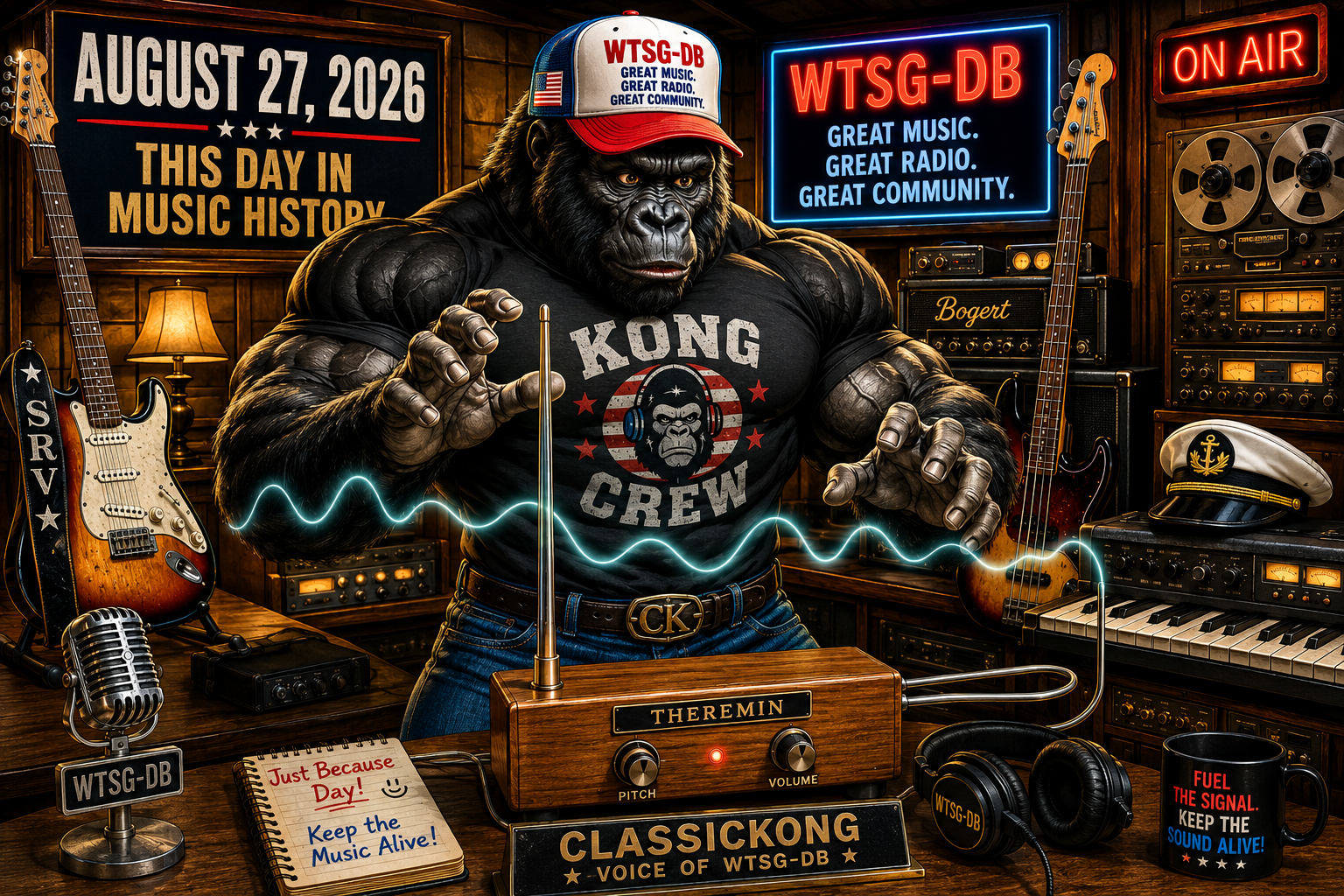
What in the World Is a Theremin?
And now for something completely different.
Léon Theremin, inventor of one of music’s strangest electronic instruments, was born August 27, 1896.
The instrument bearing his name is remarkable because…
you don’t touch it.
Seriously.
A theremin uses antennas that sense the position of the performer’s hands.
One hand controls pitch.
The other controls volume.
There are no piano keys.
No guitar frets.
No valves.
No drum heads.
You essentially play the air.
Its eerie electronic sound became strongly associated with early science-fiction and spooky music.
And yes…
CLASSICKONG has already discovered that people still sell these things.
Halloween is coming.
This could become dangerous.
👻😂
National Days — August 27
August 27 gives us several fun observances, including National Just Because Day, National Peach Day, National Banana Lovers Day, National Pots de Crème Day and World Rock Paper Scissors Day.
National Just Because Day may be the easiest holiday we’ve ever celebrated.
Want another cup of coffee?
Just because.
Want dessert?
Just because.
Want to buy some ridiculous electronic instrument that you play without touching it and put it in the WTSG-DB studio in time for Halloween?
…
JUST BECAUSE.
😂👻
I suddenly like this holiday.
CLASSICKONG’s Music Trivia
Question: Which future rock-and-roll superstars finally met their musical hero Elvis Presley at his California home on August 27, 1965?
Think you’ve got it?
Keep reading.
Final Spin
August 27 reminds us how many different roads can lead into music history.
From Stevie Ray Vaughan’s roaring Stratocaster to Elvis Presley sitting down with four star-struck Beatles…
From the progressive brilliance of Alex Lifeson and Rush to the thunderous bass of Tim Bogert…
From Captain & Tennille bringing music into our living rooms to Gene Vincent and the Blue Caps helping build rock and roll…
From George Michael’s “Monkey” to Pearl Jam’s Ten and Garth Brooks’ No Fences…
And somewhere in the middle of all of it…
there’s CLASSICKONG waving his hands around an electronic instrument he’s not allowed to touch.
😂
Music history can be heartbreaking.
It can be inspiring.
And sometimes…
it’s just plain fun.
Trivia Answer: The Beatles — John Lennon, Paul McCartney, George Harrison and Ringo Starr.
If you haven’t already, please take a moment to sign our WTSG-DB Guestbook and let us know where you’re listening from. We love hearing from the people who make up this growing community of music lovers.
Thank you for spending another day in music history with us.
Keep the memories alive.
Keep supporting the music.
And keep WTSG-DB tuned in.
Great Music. Great Radio. Great Community.
Listen to Today’s Broadcast
Sit back, relax, and enjoy today’s story in audio form with CLASSICKONG.
[sonaar_audioplayer albums=”latest” progress_bar_style=”default” wave_bar_width=”1″ wave_bar_gap=”1″ player_layout=”skin_boxed_tracklist” show_track_market=”true” css=”.srp_player_boxed, .skin_floated .album-player, .srp-artworkbg{background-color:#ffffff;}”][/sonaar_audioplayer]