From the Desk of CLASSICKONG 🦍🎙️
Greetings from all of us at WTSG-DB*, where the music never stops and the memories are always welcome.*
Before we turn up the music today, we send our continued thanks to the men and women of the United States Armed Forces — past and present — and to the families who stand beside them. Your service and sacrifice are never forgotten here.
August 25 is one of those dates when music history seems determined to fill the entire record shelf.
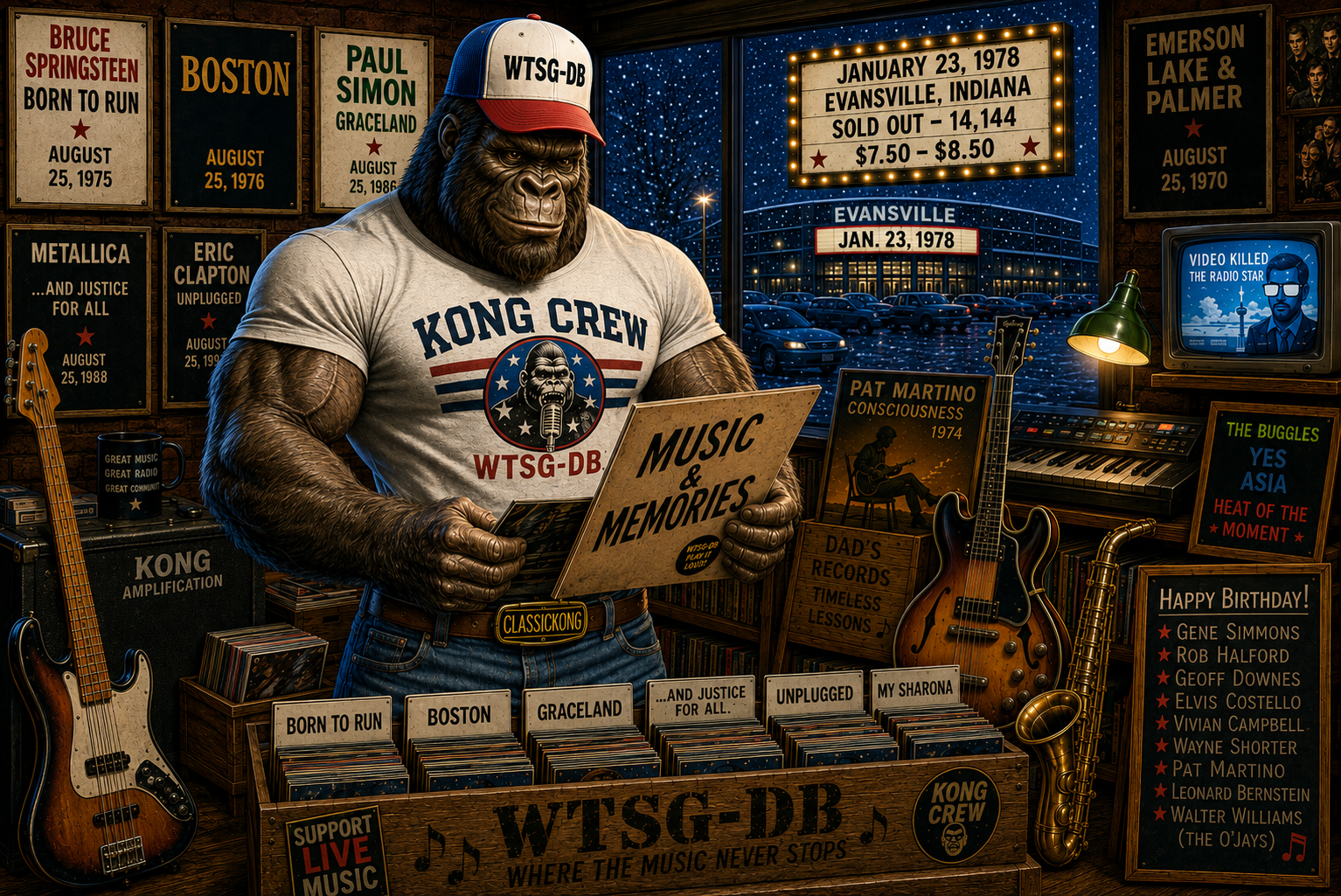
We’ve got landmark albums from Bruce Springsteen, Boston, Paul Simon, Metallica and Eric Clapton. Elton John arrives in America. Emerson, Lake & Palmer take the stage for the first time. “My Sharona” takes over the radio.
And the birthday list?
Gene Simmons. Rob Halford. Geoff Downes. Elvis Costello. Vivian Campbell. Wayne Shorter. Pat Martino. Leonard Bernstein.
Good grief.
Better turn this one up.
Bruce Springsteen Breaks Through with Born to Run
On August 25, 1975, Bruce Springsteen released his third studio album, Born to Run.
Calling it an important record almost undersells it.
Springsteen had already earned considerable critical attention, but Born to Run was the record that pushed him toward mainstream stardom. Its enormous production, cinematic storytelling and sense of youthful escape helped establish the sound and image that would follow him for decades.
The album gave us “Thunder Road,” “Tenth Avenue Freeze-Out,” “Backstreets,” “Born to Run” and “Jungleland.”
That title track remains one of the defining American rock songs of the 1970s.
Whatever anyone may think of directions an artist takes later in life, there are moments when the music itself deserves to stand on its own.
Born to Run was one of those moments.
Essential Springsteen albums:
Born to Run — 1975
Darkness on the Edge of Town — 1978
The River — 1980
Nebraska — 1982
Born in the U.S.A. — 1984
Fifty-one years later, Born to Run remains a landmark American rock album.
Boston Releases One of Rock’s Greatest Debut Albums
On August 25, 1976, Boston released its self-titled debut album.
Now we’re talking.
There are great debut albums.
There are legendary debut albums.
And then there’s Boston.
Tom Scholz’s meticulous production and guitar work combined with Brad Delp’s magnificent voice to create something that sounded polished, enormous and almost futuristic in 1976.
And just look at this record:
“More Than a Feeling.”
“Peace of Mind.”
“Foreplay/Long Time.”
“Rock & Roll Band.”
“Smokin’.”
“Hitch a Ride.”
“Something About You.”
“Let Me Take You Home Tonight.”
Eight songs.
Hardly a wasted second.
And anyone who has spent much time around CLASSICKONG knows exactly where we’re going next.
“More Than a Feeling.”
What a record.
That opening acoustic guitar, Brad Delp’s vocal, the harmonies, Scholz’s massive guitar sound and that gradual climb into one of rock’s most recognizable choruses — it still works every single time.
Boston studio albums:
Boston — 1976
Don’t Look Back — 1978
Third Stage — 1986
Walk On — 1994
Corporate America — 2002
Life, Love & Hope — 2013
For anybody just discovering Boston, I’d start right at the beginning.
Put on Boston.
Then put on Don’t Look Back.
And turn them up.
Way up.
Paul Simon Reinvents Himself with Graceland
On August 25, 1986, Paul Simon released Graceland.
Forty years later, there is no denying what an important record it became in Simon’s career.
It isn’t necessarily my favorite Paul Simon album, but that’s hardly a criticism. Simon had already built one of the finest songwriting catalogs in popular music.
And that story began long before Graceland.
Paul Simon and Art Garfunkel had known one another since childhood and even recorded together as teenagers under the name Tom & Jerry, scoring a hit with “Hey Schoolgirl” in 1957.
Eventually, of course, they became Simon & Garfunkel.
And what followed was extraordinary:
“The Sound of Silence.”
“Homeward Bound.”
“I Am a Rock.”
“Scarborough Fair/Canticle.”
“Mrs. Robinson.”
“America.”
“The Boxer.”
“Cecilia.”
“Bridge Over Troubled Water.”
Essential Simon & Garfunkel albums:
Sounds of Silence — 1966
Parsley, Sage, Rosemary and Thyme — 1966
Bookends — 1968
Bridge Over Troubled Water — 1970
After Simon & Garfunkel, Paul’s solo career demonstrated just how deep his songwriting talent ran.
“Mother and Child Reunion.”
“Kodachrome.”
“St. Judy’s Comet.”
“Still Crazy After All These Years.”
“50 Ways to Leave Your Lover.”
“Late in the Evening.”
“Hearts and Bones.”
And many more.
Essential Paul Simon solo albums:
Paul Simon — 1972
There Goes Rhymin’ Simon — 1973
Still Crazy After All These Years — 1975
One-Trick Pony — 1980
Hearts and Bones — 1983
Graceland — 1986
The Rhythm of the Saints — 1990
Then came Graceland.
Working with South African musicians and drawing upon South African musical traditions, Simon created a record unlike anything else in his catalog. The project also generated controversy because the sessions took place during apartheid and amid the international cultural boycott of South Africa. Those circumstances remain part of the album’s historical discussion.
Musically, however, Graceland became an enormous success.
And then there was:
“You Can Call Me Al.”
If you grew up watching MTV, there’s a pretty good chance you’re smiling already.
The video featured Chevy Chase towering over Simon and enthusiastically lip-syncing much of the song while Simon sat beside him looking wonderfully unimpressed.
It was simple.
It was funny.
And it became unforgettable.
Graceland may not be the Paul Simon album I reach for first, but it was unquestionably another major chapter in the career of one of America’s great songwriters.
Metallica Delivers …And Justice for All
Here they are again.
If it seems like Metallica has been following us through music history lately, they have.
On August 25, 1988, Metallica released …And Justice for All.
It was the band’s first full-length studio album following the tragic 1986 death of bassist Cliff Burton and the first Metallica studio album to feature Jason Newsted.
The record was darker, longer and increasingly complex.
Among its songs are “Blackened,” “…And Justice for All,” “Eye of the Beholder,” “One” and “Harvester of Sorrow.”
“One” became especially important, accompanied by Metallica’s first music video and helping introduce the band to an even larger audience.
And then there’s the subject Metallica fans have debated ever since:
Where’s Jason’s bass?
The notoriously low bass presence in the final mix has become nearly as famous as the album itself.
Essential Metallica albums:
Kill ‘Em All — 1983
Ride the Lightning — 1984
Master of Puppets — 1986
…And Justice for All — 1988
Metallica — 1991
Whatever your opinion of the production, …And Justice for All remains an important bridge between the Metallica of the 1980s and the enormous worldwide success that was about to arrive.
Eric Clapton, Unplugged and “Tears in Heaven”
On August 25, 1992, Eric Clapton released Unplugged.
Recorded for MTV’s hugely successful acoustic series, the album included a radically reworked version of “Layla,” blues standards and one of the most personal songs Clapton ever recorded.
“Tears in Heaven.”
The song was written by Clapton and Will Jennings following the devastating 1991 death of Clapton’s four-year-old son, Conor.
Knowing that history makes an already beautiful song almost unbearably poignant.
There are moments when music becomes something more than entertainment.
It becomes grief.
Memory.
Love.
And sometimes healing.
“Tears in Heaven” is one of those songs.
Clapton’s Unplugged performance stripped away nearly everything unnecessary and left the emotion exposed.
Essential Eric Clapton listening:
Disraeli Gears — Cream, 1967
Wheels of Fire — Cream, 1968
Layla and Other Assorted Love Songs — Derek and the Dominos, 1970
461 Ocean Boulevard — 1974
Slowhand — 1977
Journeyman — 1989
Unplugged — 1992
The album became an enormous commercial and critical success, but numbers really don’t explain why people still return to it.
Sometimes a quiet guitar and an honest voice are enough.
“My Sharona” Takes Over America
On August 25, 1979, The Knack’s “My Sharona” was in the midst of beginning its six-week run at No. 1 in America.
What a record.
Released on the band’s debut album, Get the Knack, “My Sharona” came charging out of the speakers with that instantly recognizable drum-and-guitar opening and seemingly never let up.
Doug Fieger supplied the voice and attitude, but guitarist Berton Averre deserves plenty of attention too.
That guitar solo absolutely cooks.
Essential Knack albums:
Get the Knack — 1979
…But the Little Girls Understand — 1980
Round Trip — 1981
There’s a reason this thing exploded in 1979.
It was catchy.
It was loud.
It had attitude.
And once that riff gets into your head, good luck getting it back out.
Elton John Arrives in America
On August 25, 1970, Elton John made his first live American appearance at the legendary Troubadour in Los Angeles.
He was still largely unknown to American audiences.
That wouldn’t last long.
The Troubadour engagement became one of the pivotal moments of Elton’s early career as word quickly spread about the young British singer-songwriter and pianist.
Essential Elton John albums:
Elton John — 1970
Tumbleweed Connection — 1970
Madman Across the Water — 1971
Honky Château — 1972
Goodbye Yellow Brick Road — 1973
Captain Fantastic and the Brown Dirt Cowboy — 1975
Before the outrageous costumes, enormous tours and decades of hits, there was a young Elton John sitting at a piano in a Los Angeles club trying to prove himself.
America was listening.
Emerson, Lake & Palmer Take the Stage
August 25, 1970 also brought the first live performance by Emerson, Lake & Palmer, at Plymouth Guildhall in England.
What a lineup.
Keith Emerson — keyboards
Greg Lake — vocals, bass and guitar
Carl Palmer — drums and percussion
ELP would become one of progressive rock’s defining bands, combining rock with classical influences, enormous keyboard arrangements and serious instrumental firepower.
Essential ELP albums:
Emerson, Lake & Palmer — 1970
Tarkus — 1971
Trilogy — 1972
Brain Salad Surgery — 1973
Welcome Back, My Friends, to the Show That Never Ends — 1974
Three musicians.
A tremendous amount of sound.
And on August 25, 1970, it all began onstage.
Happy Birthday to the Demon — Gene Simmons
Gene Simmons was born August 25, 1949.
And this one is personal.
I love every member of the classic KISS lineup, but Gene was always my guy.
To me, Gene Simmons was the muscle of KISS — the heartbeat of the band.
He still is in my mind.
Paul Stanley brought the swagger and frontman charisma. Ace Frehley brought that unmistakable guitar personality. Peter Criss gave KISS the Catman, the drums and a voice completely his own.
But Gene?
Gene was The Demon.
Bass hanging low. Armor. Boots. Fire. Blood. That enormous stage presence.
To a kid growing up in the 1970s, KISS didn’t look like four guys in a rock band.
They looked like comic-book superheroes who had somehow come to life.
And I got to see them.
My parents surprised me with tickets to see KISS at Roberts Stadium right here in Evansville.
For years, some of the details surrounding that childhood memory had become fuzzy. That’s what happens after nearly half a century.
But while researching today’s story, we were able to put the pieces back together.
January 23, 1978.
KISS played Roberts Stadium in Evansville before a sold-out crowd of 14,144 people.
And I was there.
I had already practically worn out Alive! and Destroyer. KISS was my favorite band in the world.
Then suddenly those guys from the album covers weren’t pictures anymore.
They were right there.
I still remember the excitement of that huge entrance from above.
For a kid who loved KISS, it was like watching my comic-book superheroes come to life.
And I remember something else.
Peter Criss sang “Beth.”
Then my parents told me we were leaving.
WHAT?!
KISS IS STILL PLAYING!
I wasn’t particularly happy about this decision.
Of course, there’s another part of the story that I understand much better today.
Roberts Stadium was packed.
My parents were musicians themselves, and looking back, I suspect they could tell the show was winding down. They wanted to get their kid out of that arena and onto the road before more than 14,000 people tried to do exactly the same thing.
The surviving set list finally explains just how good their timing was.
After “Beth,” there was only one song remaining: “Black Diamond.”
They knew.
I didn’t.
As a kid, all I knew was:
GENE SIMMONS IS STILL IN THERE!
Looking back today, though, what I remember most isn’t leaving early.
It’s that my parents took me.
They gave their kid the chance to see his favorite band in the world.
And all these years later, I’m still talking about it.
Contemporary Billboard box-office reporting listed tickets for that sold-out Roberts Stadium concert at only $7.50 to $8.50.
Imagine that today.
Essential CLASSICKONG-era KISS:
KISS — 1974
Hotter Than Hell — 1974
Dressed to Kill — 1975
Alive! — 1975
Destroyer — 1976
Rock and Roll Over — 1976
Love Gun — 1977
Alive II — 1977
If you want to understand why a kid in the 1970s could look at KISS and believe superheroes were real, start right there.
Happy birthday, Gene.
You’re still The Man.
Happy Birthday to the Metal God — Rob Halford
Rob Halford was born August 25, 1951.
We were just talking about Judas Priest yesterday, making today’s birthday a perfect follow-up.
Halford possesses one of the most instantly recognizable voices in heavy metal — capable of moving from controlled melodic singing to those incredible high-register screams.
Essential Judas Priest albums:
Sad Wings of Destiny — 1976
Sin After Sin — 1977
Stained Class — 1978
Hell Bent for Leather / Killing Machine — 1978
British Steel — 1980
Screaming for Vengeance — 1982
Defenders of the Faith — 1984
Painkiller — 1990
That’s one serious stack of heavy metal.
At 75 today, Halford remains one of the genre’s defining frontmen.
Happy birthday, Rob.
Priest freakin’ ROCKS.
Geoff Downes — From The Buggles to Yes to Asia
Geoff Downes was born August 25, 1952.
Here’s one of those musical family trees that’s fun to follow.
Downes first became widely known alongside Trevor Horn in The Buggles, the duo behind “Video Killed the Radio Star.”
Then both musicians joined Yes, appearing on the band’s 1980 album Drama.
And Downes wasn’t finished.
He subsequently joined forces with Steve Howe, John Wetton and Carl Palmer to form Asia.
Which brings us to:
“Heat of the Moment.”
Downes co-wrote the song with Wetton, and that opening keyboard-and-guitar combination remains instantly recognizable.
He also co-wrote another Asia favorite, “Only Time Will Tell.”
Essential Geoff Downes listening:
The Age of Plastic — The Buggles, 1980
Drama — Yes, 1980
Asia — Asia, 1982
Alpha — Asia, 1983
The Buggles.
Yes.
Asia.
That’s quite a résumé.
Happy birthday, Geoff.
Elvis Costello — “Everyday I Write the Book”
Elvis Costello was born August 25, 1954.
Costello emerged during the late 1970s with his distinctive glasses, sharp songwriting and an appearance that sometimes seemed to carry a little Buddy Holly DNA.
One CLASSICKONG favorite is “Everyday I Write the Book.”
Great song.
Great video.
And another one of those records that instantly takes you back to the era when MTV was still introducing us to artists and songs rather than everything else under the sun.
Essential Elvis Costello albums:
My Aim Is True — 1977
This Year’s Model — 1978
Armed Forces — 1979
Get Happy!! — 1980
Imperial Bedroom — 1982
Punch the Clock — 1983
Happy birthday, Elvis.
Vivian Campbell — From Dio to Def Leppard
Vivian Campbell was born August 25, 1962.
Now there’s a rock-and-roll résumé.
Campbell came roaring into international attention playing guitar with Dio, appearing on Holy Diver, The Last in Line and Sacred Heart.
He later worked with Whitesnake before joining Def Leppard in 1992 following the death of Steve Clark.
And he has remained part of the Def Leppard family ever since.
Essential Vivian Campbell listening:
Holy Diver — Dio, 1983
The Last in Line — Dio, 1984
Sacred Heart — Dio, 1985
Adrenalize — Def Leppard, 1992
Slang — Def Leppard, 1996
Euphoria — Def Leppard, 1999
Dio.
Whitesnake.
Def Leppard.
That will do nicely.
DEF LEPPARD ROCKS!
Happy birthday, Vivian.
Remembering Wayne Shorter
Jazz great Wayne Shorter was born August 25, 1933, and passed away March 2, 2023.
Shorter’s musical résumé is staggering.
He played with Art Blakey’s Jazz Messengers, became an essential member of Miles Davis’ Second Great Quintet, and later co-founded Weather Report with Joe Zawinul.
As both saxophonist and composer, Shorter helped shape modern jazz for generations.
Essential Wayne Shorter listening:
Night Dreamer — 1964
JuJu — 1964
Speak No Evil — 1966
Adam’s Apple — 1967
Schizophrenia — 1969
Native Dancer — 1975
Heavy Weather — Weather Report, 1977
A genuine giant of jazz.
Pat Martino — A Guitarist My Dad Studied
Jazz guitarist Pat Martino was born August 25, 1944, and passed away November 1, 2021.
This one hits close to home.
My dad was a guitarist, and Pat Martino was one of the players he genuinely admired, listened to and studied.
So Pat Martino records weren’t some obscure jazz discovery I made years later.
They were part of the soundtrack of my childhood.
And one album in particular seemed to be played over and over:
Consciousness.
I can still remember that record being played around the house. Dad wasn’t simply putting music on in the background. He listened to players like Martino closely. He studied what they were doing.
Years later, I understand much better what I was hearing.
Pat Martino wasn’t merely a good jazz guitarist.
He was a remarkable musician.
And his life story became almost as extraordinary as his playing.
After suffering a severe brain aneurysm, Martino underwent brain surgery in 1980. The aftermath left him with profound memory loss. He had lost his connection not only to much of his past, but even to the guitar and the career he’d built.
Incredibly, Martino found his way back.
Among the tools that helped him reconnect with his musical identity were his own earlier recordings.
Think about that for a moment.
A musician listening to the guitarist he once was in order to find the guitarist he could become again.
Eventually, Pat Martino returned to performing and recording.
That’s not merely a great jazz story.
That’s a remarkable human story.
Essential Pat Martino listening:
El Hombre — 1967
Strings! — 1967
East! — 1968
Baiyina (The Clear Evidence) — 1968
Desperado — 1970
Consciousness — 1974
Joyous Lake — 1976
The Return — 1987
The Maker — 1995
Live at Yoshi’s — 2001
But if you’re asking CLASSICKONG where to begin?
You already know my answer.
Consciousness.
Put it on.
Listen closely.
Somewhere in my memories, I can still hear my dad doing exactly the same thing.
Happy birthday, Pat.
And thanks for giving my dad so much music to study.
Leonard Bernstein — An American Musical Giant
Leonard Bernstein was born August 25, 1918, and passed away October 14, 1990.
Composer.
Conductor.
Pianist.
Teacher.
Bernstein became one of America’s most recognizable classical musicians, serving for years as music director of the New York Philharmonic while also bringing classical music to television audiences through his celebrated educational programs.
And then there’s West Side Story.
Bernstein composed the music for the Broadway masterpiece, giving American musical theater “Maria,” “Tonight,” “America” and “Somewhere.”
Essential Bernstein works and recordings:
West Side Story
Candide
On the Town
Chichester Psalms
Symphony No. 2 — The Age of Anxiety
His ability to move between concert halls, Broadway and television made him one of the great musical communicators of the twentieth century.
Walter Williams and The O’Jays
Walter Williams of The O’Jays was born August 25, 1943.
And you can’t talk about classic soul without eventually arriving at The O’Jays.
“Back Stabbers.”
“Love Train.”
“For the Love of Money.”
“I Love Music.”
“Use ta Be My Girl.”
That Philadelphia soul sound remains unmistakable.
Essential O’Jays albums:
Back Stabbers — 1972
Ship Ahoy — 1973
Survival — 1975
Family Reunion — 1975
Message in the Music — 1976
So Full of Love — 1978
Happy birthday, Walter.
National Park Service Celebrates 110 Years
August 25 is also the birthday of the National Park Service.
On August 25, 1916, President Woodrow Wilson signed the Organic Act creating the National Park Service within the Department of the Interior.
This year marks its 110th anniversary.
From magnificent natural landscapes to battlefields, monuments, historic homes and places preserving pieces of the American story, the National Park Service protects places intended to be enjoyed not merely by us, but by generations still to come.
Happy 110th birthday to the National Park Service.
Today’s CLASSICKONG Trivia Question
We’ve talked about several musicians today whose careers connected seemingly unrelated bands.
Here’s today’s question:
Before Geoff Downes helped form Asia with Steve Howe, John Wetton and Carl Palmer, what pioneering music video featured Downes as a member of The Buggles?
Think about it.
Answer at the bottom.
One More Spin Before We Go
What a day.
Bruce Springsteen broke through with Born to Run.
Boston delivered one of the greatest debut albums ever recorded.
Paul Simon reinvented himself with Graceland.
Metallica gave us …And Justice for All.
Eric Clapton reminded us that sometimes music can carry emotions words simply cannot.
The Knack gave us “My Sharona.”
Elton John arrived in America.
Emerson, Lake & Palmer took the stage.
And we celebrated birthdays stretching from Leonard Bernstein and Wayne Shorter to Pat Martino, Gene Simmons, Rob Halford, Geoff Downes, Elvis Costello and Vivian Campbell.
But today’s journey also unexpectedly helped me recover a little piece of my own history.
January 23, 1978.
Roberts Stadium.
KISS.
A sold-out crowd.
And one very excited kid watching his comic-book superheroes come to life.
Then another memory surfaced.
Pat Martino’s Consciousness spinning at home while my dad — a guitarist himself — listened and studied.
That’s one of the wonderful things about music.
Sometimes we’re researching history.
And suddenly…
we find ourselves in it.
Until next time, keep the music playing, keep those memories close, and keep WTSG-DB tuned in.
Great Music. Great Radio. Great Community.
Trivia Answer: “Video Killed the Radio Star.”
Listen to Today’s Broadcast
Sit back, relax, and enjoy today’s story in audio form with CLASSICKONG.
[sonaar_audioplayer albums=”latest” progress_bar_style=”default” wave_bar_width=”1″ wave_bar_gap=”1″ player_layout=”skin_boxed_tracklist” show_track_market=”true” css=”.srp_player_boxed, .skin_floated .album-player, .srp-artworkbg{background-color:#ffffff;}”][/sonaar_audioplayer]
If you haven’t already, we’d love for you to head over to WTSG.net and sign our Guestbook. It’s brand new, and we’d love to know where you’re listening from!
Thank you for being part of the WTSG-DB family.
References
- This Day in Music — August 25 Music History — August 25 album releases, performances and musician birthdays.
- Ultimate Classic Rock — This Day in Rock History: August 25 — Rock album anniversaries and August 25 artist birthdays.
- Library of Congress — Paul Simon and Graceland — Historical background on Simon & Garfunkel, Paul Simon’s career and the significance of Graceland.
- Pat Martino — Official Discography — Recording chronology including El Hombre, Strings!, Consciousness, Joyous Lake, The Return and later recordings.
- Pat Martino — Official Biography — Martino’s career and extraordinary recovery following brain surgery and memory loss.
- Billboard — Boxoffice Report, 1978 — Contemporary box-office reporting for KISS at Roberts Stadium in Evansville on January 23, 1978, including the sold-out attendance and $7.50–$8.50 ticket-price range.
- University of Southern Indiana / Evansville History Archives — Historical photographs and newspaper references concerning KISS’s 1978 Roberts Stadium concert.
- KISS Concert History / KISSFAQ — Roberts Stadium, January 23, 1978 — Concert chronology and surviving set-list information used to help identify CLASSICKONG’s childhood KISS concert.