From the Desk of CLASSICKONG 🦍🎙️
Good Monday morning from all of us at WTSG-DB*, where the music never stops and the memories are always welcome.*
Before we begin, we send our heartfelt thanks to the men and women of the United States Armed Forces—past and present. Your service, sacrifice and dedication allow the rest of us to enjoy freedoms that should never be taken for granted. From all of us at WTSG-DB: thank you. 🇺🇸
August 24 is one of those dates when you start digging through music history and suddenly realize you’re going to need a bigger shovel.
We’ve got Queen creating a masterpiece, the Doors heading into the studio, Huey Lewis taking us Back to the Future, Prince getting funky, the Ramones invading the movies, Molly Hatchet stirring up some CLASSICKONG memories, legendary keyboard players, legendary guitarists—and Microsoft somehow getting the Rolling Stones involved with a computer operating system.
Before we’re finished, we’re even going to celebrate some strange music and a warm piece of peach pie.
Yeah.
This is our kind of Monday.
Queen Begins Recording “Bohemian Rhapsody” — 1975
On August 24, 1975, Queen began recording “Bohemian Rhapsody” at Rockfield Studio in Wales.
And more than half a century later, what exactly are you supposed to say about this record?
Classic?
Absolutely.
Legendary?
Without question.
Immediately recognizable?
Within seconds.
But none of those descriptions really explain what Freddie Mercury, Brian May, Roger Taylor and John Deacon created.
“Bohemian Rhapsody” doesn’t behave like a normal rock song. There isn’t even a traditional chorus. Instead, Freddie Mercury assembled a musical journey through balladry, opera, hard rock and a reflective closing passage—all within roughly six minutes.
Mercury had much of the elaborate creation worked out before recording began and guided the band through its different sections. Producer Roy Thomas Baker helped turn that enormous vision into something that could actually exist on tape.
The recording became an extraordinary studio undertaking. Freddie Mercury, Brian May and Roger Taylor repeatedly layered their voices to create those enormous choral passages, with the limitations of analog recording requiring tracks to be combined and bounced repeatedly.
This wasn’t simply recording a band playing a song.
They were using the recording studio itself as an instrument.
And somehow, beneath all that technical wizardry, the finished record never lost its humanity.
You don’t need to understand the recording techniques.
You don’t need to understand opera.
You don’t even need to know exactly what Freddie Mercury intended the lyrics to mean.
You just hear it.
And if you’re CLASSICKONG, apparently you also have to sing it.
Every. Single. Time.
Some songs you listen to.
Some songs you sing along with.
And then there’s “Bohemian Rhapsody,” where even CLASSICKONG eventually throws dignity out the studio window and attempts to sing every part.
Yes.
Even the high ones.
We’ll apologize to the neighbors later.
CLASSICKONG Must-Have Queen Albums:
Queen II (1974)
Sheer Heart Attack (1974)
A Night at the Opera (1975)
A Day at the Races (1976)
News of the World (1977)
The Game (1980)
The Doors Enter Sunset Sound — 1966
On August 24, 1966, the Doors began the sessions that produced their self-titled debut album at Sunset Sound in Hollywood.
What emerged was The Doors, released in January 1967, containing “Break On Through (To the Other Side),” “Soul Kitchen,” “Light My Fire,” “The Crystal Ship,” “Back Door Man” and the epic “The End.”
Jim Morrison naturally became the visual focal point of the band.
But listen behind him.
Ray Manzarek.
That keyboard sound is every bit as important to the identity of the Doors as Morrison’s voice.
“Light My Fire” remains a perfect example. That opening keyboard figure arrives and you know what you’re hearing almost immediately.
Manzarek’s keyboards weren’t simply decoration sitting behind the guitar and vocals. They occupied enormous musical space in the arrangements. Onstage, Manzarek could also supply the bass foundation with his left hand on a Fender Rhodes Piano Bass while playing his organ with his right.
Add Robby Krieger’s distinctive guitar playing and John Densmore’s jazz-influenced drumming and you had four musicians who sounded like nobody else.
Producer Paul A. Rothchild and engineer Bruce Botnick captured that remarkable first album using four-track recording equipment.
Four tracks.
Think about that the next time you see a modern recording project with 100 tracks on the computer screen.
CLASSICKONG Must-Have Doors Albums:
The Doors (1967)
Strange Days (1967)
Waiting for the Sun (1968)
Morrison Hotel (1970)
L.A. Woman (1971)
“The Power of Love” Takes Us Back to 1985
On the Billboard chart dated August 24, 1985, Huey Lewis & The News reached No. 1 with “The Power of Love.”
And suddenly we’re back in 1985.
Michael J. Fox.
Christopher Lloyd.
Marty McFly.
Doc Brown.
A DeLorean.
88 miles per hour.
And one of the defining feel-good movies of the decade—Back to the Future.
Written by Huey Lewis, Chris Hayes and Johnny Colla, “The Power of Love” was released by Chrysalis Records and appeared on Back to the Future: Music from the Motion Picture Soundtrack (1985).
It became Huey Lewis & The News’ first No. 1 single in America and one of those songs that became permanently attached to the movie it accompanied.
Huey even makes a wonderful cameo in the film. When Marty’s band auditions for the school dance by blasting through a hard-rock version of “The Power of Love,” one of the judges stops them and tells Marty:
They’re just too darn loud.
That judge?
Huey Lewis.
Now THAT’S how you make a cameo.
For those of us who lived through the 1980s, there are movies that don’t simply remind us of the decade.
They are the decade.
Back to the Future is one of them.
And “The Power of Love” is forever part of the ride.
Prince Wants to Be Your Lover — 1979
On August 24, 1979, Prince released “I Wanna Be Your Lover,” the lead single from his self-titled second studio album, Prince.
Prince Rogers Nelson
Born: June 7, 1958
Died: April 21, 2016
What a record.
Funky.
Catchy.
Smooth.
And absolutely loaded with the musical personality that would soon make Prince impossible to confuse with anyone else.
Prince wrote and produced the song himself. Its success became his first major breakthrough on the American pop charts, while the song reached No. 1 on Billboard’s Hot Soul Singles chart.
Listen to that groove today and it still moves.
There are records that sound trapped in the year they were made.
“I Wanna Be Your Lover” isn’t one of them.
And Prince was only getting started.
Prince — Studio Albums:
For You (1978)
Prince (1979)
Dirty Mind (1980)
Controversy (1981)
1999 (1982)
Purple Rain (1984)
Around the World in a Day (1985)
Parade (1986)
Sign o’ the Times (1987)
Lovesexy (1988)
Batman (1989)
Graffiti Bridge (1990)
Diamonds and Pearls (1991)
Love Symbol Album (1992)
Come (1994)
The Black Album (1994)
The Gold Experience (1995)
Chaos and Disorder (1996)
Emancipation (1996)
Crystal Ball (1998)
The Vault: Old Friends 4 Sale (1999)
Rave Un2 the Joy Fantastic (1999)
The Rainbow Children (2001)
One Nite Alone… (2002)
Xpectation (2003)
N.E.W.S (2003)
Musicology (2004)
The Chocolate Invasion (2004)
The Slaughterhouse (2004)
3121 (2006)
Planet Earth (2007)
Lotusflow3r (2009)
MPLSound (2009)
20Ten (2010)
Plectrumelectrum (2014)
Art Official Age (2014)
HITnRUN Phase One (2015)
HITnRUN Phase Two (2015)
Whatever genre you try to put Prince into, eventually you’re going to need a bigger box.
The Ramones Go Back to High School — 1979
August 24, 1979 brought Rock ‘n’ Roll High School, the cult musical comedy starring the Ramones.
And really…
Who else could it have been?
Few bands have ever created an identity quite like the Ramones.
The original four:
Joey Ramone — May 19, 1951 – April 15, 2001
Johnny Ramone — October 8, 1948 – September 15, 2004
Dee Dee Ramone — September 18, 1951 – June 5, 2002
Tommy Ramone — January 29, 1949 – July 11, 2014
By the time Rock ‘n’ Roll High School was made, Marky Ramone had replaced Tommy behind the drums.
Leather jackets.
Buzz-saw guitars.
Short songs.
And an attitude recognizable from across the room.
The Ramones didn’t need ten-minute guitar solos or giant stage productions.
They needed three chords, two minutes and a count-off.
And somehow that became revolutionary.
They were original enough that once you’ve heard the Ramones, it’s almost impossible to hear another band attempt that sound without immediately recognizing where it came from.
CLASSICKONG Ramones Must-Haves:
Ramones (1976)
Leave Home (1977)
Rocket to Russia (1977)
Road to Ruin (1978)
Hey! Ho!
You know the rest.
Remembering Danny Joe Brown — Molly Hatchet
Danny Joe Brown
Born: August 24, 1951
Died: March 10, 2005
To Southern rock fans, that voice needs very little introduction.
Molly Hatchet.
And for CLASSICKONG, one song immediately comes roaring back:
“Flirtin’ with Disaster.”
There are songs that remind you of your younger days.
And then there are songs that can practically put you back in the driver’s seat.
For me, “Flirtin’ with Disaster” brings back summer days borrowing my aunt’s Cutlass, rolling down the windows, putting that Molly Hatchet cassette in the deck and cranking it.
Then comes Danny Joe Brown’s unmistakable whistle at the beginning.
You knew what was coming.
Summer day.
Windows down.
Cutlass cruising.
Molly Hatchet blasting.
Man…
Incredible memories.
That’s one of music’s greatest tricks.
Decades disappear in about three seconds.
CLASSICKONG Molly Hatchet Must-Haves:
Molly Hatchet (1978)
Flirtin’ with Disaster (1979)
Beatin’ the Odds (1980)
No Guts…No Glory (1983)
Turn “Flirtin’ with Disaster” up loud enough and somewhere an old Cutlass probably starts itself.
Thank you Danny for your tremendous vocals and for creating some awesome memories to the soundtrack of our lives!
Ken Hensley — CLASSICKONG Keyboard Approved
Ken Hensley
Born: August 24, 1945
Died: November 4, 2020
Hensley was a keyboardist, guitarist, singer and songwriter who became a central figure during the classic years of Uriah Heep, writing or co-writing some of the band’s best-known material.
And you know what that means around here.
Hammond organ.
CLASSICKONG APPROVED.
There’s something about a Hammond organ being pushed through a hard-rock arrangement that fills musical space unlike almost anything else.
Hensley understood that.
So did Jon Lord.
And so did generations of keyboard players who refused to accept that rock & roll belonged exclusively to guitarists.
Songs including “Easy Livin’,” “Lady in Black,” “Look at Yourself” and “Stealin’” demonstrate how important Hensley’s playing and songwriting were to Uriah Heep’s classic sound.
Between Ken Hensley and Ray Manzarek, August 24 is turning into a pretty darn good day for keyboard players.
CLASSICKONG Uriah Heep Must-Haves:
Look at Yourself (1971)
Demons and Wizards (1972)
The Magician’s Birthday (1972)
Sweet Freedom (1973)
Keyboard players of the world…
We salute you.
Mason Williams and a Guitarist’s Rite of Passage
Mason Williams was born August 24, 1938.
He is best remembered musically for the extraordinary instrumental “Classical Gas,” released in 1968.
Now yesterday we were sitting around appreciating the beautiful, delicate sounds of Debussy’s “Clair de Lune.”
Today we’re discussing “Classical Gas.”
And before anyone gets any ideas…
No.
We’re not talking about CLASSICKONG sitting around with a plate of beans while listening to Debussy.
Although apparently that’s the kind of reputation I’ve developed around here.
Thanks, Jarvis.
We’re talking about one of the great guitar instrumentals.
“Classical Gas” won Williams multiple Grammy Awards and has become something close to a rite of passage for generations of guitarists—a piece to learn, study, arrange, perform and occasionally use to discover just how much more practicing you need to do.
For me, though, the song carries another memory.
My dad used to play “Classical Gas” around the house.
I always loved hearing him play it.
That’s the wonderful thing about an instrumental.
There aren’t any lyrics telling you what to remember.
Your own life supplies them.
“Classical Gas” — Recordings & Interpretations Worth Hearing:
Mason Williams — The original 1968 hit recording from The Mason Williams Phonograph Record. This is where it begins.
Glen Campbell — Campbell recorded his own interpretation, bringing another world-class guitarist’s touch to Williams’ composition.
Tommy Emmanuel — The Australian virtuoso has made “Classical Gas” a spectacular part of his live guitar repertoire, turning it into a fingerstyle showcase.
And those are only a few examples of a composition that guitarists have continued to revisit for generations.
But for CLASSICKONG?
There’s another version that will always come first.
Dad playing it around the house.
That’s the recording stored in my memory.
Jeff Beck’s Truth — Heavy Blues Before Heavy Became a Genre
Geoffrey Arnold Beck
Born: June 24, 1944
Died: January 10, 2023
August 24, 1968 brought the debut Jeff Beck album, Truth.
And what a lineup surrounded him.
Jeff Beck on guitar.
Rod Stewart on vocals.
Ronnie Wood on bass.
Micky Waller on drums.
The album’s muscular combination of blues, distortion and hard rock helped point toward where heavy rock was heading as the 1960s drew to a close.
Jeff Beck never seemed particularly interested in playing guitar the way everyone expected him to.
That remained true throughout his career.
Tone.
Touch.
Dynamics.
Phrasing.
Beck could make an electric guitar sound almost vocal.
He left us in 2023 after suddenly contracting bacterial meningitis, and his passing brought an extraordinary career to an unexpected close.
But the influence he left behind is almost impossible to measure.
Truth captures one of the greatest guitarists in history helping push rock music toward its next chapter.
CLASSICKONG Jeff Beck Must-Haves:
Truth (1968)
Beck-Ola (1969)
Blow by Blow (1975)
Wired (1976)
There & Back (1980)
RIP, Jeff Beck.
The guitar world misses you.
Windows 95 Says “Start Me Up” — 1995
Okay, computer people.
This one’s for us.
On August 24, 1995, Microsoft officially launched Windows 95.
For PC users, it was a major change—and right there in Microsoft’s advertising campaign was a familiar Rolling Stones song:
“Start Me Up.”
Get it?
The Start button.
Hey, sometimes the obvious idea is the perfect idea.
But here’s where August 24 gives us a wonderful coincidence.
The Rolling Stones album Tattoo You, featuring “Start Me Up,” was itself released on August 24, 1981.
Fourteen years later—to the day—Windows 95 arrived with the song helping introduce millions of people to Microsoft’s new Start-button interface.
For those of us who were already computer users in 1995, it’s a wonderful little time capsule.
Windows 95.
Dial-up modems.
CD-ROM drives.
Huge beige computer towers.
CRT monitors that weighed approximately as much as a Buick.
And that little button in the lower-left corner:
START.
Kids, your computer history lesson for today is complete.
Little Stevie Wonder Makes History — 1963
On August 24, 1963, 13-year-old Little Stevie Wonder was sitting atop the music world.
His live recording “Fingertips, Pt. 2” was No. 1 on the Billboard Hot 100 while the album The 12 Year Old Genius — Recorded Live also reached No. 1 on the album chart.
“Fingertips, Pt. 2” became the first live recording to reach No. 1 on the Hot 100, and Stevie became the youngest solo artist ever to top that chart.
Thirteen years old.
Most of us at thirteen were trying to figure out what was for lunch.
Stevie Wonder was making Billboard history.
The “Little” eventually disappeared from his name.
The genius never did.
CLASSICKONG Stevie Wonder Must-Haves:
Talking Book (1972)
Innervisions (1973)
Fulfillingness’ First Finale (1974)
Songs in the Key of Life (1976) — CLASSICKONG’s Personal Pick ❤️
Hotter than July (1980)
If you’ve never sat down and really listened to Songs in the Key of Life, CLASSICKONG recommends fixing that.
It isn’t simply a collection of songs.
It’s an experience.
Heavy Metal Goes to Court — Judas Priest, 1990
On August 24, 1990, a Nevada judge dismissed the highly publicized lawsuit involving Judas Priest and allegations that subliminal material in the band’s music had contributed to a tragedy involving two young men.
The controversy centered on Judas Priest’s 1978 album Stained Class, particularly the band’s recording of “Better by You, Better than Me,” a song originally recorded by Spooky Tooth.
The important word here is:
Allegations.
The case put Judas Priest in the extraordinary position of having to defend its music and recording process in a courtroom.
For those who lived through the 1980s and early 1990s, the case remains part of a much larger period when heavy metal lyrics, album covers and musicians were frequently subjected to intense public scrutiny.
We’re not going to sensationalize the tragedy here.
It’s part of music history, and that’s why we’re acknowledging it.
But Judas Priest deserves to be remembered for something considerably more important:
The music.
CLASSICKONG Judas Priest Must-Haves:
Sad Wings of Destiny (1976)
Stained Class (1978)
British Steel (1980)
Screaming for Vengeance (1982)
Defenders of the Faith (1984)
Painkiller (1990)
Now THAT’S Judas Priest.
Priest freakin’ rocks.
From the Garage to the Black Album — Metallica
Seems like Metallica has been following CLASSICKONG around all week.
We’ve gone from the garage…
And here we are.
By August 24, 1991, Metallica’s self-titled album—forever known as The Black Album—was sitting atop the UK album chart.
“Enter Sandman.”
“Sad but True.”
“The Unforgiven.”
“Wherever I May Roam.”
“Nothing Else Matters.”
The album took Metallica far beyond the traditional heavy-metal audience and turned them into one of the biggest bands on the planet.
We’ve spent plenty of time with these guys over the last few days, so today we’ll simply say:
From the garage to the top of the world.
Not bad, boys.
Not bad at all.
International Strange Music Day
Now THIS is a day made for WTSG-DB.
International Strange Music Day encourages listeners to step outside their usual musical comfort zones and try something different.
And “strange” doesn’t mean bad.
Sometimes it means adventurous.
Experimental.
Unpredictable.
Or simply music created by musicians who looked at the rulebook and said:
“No thanks.”
So if you’re feeling brave, CLASSICKONG has a few recommendations.
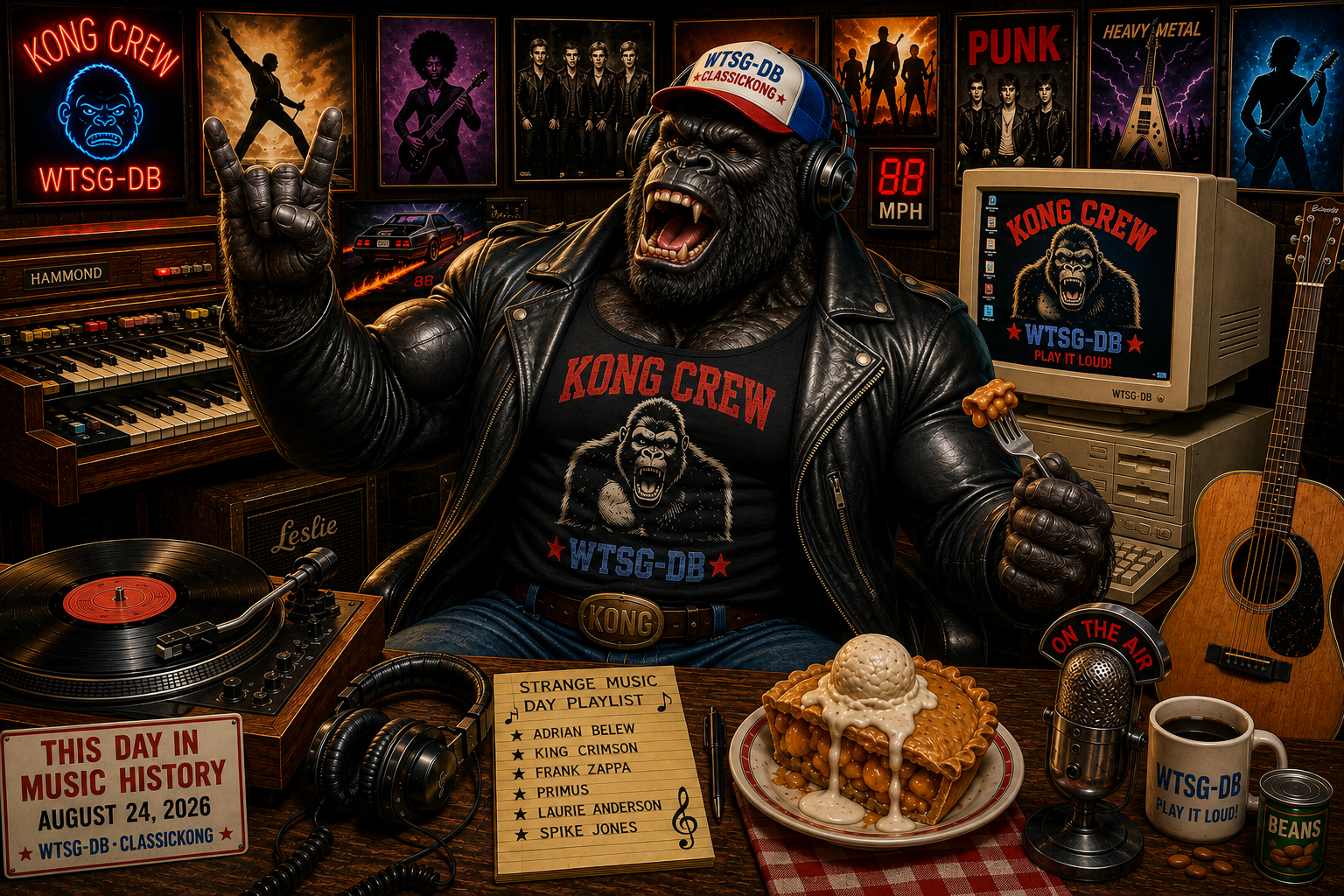
CLASSICKONG’s Strange Music Day Must-Haves:
Adrian Belew — “Big Electric Cat”
A guitar that occasionally seems determined to convince you it isn’t a guitar.
King Crimson — “Elephant Talk”
Adrian Belew, Robert Fripp, Tony Levin and Bill Bruford creating beautifully organized musical insanity.
Frank Zappa — “Peaches en Regalia”
Unusual, sophisticated, playful and musically brilliant.
Primus — “Jerry Was a Race Car Driver”
Les Claypool plays bass.
Further explanation unnecessary.
Laurie Anderson — “O Superman”
Minimalist, electronic, hypnotic and completely unlike the normal pop-radio landscape around it.
Spike Jones & His City Slickers — “Cocktails for Two”
Proof that musicians were getting gloriously weird long before synthesizers, prog rock and guitar effects entered the picture.
Think you’ve got something stranger?
Today is the day to dig into the weirdest corner of your music collection.
WTSG-DB assumes no responsibility for what happens if you listen to all six consecutively.
National Peach Pie Day
Okay.
Now we’re talking.
Give CLASSICKONG a warm piece of peach pie with a big scoop of vanilla ice cream slowly melting down the side and there will be absolutely no complaints from this desk.
None.
In fact, don’t bother asking whether I’d like another piece.
Just bring it.
National Waffle Day also falls on August 24, commemorating an American waffle-iron patent issued in 1869.
We love waffles.
We respect waffles.
But warm peach pie and vanilla ice cream?
Sorry, waffles.
You had a good run.
One More Thought From CLASSICKONG
Look at the distance we’ve traveled today.
From Stevie Wonder to the Doors and Queen.
From Molly Hatchet cruising through a summer afternoon to Prince laying down an irresistible groove.
From Ray Manzarek and Ken Hensley proving that keyboards absolutely belong in rock & roll, to Jeff Beck showing us just how far six strings could be pushed.
From Mason Williams reminding me of Dad playing guitar around the house…
…to Huey Lewis taking us Back to the Future.
That’s why we do this every day.
Music history isn’t just about dates.
Sometimes it’s a Cutlass with the windows rolled down.
Sometimes it’s Dad playing guitar in another room.
Sometimes it’s sitting in a movie theater in 1985.
Sometimes it’s staring at a Windows 95 Start button.
And sometimes it’s CLASSICKONG trying—and failing spectacularly—to sing every vocal part in “Bohemian Rhapsody.”
The records stay the same.
We’re the ones who build a lifetime around them.
Until tomorrow, keep the music playing, keep those memories close, and we’ll meet right back here for another trip through music history.
KONG CREW FOREVER! ❤️🤘🦍🎹🎸🥁🎙️🇺🇸
Listen to Today’s Broadcast
Sit back, relax, and enjoy today’s story in audio form with CLASSICKONG.
[sonaar_audioplayer albums=”latest” progress_bar_style=”default” wave_bar_width=”1″ wave_bar_gap=”1″ player_layout=”skin_boxed_tracklist” show_track_market=”true” css=”.srp_player_boxed, .skin_floated .album-player, .srp-artworkbg{background-color:#ffffff;}”][/sonaar_audioplayer]