From the Desk of CLASSICKONG
Welcome to This Day in Music History — October 12, 2026!
Happy Monday, music lovers, and welcome back to WTSG-DB, where the coffee’s hot, the jukebox is always playing, and GREAT MUSIC, GREAT RADIO is more than just a slogan!
Today we’re celebrating extraordinary musicians who helped shape the soundtrack of our lives. We’ve got soul legends from Memphis and Motown, a rebellious rock-and-roll queen, Fleetwood Mac taking a creative leap, and a Beatles mystery that had America examining album covers, playing records backward, and questioning Paul McCartney’s ears!
We’re also remembering two wonderful musicians we lost far too soon: Ricky Wilson of the B-52’s and the incomparable John Denver.
But first, a few special observances!
Today’s National Days
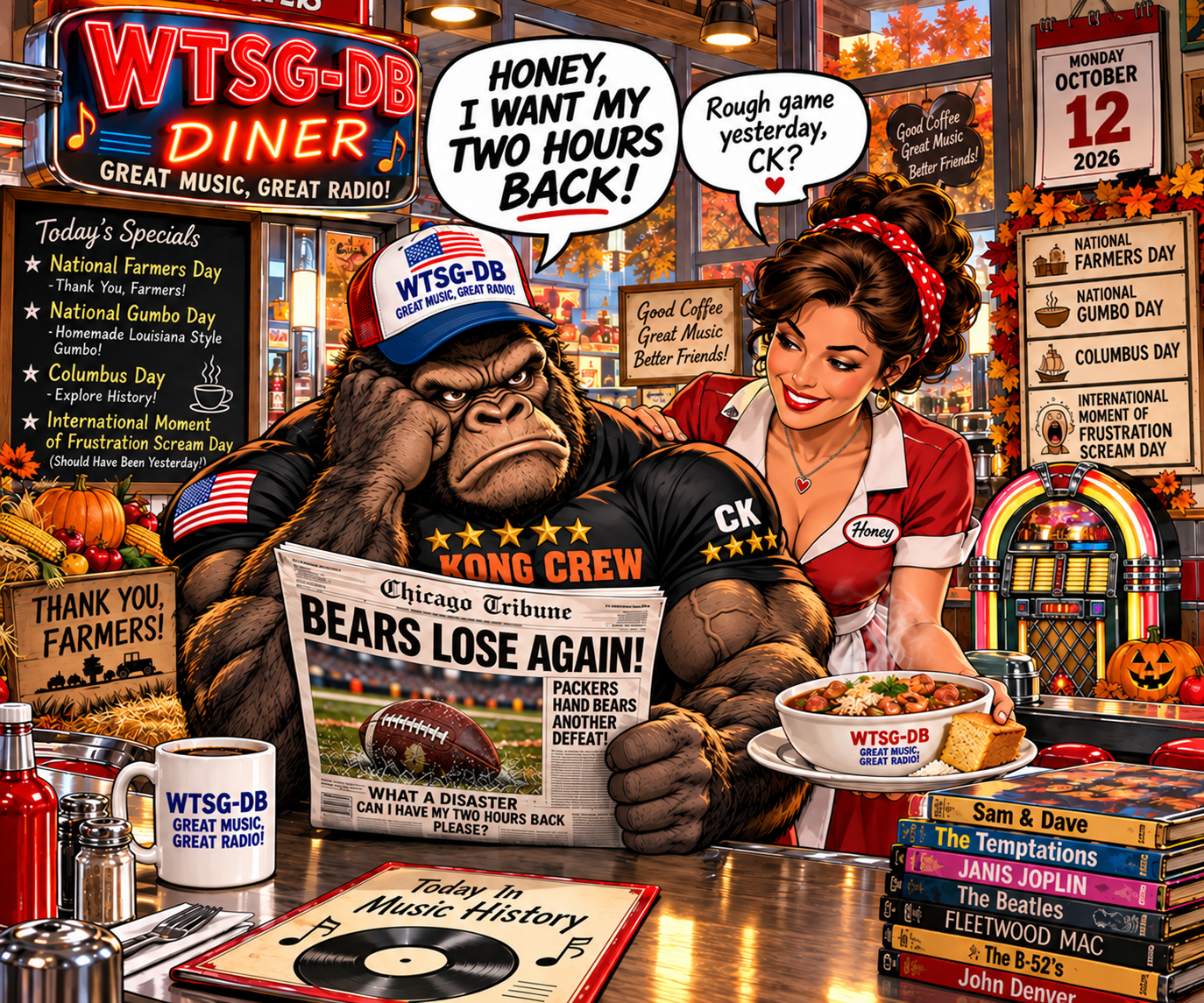
National Farmers Day
A great big CLASSICKONG salute to America’s farmers and farming families!
These hardworking men and women put in long days, face unpredictable weather, rising expenses, and countless challenges, all while helping keep food on our tables.
And as the autumn harvest continues across much of the country, it’s an especially appropriate time to recognize their dedication.
Thank God for our farmers! We appreciate you, and we salute you!
National Gumbo Day
Now we’re talking, buddy!
There’s nothing quite like a steaming bowl of homemade Louisiana gumbo, filled with wonderful flavors and served with a generous helping of Southern hospitality.
And since we’re celebrating the legendary Sam Moore today, why not put some Memphis soul music on the radio while that gumbo simmers?
Sounds like a pretty fine Monday to me!
Columbus Day
Today is also Columbus Day, a federal holiday observed on the second Monday of October.
For generations, the holiday has been associated with the history of exploration and has held special significance for many Italian-American families and communities.
The day is also observed by many communities as Indigenous Peoples’ Day, recognizing the histories and cultures of Native peoples.
However you spend the holiday, we hope you find a little time for family, friends, reflection, and some great music.
And speaking of special observances, it’s also International Moment of Frustration Scream Day.
Folks, after what happened to my beloved Chicago Bears yesterday, I could have used that holiday a day early!
But we’ll save THAT little adventure for today’s podcast!
HAHAHA!
Alright, grab your coffee, settle in, and let’s get this musical journey underway!
1935 — Sam Moore: A Soul Man Is Born
On October 12, 1935, Samuel David Moore was born in Miami, Florida.
As one-half of the legendary duo Sam & Dave, Moore helped define the powerful, gospel-influenced sound of Southern soul music.
And buddy, could these guys SING!
But here’s a wonderful story about how this legendary partnership began.
In 1961, Moore was working at the King of Hearts nightclub in Miami, where he helped host an amateur-night competition.
One evening, a young singer named Dave Prater took the stage to perform Jackie Wilson’s “Doggin’ Around” (1960, Brunswick).
Unfortunately, Dave forgot some of the words!
Rather than leave the poor guy stranded, Sam stepped in and helped him finish the song.
And just like that, one of soul music’s greatest partnerships began!
Both singers had roots in gospel music, and their eventual trademark call-and-response style brought the excitement and emotion of the church directly into rhythm and blues.
After recording for Roulette Records, Sam & Dave signed with Atlantic in 1965 and began recording at Stax Records in Memphis.
And that’s where the magic really happened.
Working with songwriters Isaac Hayes and David Porter, along with the extraordinary Stax house musicians, Sam & Dave recorded some of the most electrifying soul music of the 1960s.
Their hits included “Hold On, I’m Comin'” from Hold On, I’m Comin’ (1966, Stax), “Soul Man” from Soul Men (1967, Stax), and “I Thank You” from I Thank You (1968, Stax).
And here’s another connection, folks!
Sam & Dave were a major inspiration for the Blues Brothers!
John Belushi and Dan Aykroyd drew heavily from the great traditions of American blues and soul, and Sam & Dave’s performances were an important part of that musical heritage.
The Blues Brothers even recorded “Soul Man” on Briefcase Full of Blues (1978, Atlantic), introducing another generation to the song.
So the next time you watch Jake and Elwood Blues tearing up the stage, remember two of the men who helped inspire that musical magic.
Sam & Dave were inducted into the Rock and Roll Hall of Fame in 1992.
Sam Moore passed away on January 10, 2025, at age 89. Dave Prater preceded him in death on April 9, 1988, at age 50.
CLASSICKONG’s Take: Sam Moore didn’t just sing soul music. He helped define it! And from the stages of Memphis to the Blues Brothers, that influence continues to make people smile, dance, and turn up the radio.
Rest in peace, Sam and Dave. Nothing but love and respect!
CLASSICKONG’s Must-Haves — Sam & Dave
- Hold On, I’m Comin’ (1966, Stax)
- Double Dynamite (1966, Stax)
- Soul Men (1967, Stax)
- I Thank You (1968, Stax)
1942 — Melvin Franklin: The Voice Beneath the Temptations
On October 12, 1942, David Melvin English was born in Montgomery, Alabama.
The world would come to know him as Melvin Franklin, one of the founding members of the legendary Temptations.
And folks, when we say Melvin had a bass voice, we’re talking about a man who could seemingly reach all the way down into the basement!
HAHAHA!
As a member of the Temptations, Franklin provided the deep vocal foundation beneath some of Motown’s most magnificent recordings.
Think about “My Girl” from The Temptations Sing Smokey (1965, Gordy), “Ain’t Too Proud to Beg” from Gettin’ Ready (1966, Gordy), and the absolutely extraordinary “Papa Was a Rollin’ Stone” from All Directions (1972, Gordy).
Now, let’s spend a moment with that last recording.
Because, folks, “Papa Was a Rollin’ Stone” is a MASTERPIECE!
And before anyone sings a single note, that rhythm section has already grabbed you by the collar!
It begins with that hypnotic three-note bass figure and the crisp, steady ticking of the hi-hat.
Nothing complicated. Nothing unnecessarily flashy.
Just an irresistible groove!
Then the other instruments gradually enter. Guitar, keyboards, wah-wah effects, horns, and strings weave their way into producer Norman Whitfield’s remarkable arrangement.
And that rhythm never lets go!
The extended album recording gives the groove nearly four minutes to develop before the first vocal enters.
Think about that, folks. Nearly four minutes of instrumental music before the singing begins, and you’re hanging on every note!
That’s the power of a great arrangement.
And when the Temptations finally enter, we’re treated to something equally extraordinary.
Dennis Edwards, Melvin Franklin, Richard Street, and Damon Harris share the lead vocals, portraying sons questioning their mother about a father they barely knew.
One particularly memorable passage concerns rumors that their father had three children outside the family and another wife.
It’s delivered with an almost conversational intensity, making the song feel like a dramatic family story unfolding before our ears.
And Melvin Franklin’s magnificent low voice adds a depth and character that few vocalists could ever duplicate.
The recording became a No. 1 hit on the Billboard Hot 100 and won three Grammy Awards.
Melvin Franklin passed away on February 23, 1995, at only 52 years old.
CLASSICKONG’s Take: Listen to that bass and those drums! GOOD LORD! That’s how you build a groove, folks!
And when Melvin Franklin opens his mouth, you might want to check the basement. His voice reaches places most singers couldn’t find with a flashlight!
Rest in peace, Melvin. What a magnificent talent.
CLASSICKONG’s Must-Haves — The Temptations
- The Temptations Sing Smokey (1965, Gordy)
- Gettin’ Ready (1966, Gordy)
- Cloud Nine (1969, Gordy)
- All Directions (1972, Gordy)
- Masterpiece (1973, Gordy)
1968 — Janis Joplin and Cheap Thrills Reach Number One
On October 12, 1968, Big Brother and the Holding Company’s Cheap Thrills reached No. 1 on the Billboard album chart.
And at the center of that record was a woman who helped rewrite the rules of rock and roll.
JANIS JOPLIN!
Janis wasn’t interested in somebody else’s definition of what a female rock singer should be.
She didn’t need to look polished, act proper, or soften her personality to make the music business comfortable.
She was rebellious, fiercely expressive, and unapologetically herself.
And when she stepped up to a microphone, she could absolutely tear the roof off the building!
Just listen to “Piece of My Heart,” “Summertime,” or “Ball and Chain” from Cheap Thrills (1968, Columbia).
There’s something wonderfully raw about those performances.
Janis could sound vulnerable one moment and absolutely ferocious the next.
But let’s also give Big Brother and the Holding Company their due.
Their psychedelic blues-rock sound provided the perfect setting for her extraordinary voice.
Janis became a standard-bearer for women in rock, proving that power, independence, and authenticity didn’t belong exclusively to the men.
And her influence extended far beyond the blues-rock scene.
Generations of rock singers have drawn inspiration from her extraordinary performances, her independence, and that unmistakable rock-and-roll attitude.
But behind the powerful voice and rebellious stage presence was also a human being who struggled with insecurity, loneliness, and addiction.
It’s heartbreaking to think that someone who gave audiences so much could still struggle so deeply in her personal life.
Janis died on October 4, 1970, at only 27 years old.
And folks, I can’t help wondering what extraordinary music she might have created had she been given more years.
Because even the strongest among us sometimes need somebody to look out for them.
CLASSICKONG’s Take: It’s been said that imitation is the highest form of flattery.
Well, if that’s true, as far as I’m concerned, Janis Joplin is the GOAT!
Because more than half a century after her passing, countless singers have tried to capture that unmistakable combination of power, vulnerability, rebellion, and raw emotion.
But nobody has ever truly taken her place.
And I don’t believe anybody ever will.
Janis wasn’t trying to become somebody else’s idea of a rock-and-roll singer.
She was JANIS JOPLIN.
One of a kind.
Rest in peace, Janis. You helped kick down doors and inspired generations of us headbangers to embrace the true attitude, freedom, and rebellious spirit of rock and roll.
You never followed the rules. You helped rewrite them.
Nothing but love and respect, Janis. ROCK ON!
CLASSICKONG’s Must-Haves — Janis Joplin
- Cheap Thrills — Big Brother and the Holding Company (1968, Columbia)
- I Got Dem Ol’ Kozmic Blues Again Mama! (1969, Columbia)
- Pearl (1971, Columbia)
- Janis Joplin’s Greatest Hits (1973, Columbia)
1969 — CLASSICKONG Investigates: The Case of the Missing Beatle!
Alright, folks!
Professor CLASSICKONG is putting on his detective hat for this one!
On October 12, 1969, a caller contacted Detroit radio station WKNR-FM and told disc jockey Russ Gibb about a bizarre rumor.
PAUL McCARTNEY WAS SUPPOSEDLY DEAD!
According to the story, Paul had been killed in an automobile accident in November 1966 and secretly replaced by a lookalike.
And before long, Beatles fans were examining practically everything the band had recorded or photographed.
Album covers, song lyrics, mysterious photographs, backward recordings — nothing was off limits!
The cover of Abbey Road (1969, Apple) became one of the most famous pieces of supposed evidence.
Paul was barefoot. His walking stride appeared different from the others. And conspiracy enthusiasts believed the four Beatles were participating in a symbolic funeral procession.
John Lennon, dressed in white, supposedly represented a religious figure.
Ringo Starr, wearing black, was interpreted as the undertaker.
George Harrison, dressed in denim, was supposedly the gravedigger.
And Paul?
Well, Paul was supposedly the deceased!
But here’s where things get REALLY interesting.
Parked along the street was a white Volkswagen Beetle.
Its license plate read LMW 281F.
Conspiracy enthusiasts interpreted part of that plate as “28 IF,” suggesting that Paul would have been 28 years old IF he had survived the alleged accident.
There was just one problem.
Paul was actually 27 when the album was released!
But that didn’t stop the rumors.
Fans examined the covers of Sgt. Pepper’s Lonely Hearts Club Band (1967, Parlophone/Capitol) and Magical Mystery Tour (1967, Parlophone/Capitol), searching for supposed hidden messages.
Records were played backward.
Photographs were compared.
And even the shape of Paul’s ears became a subject of debate.
Now, Professor CLASSICKONG has one burning question.
WHAT ABOUT THOSE EARS?!
HAHAHAHA!
Folks, I’ve examined those photographs, and I’m telling you, something about those ears deserves another look!
In fact, just this morning, Honey looked across the breakfast table and said:
“CK, have you noticed your ears look different today?”
I nearly dropped my coffee!
“HONEY! DON’T START THAT AGAIN! I’VE GOT ENOUGH TROUBLE WITH PAUL McCARTNEY’S EARS!”
ROFLMAO!
But seriously, folks, the story raises some fascinating questions.
Imagine the financial consequences if a member of the Beatles really had died at the height of the band’s popularity.
Records, publishing, merchandising, and an enormous commercial enterprise were connected to those four musicians.
Could such financial pressures motivate people to attempt an elaborate deception?
It’s an interesting hypothetical.
But here’s the other side of the argument.
Finding someone who could imitate Paul’s appearance and voice would be difficult enough.
Finding someone who could also reproduce his musical instincts, songwriting talent, and personality for decades?
That would be an extraordinary achievement.
And keeping such an enormous secret for nearly sixty years would present challenges of its own.
There’s no credible evidence that Paul McCartney died in 1966 or that another musician secretly replaced him.
But the legend remains one of rock and roll’s most entertaining mysteries.
And it reminds us how easily people can begin seeing patterns once somebody suggests there’s a hidden story to uncover.
CLASSICKONG’s Take: Some mysteries are solved with fingerprints. Others require eyewitnesses.
Apparently, this one requires a magnifying glass and a very close examination of somebody’s earlobes!
And Professor Kong isn’t closing this case just yet!
HAHAHA!
1979 — Fleetwood Mac Releases Tusk
On October 12, 1979, Fleetwood Mac released Tusk on Warner Bros. Records in the United States.
And what a fascinating moment in the band’s history!
Following the staggering success of Rumours (1977, Warner Bros.), Fleetwood Mac could have played it safe.
They could have returned to the studio, followed the same formula, and attempted to manufacture another collection of radio-friendly hits.
Instead, they made something far more adventurous.
Lindsey Buckingham pushed the group toward unusual arrangements, experimental production techniques, and a sound that sometimes seemed deliberately different from what audiences expected.
The result was a sprawling 20-song double album.
Among its highlights were “Sara,” “Think About Me,” and “Tusk” from Tusk (1979, Warner Bros.).
And that title track?
The addition of the University of Southern California Trojan Marching Band gave the recording an unmistakable rhythmic identity.
But let’s talk about the drummer for a moment.
MICK FLEETWOOD!
One of CLASSICKONG’s personal drumming heroes.
Mick doesn’t simply know when to lay down a groove.
He knows HOW to lay down a groove!
And believe me, folks, there’s a world of difference.
His playing has an extraordinary combination of feel, restraint, musical intelligence, and personality.
He understands how to make a song breathe.
And if anybody wants to question just how magnificent Mick Fleetwood is behind a drum kit, I’ve got one suggestion.
Put on “Sara” from Tusk (1979, Warner Bros.).
Now listen.
Really listen.
Pay attention to the way Mick settles into that groove.
The way his playing supports Stevie Nicks without ever getting in her way.
There’s a gentle, rolling quality to his performance that gives the entire recording a wonderful sense of movement.
He doesn’t overpower the melody.
He carries it.
And as a drummer myself, I’ll tell you something.
I honestly don’t know if anybody lays down a groove better than Mick Fleetwood.
That performance on “Sara” is one of the finest examples of musical feel you’ll ever hear on a rock record.
And alongside bassist John McVie, Mick helped create the rhythmic foundation that made Fleetwood Mac such an extraordinary band.
Those two musicians were the glue that held the music together, providing a foundation that allowed Buckingham, Stevie Nicks, and Christine McVie to explore so many different musical directions.
Tusk didn’t match the enormous commercial success of Rumours, but it demonstrated that Fleetwood Mac wasn’t afraid to take creative chances.
And nearly five decades later, its adventurous musical spirit continues to earn admiration.
CLASSICKONG’s Take: Anybody can count four beats to a measure.
But making those four beats feel like Mick Fleetwood makes them feel?
That’s an entirely different level of musicianship.
Mick doesn’t just keep time.
He gives the music its heartbeat.
CLASSICKONG’s Must-Haves — Fleetwood Mac
- Fleetwood Mac (1975, Reprise)
- Rumours (1977, Warner Bros.)
- Tusk (1979, Warner Bros.)
- Mirage (1982, Warner Bros.)
- Tango in the Night (1987, Warner Bros.)
1985 — Remembering Ricky Wilson of the B-52’s
On October 12, 1985, the music world lost Ricky Wilson, guitarist and founding member of the B-52’s.
He was just 32 years old.
Ricky helped create one of the most unusual and instantly recognizable guitar sounds of the late 1970s and early 1980s.
Using unconventional tunings, rhythmic patterns, and wonderfully inventive riffs, he gave the B-52’s a sound that didn’t fit neatly into any established category.
Listen to “Rock Lobster” from The B-52’s (1979, Warner Bros.) or “Private Idaho” from Wild Planet (1980, Warner Bros.).
Those aren’t ordinary guitar arrangements.
They’re imaginative, playful, sometimes downright strange — and absolutely brilliant!
Ricky was also the older brother of B-52’s vocalist Cindy Wilson.
Tragically, he died from complications of AIDS during one of the most painful periods in modern American public health history.
And folks, this is a part of our history that deserves to be remembered.
During the early years of the AIDS epidemic, misinformation, fear, and discrimination surrounded the disease.
People living with HIV often faced rejection, hostility, and isolation.
And because AIDS was so strongly associated with gay men in the public imagination, prejudice made an already devastating public health crisis even worse.
But the suffering extended far beyond any one community.
Children, spouses, hemophiliacs, and people who received contaminated blood products were among those affected.
Many Americans still remember Ryan White, the courageous young man from Kokomo, Indiana, who contracted HIV through treatment for hemophilia.
Ryan became a national voice for understanding and compassion after facing terrible discrimination simply because he wanted to attend school.
He died on April 8, 1990, at just 18 years old.
His story remains a heartbreaking reminder of how devastating ignorance and cruelty can be, especially when directed toward children.
Years later, the film Philadelphia (1993), starring Tom Hanks and Denzel Washington, helped bring the human realities of AIDS and discrimination to a wider audience.
Bruce Springsteen’s “Streets of Philadelphia” from Philadelphia: Music from the Motion Picture (1993, Epic Soundtrax) remains one of the most moving songs associated with that history.
Its restrained arrangement and deeply vulnerable vocal performance captured the loneliness and isolation experienced by so many people during that terrible time.
But today, we also want to remember Ricky Wilson for how he lived and what he created.
Because his musical legacy is extraordinary.
Following his death, drummer Keith Strickland moved to guitar, helping the B-52’s eventually return with one of their greatest commercial successes.
“Love Shack” from Cosmic Thing (1989, Reprise) became an MTV favorite and introduced the band to an enormous new audience.
And buddy, that video was practically MADE for MTV!
The colorful clothes, Fred Schneider’s wonderfully bizarre delivery, Kate Pierson and Cindy Wilson singing their hearts out, and that irresistible party atmosphere!
And when Cindy delivered that famous “TIN ROOF! RUSTED!” line?
HAHAHA!
Everybody knew the party was underway!
Ricky wasn’t there to share in that success, but his musical imagination remained part of the band’s identity.
CLASSICKONG’s Take: Ricky Wilson deserves to be remembered not simply for the tragedy of his passing, but for the joy, creativity, and originality he brought to music.
His life mattered.
And so did the lives of countless others affected by that terrible epidemic.
Sometimes the greatest thing we can offer another human being isn’t an answer or an explanation.
It’s compassion.
Rest in peace, Ricky.
Nothing but love and respect.
CLASSICKONG’s Must-Haves — The B-52’s
- The B-52’s (1979, Warner Bros.)
- Wild Planet (1980, Warner Bros.)
- Whammy! (1983, Warner Bros.)
- Bouncing Off the Satellites (1986, Warner Bros.)
- Cosmic Thing (1989, Reprise)
1997 — Remembering John Denver
On October 12, 1997, singer, songwriter, actor, and humanitarian John Denver died in an airplane accident near Monterey Bay, California.
He was 53 years old.
And folks, this is one of those losses that still hurts.
John Denver possessed one of the warmest, most recognizable voices in popular music.
There was a sincerity about his performances that made you feel as though he wasn’t simply singing to an audience.
He was singing to you.
Consider “Take Me Home, Country Roads” from Poems, Prayers & Promises (1971, RCA Victor).
It’s one of those songs that can bring an entire room of strangers together.
Or “Rocky Mountain High” from Rocky Mountain High (1972, RCA Victor), a magnificent celebration of nature and the spiritual connection people can feel with the world around them.
And then there’s “Sunshine on My Shoulders” from Poems, Prayers & Promises (1971, RCA Victor).
Buddy, what a beautiful song.
There’s something almost magical about its simplicity.
John didn’t need a thunderous orchestra or an elaborate production to reach people.
Just a gentle melody, thoughtful words, and that extraordinary voice.
And as far as I’m concerned, it’s one of the most beautiful songs ever written.
Sometimes the quietest songs leave the deepest impressions.
John also brought his warmth and easygoing personality to the movies.
In 1977, he starred alongside the legendary George Burns in Oh, God!, a charming comedy about an ordinary grocery store manager who finds himself communicating with God.
And what a wonderful pairing those two made!
Burns later returned for Oh, God! Book II (1980) and Oh, God! You Devil (1984), although Denver did not appear in those sequels.
Beyond music and acting, Denver supported environmental conservation and humanitarian causes throughout his life.
His love of nature wasn’t simply something he sang about.
It was an important part of who he was.
And that genuine appreciation for the natural world gave so much of his music its unmistakable warmth.
CLASSICKONG’s Take: John Denver had a remarkable gift for reminding us of the beauty in ordinary things — sunshine, mountains, home, friendship, and love.
And if “Sunshine on My Shoulders” doesn’t move you, buddy, you might want to check your pulse!
Rest in peace, John.
Your music still brings a little sunshine into this world.
CLASSICKONG’s Must-Haves — John Denver
- Poems, Prayers & Promises (1971, RCA Victor)
- Rocky Mountain High (1972, RCA Victor)
- Farewell Andromeda (1973, RCA Victor)
- Back Home Again (1974, RCA Victor)
- Windsong (1975, RCA Victor)
- John Denver’s Greatest Hits (1973, RCA Victor)
Final Spin
You know, folks, there’s something I’ve come to appreciate more and more as the years go by.
The world doesn’t need another copy of somebody else.
It needs people who aren’t afraid to be themselves.
Janis Joplin didn’t become a legend by following somebody else’s rules.
Mick Fleetwood didn’t become a great drummer by trying to play more notes than everybody else.
John Denver didn’t need to shout to make himself heard.
And Ricky Wilson didn’t follow a conventional musical formula. He helped invent a sound that was unmistakably his own.
Every one of those artists reminds us that greatness doesn’t always come from doing what everybody expects.
Sometimes it comes from having the courage to do something different.
And I think there’s a lesson in that for all of us.
We spend so much of our lives being told what we ought to be, how we ought to act, and what success is supposed to look like.
But maybe the real measure of a life isn’t how closely we follow somebody else’s expectations.
Maybe it’s whether we have the courage to live with a little originality, treat people with kindness, and leave the world a little better than we found it.
Because the greatest thing you can bring to this world is something nobody else has.
Yourself.
I’m your host, CLASSICKONG. Hopefully we’ve put a smile on your face and put a song in your heart.
Until tomorrow, take care of yourself, help others when you can, and always keep the music playing.
We’ll see ya down the road!
Listen to Today’s Broadcast/Podcast
Join CLASSICKONG for the October 12, 2026 edition of This Day in Music History, featuring the music, memories, milestones, and remarkable people who helped shape the soundtrack of our lives.
Listen right here on WTSG-DB, where it’s always GREAT MUSIC, GREAT RADIO!
References
- National Days — October 12
- U.S. Office of Personnel Management — Federal Holidays
- Rock & Roll Hall of Fame — Sam & Dave
- The Temptations — Official Website
- Rock & Roll Hall of Fame — Janis Joplin
- The Beatles — Official Website
- The Beatles — Abbey Road
- Fleetwood Mac — Official Website
- The B-52’s — Official Website
- HIV.gov — HIV and AIDS Timeline
- HRSA — Ryan White HIV/AIDS Program
- John Denver — Official Website
- Chicago Bears — Remembering Mike Ditka
- Reuters — Packers Defeat Bears, October 11, 2026
© 2026 WTSG-DB. Original commentary and editorial content by CLASSICKONG. All artist names, album titles, and song titles remain the property of their respective rights holders.