From the Desk of CLASSICKONG
Welcome back, music lovers, to another trip through the records, artists and moments that built the soundtrack of our lives.
Before we spin the first record, WTSG-DB proudly sends our thanks to the men and women of the United States Armed Forces—past and present—and to the families who stand beside them. Your service and sacrifice are never forgotten.
October has settled in now. The days are getting shorter, the nights a little longer, and there’s something about this time of year that makes certain records sound even better.
And October 7 gives us plenty to work with.
We’ve got Queen creating two songs that became part of the language of sports. An Indiana legend celebrating a birthday. An 11-year-old Michael Jackson helping introduce the Jackson 5 to the world—and exactly two years later beginning his own solo career. José Feliciano changing the way America heard its national anthem. Toni Braxton bringing one of the great voices of the ’90s. And jazz organist Larry Young taking the Hammond B-3 someplace new.
Along the way, we’re also going to make room for George Benson, Tony Williams, Mark Knopfler, Pick Withers…and one very important drumming lesson I learned from my dad.
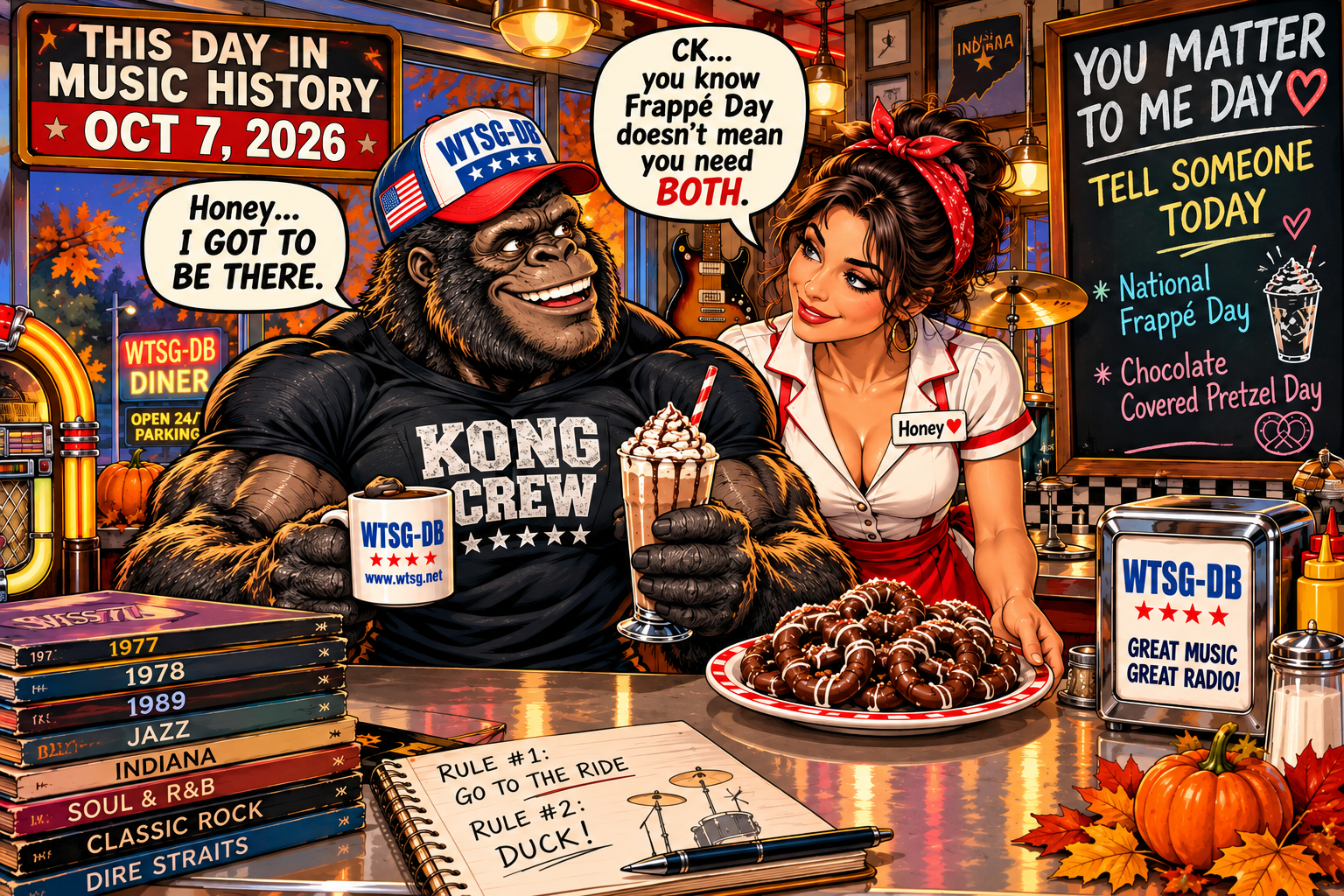
Lesson Number One: Go to the ride cymbal.
Lesson Number Two: DUCK!
We’ll explain that one.
But before we drop the needle, October 7 has a few National Days worth celebrating too.
Today is National Frappé Day, so when I tell you to grab some coffee in a minute, apparently you’re allowed to get a little fancy with it.
It’s also National Chocolate Covered Pretzel Day—proof that sweet and salty figured out a long time ago that they’re better together.
But the one that really fits today’s show is You Matter to Me Day.
The idea couldn’t be much simpler:
Don’t just assume the people you care about know how much they mean to you.
Tell them.
And before today’s trip through music history is over, I think we’re going to discover just how perfectly that thought fits the music we’re talking about.
So grab that coffee—or make it a frappé today—find yourself a chocolate-covered pretzel if you’ve got one, turn it up, and let’s get started.
Queen Gives the World Two Anthems
On October 7, 1977, Queen released one of the most remarkable pairings in rock history in the United States: “We Are the Champions” backed with “We Will Rock You.”
Both songs appeared on News of the World, released in 1977 on EMI in the UK and Elektra in the United States.
Freddie Mercury wrote “We Are the Champions.”
Brian May wrote “We Will Rock You.”
Put them together and you’ve got two songs that eventually became almost inseparable—not only from Queen, but from sports arenas and stadiums around the world.
And as a drummer, I’ve always loved the beautiful simplicity of “We Will Rock You.”
You don’t need some enormous drum fill.
You don’t need twenty cymbals.
For most of the record, you don’t even need a conventional drum groove.
You need:
STOMP. STOMP. CLAP.
And suddenly the audience becomes the rhythm section.
That’s brilliant.
Then comes “We Are the Champions,” with Freddie Mercury turning what could have been a simple victory song into something theatrical, emotional and unmistakably Queen.
Two songs.
One single.
Nearly fifty years later, put either one on at a sporting event and thousands of people instinctively know exactly what to do.
That’s staying power.
CLASSICKONG Must Haves — Queen
A Night at the Opera — 1975 — EMI/Elektra
A Day at the Races — 1976 — EMI/Elektra
News of the World — 1977 — EMI/Elektra
Jazz — 1978 — EMI/Elektra
The Game — 1980 — EMI/Elektra
Freddie Mercury died November 24, 1991, at age 45.
Happy Birthday, John Mellencamp
Born October 7, 1951, in Seymour, Indiana, John Mellencamp turns 75 today.
And around here, that Indiana connection means something.
Mellencamp’s career traveled through Johnny Cougar, John Cougar, John Cougar Mellencamp and eventually simply John Mellencamp—but underneath all those names was an artist steadily developing one of the most recognizable voices in American heartland rock.
American Fool from 1982 on Riva/Mercury gave us “Hurts So Good” and “Jack & Diane.”
Uh-Huh from 1983, also on Riva/Mercury, brought “Crumblin’ Down,” “Pink Houses” and “Authority Song.”
Then came Scarecrow in 1985 on Riva/Mercury, with “Small Town,” “Lonely Ol’ Night” and “Rain on the Scarecrow.”
And if there’s a Mellencamp album that sounds especially good when autumn rolls into Indiana, Scarecrow has to be somewhere near the top of the pile.
Then there’s The Lonesome Jubilee from 1987 on Mercury, with “Paper in Fire,” “Cherry Bomb” and “Check It Out.”
And Big Daddy followed in 1989 on Mercury.
That title—Big Daddy—always gets me thinking about my own dad.
He was a real bandleader, and when I say that, I’m not kidding. I don’t know if I’ve ever watched anyone work harder.
Later, when I became a father myself, there were lessons I’d learned from watching him that I wanted to carry forward. I wanted to make sure I was the kind of dad my own kids knew would be there.
Maybe that’s another reason Mellencamp’s music works so well this time of year.
There’s something about his best records that feels like Indiana in autumn—small towns, changing seasons, family, working people, roads we’ve traveled and the places we still call home.
Happy 75th birthday to one of Indiana’s own.
CLASSICKONG Must Haves — John Mellencamp
American Fool — 1982 — Riva/Mercury
Uh-Huh — 1983 — Riva/Mercury
Scarecrow — 1985 — Riva/Mercury
The Lonesome Jubilee — 1987 — Mercury
Big Daddy — 1989 — Mercury
Michael Jackson — Two October 7 Milestones
Here’s one of those connections that makes This Day in Music History so much fun.
On October 7, 1969, Motown released the Jackson 5’s “I Want You Back.”
The song would appear on Diana Ross Presents The Jackson 5, released in 1969 on Motown.
Michael Jackson was only 11 years old.
Listen to that record today and it’s still astonishing.
The piano figure.
The bass.
The strings.
The percussion.
Those background vocals.
And then that little kid opens his mouth and sings with the confidence, phrasing and soul of somebody who sounds like he’s already been doing this for decades.
“I Want You Back” eventually reached No. 1 on the Billboard Hot 100.
Now move ahead exactly two years.
October 7, 1971.
Motown releases “Got to Be There,” Michael Jackson’s debut solo single.
The song would become the title track of Got to Be There, released in 1972 on Motown.
Think about that.
October 7, 1969 — “I Want You Back.”
October 7, 1971 — “Got to Be There.”
Same date.
Two years apart.
One helps launch the Jackson 5 into superstardom.
The other begins Michael Jackson’s solo recording career.
And we’re going to come back to this very same song later—not just another song with the same title.
Years later, George Benson recorded his own version of Michael’s “Got to Be There.”
And when we get there, you’ll understand why that song means something special around here.
José Feliciano Changes the National Anthem
On October 7, 1968, before Game 5 of the World Series between the Detroit Tigers and St. Louis Cardinals at Tiger Stadium, José Feliciano performed “The Star-Spangled Banner.”
And he didn’t sing it the way Americans were accustomed to hearing it.
Feliciano slowed it down.
He accompanied himself on acoustic guitar.
He gave it his own phrasing, rhythm and personality.
Today, hearing an artist reinterpret the national anthem isn’t unusual.
In 1968?
Different story.
His performance created controversy and backlash—but it also became historically important. Feliciano’s biography describes it as a pioneering moment in the personalized interpretation of the anthem, and the performance itself became a Top 40 recording.
Feliciano, born September 10, 1945, is still with us today.
And what a career.
His interpretation of “Light My Fire” appeared on Feliciano! in 1968 on RCA Victor, helping establish him as an international star.
Then, of course, came the song that guarantees José Feliciano will be heard every December for generations:
“Feliz Navidad,” from the 1970 RCA Victor album Feliz Navidad.
But on October 7, 1968, he did something else.
He trusted his own musical instincts.
And whether everybody was ready for it or not, he played the song the way José Feliciano heard it.
That’s what artists do.
CLASSICKONG Must Haves — José Feliciano
Feliciano! — 1968 — RCA Victor
Souled — 1968 — RCA Victor
Feliciano/10 to 23 — 1969 — RCA Victor
Feliz Navidad — 1970 — RCA Victor
Toni Braxton — A Voice You Never Mistake
Happy birthday today to Toni Braxton, born October 7, 1967.
Some singers need about three seconds before you know exactly who you’re hearing.
Toni is one of them.
That deep, rich contralto immediately separated her from much of the pop and R&B world of the early 1990s.
Her self-titled debut, Toni Braxton, arrived in 1993 on LaFace Records.
And then came “Breathe Again.”
What a beautiful song.
Written and produced by Babyface, “Breathe Again” became one of the defining records of Toni Braxton’s early career.
There’s vulnerability in that performance without oversinging it.
And underneath everything else the song is talking about, there’s something basic and human sitting there:
We need love.
Maybe that’s part of today’s story too.
Because whether it’s Toni Braxton, George Benson, Michael Jackson or any of the other wonderful artists we talk about around here, music keeps finding different ways to remind us of that.
CLASSICKONG Must Haves — Toni Braxton
Toni Braxton — 1993 — LaFace
Secrets — 1996 — LaFace
The Heat — 2000 — LaFace
Larry Young — Taking the Hammond Somewhere Else
Jazz gets a seat at today’s table with Larry Young, born October 7, 1940.
Young was a Hammond B-3 organist—but if you’re expecting another musician simply following the Jimmy Smith soul-jazz blueprint, think again.
Larry Young wanted to take the instrument somewhere else.
His playing became increasingly modal and exploratory, and his landmark Unity, released in 1966 on Blue Note Records, featured an extraordinary lineup with Woody Shaw on trumpet, Joe Henderson on tenor saxophone and Elvin Jones on drums.
That’s serious company.
Young later became part of The Tony Williams Lifetime alongside guitarist John McLaughlin, placing him right in the middle of the emerging jazz-rock fusion movement.
And there’s that name again…
Tony Williams.
One of my absolute drumming heroes.
Williams was only 17 years old when Miles Davis recruited him to play drums.
Seventeen!
Think about that for a second.
Miles Davis could have called just about anybody he wanted—and he brings in a 17-year-old kid to sit behind the drums.
And you don’t have to take my word for how special Tony Williams was.
Miles Davis himself essentially said there had never been another drummer like him.
That’s some pretty serious validation.
Put Tony Williams on drums, John McLaughlin on guitar and Larry Young on Hammond organ, and you’ve got the original Tony Williams Lifetime—the trio that recorded Emergency! in 1969 on Polydor.
These guys weren’t simply mixing a little rock into jazz.
They were helping figure out what jazz-rock fusion could become.
And if you’re wondering whether I’m a Tony Williams fan, two of my personal favorites are Believe It by The New Tony Williams Lifetime from 1975 on Columbia, and Tony’s Angel Street from 1988 on Blue Note.
So yeah…
You could say I’ve spent a little time listening to this guy.
Sadly, neither Larry Young nor Tony Williams got nearly enough time.
Larry Young died March 30, 1978, at only 37 years old. Pneumonia was reported as the cause following hospitalization, although accounts surrounding his final illness have never been entirely clear.
Tony Williams died February 23, 1997, at only 51, after suffering a heart attack while recovering from gallbladder surgery.
Two extraordinary musicians gone far too young.
But put on Emergency! and you’ll hear why we’re still talking about them.
CLASSICKONG Must Haves — Larry Young
Into Somethin’ — 1965 — Blue Note
Unity — 1966 — Blue Note
Of Love and Peace — 1967 — Blue Note
Lawrence of Newark — 1973 — Perception
And for that essential fusion connection:
Emergency! — The Tony Williams Lifetime — 1969 — Polydor
Dire Straits, “Sultans of Swing” and a Lesson From Dad
We’re going to make a slight detour here.
Dire Straits’ self-titled debut Dire Straits was released in 1978 on Vertigo internationally and Warner Bros. in the United States.
And sitting on that album is one of my absolute favorite songs:
“Sultans of Swing.”
Mark Knopfler’s guitar playing is magnificent.
That clean tone.
The fingerstyle technique.
The phrasing.
He doesn’t sound like he’s attacking the guitar.
He sounds like he’s having a conversation with it.
But as a drummer, there’s somebody else on that recording I want you to listen to.
Pick Withers.
And by the way…
With a name like Pick Withers, you’d swear the guy played guitar.
Nope.
He’s the drummer.
Personally, I think Stix Withers would’ve saved everybody a lot of confusion—but nobody asked me.
And believe it or not, among Pick’s documented percussion credits are spoons.
So apparently Pick Withers didn’t pick.
He drummed…
and occasionally ate with his instrument.
Okay, I’ll stop.
But seriously, listen to this guy play.
Particularly his ride cymbal work.
My dad was a bandleader, and he taught me very early that when you hit that chorus, you move to the ride cymbal and let the song open up.
And when I say Dad taught me that—I mean he TAUGHT me that.
If I’d stayed on the hi-hat through the chorus, I think Dad might’ve thrown his guitar at me!
So let’s just say I learned that fundamental rule pretty early on.
Lesson Number One: Go to the ride cymbal.
Lesson Number Two: DUCK!
But underneath the joke was a lesson I’ve carried with me ever since.
The drummer isn’t just keeping time.
You’re helping arrange the song.
You’re helping it breathe.
You’re telling the listener—sometimes without them consciously realizing it—that we’ve arrived somewhere new.
And Pick Withers demonstrates that beautifully on “Sultans of Swing.”
Listen to when he moves to that ride cymbal.
Listen to his touch.
Listen to the space he leaves around Mark Knopfler’s guitar.
That’s not about showing everybody how much you can play.
That’s knowing what to play, when to play it—and when to get the hell out of the way.
Dad called that serving the song.
And Dad…
I was listening.
CLASSICKONG Must Haves — Dire Straits
Dire Straits — 1978 — Vertigo/Warner Bros.
Communiqué — 1979 — Vertigo/Warner Bros.
Making Movies — 1980 — Vertigo/Warner Bros.
Love over Gold — 1982 — Vertigo/Warner Bros.
Brothers in Arms — 1985 — Vertigo/Warner Bros.
On Every Street — 1991 — Vertigo/Warner Bros.
George Benson — Got to Be There
Remember Michael Jackson’s “Got to Be There” from earlier?
We’re talking about the same song.
George Benson later recorded his own version of it for Love Remembers, released in 1993 on Warner Bros. Records.
And I’ve gotta tell you…
I absolutely adore this album.
My wife and I must have played Love Remembers a thousand times over the years.
It just flows.
And while we’re clearing up song titles, “Love of My Life” on this album is not the same song as Benson’s earlier “You Are the Love of My Life,” his duet with Roberta Flack from 20/20 in 1985.
Different song.
The one we’re talking about here is “Love of My Life” from Love Remembers.
And what a beautiful record.
Look at some of the titles scattered across this album:
“I’ll Be Good to You.”
“Got to Be There.”
“My Heart Is Dancing.”
“Love of My Life.”
“Love Remembers.”
“Lost in Love.”
And then there’s that eerie but beautiful “Calling You.”
Man…
Put “Calling You” on during a cool October night and tell me it doesn’t somehow fit the season.
There’s something haunting about it.
Not frightening.
Just atmospheric.
Autumn.
Longer nights.
Halloween getting closer.
And Benson gave us another perfect nighttime record years earlier with “Give Me the Night,” the title track from Give Me the Night, released in 1980 on Qwest/Warner Bros. and produced by Quincy Jones.
What a record.
George Benson is one of those musicians you simply can’t put in one box.
Jazz guitarist?
Absolutely.
Singer?
Absolutely.
R&B?
Soul?
Pop?
Jazz-funk?
Absolutely.
Sometimes Benson even scats along with his guitar lines as though his voice and guitar are simply two extensions of the same musical thought.
But today I keep coming back to “Got to Be There.”
Because when I hear George Benson sing that song, I immediately think about family and friends.
People I love.
People who’ve been there.
People I want to make sure I’m there for.
And maybe George was telling us something throughout Love Remembers without ever intending these song titles to become some kind of life philosophy.
Got to be there.
I’ll be good to you.
My heart is dancing.
Love of my life.
Love remembers.
Sometimes the records we love end up saying more to us than anybody planned.
CLASSICKONG Must Haves — George Benson
Breezin’ — 1976 — Warner Bros.
In Flight — 1977 — Warner Bros.
Weekend in L.A. — 1978 — Warner Bros.
Give Me the Night — 1980 — Qwest/Warner Bros.
20/20 — 1985 — Warner Bros.
Love Remembers — 1993 — Warner Bros.
And yes…
Love Remembers is HIGHLY recommended around here.
A Quick Stop in 1978 and 1989
Before we head toward the Final Spin, let’s make two quick stops.
During the chart week ending October 7, 1978, the Grease soundtrack sat at No. 1 on the UK Albums Chart on RSO Records.
And sitting at No. 1 on the UK singles chart?
John Travolta and Olivia Newton-John with “Summer Nights.”
You already know how we feel about Olivia around here.
And “Hopelessly Devoted to You,” also from the Grease soundtrack, remains one of those performances that reminds you just how extraordinary her voice was.
Olivia Newton-John died August 8, 2022, at age 73.
Then jump to 1989, when pop music was deep into an era of big production, choreography and dance records.
Janet Jackson’s “Miss You Much” from Janet Jackson’s Rhythm Nation 1814 — 1989, A&M Records — was ruling the American singles chart during this period.
Paula Abdul’s Forever Your Girl — 1988, Virgin Records — had completed one of the slowest climbs imaginable to the top of the Billboard 200.
And Tears for Fears were back with The Seeds of Love — 1989, Fontana/Mercury — led by the magnificent “Sowing the Seeds of Love.”
That’s a pretty good snapshot of 1989.
Final Spin
There’s a reason a song like “Got to Be There” can hit a little differently as the years go by.
When we’re young, we sometimes think being there means the big moments—the birthdays, the celebrations, the milestones everybody remembers.
But life eventually teaches us that being there is usually much simpler than that.
It’s answering the phone.
It’s sitting around the table a little longer.
It’s checking on an old friend for no particular reason.
It’s telling somebody you love them while you still have the chance to say it.
Because when you really think about it, the loves of our lives aren’t found in only one person or one kind of love.
They’re our husbands and wives.
Our children.
Our parents.
Our brothers and sisters.
Our friends.
They’re the people who walk into our lives and somehow become part of who we are.
Toni Braxton reminded us today just how deeply we need love.
George Benson gave us “Got to Be There.”
Then “I’ll Be Good to You.”
“My Heart Is Dancing.”
“Love of My Life.”
And eventually…
Love Remembers.
Maybe that’s the order that matters.
And maybe it’s fitting that October 7 is also You Matter to Me Day.
Because those words don’t do much good if we only think them.
Sometimes we need to actually say them.
Because before somebody becomes a memory, before the years get away from us, before we’re left wishing we’d made one more phone call or spent one more afternoon together…
we’ve got something better.
We’ve got today.
So for your family…
for your friends…
for the people who’ve been there when you needed them…
and for those people who make this crazy ride called life better simply because they’re part of it…
Got to be there.
Listen to Today’s Broadcast/Podcast
Prefer to hear the stories instead?
Listen to today’s WTSG-DB This Day in Music History broadcast and join CLASSICKONG for the music, history, stories and occasional flying guitar that made October 7 a pretty remarkable day in music history.
WTSG-DB — Great Music, Great Radio!
References
John Mellencamp — Official Biography
Michael Jackson — Official Website
José Feliciano — Official Website
Blue Note Records — Larry Young
Encyclopaedia Britannica — Miles Davis
Dire Straits — Official Website
George Benson — Official Website
Official Charts — UK Albums Chart
Official Charts — UK Singles Chart

Author: Tim Glore
General Manager of WTSG Digital Broadcasting and licensed streaming broadcaster for 19 years. Passionate about music, retro entertainment, classic radio culture, and building creative digital experiences through WTSG-DB and CLASSICKONG.COM. 📻 Great Music • 🇺🇸 Americana • 🎮 Retro Culture • 🔥 Great Radio