From the Desk of CLASSICKONG
Welcome back, music lovers, to another trip through the records, artists, voices and moments that built the soundtrack of our lives.
Before we spin the first record, WTSG-DB proudly sends our thanks to the men and women of the United States Armed Forces—past and present—and to the families who stand beside them. Your service and sacrifice are never forgotten.
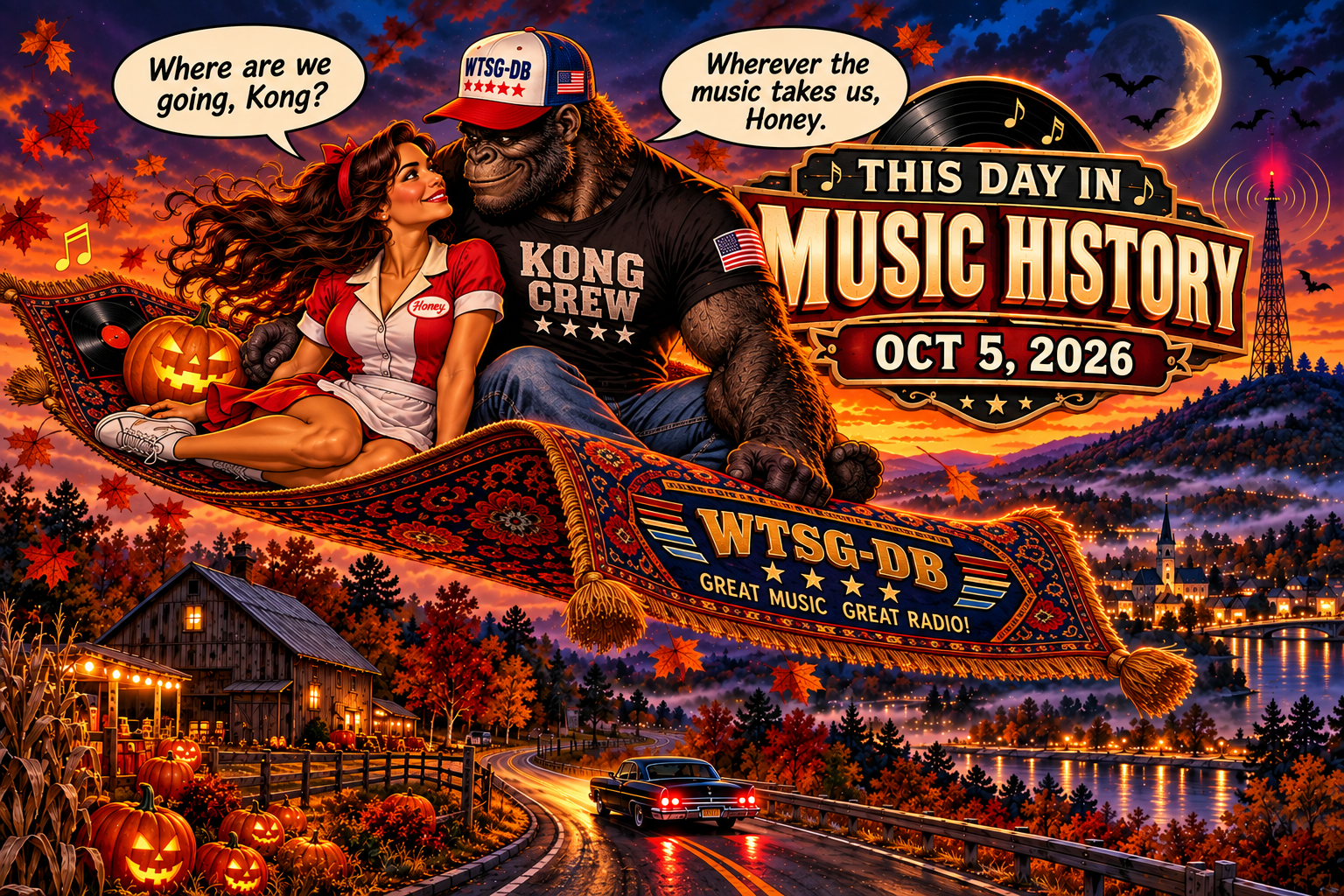
October is settling in, summer is disappearing in the rearview mirror, and today we’re taking a ride.
And what a ride October 5 gives us.
The Beatles ask us to “Love Me Do.” Olivia Newton-John answers with one of the most honest declarations of love ever put on a record. Led Zeppelin has been loving somebody for a long time. The Guess Who are clapping for one of radio’s greatest personalities, Wolfman Jack. And Steppenwolf invites everybody aboard for a “Magic Carpet Ride.”
Along the way we’ve got Bobby Darin, Cream, Elton John, Genesis, The Beach Boys, The Police, Eddie Kendricks, Paul McCartney, Larry Junstrom and one remarkable AC/DC coincidence involving both Bon Scott and Brian Johnson.
So climb aboard.
We may not know exactly where we’re going.
But that’s half the fun.
October 5, 1959 — Bobby Darin Takes “Mack the Knife” to No. 1
As a kid, I loved this record.
It’s smooth. It’s swinging. Bobby Darin sounds impossibly cool.
Then you grow up and discover what “Mack the Knife” is actually about.
Good grief!
The song originated in The Threepenny Opera, created by Bertolt Brecht and Kurt Weill. “Mack” is Macheath, a charming but thoroughly dangerous criminal, and the song describes some very dark deeds.
You’d never know it from Bobby Darin’s performance.
His version turns the whole thing into a finger-snapping, big-band spectacular.
Released on Atco Records, “Mack the Knife” reached No. 1 on the Billboard Hot 100 on October 5, 1959 and ultimately spent nine nonconsecutive weeks at the top.
The record won Darin Record of the Year at the Grammy Awards, while Darin himself was named Best New Artist.
But behind that confident performer was a man who knew from childhood that time might not be on his side.
Darin suffered rheumatic fever as a child, leaving his heart badly damaged. He was told that he might not live a long life, and that knowledge helped fuel an extraordinary ambition to accomplish as much as possible while he could.
Sadly, those childhood warnings proved painfully prophetic.
Bobby Darin died on December 20, 1973.
He was only 37 years old.
But whenever “Mack the Knife” starts swinging, Bobby Darin still sounds forever young—and forever cool.
October 5, 1962 — The Beatles Say “Love Me Do”
Before Sgt. Pepper.
Before Shea Stadium.
Before Abbey Road.
Before the screaming crowds, the movies, the experimentation and the cultural phenomenon that became Beatlemania…
there was “Love Me Do.”
The Beatles released their first Parlophone single in the United Kingdom on October 5, 1962.
“Love Me Do” was backed with “P.S. I Love You.”
Simple songs.
Simple words.
And the beginning of something enormous.
“Love Me Do” initially reached No. 17 on the British chart. When it was released in America during Beatlemania, it eventually reached No. 1.
It’s almost funny looking back now.
Four young guys asking:
Love, love me do…
Who exactly were they talking to?
Apparently, the entire world.
Twenty years later, on October 5, 1982, “Love Me Do” was reissued in Britain and climbed all the way back to No. 4.
Not bad for a little song that helped open one of the biggest chapters in popular music history.
Song: “Love Me Do”
Single: “Love Me Do” / “P.S. I Love You”
Year: 1962
Label: Parlophone
October 5, 1968 — Cream Enters the “White Room”
On October 5, 1968, Cream’s “White Room” entered the Billboard Hot 100.
Written by bassist Jack Bruce and lyricist Pete Brown, the song came from Cream’s double album Wheels of Fire.
But what exactly is the “White Room”?
That’s a fair question because people have been listening to this record for decades trying to figure out what the heck Pete Brown was talking about.
The title was inspired by an actual room where Brown had been living, but the lyrics aren’t meant to tell a straightforward story about somebody sitting in a white room. Brown’s words are impressionistic—images of loneliness, waiting, relationships and emotional isolation.
In other words, the white room becomes almost an emotional place rather than simply a physical one.
And Cream makes it sound that way.
Ginger Baker’s unusual opening immediately creates a strange atmosphere. Jack Bruce’s enormous voice and bass give the song its weight, and Eric Clapton’s wah-wah guitar makes the whole thing feel psychedelic and slightly disorienting.
“White Room” eventually reached No. 6 in America.
Cream wouldn’t remain together much longer, but records like this explain why three musicians could make such an enormous noise.
Song: “White Room”
Album: Wheels of Fire
Year: 1968
Label: Atco Records
October 5, 1968 — Steppenwolf Takes a “Magic Carpet Ride”
Now THIS is rock and roll.
Steppenwolf’s “Magic Carpet Ride” arrived in 1968 and became one of the band’s signature records.
The song appears on The Second, released on Dunhill Records, and eventually climbed to No. 3 on the Billboard Hot 100.
That opening alone tells you something is about to happen.
Then John Kay comes roaring in and the whole thing takes off.
But there’s another ingredient that makes this record so damn good:
Goldy McJohn’s organ.
Listen to it.
That swirling, growling Hammond organ isn’t sitting politely in the background providing decoration. It’s practically another lead instrument.
McJohn helped demonstrate something that other great hard-rock keyboard players would prove again and again: put a Hammond organ through the right amplification, turn it loose and it can stand right beside an electric guitar.
Think Goldy McJohn with Steppenwolf, Jon Lord with Deep Purple and Ken Hensley with Uriah Heep.
That’s hard-rock organ.
And “Magic Carpet Ride” is one of the great examples.
John Kay’s own road to Steppenwolf is remarkable too.
Born Joachim Fritz Krauledat in East Prussia during World War II, Kay lost his father during the war and fled with his mother as Europe was being reshaped around them.
As a young man, Kay heard American music partly through Armed Forces Radio.
Think about that.
A kid on the other side of the world hears music coming through a radio, follows that sound, eventually comes to North America and becomes the voice behind “Born to Be Wild” and “Magic Carpet Ride.”
Sometimes radio really can take you somewhere.
Song: “Magic Carpet Ride”
Album: The Second
Year: 1968
Label: Dunhill Records
October 5, 1970 — Led Zeppelin Changes Direction
Led Zeppelin released Led Zeppelin III in the United States on October 5, 1970 through Atlantic Records.
Anyone expecting nothing but another round of Led Zeppelin II was in for a surprise.
Yes, the album opens with the thunderous “Immigrant Song.”
But then Zeppelin begins opening other doors.
Acoustic instruments. Folk influences. Different textures and different moods.
And one of my favorites, “Since I’ve Been Loving You.”
That song is Led Zeppelin proving that power doesn’t always mean playing louder.
Jimmy Page’s guitar aches. Robert Plant sounds like he’s living every word. John Paul Jones holds everything together, and John Bonham reminds us that a drummer doesn’t need to beat a song into submission to make his presence known.
Elsewhere we get “Tangerine,” “That’s the Way” and “Bron-Y-Aur Stomp.”
Led Zeppelin III demonstrated something important:
Led Zeppelin was never going to be confined to one box.
Album: Led Zeppelin III
Year: 1970
Label: Atlantic Records
October 5, 1973 — Elton John Says Goodbye to the Yellow Brick Road
Elton John released Goodbye Yellow Brick Road in 1973, and what an album it became.
“Bennie and the Jets.”
“Candle in the Wind.”
“Saturday Night’s Alright for Fighting.”
And the magnificent title track, “Goodbye Yellow Brick Road.”
Elton and Bernie Taupin were operating at an extraordinary level.
Interestingly, the album almost took a very different path.
The original plan was to record in Jamaica, but circumstances made the sessions difficult, and Elton and the band eventually returned to the Château d’Hérouville in France—the same place where they’d previously found success.
Sometimes the road you planned isn’t the road you’re supposed to take.
Goodbye Yellow Brick Road became one of Elton John’s defining albums and spent eight weeks at No. 1 in the United States.
More than half a century later, those songs haven’t gone anywhere.
Album: Goodbye Yellow Brick Road
Year: 1973
Label: MCA Records (U.S.)
October 5, 1973 — Genesis Is Selling England by the Pound
Also arriving on October 5, 1973 was Genesis’ Selling England by the Pound.
Peter Gabriel.
Tony Banks.
Mike Rutherford.
Steve Hackett.
Phil Collins.
What a lineup.
The album gave us “Dancing with the Moonlit Knight,” “I Know What I Like (In Your Wardrobe),” “Firth of Fifth” and “The Cinema Show.”
Progressive rock could sometimes become complicated simply for the sake of being complicated.
At their best, Genesis made that complexity musical.
And yes, the title Selling England by the Pound sounds strangely relevant more than fifty years later.
Some titles simply refuse to get old.
Album: Selling England by the Pound
Year: 1973
Label: Charisma Records
October 5, 1974 — Olivia Newton-John Honestly Loves You
There are songs about love.
And then there are songs that sound like somebody simply opened their heart and told you the truth.
“I Honestly Love You” is one of those songs.
On October 5, 1974, Olivia Newton-John reached No. 1 on the Billboard Hot 100 with the song, beginning a two-week stay at the top.
Written by Peter Allen and Jeff Barry and produced by John Farrar, it became Olivia’s first No. 1 single in America.
There’s no need for fireworks here.
No giant vocal gymnastics.
No wall of production.
Olivia simply sings it.
And that’s what makes it so powerful.
The song isn’t really about the beginning of some great romance. It’s about recognizing love while also recognizing that circumstances may prevent that love from becoming what two people might wish it could be.
Sometimes the most loving thing someone can do is simply tell the truth.
And there’s another little detail that jumped out at us today.
Look at the title of the album:
If You Love Me, Let Me Know.
Now look at the song:
“I Honestly Love You.”
It’s almost a conversation.
If you love me, let me know.
I honestly love you.
But the answer doesn’t magically solve everything.
That’s what gives the song its emotional weight. She can admit the love is real while also understanding that sometimes love alone doesn’t determine where two people’s lives are going.
The American album wasn’t created as a concept album around those two titles, but sitting beside one another, the connection is hard not to notice.
Olivia Newton-John died on August 8, 2022, at age 73.
She left behind many wonderful records, but few performances capture the warmth and honesty of her voice better than this one.
Beautiful song.
Beautiful voice.
And one of those records that doesn’t need to shout to break your heart.
Song: “I Honestly Love You”
Album: If You Love Me, Let Me Know
Year: 1974
Label: MCA Records
October 5, 1974 — Clap for the Wolfman
Sitting at No. 6 on the Billboard Hot 100 was one of the coolest radio tributes ever put on a record:
The Guess Who’s “Clap for the Wolfman.”
And yes, that’s really Wolfman Jack on the record.
Around here, we’d call Wolfman Jack something else:
A Radio Hero.
If you love radio, you have to appreciate what this man represented.
That unmistakable gravelly voice.
That laugh.
That howl.
The personality.
Wolfman wasn’t merely introducing records.
Wolfman Jack WAS radio.
And he became bigger than the radio booth.
One of his most memorable appearances came in George Lucas’ 1973 film American Graffiti.
Throughout the movie, Wolfman’s mysterious voice floats through the radios of the young characters cruising the streets at night. Richard Dreyfuss’ character, Curt, eventually goes searching for the legendary broadcaster and discovers the man behind that enormous voice.
It’s a wonderful reminder of what late-night radio once felt like.
You could be driving down some lonely road in the middle of the night with nothing but dashboard lights in front of you, and suddenly this larger-than-life personality came pouring through the speakers.
You might never have met him.
You might not even have known exactly where he was broadcasting from.
But somehow he was riding along with you.
That’s radio.
“Clap for the Wolfman” captured something that’s increasingly rare—the idea that the person behind the microphone could become as recognizable as some of the artists whose records he played.
Radio should have personality.
It should feel like somebody is actually there with you.
The Guess Who understood that.
So do we.
Song: “Clap for the Wolfman”
Album: Road Food
Year: 1974
Label: RCA Records
And for one week in October 1974, Olivia Newton-John was telling America “I Honestly Love You” from No. 1 while The Guess Who and Wolfman Jack were howling from No. 6.
Now THAT was a radio dial.
October 5, 1974 — The Beach Boys Bring Summer Back
On October 5, 1974, The Beach Boys’ compilation Endless Summer reached No. 1 on the Billboard album chart.
The timing couldn’t have been better.
America rediscovered the classic Beach Boys sound through songs like “Surfin’ U.S.A.,” “Surfer Girl,” “Fun, Fun, Fun,” “Don’t Worry Baby” and “California Girls.”
The album introduced—or reintroduced—a generation to that unmistakable combination of voices, cars, beaches, sunshine and youth.
And here we are in October.
The days are getting shorter. The leaves are beginning to turn. Summer is disappearing behind us again.
But put on a Beach Boys record and somehow…
it’s still out there.
Album: Endless Summer
Year: 1974
Label: Capitol Records
October 5, 1974 — Bon Scott Begins an AC/DC Chapter
Now here’s one of those coincidences that makes music history so much fun.
On October 5, 1974, Bon Scott performed his first show as the lead singer of AC/DC in Australia.
AC/DC already existed, but Bon changed the chemistry.
That voice.
That attitude.
That grin that always seemed to suggest he knew something you didn’t.
With Bon out front, AC/DC developed into one of the great hard-rock bands.
Then comes the strange part.
Brian Johnson was born on October 5, 1947.
The same calendar date that would later mark the beginning of Bon Scott’s performing career with AC/DC was also the birthday of the man who would eventually face the nearly impossible task of following him.
Bon Scott died on February 19, 1980, at only 33 years old.
AC/DC could easily have ended.
Instead, another chapter began.
Brian Johnson came aboard, and AC/DC’s first album with their new singer was Back in Black.
A new chapter.
A new birth.
And Back in Black.
There’s something strangely appropriate about that for October, isn’t there?
Bon Scott: First AC/DC performance — October 5, 1974
Brian Johnson: Born — October 5, 1947
Album: Back in Black
Year: 1980
Label: Atlantic Records
October 5, 1979 — The Police Release Reggatta de Blanc
The Police released their second album, Reggatta de Blanc, in 1979.
And this trio was something special.
Sting on bass.
Andy Summers on guitar.
Stewart Copeland on drums.
Three musicians occupying their own space without getting in each other’s way.
As a drummer, I’ve always appreciated that.
My father taught me that your job is to serve the song.
Stewart Copeland could play incredibly busy ideas while somehow leaving room for Sting and Summers. Sting’s bass could be melodic. Summers could create atmosphere instead of filling every available space with guitar.
Together, they created a sound much bigger than three people.
The album includes “Message in a Bottle,” “Walking on the Moon,” “Bring on the Night” and “The Bed’s Too Big Without You.”
Three musicians.
One unmistakable sound.
Album: Reggatta de Blanc
Year: 1979
Label: A&M Records
October 5, 1992 — Remembering Eddie Kendricks
On October 5, 1992, we lost Eddie Kendricks at only 52 years old.
That beautiful falsetto helped define the sound of The Temptations.
You hear Eddie on classics including “The Way You Do the Things You Do,” “Get Ready” and “Just My Imagination (Running Away with Me).”
After leaving The Temptations, Kendricks found major solo success as well, including the No. 1 hit “Keep On Truckin’” in 1973.
That’s not a bad message for today either.
Life changes. Roads turn. People come and go.
Keep on truckin’.
RIP Eddie Kendricks.
October 5, 1999 — Paul McCartney Goes Back to the Beginning
Paul McCartney released Run Devil Run in the United States on October 5, 1999.
After the death of Linda McCartney in 1998, Paul eventually returned to something deeply familiar:
rock and roll.
Rather than chasing contemporary trends, McCartney revisited the music that had excited him as a teenager—songs associated with artists including Elvis Presley, Gene Vincent, Chuck Berry and Little Richard—along with several new McCartney compositions written in the same spirit.
And check out part of the band:
David Gilmour of Pink Floyd on guitar.
Ian Paice of Deep Purple on drums.
Paul McCartney playing rock and roll with David Gilmour and Ian Paice?
Yeah.
We’ll take some of that.
Album: Run Devil Run
Year: 1999
Label: Capitol Records
October 5, 2019 — Remembering Larry Junstrom
On October 5, 2019, Southern rock lost bassist Larry Junstrom.
And what a résumé.
Junstrom was an original member of Lynyrd Skynyrd before eventually becoming the longtime bassist for .38 Special, playing with the band from 1977 until his retirement in 2014.
Skynyrd.
Then .38 Special.
That’s Southern-rock history running straight through one bass player’s career.
With .38 Special, Junstrom helped anchor the rhythm section during the band’s great run of records including “Hold On Loosely,” “Caught Up in You,” “Rockin’ into the Night,” “If I’d Been the One” and “Fantasy Girl.”
Sometimes the bass player isn’t supposed to call attention to himself.
He’s supposed to make the entire band feel better.
Larry Junstrom did that for decades.
RIP Larry.
October 5 Birthdays
Steve Miller — Born October 5, 1943
Happy birthday to Steve Miller—guitarist, singer, songwriter and leader of the Steve Miller Band.
From “The Joker” and “Fly Like an Eagle” to “Rock’n Me,” “Jet Airliner,” “Jungle Love” and “Take the Money and Run,” Miller created one of the most recognizable catalogs in classic rock.
And somehow those records still sound absolutely perfect coming out of a radio.
Brian Johnson — Born October 5, 1947
Happy birthday to Brian Johnson.
Before AC/DC, Brian fronted the British band Geordie.
Then came 1980 and an opportunity nobody would have wanted under the circumstances: following Bon Scott.
Brian didn’t try to become Bon.
He became Brian Johnson.
And Back in Black did the rest.
Bob Geldof — Born October 5, 1951
Happy birthday to Bob Geldof, frontman of The Boomtown Rats, whose best-known recording is “I Don’t Like Mondays” from The Fine Art of Surfacing (1979, Ensign).
Geldof later helped organize Band Aid and the enormous Live Aid concerts in 1985.
And movie fans may remember him as Pink in Pink Floyd – The Wall.
Harold Faltermeyer — Born October 5, 1952
And happy birthday to German composer and keyboardist Harold Faltermeyer.
Don’t recognize the name?
You probably recognize this:
“Axel F.”
That’s the synthesizer-driven instrumental theme associated with Eddie Murphy’s Axel Foley in Beverly Hills Cop.
Faltermeyer also co-wrote the “Top Gun Anthem” with guitarist Steve Stevens.
Two enormous pieces of 1980s movie music from one guy.
Not bad at all.
Quick Spins
1991 — Guns N’ Roses occupied the top two positions on the Billboard album chart with Use Your Illusion II at No. 1 and Use Your Illusion I at No. 2.
1991 — Ray Charles: 50 Years of Music aired on television, bringing Ray together with artists including Stevie Wonder and Willie Nelson.
2000 — CSI: Crime Scene Investigation premiered, introducing millions of television viewers to The Who’s “Who Are You” as the show’s theme.
And apparently one Who song wasn’t enough.
CSI: Miami used “Won’t Get Fooled Again.”
CSI: NY used “Baba O’Riley.”
CSI: Cyber used “I Can See for Miles.”
Looks like somebody over at CSI was a WHO fan!
Final Spin
You know, maybe today’s stories aren’t as different as they first appear.
The Beatles simply ask us to love them. Olivia Newton-John finds the courage to say it out loud. Wolfman Jack reminds us of a time when one unforgettable voice coming through a radio could keep you company late at night, while The Beach Boys can still take us back to a summer that disappeared years ago.
And then there’s that remarkable October 5 connection between Bon Scott and Brian Johnson—a reminder that we never really know what’s waiting farther down the road.
Maybe that’s why “Magic Carpet Ride” feels like the right record to leave spinning today.
Music has been carrying us places our entire lives—back to people we’ve loved, summers we remember, radios we listened to in the dark and moments we thought we’d forgotten.
We don’t always get to choose where the ride takes us.
But if you’ve got somebody you love beside you and a great song playing…
I’d say you’re already headed in the right direction.
Until tomorrow, take care of yourself, take care of others, and keep the music playing.
We’ll see you down the road.
Listen to Today’s Broadcast / Podcast
Hear today’s edition of This Day in Music History on WTSG-DB as we travel through the songs, artists and unforgettable voices of October 5.
From Bobby Darin and The Beatles to Steppenwolf, Led Zeppelin, Olivia Newton-John, Wolfman Jack, AC/DC and beyond—climb aboard and see where the music takes us.
References
Elton John — Goodbye Yellow Brick Road
Led Zeppelin — Official Website
Olivia Newton-John — Official Website
The Beach Boys — Official Website
Paul McCartney — Run Devil Run