From the Desk of CLASSICKONG
Welcome back, music lovers, as we roll into another October day filled with the records, artists and moments that built the soundtrack of our lives.
Before we spin the first record, WTSG-DB proudly sends our thanks to the men and women of the United States Armed Forces—past and present—and to the families who stand beside them. Your service and sacrifice are never forgotten.
October has arrived, and already there’s a little Halloween atmosphere creeping into the studio.
Today we’ll encounter a Ghost in the Machine, take a trip through The Twilight Zone, and eventually run headfirst into a German heavy-metal singer who sounds like he’s about to come through your speakers and kick your ass.
Yep.
Must be October.
But first, October 2 gives us a few special observances worth celebrating.
It’s National Smarties Day, celebrating those little candy rolls that have been around since 1949.
Around here, however, we’ve discovered something considerably more important.
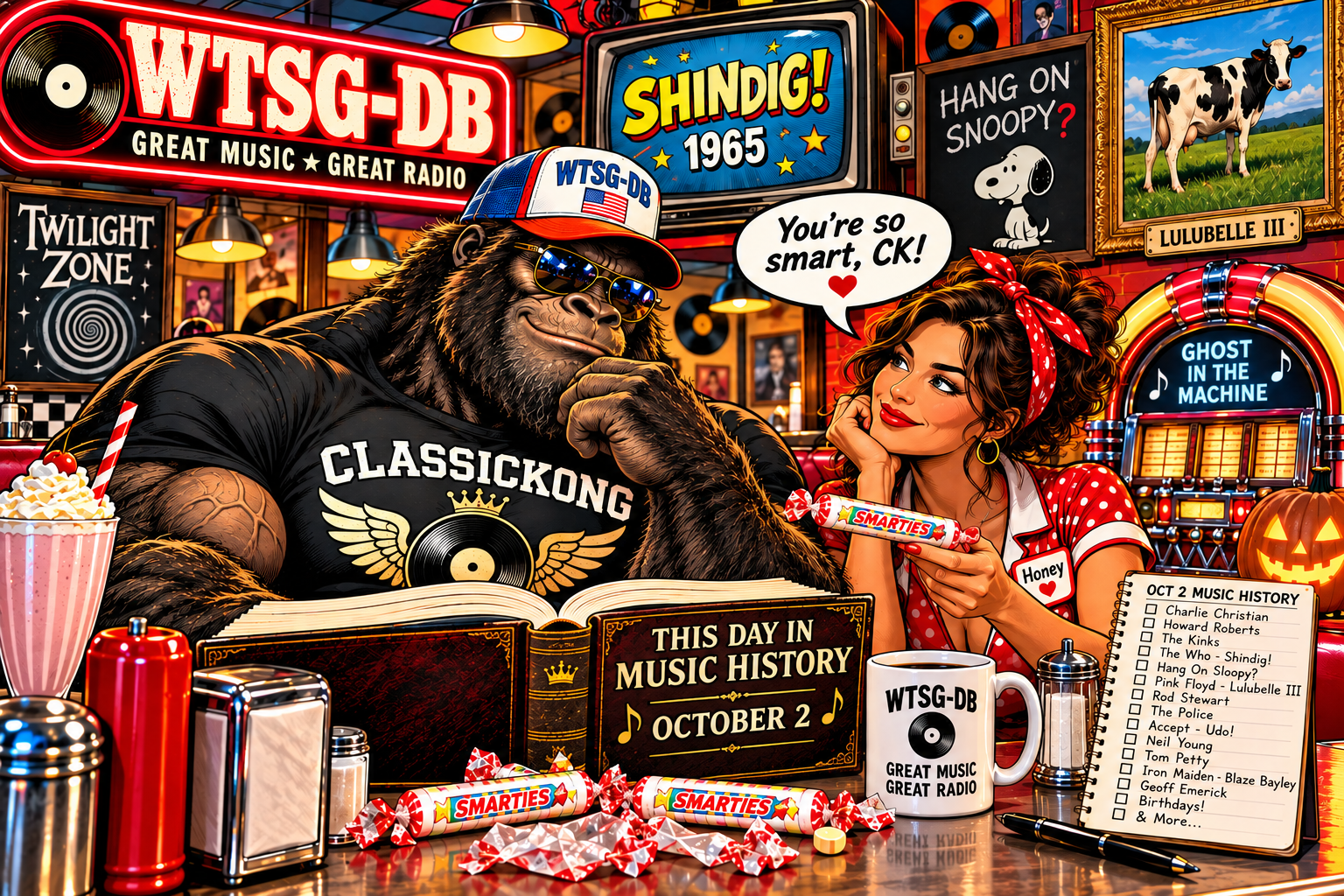
Apparently, Smarties are Professor CLASSICKONG’s secret weapon.
Honey just handed me another roll and said:
“You’re so smart, CK!”
See?
I knew that woman recognized genius when she saw it.
It’s also Kids Music Day, and that one means considerably more.
Music is one of the greatest gifts we can pass along to children. Sometimes we don’t even realize we’re doing it.
They’re sitting in the back seat while the radio plays.
They’re running through the house while Mom or Dad has an album spinning.
Maybe somebody puts a guitar, drumsticks or piano keys beneath their fingers for the first time.
Years later, those songs become part of their memories.
God bless the children. They are our most precious resource.
Somewhere along the way, we get to hand them some of the music that was handed to us.
October 2 also recognizes Audiophile Day, which seems perfectly at home around WTSG-DB.
You know the audiophile—the person who can tell you which pressing sounds better, which cartridge is tracking properly, and exactly why your speakers are positioned three inches too close to the wall.
Honey says I just turn up the bass.
I prefer the term precision audio calibration.
Let’s spin some history.
1939 – Charlie Christian Helps Change the Sound of the Guitar
On October 2, 1939, guitarist Charlie Christian entered the studio for his first recording session with the Benny Goodman Sextet.
Among the music recorded that day were “Flying Home” and “Rose Room.”
Christian’s importance is difficult to overstate.
The guitar had certainly existed in jazz before Charlie Christian, but amplification allowed him to bring the instrument forward as a genuine melodic solo voice alongside horns and other lead instruments.
Suddenly the guitarist didn’t have to remain buried in the rhythm section.
Christian could step out front.
My dad mentioned Charlie Christian to me more than once when I was growing up, and the older I’ve gotten, the more I’ve understood why that name mattered.
Christian died tragically young in 1942 at only 25 years old, but his influence traveled far beyond the short life he was given.
Follow the electric guitar through jazz, blues, R&B and eventually rock and roll, and sooner or later that road takes you back through Charlie Christian.
Sometimes musical history isn’t simply passed from musician to musician.
Sometimes it’s passed from a father to his son.
CLASSICKONG Must Haves – Charlie Christian
The Genius of the Electric Guitar — 1987, Columbia
Solo Flight: The Genius of Charlie Christian — 2003, Columbia/Legacy
The Original Guitar Hero — 2002, Columbia/Legacy
1929 – Howard Roberts Is Born
Jazz guitarist and legendary studio musician Howard Roberts was born October 2, 1929, in Phoenix, Arizona.
Roberts became one of Los Angeles’ busiest session guitarists and was associated with the remarkable collection of studio musicians we now call The Wrecking Crew.
But here’s where October starts getting spooky.
Howard Roberts played guitar on the television theme for The Twilight Zone.
Perfect timing.
But there’s another piece of trivia I absolutely love.
Roberts was also the man snapping his fingers on Peggy Lee’s recording of “Fever.”
That’s right.
Those sparse finger snaps helping create that cool, seductive atmosphere?
Howard Roberts.
“Fever” appeared on Peggy Lee’s 1958 Capitol Records album Things Are Swingin’, and that sparse arrangement—bass, drums and those finger snaps—gave Peggy plenty of room to work her magic.
And speaking of Peggy Lee…
Whew.
What a voice.
What a talent.
What a presence.
Professor Kong may require another roll of Smarties before continuing this research.
CLASSICKONG Must Haves – Howard Roberts
Good Pickin’s — 1959, Verve Records
Color Him Funky — 1963, Capitol Records
H.R. Is a Dirty Guitar Player — 1963, Capitol Records
1964 – The Kinks Release Their Debut Album
On October 2, 1964, The Kinks released their self-titled debut album in the UK on Pye Records.
And sitting right in the middle of it was a guitar sound that helped change rock and roll:
“You Really Got Me.”
Ray Davies wrote it.
Dave Davies supplied that snarling guitar attack.
And suddenly rock guitar sounded meaner.
That distorted riff has become so familiar that it’s easy to forget how aggressive it must have sounded coming through a radio in 1964.
The Kinks would become far more sophisticated songwriters and storytellers as the years passed, but this was one hell of an opening shot.
“You Really Got Me” appeared on Kinks, released in 1964 on Pye Records.
CLASSICKONG Must Haves – The Kinks
Kinks — 1964, Pye Records
Face to Face — 1966, Pye Records
Something Else by The Kinks — 1967, Pye Records
The Kinks Are the Village Green Preservation Society — 1968, Pye Records
Lola Versus Powerman and the Moneygoround, Part One — 1970, Pye Records
1965 – The Who Invade Shindig!
On October 2, 1965, American television viewers got their first televised look at The Who performing “I Can’t Explain” on ABC’s Shindig!
So what exactly was Shindig!?
Premiering in 1964 and hosted by Los Angeles disc jockey Jimmy O’Neill, Shindig! was a nationally televised ABC music program built around contemporary rock, pop and R&B.
That was significant.
Remember, this was long before MTV, YouTube, streaming video or hundreds of cable channels. American teenagers couldn’t simply pull up footage of the latest British band whenever they wanted.
A national television program like Shindig! could put an artist in front of millions of potential new fans.
The Who’s performance had actually been taped earlier in England, but it aired to the American audience on October 2.
And what an introduction.
Pete Townshend.
Roger Daltrey.
John Entwistle.
Keith Moon.
Four enormous personalities somehow fitting into one band.
“I Can’t Explain” was released in 1965 on Brunswick Records in the UK and Decca Records in America.
America had now seen The Who.
Things were about to get considerably louder.
1965 – Hang On…Snoopy?
Also on October 2, 1965, The McCoys reached No. 1 on the Billboard Hot 100 with “Hang On Sloopy.”
The record was released on Bang Records and featured teenage guitarist Rick Zehringer—the young man we would eventually know as Rick Derringer.
I have to confess something.
For the longest time, I thought they were singing:
“Hang On Snoopy.”
Apparently, in my young mind, Charlie Brown’s dog was fighting for his life at the top of the Billboard charts.
No wonder I loved Snoopy even more.
The McCoys came out of the Indiana/Ohio music scene, and “Hang On Sloopy” would develop a particularly strong connection with Ohio, eventually becoming an institution at Ohio State football games.
Derringer, meanwhile, would eventually give rock fans another guitar-driven favorite with “Rock and Roll, Hoochie Koo,” from his 1973 Blue Sky Records album All American Boy.
But on this day in 1965…
Hang on, Snoopy.
I mean SLOOPY.
1970 – Pink Floyd Meet Lulubelle III
On October 2, 1970, Pink Floyd released their fourth studio album, Atom Heart Mother, in the UK on Harvest Records.
It became Pink Floyd’s first No. 1 album in Britain.
The title composition occupied the entire first side of the original LP and found Pink Floyd working with brass and choir as the band continued exploring territory far removed from conventional pop music.
And then there’s the cover.
A cow.
Her name was Lulubelle III.
Pink Floyd didn’t name her.
Photographer and Hipgnosis co-founder Storm Thorgerson wanted to get away from the elaborate psychedelic imagery increasingly associated with the band’s record covers. He headed into the countryside looking for something deliberately ordinary.
There stood Lulubelle III.
That was already her name, given by her owner.
Thorgerson photographed her.
No photograph of Pink Floyd.
No psychedelic landscape.
No elaborate symbolism.
Just…
a cow.
And somehow it worked.
Musically, the album wasn’t nearly as simple as its cover. The enormous title suite “Atom Heart Mother” occupied the entire first side, while Roger Waters, Rick Wright and David Gilmour each contributed songs to side two. Gilmour’s beautiful “Fat Old Sun” became one of the album’s enduring favorites.
Both “Atom Heart Mother” and “Fat Old Sun” appeared on Atom Heart Mother, released in 1970 on Harvest Records.
CLASSICKONG Must Haves – Pink Floyd
Meddle — 1971, Harvest Records
The Dark Side of the Moon — 1973, Harvest Records
Wish You Were Here — 1975, Harvest Records
Animals — 1977, Harvest Records
The Wall — 1979, Harvest Records
1971 – Rod Stewart Owns the Charts
October 2, 1971 belonged to Rod Stewart.
“Maggie May” reached No. 1 on the Billboard Hot 100 while Rod’s album Every Picture Tells a Story was also sitting at No. 1.
And here’s the great part:
“Maggie May” wasn’t originally supposed to be the hit.
The single had been released with Tim Hardin’s “Reason to Believe” as the intended A-side.
Then radio programmers began flipping the record over.
Listeners responded.
And “Maggie May” exploded.
Eventually Rod Stewart had the No. 1 single and No. 1 album in both America and Britain.
Not bad for the B-side.
Both “Maggie May” and “Reason to Believe” appeared on Every Picture Tells a Story, released in 1971 on Mercury Records.
And what an album it was.
The title track, “Mandolin Wind,” “I’m Losing You,” and the two songs from that famous single helped make Every Picture Tells a Story one of the defining records of Rod Stewart’s career.
CLASSICKONG Must Haves – Rod Stewart
Gasoline Alley — 1970, Mercury Records
Every Picture Tells a Story — 1971, Mercury Records
Never a Dull Moment — 1972, Mercury Records
A Night on the Town — 1976, Warner Bros. Records
1981 – The Police Find a Ghost in the Machine
Now October starts sounding like October.
On October 2, 1981, The Police released their fourth studio album:
Ghost in the Machine.
Released on A&M Records, the album expanded the band’s sound with keyboards, synthesizers and saxophones.
But underneath all of that experimentation was still one of the greatest three-piece combinations of the era:
Sting. Andy Summers. Stewart Copeland.
Around here, we absolutely love Stewart Copeland.
My wife and I think the guy is not only a brilliant musician—he’s absolutely hilarious.
But what made The Police special wasn’t one guy.
Copeland’s restless rhythmic imagination worked because Andy Summers knew exactly how much space to leave, while Sting could anchor the bottom and deliver those unmistakable songs and vocals.
Remove one corner of that triangle and it’s a different band.
Among the essential tracks on Ghost in the Machine are “Every Little Thing She Does Is Magic,” “Invisible Sun,” and “Spirits in the Material World.”
All three appeared on the 1981 A&M Records album.
And with a title like Ghost in the Machine, we’re officially declaring Halloween season underway at WTSG-DB.
CLASSICKONG Must Haves – The Police
Outlandos d’Amour — 1978, A&M Records
Reggatta de Blanc — 1979, A&M Records
Zenyatta Mondatta — 1980, A&M Records
Ghost in the Machine — 1981, A&M Records
Synchronicity — 1983, A&M Records
1982 – Accept Get Restless and Wild
OH YEAH.
On October 2, 1982, German heavy-metal powerhouse Accept released Restless and Wild.
And then somebody dropped the needle on the opening track:
“Fast as a Shark.”
At first you hear that scratchy old German folk recording.
Everything seems harmless.
Then—
HERE COME THE DRUMS.
Stefan Kaufmann unleashes that double-kick attack, the guitars come charging in, and then Udo Dirkschneider starts screaming like he’s about to jump through your speakers and personally kick your ass.
I loved Accept back in the early ’80s, and THIS is one of the reasons why.
“Fast as a Shark” was ferocious for 1982. Its speed and aggression helped point toward the developing language of speed metal and thrash.
And Udo?
Around here, WE LOVE UDO.
But Restless and Wild wasn’t a one-song album.
The charging title track “Restless and Wild” and the epic “Princess of the Dawn” helped make the record one of Accept’s defining releases.
“Fast as a Shark,” “Restless and Wild,” and “Princess of the Dawn” all appeared on Restless and Wild, released in 1982.
Turn it up.
Professor Kong has spoken.
CLASSICKONG Must Haves – Accept
Breaker — 1981
Restless and Wild — 1982
Balls to the Wall — 1983
Metal Heart — 1985
1989 – Neil Young Finds Freedom
On October 2, 1989, Neil Young released Freedom on Reprise Records.
After one of the strangest decades of stylistic detours any major artist ever navigated, Neil came roaring back with an album that reminded everybody exactly who he was.
And framing the record at both ends was:
“Rockin’ in the Free World.”
The album opens with a live acoustic version and closes with the electric version.
Same song.
Two entirely different punches.
Freedom helped reestablish Neil Young just as a younger generation of alternative and grunge musicians was beginning to recognize him as one of their musical ancestors.
“Rockin’ in the Free World” appeared on Freedom, released in 1989 on Reprise Records.
CLASSICKONG Must Haves – Neil Young
After the Gold Rush — 1970, Reprise Records
Harvest — 1972, Reprise Records
Tonight’s the Night — 1975, Reprise Records
Rust Never Sleeps — 1979, Reprise Records
Freedom — 1989, Reprise Records
1994 and 2017 – An October 2 Heartbreak
This one hurts.
On October 2, 1994, drummer Stan Lynch played his final concert as a member of Tom Petty and the Heartbreakers at the Bridge School Benefit in Mountain View, California.
Stan had been there from the early days.
And when I picture the Heartbreakers of the early ’80s, I immediately think about that lineup around the time of “You Got Lucky.”
“You Got Lucky” appeared on Long After Dark, released in 1982 on Backstreet Records.
I loved that song, and I always loved that video—the strange post-apocalyptic landscape, the guys wandering into that abandoned building and discovering the old jukebox.
Those early Heartbreakers years were just special.
Stan eventually left, and the band continued.
Then we lost bassist Howie Epstein far too young in 2003 at only 47.
Howie had joined the Heartbreakers in 1982, and in addition to being a wonderful bassist, he supplied that beautiful high harmony voice that became part of the band’s sound.
Then came another October 2.
Twenty-three years to the day after Stan Lynch’s final Heartbreakers performance, Tom Petty died on October 2, 2017.
He was 66.
My wife and I always loved Tom Petty and the Heartbreakers.
When our kids were very young, they used to run around the house and dance while Full Moon Fever played.
And there was one little song on that album that became something more personal in our family:
“Alright for Now.”
The song appeared on Full Moon Fever, released in 1989 on MCA Records.
My wife and I used to sing it to our children when they were little.
Our children grew up.
The house changed.
Life moved forward.
But every once in a while, a record starts playing and suddenly those years don’t feel quite so far away.
Maybe that’s the perfect thought for Kids Music Day.
We pass music to our children, just as somebody once passed it to us.
And if we’re lucky, somewhere along the way a song becomes part of the family.
Tom Petty gave our family a few of those songs.
We haven’t forgotten them.
And we haven’t forgotten Tom.
CLASSICKONG Must Haves – Tom Petty and the Heartbreakers / Tom Petty
Tom Petty and the Heartbreakers — 1976, Shelter Records
Damn the Torpedoes — 1979, Backstreet Records
Hard Promises — 1981, Backstreet Records
Long After Dark — 1982, Backstreet Records
Full Moon Fever — 1989, MCA Records
Wildflowers — 1994, Warner Bros. Records
1995 – Iron Maiden Enter the Blaze Bayley Era
On October 2, 1995, Iron Maiden released The X Factor on EMI Records.
And there was one rather significant change.
No Bruce Dickinson.
Instead, the microphone belonged to:
BLAZE BAYLEY.
Buddy, if you’re going to replace Bruce Dickinson in Iron Maiden, showing up with a name like BLAZE BAYLEY is certainly a step in the right direction.
That’s a kick-ass heavy-metal name if I’ve ever heard one.
But seriously, Blaze walked into an almost impossible situation.
Bruce Dickinson’s voice and stage presence had become inseparable from the identity of Iron Maiden. Trying to imitate Bruce would have been a losing proposition.
Bayley didn’t.
His lower, darker voice helped give The X Factor its own character, and the album itself carried a noticeably darker atmosphere.
The record opens with the eleven-minute-plus epic “Sign of the Cross,” while “Man on the Edge” became another of the album’s best-known songs.
Both appeared on The X Factor, released in 1995 on EMI Records.
It wasn’t classic-era Bruce Maiden.
It wasn’t supposed to be.
It was Iron Maiden entering a different chapter.
And whatever you think of that chapter, you’ve got to give Blaze Bayley credit for having the guts to walk up to that microphone.
CLASSICKONG Must Haves – Iron Maiden
The Number of the Beast — 1982, EMI Records
Piece of Mind — 1983, EMI Records
Powerslave — 1984, EMI Records
Somewhere in Time — 1986, EMI Records
Seventh Son of a Seventh Son — 1988, EMI Records
2018 – Remembering Geoff Emerick
On October 2, 2018, the music world lost legendary recording engineer Geoff Emerick at age 72.
If you love the sound of the Beatles’ studio years, you know his work—even if you never knew his name.
Emerick became the Beatles’ principal recording engineer beginning with Revolver and worked on landmark recordings associated with Sgt. Pepper’s Lonely Hearts Club Band and Abbey Road.
He was part of a studio team willing to ask:
What happens if we try this?
Can we put the microphone there?
Can we make the drums sound different?
Can we make a voice sound like THAT?
Emerick helped turn the recording studio itself into another musical instrument.
His relationship with Paul McCartney continued beyond the Beatles, too. Emerick traveled to Lagos to engineer Paul McCartney and Wings’ Band on the Run.
That’s why people like Geoff Emerick deserve to have their names remembered.
The person standing behind the microphone gets the photograph.
Sometimes the person standing behind the console helps make the photograph immortal.
CLASSICKONG Must Haves – Geoff Emerick Behind the Console
Revolver — The Beatles, 1966, Parlophone
Sgt. Pepper’s Lonely Hearts Club Band — The Beatles, 1967, Parlophone
Abbey Road — The Beatles, 1969, Apple Records
Band on the Run — Paul McCartney and Wings, 1973, Apple Records
Birthday Spotlight – Don McLean
Happy birthday to Don McLean, born October 2, 1945, in New Rochelle, New York.
Funny how these things work—we were just talking about Don yesterday.
Naturally, “American Pie” will always tower over his catalog, but there’s much more there.
“Vincent” remains one of his most beautiful recordings, while his interpretation of Roy Orbison’s “Crying” demonstrated what a tremendous singer McLean could be.
His official biography reveals another part of his story that really caught my attention.
McLean suffered from severe asthma as a child and missed significant amounts of school because of it.
I know something about that struggle myself.
Living with severe asthma can be incredibly challenging, which makes another part of McLean’s story particularly interesting: he has credited voice lessons and exercise with helping him develop better breathing and breath control.
The power of exercise and conditioning, when you’re able to do it, can be incredibly important.
And in McLean’s case, the kid struggling with asthma grew up to become a singer capable of delivering those famously long lyrical passages.
That’s quite a journey.
“American Pie” and “Vincent” appeared on American Pie, released in 1971 on United Artists Records.
His version of “Crying” appeared on Chain Lightning, originally released in 1978.
Happy birthday, Don.
Birthday Spotlight – Mike Rutherford
A huge WTSG-DB birthday salute goes to Mike Rutherford, born October 2, 1950.
Genesis alone would make Rutherford a legend.
He was there from the beginning, providing bass, guitar and songwriting as Genesis evolved through multiple eras and personnel changes.
Then he helped create Mike + The Mechanics.
And that brings us to one song that still stops me in my tracks:
“The Living Years.”
The song appeared on Living Years, released in 1988 on Atlantic Records.
B.A. Robertson wrote the lyric from deeply personal experience involving the relationship with his father. Mike Rutherford had also lost his father during that period, giving the song another layer of personal meaning.
And there’s something remarkable about discussing this song today.
Just yesterday, we were talking about Harry Chapin’s “Cat’s in the Cradle,” from his 1974 Elektra Records album Verities & Balderdash.
The two songs tell different stories, but they seem to speak to each other across the years.
“Cat’s in the Cradle” warns us how easily the years can slip away.
“The Living Years” reminds us what can happen when they already have.
One says:
Don’t wait.
The other says:
I waited.
“The Living Years” hits me hard every time I hear it.
I loved and admired my dad tremendously.
For me, that song isn’t about wishing I had somehow loved him differently.
It’s about how quickly music can bring someone we love back into the room.
There are certain songs where you don’t really choose to remember someone.
The first few notes play…
and they’re already standing beside you.
That’s “The Living Years” for me.
Happy birthday, Mike Rutherford.
And thank you for that one.
CLASSICKONG Must Haves – Mike Rutherford / Mike + The Mechanics
Mike + The Mechanics — 1985, Atlantic Records
Living Years — 1988, Atlantic Records
Beggar on a Beach of Gold — 1995, Atlantic Records
And from Genesis:
A Trick of the Tail — 1976, Charisma Records
Duke — 1980, Charisma Records
Invisible Touch — 1986, Atlantic Records
Birthday Spotlight – Sting
Happy birthday to Gordon Matthew Thomas Sumner, better known to the world as Sting, born October 2, 1951, in Wallsend, England.
The nickname came from a black-and-yellow striped sweater he wore while playing with the Phoenix Jazzmen.
Someone thought he resembled a bee.
Sting stuck—and most certainly stung!
Later, drummer Stewart Copeland spotted him performing with Last Exit and recognized something special in the bass player.
Eventually those paths led to The Police.
And what a band they became.
Sting went on to build an enormous solo career, but today I want to salute the whole triangle again:
Sting. Andy Summers. Stewart Copeland.
Three musicians with very different instincts somehow colliding in exactly the right place.
CLASSICKONG Must Haves – Sting
The Dream of the Blue Turtles — 1985, A&M Records
…Nothing Like the Sun — 1987, A&M Records
Ten Summoner’s Tales — 1993, A&M Records
Brand New Day — 1999, A&M Records
Happy birthday, Sting.
Birthday Spotlight – Philip Oakey
And finally, happy birthday to Philip Oakey, born October 2, 1955, in Sheffield, England.
Before international fame…
before the synthesizers…
before The Human League became one of the defining groups of the early ’80s…
Oakey worked as a hospital porter.
Then he was recruited into an experimental electronic group.
There was just one little problem.
He wasn’t an established singer.
And he didn’t exactly arrive as some virtuoso synthesizer wizard.
A few years later:
“DON’T. DON’T YOU WANT ME…”
Funny how life works.
We LOVE The Human League around here.
“Don’t You Want Me” and “Love Action (I Believe in Love)” appeared on Dare, released in 1981 on Virgin Records.
The Jimmy Jam and Terry Lewis-produced “Human” appeared on Crash, released in 1986 on Virgin Records.
And let’s not forget Oakey’s terrific collaboration with Giorgio Moroder:
“Together in Electric Dreams,” from the 1984 Electric Dreams soundtrack on Virgin Records.
Not bad for the former hospital porter.
Happy birthday, Philip.
Final Spin
Sometimes these stories connect before we even realize they’re doing it.
Yesterday we talked about Harry Chapin and “Cat’s in the Cradle.”
Today it’s Mike Rutherford and “The Living Years.”
Charlie Christian reminded me of conversations with my dad.
Tom Petty reminded me of my wife and me singing to our children.
And Kids Music Day reminds us that somewhere right now, another child is hearing a song that may remain with them for the rest of their life.
That’s how music travels.
Someone hands you a song.
You carry it for a while.
Then one day, without even realizing it, you hand it to somebody else.
Maybe that’s one of the greatest things music allows us to do.
So play the records.
Tell the stories.
Teach the kids who Charlie Christian was.
Tell them about Tom Petty.
Let them discover their own heroes, too.
And while the people you love are still here…
tell them.
Don’t wait for the living years to become memories.
And every once in a while…
eat a roll of Smarties.
Apparently it makes you a professor.
Until tomorrow, take care of yourself, take care of others, and keep the music playing.
We’ll see you down the road.
— CLASSICKONG
Listen to Today’s Broadcast/Podcast
Prefer to listen instead of read?
Join CLASSICKONG for today’s WTSG-DB This Day in Music History broadcast as we travel through the artists, albums, songs and stories of October 2.
Turn it up, settle in and enjoy the ride.
References
Pink Floyd – Official Timeline
Ohio State – The Story of Hang On Sloopy
Rod Stewart – Official Timeline
Paul McCartney – Remembering Geoff Emerick
Don McLean – Official Biography
The Petty Archives – Stan Lynch
The Petty Archives – Remembering Howie Epstein
Mike Rutherford – The Living Years