From the Desk of CLASSICKONG
Welcome back, music lovers, to another trip through the records, artists and moments that built the soundtrack of our lives.
Before we spin the first record, WTSG-DB proudly sends our thanks to the men and women of the United States Armed Forces—past and present—and to the families who stand beside them. Your service and sacrifice are never forgotten.
And before CLASSICKONG gets anywhere near the record player, September 24 gives us a couple of reasons to celebrate.
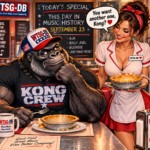
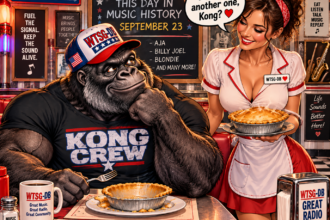
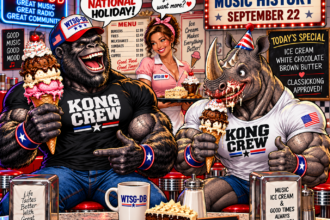
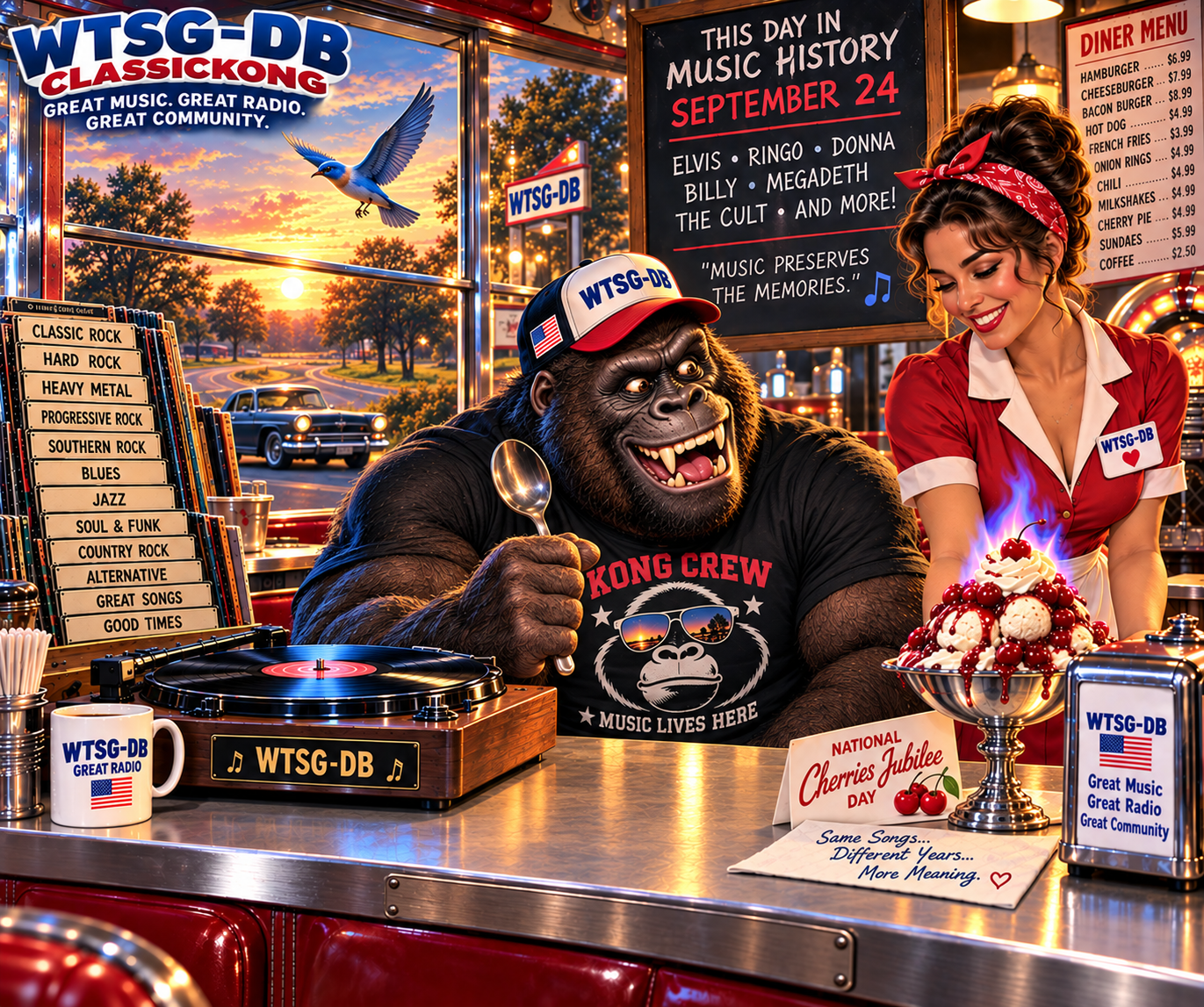
Today is National Cherries Jubilee Day, honoring that glorious combination of cherries, flame and ice cream—which probably explains why CLASSICKONG is standing there with a spoon in his hand and a look on his face that says somebody had better get out of the way. 😂🍒🍨
It’s also Bluebird of Happiness Day, celebrating that little blue symbol of happiness, hope and brighter days. And somehow that feels especially appropriate for what we do around here. Great music has a way of lifting us up, bringing a smile to our face and occasionally carrying us back to places we haven’t visited in years.
And believe me, we’re going to visit a few of those places today, because September 24 is absolutely packed.
We’ve got Elvis shaking up 1957, Jon Lord bringing Deep Purple together with a symphony orchestra, Rush beginning to stretch toward the progressive giants they would become, Ringo Starr and George Harrison preserving a friendship in song, Donna Summer transforming a Jimmy Webb classic, Timothy B. Schmit beginning a new chapter with the Eagles, Billy Joel sitting at No. 1, Cheap Trick putting its own stamp on Elvis, Megadeth delivering a thrash-metal landmark—and one absolutely ridiculous release day in 1991.
But running underneath all of that is something even bigger.
Memory.
Because sometimes a song is just a song when we first hear it.
Thirty or forty years later?
It can become a doorway.
1957 — Elvis Presley Goes to Jail…and Rock & Roll Wins
On September 24, 1957, RCA Victor released Elvis Presley’s “Jailhouse Rock,” backed with “Treat Me Nice.”
Written by the legendary songwriting team of Jerry Leiber and Mike Stoller, “Jailhouse Rock” was recorded for the motion picture of the same name.
And look at the musicians in that room:
Scotty Moore — guitar
Bill Black — bass
D.J. Fontana — drums
Dudley Brooks and Mike Stoller — piano
The Jordanaires — vocals
And, of course, Elvis.
“Jailhouse Rock” became one of the defining recordings of Elvis Presley’s career—and one of those records where the opening seconds alone immediately identify an era.
Elvis Must-Haves
Elvis Presley — 1956, RCA Victor
Elvis — 1956, RCA Victor
Loving You — 1957, RCA Victor
Elvis Is Back! — 1960, RCA Victor
From Elvis in Memphis — 1969, RCA Victor
1966 — Jimi Hendrix Arrives in London
On September 24, 1966, Jimi Hendrix arrived in London with former Animals bassist Chas Chandler, the man who had recognized something extraordinary in the young American guitarist.
Within weeks, Hendrix would be joined by bassist Noel Redding and drummer Mitch Mitchell.
The Jimi Hendrix Experience was taking shape.
It’s difficult to imagine now, but at this point the wider world didn’t yet know what was coming.
The records.
The performances.
The Stratocaster.
The sound.
London was about to meet Jimi Hendrix.
Rock guitar was about to change.
1969 — Jon Lord Brings Rock and Orchestra Together
On September 24, 1969, Deep Purple joined the Royal Philharmonic Orchestra at London’s Royal Albert Hall for Jon Lord’s ambitious Concerto for Group and Orchestra.
The Deep Purple lineup:
Jon Lord — keyboards
Ritchie Blackmore — guitar
Ian Gillan — vocals
Roger Glover — bass
Ian Paice — drums
The Royal Philharmonic Orchestra was conducted by Malcolm Arnold.
This wasn’t simply a rock band adding a few strings behind a song.
Lord had composed an actual concerto designed to bring a rock group and symphony orchestra into the same musical conversation.
Today, rock musicians working with orchestras isn’t particularly unusual.
In 1969?
This was adventurous territory.
And Jon Lord was exactly the kind of musician to try it—a classically trained keyboard player who could move from delicate passages to that roaring Hammond organ sound that became such an important part of Deep Purple.
Fortunately, the performance wasn’t lost to history.
It became the live album Concerto for Group and Orchestra.
Recorded at Royal Albert Hall that night, the album was initially released in the United States on Tetragrammaton Records in 1969, followed by its UK release on Harvest Records in 1970.
The Royal Albert Hall itself describes the performance as one of the earliest examples of collaboration between a rock band and orchestra.
Jon Lord / Deep Purple Must-Haves
Concerto for Group and Orchestra — 1969/1970, Tetragrammaton / Harvest
Deep Purple in Rock — 1970, Harvest / Warner Bros.
Fireball — 1971, Harvest / Warner Bros.
Machine Head — 1972, Purple / Warner Bros.
Made in Japan — 1972, Purple / Warner Bros.
Jon Lord’s Hammond isn’t decoration on those records.
It’s part of the architecture.
Give the man his roses.
1973 — Ringo Starr, George Harrison and “Photograph”
September 1973 brought one of the finest singles of Ringo Starr’s solo career:
“Photograph.”
Released on Apple Records, “Photograph” would also appear on Ringo’s 1973 album Ringo, produced by Richard Perry.
And this one has something special behind it.
The song was written by Ringo Starr and George Harrison.
The recording featured quite a cast, including George Harrison, Klaus Voormann, Jim Keltner, Bobby Keys and Jack Nitzsche alongside Ringo and other musicians.
On its surface, “Photograph” is about looking at an image of someone who is no longer there and realizing that the picture is all you have left.
But time has a way of changing songs.
After George Harrison died in 2001, hearing Ringo sing “Photograph” inevitably carried another emotional dimension. What began as a beautiful pop song written by two friends became capable of reminding listeners of the friendship itself.
That’s one of music’s little miracles.
The recording doesn’t change.
We do.
And sometimes the meaning waiting inside a song doesn’t fully reveal itself until years later.
Ringo Starr Must-Haves
Ringo — 1973, Apple
Goodnight Vienna — 1974, Apple
Ringo’s Rotogravure — 1976, Polydor / Atlantic
Photograph: The Very Best of Ringo Starr — 2007, Capitol/EMI
And if you’re only going to begin with one?
Start with Ringo.
It’s a remarkable piece of post-Beatles history, with contributions from John Lennon, Paul McCartney and George Harrison—all four former Beatles appearing on the same Ringo album, though not together on one track.
1975 — Rush Takes the Long Road with Caress of Steel
September 1975 brought Rush’s third studio album, Caress of Steel.
Some discographies place its release specifically on September 24, although Rush’s own archive identifies the release simply as September 1975, so we’ll leave the exact day with that qualification.
What isn’t debatable is how important the album was to Rush’s development.
The record included “Bastille Day,” “Lakeside Park,” the 12-minute “The Necromancer,” and the nearly 20-minute “The Fountain of Lamneth.”
Rush’s own history describes “The Necromancer” and “The Fountain of Lamneth” as the band’s first two epic pieces.
Commercially, Caress of Steel wasn’t the breakthrough everyone hoped for.
Artistically?
You can hear three musicians refusing to play it safe.
Geddy Lee, Alex Lifeson and Neil Peart were beginning to stretch songs beyond conventional rock structures and chase bigger ideas.
The next studio album was 2112.
Sometimes the record that struggles is the record that teaches you how to make the one that changes everything.
Rush Must-Haves from the Era
Fly by Night — 1975, Mercury
Caress of Steel — 1975, Mercury
2112 — 1976, Mercury
A Farewell to Kings — 1977, Mercury
Hemispheres — 1978, Mercury
1976 — Led Zeppelin Captures the Stage
On September 24, 1976, Swan Song Records issued a press announcement for Led Zeppelin’s forthcoming double-LP soundtrack The Song Remains the Same.
This one matters because it represented Led Zeppelin’s first official live album.
The performances had been captured at Madison Square Garden during the band’s 1973 concerts, with the recordings later mixed by Jimmy Page.
The accompanying film would bring Jimmy Page, Robert Plant, John Paul Jones and John Bonham onto cinema screens, but the soundtrack itself gave fans something equally valuable:
A permanent document of Led Zeppelin onstage.
Before everybody carried a camera and recording device in a pocket, a live album could be the closest many fans would ever get to standing in the room.
Around This Time in 1977 — Styx Invites Us to “Come Sail Away”
September 1977 brought one of Styx’s signature recordings to radio and record stores:
“Come Sail Away.”
Several music-history sources assign September 24 as its exact release date, but the A&M discographical information we’ve located confirms only September 1977.
So we’re going to do something simple:
Tell you what we know and not pretend we know what we don’t.
Written and sung by Dennis DeYoung, “Come Sail Away” appeared on The Grand Illusion — A&M Records, 1977.
It begins almost delicately with piano and voice before gradually opening into that unmistakable Styx combination of progressive rock, huge harmonies and arena-sized guitars.
And then the song takes that wonderfully strange turn into science fiction.
Only Styx could start you aboard a sailing ship and somehow have you wondering whether the passengers are about to leave Earth.
That’s part of the fun.
1977 — Motörhead Arrives
September 1977 also brought the self-titled debut from Motörhead, released by Chiswick Records.
And there was no mistaking that sound.
Lemmy Kilmister.
Bass turned up like a weapon. Gravel in the voice. Rock and roll played with enough speed and aggression to influence generations of punk and heavy-metal musicians who followed.
Songs included “Motörhead,” “Iron Horse/Born to Lose,” “White Line Fever” and “Keep Us on the Road.”
Motörhead never needed to fit neatly inside anybody else’s box.
Lemmy famously considered what they did rock and roll.
Fair enough.
Turn it up.
RIP, Lemmy.
Lemmy / Motörhead Must-Haves
Overkill — 1979, Bronze
Bomber — 1979, Bronze
Ace of Spades — 1980, Bronze
No Sleep ’til Hammersmith — 1981, Bronze
Another Perfect Day — 1983, Bronze
Orgasmatron — 1986, GWR
If you’ve somehow never taken the Motörhead plunge, Ace of Spades is an obvious doorway—but don’t overlook Overkill.
And No Sleep ’til Hammersmith?
That’s where you hear what this band could do when somebody opened the cage door.
1978 — Donna Summer Reinvents “MacArthur Park”
On September 24, 1978, Donna Summer’s “MacArthur Park” arrived.
The song had been written by the brilliant Jimmy Webb and famously recorded a decade earlier by Richard Harris.
But Donna didn’t simply sing somebody else’s hit.
She transformed it.
Working within the grand, dramatic production world she created with Giorgio Moroder and Pete Bellotte, Donna took Webb’s unusual composition and turned it into something unmistakably her own.
Her recording ultimately became Donna Summer’s first No. 1 single on the Billboard Hot 100.
That voice could soar, whisper, ache and explode.
And this recording is a wonderful example of what a great interpreter can do with a great songwriter’s material.
Jimmy Webb wrote the gem.
Donna Summer put her own stamp on it.
And here’s a fun little connection: Donna’s great run through the 1970s happened on Casablanca Records.
Yes, rock fans.
The same Casablanca Records that was home to KISS.
Donna Summer and KISS occupying the same label roster.
Only the 1970s could make that combination seem perfectly reasonable.
Donna Summer Essentials
Love to Love You Baby — 1975, Casablanca
I Remember Yesterday — 1977, Casablanca
Once Upon a Time — 1977, Casablanca
Live and More — 1978, Casablanca
Bad Girls — 1979, Casablanca
The Wanderer — 1980, Geffen
And Live and More is particularly important to today’s story because it contains the extended “MacArthur Park Suite.”
If your image of Donna Summer begins and ends with the word “disco,” keep listening.
There was a tremendous singer underneath those productions.
1979 — Timothy B. Schmit Begins The Long Run with the Eagles
On September 24, 1979, the Eagles released The Long Run on Asylum Records.
Produced by Bill Szymczyk, it was the band’s sixth studio album—and their first Eagles studio album featuring Timothy B. Schmit, who had replaced Randy Meisner on bass.
What an introduction.
“The Long Run.”
“Heartache Tonight.”
Joe Walsh’s “In the City.”
“Those Shoes.”
“The Sad Café.”
And then there is “I Can’t Tell You Why.”
Written by Timothy B. Schmit, Glenn Frey and Don Henley, the song gave Timothy a beautiful showcase as a lead vocalist.
Smooth. Restrained. Soulful.
I’ve always been a fan of Timothy B. Schmit, and “I Can’t Tell You Why” is one of those performances that explains exactly why.
He didn’t need to walk into the Eagles and try to become Randy Meisner.
He brought Timothy B. Schmit with him.
And the band gained another distinctive voice.
Eagles Must-Haves
Desperado — 1973, Asylum
On the Border — 1974, Asylum
One of These Nights — 1975, Asylum
Hotel California — 1976, Asylum
The Long Run — 1979, Asylum
Timothy B. Schmit — Solo Must-Haves
Playin’ It Cool — 1984, Asylum
Timothy B — 1987, MCA
Tell Me the Truth — 1990, MCA
Feed the Fire — 2001
Expando — 2009, Lost Highway
Leap of Faith — 2016
Day by Day — 2022
For somebody who knows Timothy primarily through Poco and the Eagles, his solo catalog deserves exploring too.
And Playin’ It Cool brought along some serious company, including Don Henley, Joe Walsh, Steve Lukather, Carl Wilson, J.D. Souther and Rita Coolidge.
There’s a lot more Timothy B. Schmit music waiting beyond the Eagles.
1983 — Billy Joel Tells Us About It
On the Billboard Hot 100 dated September 24, 1983, Billy Joel reached No. 1 with “Tell Her About It.”
The song came from An Innocent Man — Columbia Records, 1983 — and was produced by the great Phil Ramone.
Billy was deliberately looking backward on that album, paying tribute to the sounds he had loved growing up: doo-wop, soul and early rock and roll.
But “Tell Her About It” contains a pretty timeless bit of advice.
If you love somebody?
Tell them.
Don’t assume they know.
Don’t wait forever for the perfect moment.
There’s our man Billy again.
And around here, we always make room for Billy Joel.
Billy Joel Must-Haves
Turnstiles — 1976, Columbia
The Stranger — 1977, Columbia
52nd Street — 1978, Columbia
Glass Houses — 1980, Columbia
Songs in the Attic — 1981, Columbia
The Nylon Curtain — 1982, Columbia
An Innocent Man — 1983, Columbia
And let’s make something clear:
Around WTSG-DB, we love them all.
Billy Joel simply doesn’t put out bad records.
Every album has something worth discovering, rediscovering and turning up.
That’s Billy.
1988 — Cheap Trick Gives Elvis a Little Rock-and-Roll Muscle
In September 1988, Cheap Trick’s version of “Don’t Be Cruel” reached the U.S. Top 10.
Decades earlier, Elvis Presley had helped turn the original into rock-and-roll history.
Cheap Trick didn’t try to impersonate Elvis.
Robin Zander, Rick Nielsen, Tom Petersson and Bun E. Carlos did what good bands should do with a cover:
They made it sound like Cheap Trick.
Big guitars.
Big drums.
Robin Zander’s voice out front.
That’s how you honor a classic without putting it behind glass.
And it gives today’s history a nice little circle.
We started with Elvis.
Decades later, Cheap Trick was still carrying some of that electricity forward.
Cheap Trick Must-Haves
Cheap Trick — 1977, Epic
In Color — 1977, Epic
Heaven Tonight — 1978, Epic
Cheap Trick at Budokan — 1978/1979, Epic
Dream Police — 1979, Epic
And At Budokan is mandatory.
That’s one of those live albums that didn’t merely document a band.
For millions of listeners, it introduced them.
1990 — Megadeth Releases Rust in Peace
September 24, 1990.
Megadeth — Rust in Peace.
Capitol Records.
Dave Mustaine.
David Ellefson.
Marty Friedman.
Nick Menza.
This was Megadeth’s fourth studio album and the first featuring Marty Friedman and Nick Menza. Megadeth’s own history confirms the September 24 release date.
“Holy Wars… The Punishment Due.”
“Hangar 18.”
“Take No Prisoners.”
“Tornado of Souls.”
The playing is ferocious, technical and incredibly tight.
More than three decades later, Rust in Peace remains one of the records most closely associated with Megadeth’s classic era.
If you want guitars?
There are guitars.
Lots of them.
Megadeth Must-Haves
Killing Is My Business… and Business Is Good! — 1985, Combat
Peace Sells… but Who’s Buying? — 1986, Capitol
So Far, So Good… So What! — 1988, Capitol
Rust in Peace — 1990, Capitol
Countdown to Extinction — 1992, Capitol
Youthanasia — 1994, Capitol
If you want to understand why Megadeth occupies such an important place in thrash metal, there’s quite a story contained in those records.
1991 — One Ridiculous Day for Music
Then we arrive at September 24, 1991.
Good grief.
Several major albums landed at essentially the same moment.
Nirvana — Nevermind
DGC Records, 1991.
Produced by Butch Vig.
“Smells Like Teen Spirit.”
“Come as You Are.”
“In Bloom.”
“Lithium.”
Whatever your personal feelings about grunge, there’s no getting around the impact of this record.
Rock radio changed.
MTV changed.
Popular culture changed.
Nirvana Must-Haves
Bleach — 1989, Sub Pop
Nevermind — 1991, DGC
In Utero — 1993, DGC
MTV Unplugged in New York — 1994, DGC
It’s a remarkably small studio catalog considering the enormous cultural footprint the band left behind.
And MTV Unplugged in New York revealed another side of Nirvana entirely.
Red Hot Chili Peppers — Blood Sugar Sex Magik
Warner Bros. Records, 1991.
Produced by Rick Rubin.
“Give It Away.”
“Under the Bridge.”
“Breaking the Girl.”
“Suck My Kiss.”
The album was released September 24, the same day as Nevermind, and became the Chili Peppers’ commercial breakthrough.
It gave the band room to combine funk, hard rock, melody and something much more vulnerable than many listeners had previously heard from them.
Red Hot Chili Peppers Must-Haves
Mother’s Milk — 1989, EMI
Blood Sugar Sex Magik — 1991, Warner Bros.
Californication — 1999, Warner Bros.
By the Way — 2002, Warner Bros.
Stadium Arcadium — 2006, Warner Bros.
For today’s story, Blood Sugar Sex Magik is the pivot point—the record where funk, hard rock and increasingly mature songwriting came together in a way that changed the band’s trajectory.
The Cult — Ceremony
Here’s where music-history detective work gets interesting.
Some major catalogs list Ceremony as a September 24, 1991 release, while The Cult’s current Bandcamp catalog gives September 23.
So rather than declare a winner where the surviving sources disagree, we’ll simply say that Ceremony arrived during these same remarkable days in September 1991.
And what a band.
Ian Astbury.
Billy Duffy.
“Wild Hearted Son.”
“Heart of Soul.”
And if we’re talking about The Cult, I’ve got to go back two years to Sonic Temple and one particular song:
“Fire Woman.”
That one takes me straight back to MTV.
I’ve always loved Ian Astbury’s style and delivery. There’s something in the swagger and that deep, dramatic vocal that even carries a little of that old-school, Elvis-like rock-and-roll presence to my ears.
And underneath it?
Billy Duffy’s guitar absolutely roars.
The Cult Must-Haves
Love — 1985, Beggars Banquet
Electric — 1987, Beggars Banquet
Sonic Temple — 1989, Beggars Banquet / Sire
Ceremony — 1991, Beggars Banquet
Love gives you “She Sells Sanctuary” and “Rain.”
Electric brings in Rick Rubin and strips the band down into hard-driving rock and roll.
Then Sonic Temple arrives with Bob Rock behind the board and songs including “Fire Woman,” “Edie (Ciao Baby)” and “Sweet Soul Sister.”
Ian Astbury and Billy Duffy.
That’s one hell of a combination.
1991 — Bryan Adams Wakes Up the Neighbours
Also on September 24, 1991, Bryan Adams released Waking Up the Neighbours on A&M Records.
Produced by Bryan Adams and Robert John “Mutt” Lange, the album included:
“Can’t Stop This Thing We Started.”
“Thought I’d Died and Gone to Heaven.”
“Do I Have to Say the Words?”
And one enormous love song:
“(Everything I Do) I Do It for You.”
The song had already been released earlier that summer in connection with the Kevin Costner film Robin Hood: Prince of Thieves, starring Costner, Morgan Freeman, Christian Slater, Alan Rickman and Mary Elizabeth Mastrantonio as Marian.
Film composer Michael Kamen provided the musical foundation. Bryan Adams, Mutt Lange and Kamen share the songwriting credit.
And listen to some of the musicians:
Keith Scott — lead guitar
Mickey Curry — drums
Bill Payne of Little Feat — keyboards
Larry Klein — bass
The record spent an astonishing 16 consecutive weeks at No. 1 in the United Kingdom.
But statistics aren’t why this one matters to me.
When I hear “Everything I Do,” it takes me back to when my wife and I were younger and our children were running around the house.
Back then, it was a beautiful love song.
Today?
It means even more.
That’s the strange thing about music.
Bryan Adams, Mutt Lange and Michael Kamen wrote the song once.
But all of us who lived with it have been adding our own verses to it ever since.
Not with words.
With memories.
Birthday Spotlight — Steve Douglas
Born September 24, 1938, saxophonist and multi-instrumentalist Steve Douglas became one of the great session musicians of the rock-and-roll era.
And rather than simply tell you how important he was, let’s give you something to listen to.
Douglas became one of the key musicians associated with the great Los Angeles session-player community later known as the Wrecking Crew.
His saxophone can be heard with Duane Eddy, and his résumé stretched across records involving Phil Spector, the Beach Boys, Jan & Dean, Bob Dylan, Ry Cooder and many others.
Want to Hear Steve Douglas? Start Here
Duane Eddy — “Peter Gunn”
The Crystals — “He’s a Rebel”
The Ronettes — “Be My Baby”
The Righteous Brothers — “You’ve Lost That Lovin’ Feelin’”
Ike & Tina Turner — “River Deep – Mountain High”
Jan & Dean — “Surf City” and “Dead Man’s Curve”
The Beach Boys — selections from the great 1960s sessions
Bob Dylan — Street-Legal
Steve Douglas — Hot Sax
That’s why session musicians deserve their roses.
Sometimes you’ve known their playing your entire life without ever knowing their names.
Birthday Spotlight — Wayne Henderson
Born September 24, 1939, in Houston, Texas, trombonist Wayne Henderson helped co-found the Jazz Crusaders.
That puts him alongside Joe Sample, Wilton Felder and Stix Hooper in one of the great groups to bridge jazz, soul, funk and R&B.
Henderson’s trombone helped give the Jazz Crusaders their muscular horn identity before the group eventually shortened its name to the Crusaders.
We’ve talked recently about the wonderful Joe Sample.
Today we give Wayne Henderson his roses.
Wayne Henderson / Jazz Crusaders Must-Haves
Freedom Sound — 1961, Pacific Jazz
The Thing — 1965, Pacific Jazz
Lighthouse ’68 — 1968, Pacific Jazz
Old Socks, New Shoes…New Socks, Old Shoes — 1970, Chisa
Southern Comfort — 1974, Blue Thumb
If you’re exploring the Crusaders, don’t just stop at the hits.
Dig.
There’s a whole musical education waiting in that catalog.
Birthday Spotlight — Linda McCartney
Linda Eastman McCartney was born September 24, 1941, in Scarsdale, New York.
And let’s get something straight immediately.
Linda McCartney deserves to be remembered as much more than simply Paul McCartney’s wife.
Before Wings, Linda had already built a career as a photographer.
Her lens captured some of the defining musicians of the era, and photography remained an important part of her creative life.
Then came Paul.
Marriage.
Family.
And eventually Wings.
Linda became one of the group’s founding members, standing alongside Paul during a period when he was trying to build a musical identity after the Beatles.
And that brings us to one remarkable album:
Band on the Run — Apple Records, 1973.
Before recording began in Lagos, Nigeria, Wings members Denny Seiwell and Henry McCullough departed, leaving Paul, Linda and Denny Laine to carry on.
They did.
And somehow, from that difficult situation, came:
“Band on the Run.”
“Jet.”
“Bluebird.”
“Mrs. Vandebilt.”
“Let Me Roll It.”
“Nineteen Hundred and Eighty Five.”
Paul McCartney’s official album credits list the songs as composed by Paul and Linda McCartney, with “No Words” credited to Paul McCartney and Denny Laine.
Linda also performed on the album alongside Paul and Denny.
That’s worth remembering.
Linda didn’t need to be Paul McCartney.
There was already one of those.
She was Linda.
Photographer.
Musician.
Songwriter.
Wife.
Mother.
Partner.
Paul and Linda remained together until her death in 1998.
And on her birthday, we’d rather celebrate what she helped create than dwell on what was lost.
Give Linda her roses.
Birthday Spotlight — Gerry Marsden
Born September 24, 1942, Gerry Marsden became the unmistakable voice of Gerry and the Pacemakers.
The Liverpool group emerged during the same Merseybeat explosion that gave the world the Beatles.
Their recordings included:
“How Do You Do It?”
“I Like It.”
“Ferry Cross the Mersey.”
And, most enduringly, “You’ll Never Walk Alone.”
Marsden died in 2021, but that voice remains permanently tied to Liverpool.
CLASSICKONG Trading Card — September 24 Edition
CLASSICKONG — THE MEMORY KEEPER
Position: Keeper of the Groove
Team: WTSG-DB
Number: 24
Hometown: Evansville, Indiana
Bats: Records
Throws: Facts
Special Weapon: The Deep Dive
Power Move: Drops the needle and unlocks a 40-year-old memory
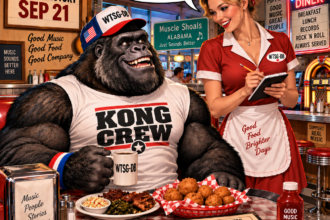
Favorite Fuel: Great music and questionable quantities of cheese pizza
Arch Enemy: Bad release dates
Research Defense: 99
Musical Memory: 98
Deep-Cut Detection: 97
Genre Range: 100
Air-Guitar Power: 96
Hammond B3 Appreciation: 100
Resistance to Pretty Waitresses: 03
Overall Rating: CLASSIC
Card Fact: CLASSICKONG knows that sometimes the most important thing preserved on an old record isn’t the music—it’s the person you were when you first heard it.
Final Spin — We Don’t Know We’re Making Memories
There’s something about today’s stories that keeps bringing us back to the same place.
Ringo Starr and George Harrison wrote “Photograph.”
Paul and Linda McCartney built music and a life together.
Bryan Adams sang “Everything I Do,” and somewhere far away from the recording studio, families were living ordinary days while that song played in the background.
Kids running through the house.
Mom and Dad still young.
A drive somewhere.
Dinner on the stove.
A record playing.
Nobody stops and says:
Remember this exact moment. You’re going to miss it someday.
We just live it.
That’s what makes music so precious.
We don’t always know we’re making memories when we’re making them.
Sometimes we’re simply driving the car, sitting around the house, raising the kids, loving somebody or listening to a record.
Then thirty years pass.
A familiar song begins.
And suddenly everybody is young again.
The house is the old house.
The kids are little.
The people we’ve lost are standing beside us.
And for three or four minutes, time gives something back.
Maybe that’s one reason we preserve these records and tell these stories.
Music history isn’t only about release dates, chart positions and catalog numbers.
It’s about people.
The people who made the music.
And the people we were when we heard it.
I want to thank you for spending a little bit of your time with us today. We hope we’ve said something you enjoyed and put a smile on your face.
Have a great day, and take care of yourself and others.
We’ll see ya tomorrow.
Take care.
Great Music. Great Radio. Great Community.
— CLASSICKONG
WTSG-DB
Listen to Today’s Broadcast
Prefer to hear the stories?
Listen to today’s WTSG-DB spoken-word edition of This Day in Music History, where CLASSICKONG takes you through the music, memories and artists behind September 24.
And while you’re here, stop by the WTSG-DB Guestbook and say hello. We’d love to hear what these songs mean to you.
References
- Elvis Presley Official Music Site — “Jailhouse Rock” — Official confirmation of the September 24, 1957 single release, backed with “Treat Me Nice,” along with historical information about the recording.
- Elvis Presley Official Music Site — “Jailhouse Rock” Recording Credits — Songwriters Jerry Leiber and Mike Stoller; recording date and personnel including Scotty Moore, Bill Black, D.J. Fontana, Dudley Brooks, Mike Stoller and the Jordanaires.
- Royal Albert Hall Archive — Deep Purple and the Royal Philharmonic Orchestra, September 24, 1969 — Official venue archive documenting Jon Lord’s Concerto for Group and Orchestra, the Deep Purple lineup, Malcolm Arnold and the Royal Philharmonic Orchestra.
- Rush Official Site — Caress of Steel — Official album history confirming September 1975, the band’s third studio recording, and the importance of “The Necromancer” and “The Fountain of Lamneth.”
- Led Zeppelin Official Site — September 24, 1976 — Original Swan Song press release announcing The Song Remains the Same, Led Zeppelin’s first official live recording, drawn from the 1973 Madison Square Garden performances.
- Ringo Starr Official Store — Ringo — Official album information for Ringo, including “Photograph.”
- Donna Summer Official Store — Casablanca Albums Collection — Donna Summer’s Casablanca-era catalog, including the albums surrounding “MacArthur Park.”
- Eagles Official Site — Official Eagles artist history and catalog.
- Apple Music — Eagles, The Long Run — September 24, 1979 release information for The Long Run.
- Timothy B. Schmit Official Site — Timothy B. Schmit’s official home for his solo career, music and history.
- Megadeth Official Site — Rust in Peace Anniversary — Official confirmation of the September 24, 1990 release of Rust in Peace.
- Warner Records — Red Hot Chili Peppers, Blood Sugar Sex Magik — Album history and background on the landmark 1991 release.
- Nirvana Official Site — Official Nirvana artist and catalog archive.
- The Cult Official Site — Official home of The Cult.
- The Cult Official Bandcamp — Ceremony — Official current catalog listing for Ceremony and its September 1991 release information.
- Billy Duffy Official Site — The Cult Discography — Billy Duffy’s official discography covering The Cult’s recordings, including the Sonic Temple era.
- Bryan Adams Official Site — Official Bryan Adams artist and recording archive.
- Michael Kamen Official Archive — “(Everything I Do) I Do It for You” — Songwriting, recording personnel, chart history and the collaboration among Bryan Adams, Robert John “Mutt” Lange and Michael Kamen.
- Michael Kamen Official Archive — Robin Hood: Prince of Thieves — Michael Kamen’s score and the musical connection between “(Everything I Do) I Do It for You” and the 1991 film.
- Linda McCartney Official Site — Biography — Linda McCartney’s life, photography career and artistic history.
- Paul McCartney Official Site — Band on the Run — Official album credits and history documenting Paul, Linda McCartney and Denny Laine’s work on Band on the Run.
- Paul McCartney Official Site — Wings — Official history of Wings and Linda McCartney’s role as a founding member.
- Steve Douglas — AllMusic Artist Biography — Biography and career information on the great saxophonist and session musician.
- Cheap Trick Official Site — Official Cheap Trick artist and catalog information.
- Billy Joel Official Site — Official Billy Joel catalog and career archive.
- Motörhead Official Site — Official Motörhead archive and catalog.
- Styx Official Site — Official Styx artist and catalog archive.