From the Desk of CLASSICKONG
Good morning, music lovers, and welcome back to WTSG Digital Broadcasting.
Before we turn up the music, CLASSICKONG and everyone here at WTSG-DB would like to send our sincere thanks to the men and women of the United States Armed Forces—past and present. Thank you for your service and sacrifice. 🇺🇸❤️
September 8 is one of those dates where you start digging through music history and suddenly realize you’ve opened a very large door.
Today we’ve got radio royalty, country royalty, progressive rock, heavy metal, screaming guitars, a little horror-movie history, and a jazz musician whose résumé reads like a Who’s Who of American music.
But there’s another thread running through today’s stories.
Sometimes a record becomes attached to a person, a place or a moment in our lives. Years later, all it takes is the opening few seconds of that song—and suddenly we’re there again.
Turn up the radio.
We’ve got some memories to make.
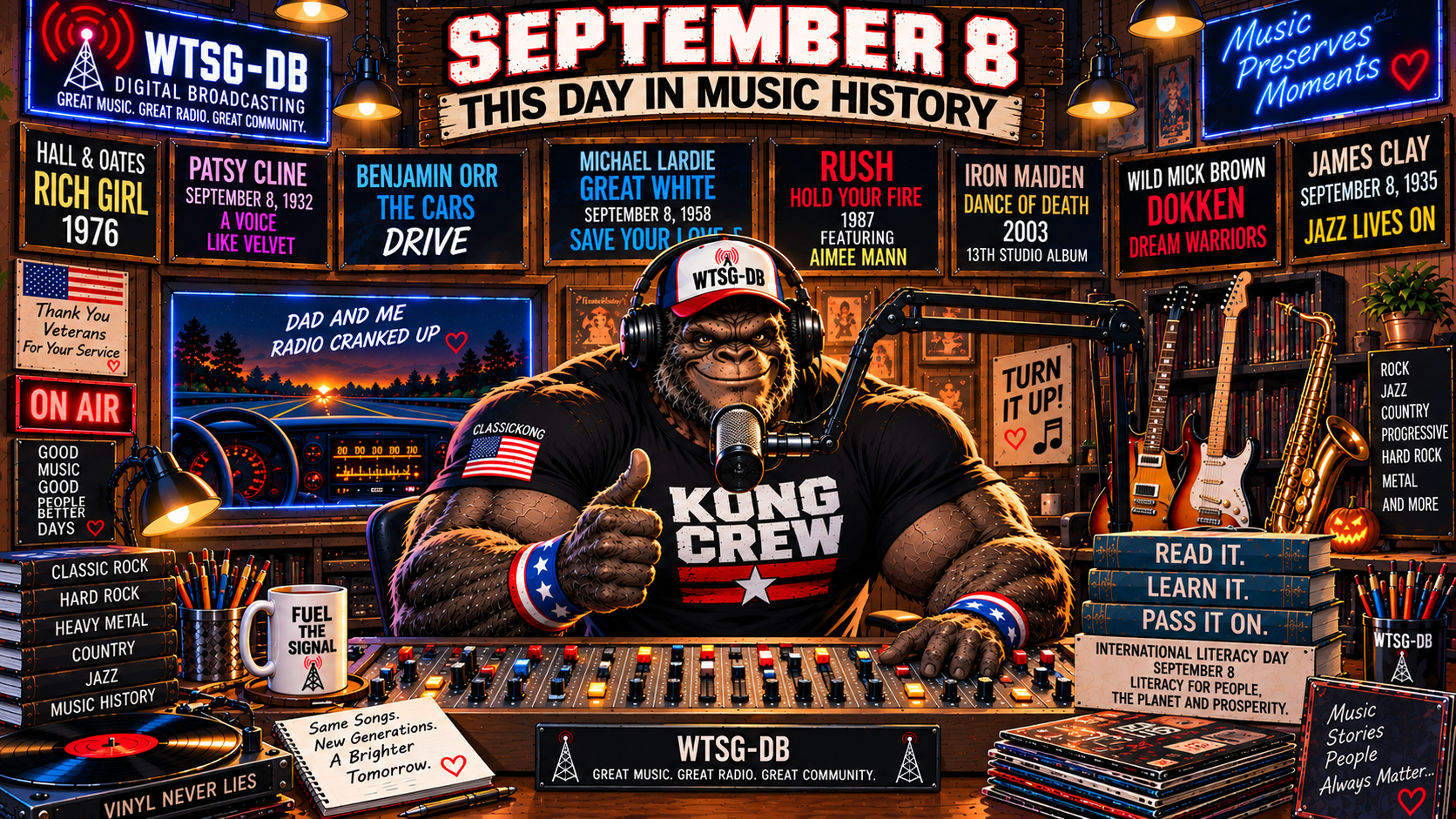
Hall & Oates — Rich Girl and the Sound of the Radio
On September 8, 1976, Daryl Hall and John Oates released their fifth studio album, Bigger Than Both of Us, on RCA Records.
The album contained “Rich Girl,” which would become the duo’s first No. 1 hit on the Billboard Hot 100.
Hall & Oates weren’t merely successful.
These guys became radio royalty.
“She’s Gone.”
“Sara Smile.”
“Rich Girl.”
“Kiss on My List.”
“You Make My Dreams.”
“Private Eyes.”
“I Can’t Go for That.”
“Maneater.”
“Out of Touch.”
For years, their music seemed to be everywhere—and that’s exactly how CLASSICKONG remembers them.
As a youngster, I can remember riding around in the car with my Dad behind the wheel and the radio cranked up. Those were great times. Dad and I shared a lot of laughs together.
And whenever “Rich Girl” came over that radio, young CLASSICKONG had a question.
Was Daryl Hall really singing…
“Bitch Girl”?
ROFLMAO! 😂😂😂
Hey, give me a break. This was the radio, there were no lyric websites, and those little car speakers weren’t exactly studio monitors.
But today, hearing “Rich Girl” brings back something considerably more important than a misheard lyric.
It brings back those rides with Dad.
The radio turned up. Music filling the car. Dad and me laughing together.
It doesn’t seem like a day goes by that I don’t think about him and miss him.
That’s one of music’s greatest gifts. A song doesn’t merely remind us of a time.
Sometimes it gives us a few minutes with somebody again. ❤️
CLASSICKONG Must-Have Hall & Oates
- Abandoned Luncheonette — 1973, Atlantic
- Daryl Hall & John Oates — 1975, RCA
- Bigger Than Both of Us — 1976, RCA
- Voices — 1980, RCA
- Private Eyes — 1981, RCA
- H2O — 1982, RCA
If you’re building a Hall & Oates collection, there’s one heck of a foundation.
Patsy Cline — A Voice Like Velvet
Patsy Cline was born September 8, 1932, in Winchester, Virginia. She died March 5, 1963, at only 30 years old.
Thirty years.
Think about that.
Such a short time on this earth, yet more than six decades after her death we’re still talking about that voice.
And what a voice it was.
Velvet.
That’s the word CLASSICKONG keeps coming back to.
There was tremendous control in Patsy’s singing, but it never sounded clinical. There was warmth, heartbreak and humanity inside it. She didn’t need to overpower a song. She could simply settle into a melody and somehow make every word matter.
“Walkin’ After Midnight.”
“I Fall to Pieces.”
“She’s Got You.”
And, of course, Willie Nelson’s “Crazy.”
Patsy became the first solo female artist elected to the Country Music Hall of Fame, and her influence continued through generations of singers including Loretta Lynn and Linda Ronstadt.
And that Loretta Lynn connection deserves special attention.
Patsy and Loretta became close friends during the early years of Loretta’s career. Patsy encouraged her and helped her navigate the music business. Their friendship lasted only a short time before Patsy’s death, but Loretta never forgot her.
In 1977, Loretta released an entire tribute album, I Remember Patsy.
That’s love.
That’s respect.
And that’s legacy. ❤️
Patsy Cline didn’t receive nearly enough years.
But she made the years she had count.
CLASSICKONG Must-Have Patsy Cline
- Patsy Cline — 1957, Decca
- Patsy Cline Showcase — 1961, Decca
- Sentimentally Yours — 1962, Decca
- The Patsy Cline Story — 1963, Decca
- Patsy Cline’s Greatest Hits — 1967, Decca
For the original studio albums, Showcase and Sentimentally Yours are essential. “I Fall to Pieces” and “Crazy” appear on Showcase, while Sentimentally Yours opens with the wonderful “She’s Got You.”
Turn down the lights and listen to that voice.
Velvet.
Pure velvet. ❤️
Benjamin Orr — The Voice That Asked Who’s Gonna Drive You Home
Benjamin Orr was born September 8, 1947, in Cleveland, Ohio. He died October 4, 2000.
Orr was the bassist, co-lead vocalist and co-founder of The Cars, and he sang lead on several of their most recognizable recordings, including “Just What I Needed,” “Let’s Go,” “Moving in Stereo” and “Drive.”
Buddy, The Cars were another band that simply belonged on the radio.
They had rock guitars, synthesizers, enormous hooks and a sound that helped connect late-’70s rock with the new-wave era that followed.
And they sounded like nobody else.
Then there’s Benjamin Orr’s voice.
In 1984, The Cars released “Drive,” written by Ric Ocasek but sung by Orr.
What a performance.
Orr didn’t need to scream. He didn’t need vocal gymnastics. He delivered the song with restraint, sadness and warmth—and that’s precisely why it works.
“Drive” remains one of those records where the voice and the song seem inseparable.
The Cars left a massive footprint on popular music, and Benjamin Orr left his own footprint within that band.
When that voice comes through the speakers, we still know exactly who it is.
Happy birthday, Ben. ❤️
CLASSICKONG recommends: “Just What I Needed,” “Let’s Go,” “Moving in Stereo,” “Drive,” plus Orr’s solo recording “Stay the Night.”
Michael Lardie — The Musical Architecture Behind Great White
Oh, buddy.
Now we’re going to turn this sucker UP. 🤘🔥
Michael Lardie was born September 8, 1958, in Anchorage, Alaska.
Most rock fans know him as the longtime keyboardist and guitarist for Great White, but that description barely scratches the surface.
Lardie’s résumé includes guitar, keyboards and numerous other instruments, along with work as an arranger, producer and engineer.
In other words…
MUSICIAN.
Great White has always held a special place around here because beneath the hard-rock exterior was something that separated them from many of their contemporaries:
the blues.
And we also need to stop here and remember the man who sang so many of these songs.
Jack Russell — December 5, 1960–August 15, 2024. ❤️
What a voice.
Jack could make his voice cry.
Mark Kendall could make his guitar cry right back.
And when those two sounds met, Great White could be absolutely devastating.
The band had the monster hit “Once Bitten, Twice Shy,” of course, but if that’s the only Great White song you know, you’ve barely opened the door.
“Rock Me.”
“Lady Red Light.”
“House of Broken Love.”
“The Angel Song.”
“Mista Bone.”
And then there’s…
“Save Your Love.” ❤️🤘
Lord have mercy.
Listen to Jack Russell sing that song. Listen to the way it builds. Listen to those guitars begin to scream around him.
THAT is Great White.
The music continues today with Great White’s current lineup of Brett Carlisle on vocals, Mark Kendall on guitar, Michael Lardie on guitar and keyboards, Audie Desbrow on drums and Scott Snyder on bass.
And at the center of today’s birthday story is Michael Lardie, one of the musicians who helped build the architecture underneath that unmistakable Great White sound.
CLASSICKONG Must-Have Great White
- Great White — 1984, EMI
- Shot in the Dark — 1986, Capitol
- Once Bitten — 1987, Capitol
- …Twice Shy — 1989, Capitol
- Hooked — 1991, Capitol
- Psycho City — 1992, Capitol
If you only know “Once Bitten, Twice Shy,” start with Once Bitten.
Put on “Rock Me.”
Then find “Save Your Love.”
Turn it up.
You’ll understand. 🤘❤️🎸
Happy birthday, Michael Lardie.
And Jack…
Thank you for that voice. ❤️
Rush — Hold Your Fire and an Aimee Mann Surprise
On September 8, 1987, Rush released their 12th studio album, Hold Your Fire.
The album was released through Anthem in Canada and Mercury internationally, and was produced by Rush and Peter Collins.
This was unquestionably synth-era Rush, but Alex Lifeson’s guitar riffs and solos were more prominent on several songs than they had been on Power Windows.
The record gave us:
“Force Ten.”
“Time Stand Still.”
“Open Secrets.”
“Second Nature.”
“Prime Mover.”
“Lock and Key.”
“Mission.”
“Turn the Page.”
But here’s today’s wonderful little connection.
You remember ‘Til Tuesday?
You remember that unmistakable voice on “Voices Carry”?
That’s Aimee Mann, born September 8, 1960.
And guess who sings additional vocals on Rush’s “Time Stand Still”?
Yep.
Aimee Mann.
So on Aimee Mann’s birthday, September 8, Rush released an album containing Aimee Mann singing with Rush.
How cool is THAT?
CLASSICKONG Must-Have Rush
Trying to reduce Rush to a tiny stack of records ought to be illegal, but we’ll try:
- 2112 — 1976, Anthem/Mercury
- A Farewell to Kings — 1977, Anthem/Mercury
- Hemispheres — 1978, Anthem/Mercury
- Permanent Waves — 1980, Anthem/Mercury
- Moving Pictures — 1981, Anthem/Mercury
- Signals — 1982, Anthem/Mercury
- Hold Your Fire — 1987, Anthem/Mercury
Yes, Rush fans—we know we left great records out.
We said small discography. 😂🤘
CLASSICKONG Must-Have Aimee Mann
Start with ‘Til Tuesday and then follow that voice into her solo career:
- Voices Carry — ‘Til Tuesday, 1985, Epic
- Welcome Home — ‘Til Tuesday, 1986, Epic
- Everything’s Different Now — ‘Til Tuesday, 1988, Epic
- Whatever — Aimee Mann, 1993, Imago
- I’m with Stupid — Aimee Mann, 1995/96 era
- Bachelor No. 2 or, the Last Remains of the Dodo — 2000
- Lost in Space — 2002
If you only remember Aimee Mann from “Voices Carry,” there’s an entire songwriting career waiting for you.
Today we’re giving her some roses too. 🌹❤️
Happy birthday, Aimee.
Iron Maiden — Dance of Death
UP THE IRONS! 🤘
On September 8, 2003, Iron Maiden released Dance of Death, the band’s 13th studio album.
It was produced by Kevin Shirley and Steve Harris and recorded at Sarm West Studios in London.
The original 2003 album was issued through EMI internationally, with the U.S. release associated with Columbia.
And this wasn’t Maiden simply trying to recreate the past.
Bruce Dickinson and Adrian Smith had returned for Brave New World in 2000. By Dance of Death, the now-familiar six-man Maiden lineup was firmly established:
Bruce Dickinson — vocals
Steve Harris — bass
Dave Murray — guitar
Adrian Smith — guitar
Janick Gers — guitar
Nicko McBrain — drums
The album contains:
“Wildest Dreams.”
“Rainmaker.”
“No More Lies.”
“Montségur.”
“Dance of Death.”
“Paschendale.”
“Journeyman.”
Dance of Death isn’t a strict concept album in the way Seventh Son of a Seventh Son is, but there is a recurring darkness running through it—war, mortality, history, fear and the supernatural.
The title track has a particularly interesting origin.
Janick Gers has explained that “Dance of Death” was inspired by Ingmar Bergman’s 1957 film The Seventh Seal, with its famous meditation on death and a man searching for hope in a devastated world.
Then there’s “Paschendale.”
The song takes listeners into the First World War and the Battle of Passchendaele. At more than eight minutes, it’s classic Maiden storytelling: history, atmosphere, shifting dynamics, twin-and-triple guitar textures and that unmistakable Steve Harris-driven attack.
And “Montségur” reaches even farther back into history, drawing from the fall of the Cathar stronghold at Montségur in medieval France.
That’s something Iron Maiden has always done remarkably well.
They don’t merely write songs.
Sometimes they open a history book, plug it into a Marshall stack and build a world around it. 🤘
Dance of Death proved that Maiden’s post-reunion era wasn’t nostalgia.
These guys still had something to say.
UP THE IRONS!
Wild Mick Brown — Dokken, Dream Warriors and Halloween
“Wild” Mick Brown was born September 8, 1956.
And around WTSG-DB, mentioning Mick Brown means we’re about three seconds away from cranking some DOKKEN. 🤘🥁
Brown spent decades behind the kit with Dokken and also worked with Lynch Mob and Ted Nugent.
Now look at this run:
“Breaking the Chains.”
“Into the Fire.”
“Just Got Lucky.”
“In My Dreams.”
“It’s Not Love.”
“Alone Again.”
And…
“Dream Warriors.”
Ohhhhh yeah.
“Dream Warriors” was recorded for the 1987 horror movie A Nightmare on Elm Street 3: Dream Warriors and was later included on Dokken’s fourth studio album, Back for the Attack, released in 1987 on Elektra Records.
For CLASSICKONG, “Dream Warriors” has become one of those records that signals Halloween is getting close. 🎃🤘
There was something magical about that era when horror movies and hard rock collided.
Freddy Krueger and Dokken?
Come on.
That’s CLASSICKONG country. 😂
CLASSICKONG Must-Listen Dokken
- Breaking the Chains — 1981/1983, Carrere/Elektra
- Tooth and Nail — 1984, Elektra
- Under Lock and Key — 1985, Elektra
- Back for the Attack — 1987, Elektra
- Beast from the East — 1988, Elektra
If you’re new to Dokken, those records will explain very quickly why Don Dokken, George Lynch, Jeff Pilson and Wild Mick Brown remain such a beloved hard-rock lineup.
But Mick Brown also takes us into another guitar rabbit hole.
LYNCH MOB.
After George Lynch’s original run with Dokken ended, he formed Lynch Mob and took that unmistakable guitar sound into another chapter.
CLASSICKONG Must-Listen Lynch Mob
- Wicked Sensation — 1990, Elektra
- Lynch Mob — 1992, Elektra
- Smoke This — 1999
- Rebel — 2015
- The Brotherhood — 2017, Rat Pak Records
And if you’re wondering where to begin…
Wicked Sensation.
Start there.
George Lynch is one of those guitar players whose personality comes through his amplifier. Tone, attack, phrasing—you know you’re listening to somebody.
Happy birthday to Wild Mick Brown.
Dokken fans, you know what to do.
Crank up “Dream Warriors.”
Halloween isn’t that far away. 🎃🤘🥁
James Clay — Follow the Jazz Trail
Now we’re going to change gears.
One of the best discoveries in today’s research is a musician some readers may not immediately recognize.
James Earl Clay was born September 8, 1935, in Dallas, Texas. He died January 6, 1995.
Clay played tenor saxophone and flute and emerged from the great Texas tenor tradition.
But here’s where things get interesting.
Start following the names surrounding James Clay.
Chet Baker.
Then keep going.
Ornette Coleman.
Don Cherry.
Billy Higgins.
Ray Charles.
Wes Montgomery.
That’s one heck of a neighborhood.
Clay worked periodically with Ray Charles’s orchestra and also recorded with Wes Montgomery.
And this is exactly why we love digging deeper into music history.
Sometimes the most rewarding discovery isn’t another story about an artist everybody already knows.
Sometimes it’s seeing a name like James Clay, asking, “Who was this guy?” and suddenly finding yourself surrounded by giants.
That’s the rabbit hole.
And around here, we happily jump in. 🎷❤️
CLASSICKONG recommends: Start with The Sound of the Wide Open Spaces!!!! with David “Fathead” Newman, then follow Clay’s work with Wes Montgomery.
You may discover another musician who deserves a place in your collection.
International Literacy Day
September 8 is International Literacy Day.
UNESCO proclaimed the observance in 1966, and 2026 marks its 60th anniversary.
The official 2026 theme is:
“Literacy for people, the planet and prosperity.”
And this one belongs in our music-history page more naturally than you might initially think.
Every biography we’ve ever read…
Every set of album liner notes…
Every music magazine…
Every interview…
Every history book…
Every lyric sheet that finally proved Daryl Hall wasn’t singing what young CLASSICKONG thought he was singing… 😂
Literacy opens doors.
It allows history to be recorded, preserved, questioned, studied and passed to the next generation.
And that’s exactly what we’re trying to do here every day—preserve a little piece of music history and hopefully send somebody away wanting to learn more.
So today, read something.
Learn something.
Then pass it along. ❤️📚
Final Spin
There’s a funny thing about music.
When we’re young, we think we’re simply listening to songs.
We don’t realize we’re storing memories.
A song plays while you’re riding around in the car with your Dad.
Another comes through the radio during a summer you’ll never forget.
A voice like Patsy Cline’s somehow becomes connected to people who aren’t even in the room anymore.
Benjamin Orr asks who’s going to drive you home.
Jack Russell starts singing “Save Your Love,” Mark Kendall’s guitar begins to scream, and suddenly you’re right back where you were the first time that record knocked you out.
Dokken’s “Dream Warriors” comes on and you know Halloween must be getting close.
And somewhere along the way, the songs stop belonging only to the artists who recorded them.
They become part of us.
I think about my Dad every day.
I miss him.
But sometimes a song comes on the radio that we used to crank up together, and for a few minutes something remarkable happens.
I’m back in that car.
Dad’s driving.
The radio is loud.
We’re laughing again. ❤️
Maybe that’s one of the reasons we keep listening.
Records preserve performances.
But music preserves moments.
So turn up an old favorite today.
And if it takes you somewhere…
stay there for a little while.
That’s what the music is for.
Until next time, keep the music playing, keep the memories close, and remember:
Great Music. Great Radio. Great Community.
— CLASSICKONG
WTSG Digital Broadcasting
Listen to Today’s Broadcast
Hear the spoken-word edition of today’s This Day in Music History on WTSG Digital Broadcasting.
References
Apple Music — Hall & Oates, Bigger Than Both of Us
Country Music Hall of Fame — Patsy Cline
Patsy Cline Discography — Original Albums and Decca Sessions
Great White — Official Biography
Los Angeles Times — Jack Russell, 1960–2024
Aimee Mann — Official Discography
Texas State Historical Association — James Clay
UNESCO — International Literacy Day