From the Desk of CLASSICKONG
Good morning, music lovers, and welcome to another trip through the records, stories, musicians, and moments that built the soundtrack of our lives.
Before we get started, CLASSICKONG and everyone at WTSG Digital Broadcasting would like to thank the men and women of the United States Armed Forces—past and present—for their service and sacrifice. We appreciate you. 🇺🇸❤️
September 7 is one of those dates that makes you wish you could walk into an old record store with a pocket full of money and nowhere else to be.
We’ve got the first performance by four musicians who would soon become Led Zeppelin. We’ve got Sam Cooke making pop music sound impossibly beautiful. We’ve got an extraordinary day for heavy music in 1984, Pink Floyd proving there was life after Roger Waters, Ronnie James Dio writing what would ultimately become the final studio chapter of his namesake band, two remarkable women celebrating birthdays, and one of the greatest jazz musicians who ever lived reminding us why humility and hard work matter.
But before we get to the records, today is also a day set aside to honor something that will eventually connect many of these stories:
The work.
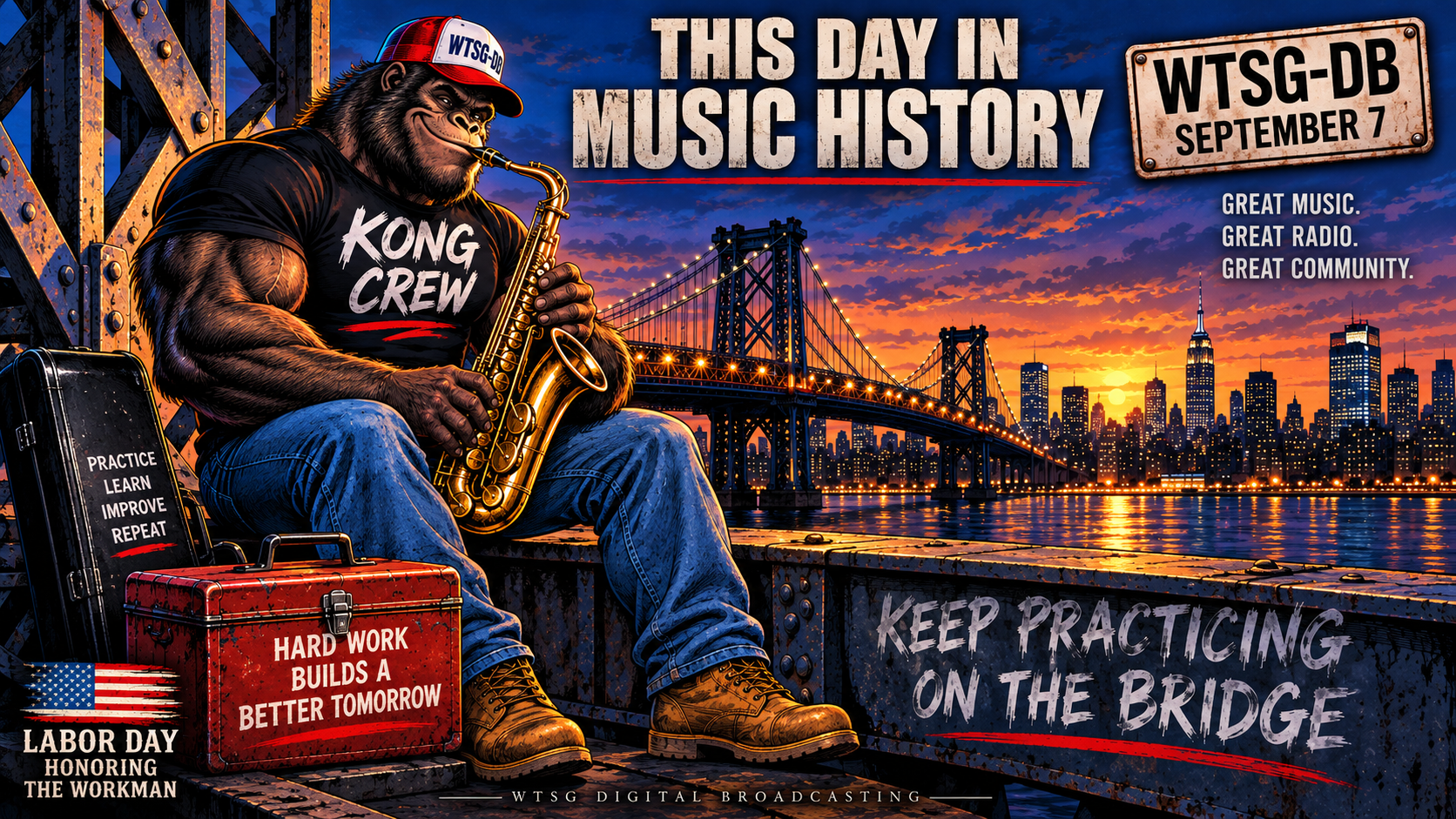
Labor Day — Honoring the Workman
Today, September 7, 2026, is Labor Day in the United States.
Observed on the first Monday in September, Labor Day recognizes the contributions and achievements of American workers—the people whose labor has helped build, serve, protect, feed, transport, teach, heal, entertain, and sustain our communities.
At WTSG Digital Broadcasting, we’d like to send our appreciation to all of you who get up every day and do the work. 🇺🇸❤️
The factory worker.
The farmer.
The truck driver.
The teacher.
The nurse.
The mechanic.
The electrician.
The carpenter.
The first responder.
The small-business owner.
The musician playing the gig while everyone else is enjoying the weekend.
And countless others whose work often happens without applause.
There’s dignity in doing a job well.
There’s pride in knowing your craft.
And there’s something especially admirable about the person who understands that no matter how experienced they become, there’s always something more to learn.
Keep that thought with us today.
We’re going to come back to it.
Before Led Zeppelin Was Led Zeppelin
On September 7, 1968, Jimmy Page, Robert Plant, John Paul Jones, and John Bonham performed together publicly for the first time at a youth club in Gladsaxe, Denmark.
They weren’t yet billed as Led Zeppelin.
Page was fulfilling remaining Yardbirds commitments, and the new group initially traveled under the New Yardbirds name.
Think about what was standing on that little stage.
Jimmy Page.
Robert Plant.
John Paul Jones.
John Bonham.
Four musicians who would soon create some of the most influential hard rock ever recorded—and at that moment, the world didn’t know what was coming.
Jimmy Page later remembered that the musicians had spent only about 15 hours rehearsing together before their Scandinavian dates.
Because early Zeppelin set lists have been reconstructed and debated over the years, we’re not going to pretend we possess a definitive song-by-song running order for that first performance. Led Zeppelin’s own archive identifies songs that appeared during those early shows, including “Train Kept A-Rollin’,” “I Can’t Quit You Baby,” “Dazed and Confused,” “Communication Breakdown,” and others.
But the set list isn’t really the important part of today’s story.
September 7, 1968 was the beginning.
Later that same day, the four musicians performed another show in Brøndby.
Within months, the New Yardbirds name would disappear.
Led Zeppelin was coming.
Sometimes history doesn’t announce itself.
Sometimes four guys simply plug in their instruments and start playing.
Sam Cooke Sends One Straight to the Heart
On September 7, 1957, Sam Cooke’s “You Send Me” was released.
Oh, buddy.
Darlin’…you send me.
❤️
Cooke had already established himself as a remarkable gospel singer with the Soul Stirrers, but “You Send Me” helped introduce his extraordinary voice to the pop world.
The original record was issued by Keen Records, backed with Cooke’s beautiful interpretation of “Summertime.”
Original single: You Send Me / Summertime
Label: Keen Records
Catalog: Keen 3-4013
Producer: Robert “Bumps” Blackwell
“You Send Me” was written by Sam Cooke, although the original record credited his brother L.C. Cook. René Hall provided the arrangement, and among the musicians on the recording was legendary drummer Earl Palmer.
The song subsequently appeared on Cooke’s first full-length LP, Sam Cooke, released by Keen Records in 1958.
Sam Cooke — 1958, Keen Records
Selected tracks include:
“You Send Me”
“The Lonesome Road”
“Tammy”
“Ol’ Man River”
“Moonlight in Vermont”
“Canadian Sunset”
“Summertime”
“Around the World”
“Danny Boy”
For listeners wanting to dig further into Sam’s catalog, the road leads through records such as Encore, Tribute to the Lady, Cooke’s Tour, Hits of the 50’s, My Kind of Blues, Twistin’ the Night Away, Night Beat, and One Night Stand! Live at the Harlem Square Club, 1963.
“You Send Me” became a major crossover success and reached No. 1 on Billboard’s pop and R&B charts.
Listen to Cooke sing it.
There’s no need for vocal gymnastics. No need to beat the listener over the head.
It’s smooth.
Intimate.
Effortless.
And beautiful.
Sam Cooke helped build the bridge between gospel, R&B, soul, and popular music that generations of singers would cross afterward.
Some singers perform a love song.
Sam Cooke could make you believe it. ❤️
September 7, 1984 — Bring a Bigger Record Bag
Buddy, if you walked into a record store on September 7, 1984, you’d better have brought some money.
Queensrÿche released The Warning.
Mercyful Fate released Don’t Break the Oath.
And Jethro Tull’s Under Wraps belongs to this same extraordinary September 1984 record-store moment.
Three dramatically different records.
Three bands moving heavy and progressive music in very different directions.
Let’s go shopping.
Queensrÿche — The Warning
Before Operation: Mindcrime.
Before Empire.
Before “Silent Lucidity.”
There was The Warning.
Released September 7, 1984, The Warning was Queensrÿche’s first full-length studio album.
And we’re talking classic Queensrÿche:
Geoff Tate — vocals
Chris DeGarmo — guitar
Michael Wilton — guitar
Eddie Jackson — bass
Scott Rockenfield — drums
That lineup had musicianship to burn.
Songs such as “Warning,” “En Force,” “Deliverance,” “No Sanctuary,” “Take Hold of the Flame,” and “Roads to Madness” showed a band already reaching beyond conventional heavy metal.
Geoff Tate’s voice was extraordinary, but listen underneath it.
DeGarmo and Wilton were developing one of metal’s great guitar partnerships, while Jackson and Rockenfield gave the music a foundation capable of following the band’s increasingly ambitious arrangements.
And sitting behind the console was a fascinating connection to another story we’re telling today.
James Guthrie.
James Guthrie — The Man Behind the Glass
James Guthrie may not be a household name to casual listeners, but record collectors who read liner notes know exactly why he matters.
The English producer and engineer became deeply associated with Pink Floyd after co-producing and engineering The Wall alongside Bob Ezrin and the band.
His relationship with Pink Floyd would continue for decades through recording, mixing, mastering, and surround-sound projects.
Then Guthrie found himself working with a young American metal band called Queensrÿche.
During The Warning sessions in London, Guthrie introduced Queensrÿche to composer and arranger Michael Kamen.
Remember that name.
Years later, when Chris DeGarmo wrote “Silent Lucidity,” Queensrÿche worked with Kamen on the song’s beautiful orchestral arrangement.
So follow the thread:
Pink Floyd → James Guthrie → Queensrÿche → Michael Kamen → “Silent Lucidity.”
That’s one of the things CLASSICKONG loves most about music history.
The records don’t live in separate boxes.
Musicians, engineers, producers, arrangers, studios, and ideas cross paths—and sometimes a meeting in one decade helps create a masterpiece in another.
Mercyful Fate — Don’t Break the Oath
Now let’s make things considerably darker. 🤘
Also released September 7, 1984 was Mercyful Fate’s second studio album, Don’t Break the Oath.
Formed in Copenhagen in the early 1980s, Mercyful Fate developed around the unmistakable voice and theatrical presence of King Diamond and the guitar work of Hank Shermann.
The classic lineup featured:
King Diamond — vocals
Hank Shermann — guitar
Michael Denner — guitar
Timi Hansen — bass
Kim Ruzz — drums
Their 1983 debut album, Melissa, had already announced that something unusual was happening in European heavy metal.
Then came Don’t Break the Oath.
“A Dangerous Meeting.”
“Nightmare.”
“Desecration of Souls.”
“The Oath.”
“Gypsy.”
“Come to the Sabbath.”
This wasn’t generic 1980s metal.
Mercyful Fate combined intricate twin-guitar work, sudden musical changes, heavy riffs, dark atmosphere, theatrical imagery, and King Diamond’s astonishing falsetto into something unmistakably their own.
Hank Shermann has recalled that the album was recorded and mixed in Copenhagen in only about three weeks.
What emerged from those sessions became one of Mercyful Fate’s defining records and an important piece of heavy-metal history.
They weren’t simply asking where heavy metal was going.
They were helping expand the answer.
Jethro Tull — Under Wraps and Into the Future
September 1984 also brought one of the strangest turns in Jethro Tull’s long career.
Under Wraps pushed the band deep into contemporary technology—synthesizers, electronic textures, sequencing, and programmed drums.
And look at the musicians responsible for it:
Ian Anderson — vocals, flute, acoustic guitar and programmed drums
Martin Barre — electric guitar
Dave Pegg — bass
Peter-John Vettese — keyboards and percussion
The album was released on Chrysalis Records.
There was no conventional drummer driving the studio album. Much of the percussion was electronically programmed, principally by Anderson—one of the reasons Under Wraps sounds so unlike the classic Tull records that preceded it.
And we can verify something important about its timing: Under Wraps entered the official UK album chart at No. 18 during the week of September 9, 1984, confirming that it was already in British record stores by that point.
For some longtime Tull listeners, it was a difficult record.
But whether you love the album or not, the story is fascinating because Anderson was willing to experiment.
There was also a physical cost.
Anderson has said that performing the demanding Under Wraps material on tour contributed to serious vocal problems, and he felt his singing voice never completely returned to what it had been before.
That’s an extraordinary chapter in Jethro Tull’s history.
Experimentation carries risk.
Sometimes an artist reaches for something new and discovers something wonderful.
Sometimes the audience doesn’t follow.
Sometimes the artist pays a price.
But Ian Anderson kept moving.
Pink Floyd — Could There Be Floyd Without Roger Waters?
On September 7, 1987, Pink Floyd released A Momentary Lapse of Reason in the United Kingdom.
Roger Waters had left.
And that raised an obvious question:
Could Pink Floyd still be Pink Floyd without Roger Waters?
David Gilmour and Nick Mason decided there was only one way to answer it.
Make another Pink Floyd record.
Richard Wright also returned to participate in the project.
The album gave us songs including “Learning to Fly,” “On the Turning Away,” and “Sorrow.”
And listeners responded.
A Momentary Lapse of Reason reached No. 3 in the United Kingdom and No. 3 in the United States.
Pink Floyd had certainly climbed higher during the Waters era—Wish You Were Here, for example, reached No. 1 on both sides of the Atlantic.
But that’s what makes the success of A Momentary Lapse of Reason so interesting.
This wasn’t Pink Floyd reaching unprecedented commercial heights.
It was Pink Floyd proving they could survive an enormous change.
Waters never permanently returned to the band. The classic quartet of Waters, Gilmour, Wright, and Mason did reunite for a remarkable one-off performance at Live 8 in 2005.
But in 1987, nobody knew that moment was waiting years down the road.
There was simply a band with something to prove.
And millions of listeners were willing to hear the answer.
Dio — Master of the Moon
September 7, 2004 brought us Master of the Moon, the tenth studio album released under the Dio name.
And you already know how CLASSICKONG feels about Ronnie James Dio. ❤️🤘
Rainbow.
Black Sabbath.
Dio.
Three monumental chapters in one remarkable musical life.
For Master of the Moon, Ronnie was joined by:
Ronnie James Dio — vocals
Craig Goldy — guitar
Jeff Pilson — bass
Simon Wright — drums
Scott Warren — keyboards
The record included “One More for the Road,” “Master of the Moon,” “The End of the World,” “The Eyes,” “I Am,” and “In Dreams.”
It was a darker, heavier late-period Dio record.
But today we hear it differently because we know something nobody standing in a record store on September 7, 2004 could have known.
Master of the Moon would ultimately become the final studio album released by the Dio band during Ronnie’s lifetime.
Ronnie James Dio died in 2010.
Metal lost much more than an extraordinary singer.
Ronnie was an intelligent, articulate musician who treated his craft seriously and earned enormous respect from musicians and fans alike.
You can hear Ronnie sing three notes and know exactly who’s behind the microphone.
There was only one.
And for those of us who love heavy metal, his absence is still felt.
Turn it up for Ronnie today. ❤️🤘
Happy Birthday, Chrissie Hynde
Born September 7, 1951, in Akron, Ohio, Chrissie Hynde carved out one of rock music’s most distinctive careers.
And “carved out” seems like the right description.
Hynde didn’t arrive in Britain and have somebody hand her a rock-and-roll career.
She fought for it.
She moved through the London music scene of the 1970s, endured false starts and failed bands, and kept going until the Pretenders finally came together.
Then there was that voice.
Cool.
Tough.
Vulnerable when it needed to be.
And instantly recognizable.
“Brass in Pocket.”
“Back on the Chain Gang.”
“Middle of the Road.”
“I’ll Stand by You.”
Chrissie Hynde never seemed terribly interested in fitting anybody else’s definition of what a female rock singer was supposed to be.
Ohio girl.
Songwriter.
Guitar player.
Frontwoman.
Rebel.
Happy birthday, Chrissie. Keep doing it your way. ❤️
Happy Birthday, Gloria Gaynor
Born September 7, 1943, Gloria Gaynor became one of the defining voices of the disco era.
But one record escaped every boundary anybody could put around it.
“I Will Survive.”
You don’t even need the whole record.
Those opening notes arrive and millions of people already know what’s coming.
The song became a No. 1 hit and ultimately something much larger than a disco record.
It’s a song about getting knocked down and discovering that you’re stronger than you thought you were.
Decades later, people still sing it.
At weddings.
At parties.
In cars.
In kitchens.
Probably into a hairbrush when nobody’s looking. 😂
And that’s when a song stops belonging to an era and becomes part of the culture.
Happy birthday, Gloria. ❤️
Sonny Rollins — Go Practice on the Bridge
Born September 7, 1930, Sonny Rollins became one of the towering tenor saxophonists in jazz history.
His résumé alone is staggering.
Miles Davis.
Thelonious Monk.
Max Roach.
Clifford Brown.
Bud Powell.
J.J. Johnson.
John Coltrane.
Then there are the records.
Tenor Madness.
Saxophone Colossus.
Way Out West.
The Bridge.
And compositions such as “St. Thomas.”
But today, CLASSICKONG doesn’t want to talk only about what Sonny Rollins accomplished.
I want to talk about what he did when people started telling him how great he was.
He went back to work.
By the late 1950s, Rollins was receiving enormous acclaim.
Instead of allowing the praise to convince him that he’d mastered his instrument, Rollins became uncomfortable with the attention.
He believed he could become better.
So he stepped away from public performance.
And he practiced.
Famously, Rollins began practicing on the Williamsburg Bridge in New York, where he could play without disturbing his neighbors.
Think about that.
One of the finest jazz saxophonists alive.
Already respected by musicians.
Already recording important albums.
Already being called great.
And his response was essentially:
I’ve still got work to do.
Eventually Rollins returned to recording.
The album that marked that return carried a perfect title:
The Bridge.
Sonny Rollins died on May 25, 2026, at age 95.
So today would have been his 96th birthday.
And perhaps one of the greatest things this legendary musician left us isn’t contained on a record at all.
It’s the example.
Humility doesn’t mean believing you’re incapable.
Humility means never believing you’re finished.
❤️🎷
Final Spin
We began today by talking about Labor Day and honoring the workman.
After traveling through all these stories, maybe we’ve discovered that the word workman reaches farther than we sometimes realize.
A workman can carry a toolbox.
A workman can drive a truck.
A workman can stand behind a machine, teach a classroom, care for a patient, or build something with his or her hands.
And sometimes…
a workman carries a saxophone onto a bridge.
There is truth in humility.
That’s something CLASSICKONG was taught by his parents and grandparents as a youngster, whether the challenge involved music, competition, sports, or simply getting through life.
Success doesn’t mean the work is finished.
Winning doesn’t mean you’ve arrived.
And applause can become dangerous if you start believing it means there’s nothing left to learn.
There’s always somebody practicing.
Somebody studying.
Somebody working while you’re celebrating.
Somebody who’s still hungry.
The Apostle Paul wrote in 2 Timothy 2:15:
“Study to shew thyself approved unto God, a workman that needeth not to be ashamed, rightly dividing the word of truth.”
A workman.
There’s something powerful in that word.
Preparation.
Discipline.
Study.
Effort.
Work.
Rocky had Mickey and Apollo reminding him of the same fundamental truth in a different setting: don’t lose the hunger just because people are cheering your name.
And Sonny Rollins lived it.
Imagine achieving what he’d already achieved and still having enough humility to pick up that saxophone, walk onto a bridge, and practice.
That’s our lesson from September 7.
Stay hungry when you’re winning.
Stay teachable when you’re accomplished.
Stay humble when people are applauding.
Because somewhere out there, somebody is still practicing on the bridge.
Success is not permission to stop learning.
Humility isn’t thinking less of yourself.
It’s respecting the work enough to understand that there’s always more to learn.
And maybe that’s why so many of today’s stories belong together.
Queensrÿche kept reaching.
Mercyful Fate created its own path.
Ian Anderson experimented.
Pink Floyd rebuilt.
Ronnie James Dio kept making music.
And Sonny Rollins kept practicing.
Never be afraid to turn the page.
Just make damn sure you’re still the one holding the pen.
On this Labor Day, here’s to the workmen and women everywhere—the people who keep showing up, keep learning, and keep doing the job.
Whatever your craft may be…
keep practicing on the bridge.
Until tomorrow, keep learning, keep listening, keep working—and keep the music playing.
— CLASSICKONG
WTSG Digital Broadcasting
Great Music. Great Radio. Great Community.
Listen to Today’s Broadcast
Listen to the spoken-word edition of today’s This Day in Music History right here on WTSG Digital Broadcasting.
References
Led Zeppelin — Official Concert Archive: September 7, 1968
Led Zeppelin — Official Archive: Brøndby, September 7, 1968
Official Charts — Jethro Tull: Under Wraps
Sonny Rollins — Official Biography
National Endowment for the Arts — Sonny Rollins
Hank Shermann — Mercyful Fate History
Hank Shermann — Don’t Break the Oath
Pink Floyd — A Momentary Lapse of Reason
Pink Floyd Official Archive — 1987
Pink Floyd Official Archive — Live 8, 2005
Dio — Official Discography: Master of the Moon
U.S. Department of Labor — History of Labor Day