From the Desk of CLASSICKONG
Good morning, friends, and welcome to another journey through the music, memories, people and moments that helped create the soundtrack of our lives.
Today we’re remembering a historic changing of the guard behind the drum kit of Rush, the song that put Sonny & Cher on top of America, an early and hungry Led Zeppelin, David Crosby and the Byrds, the strange space-rock road that helped give us Lemmy and Motörhead, the Beatles’ final live performance for The Ed Sullivan Show, and one of the greatest cult movies ever made.
We’ll also celebrate Meat Loaf, the remarkable women who helped bring those enormous theatrical songs to life, and one wild and crazy guy named Steve Martin who happens to play a mean banjo.
And apparently CLASSICKONG has a Creamsicle.
This could get messy.
Before the Music — A Salute to Those Who Serve 🇺🇸
Before we turn up the music, everyone at WTSG-DB would like to begin where we always do—with our heartfelt thanks to the men and women of the United States Armed Forces.
To those serving today, those who served before us, and the families who stand beside them: thank you.
Your service, sacrifice and devotion to our country are never taken for granted here.
From all of us at WTSG-DB and the KONG CREW, we salute you.
🇺🇸 God bless our troops, our veterans, and the United States of America.
National Navajo Code Talkers Day 🇺🇸
August 14 carries special meaning in American military history.
In 1982, President Ronald Reagan designated August 14 as National Navajo Code Talkers Day, honoring the Navajo Marines whose extraordinary service during World War II helped protect vital American communications in the Pacific.
The Navajo Code Talkers used their native language as the foundation for an ingenious military communications code.
But they weren’t simply speaking Navajo.
They developed specialized terms for military equipment, units and operations, allowing critical battlefield information to be transmitted rapidly and accurately.
Their work proved invaluable during some of the most difficult fighting of the Pacific campaign, including Guadalcanal, Tarawa, Saipan, Peleliu and Iwo Jima.
Their accomplishments remained classified for years after the war, meaning many Americans had no idea what these men had done for their country.
President Reagan’s 1982 proclamation also recognized Native American Code Talkers from other tribal nations who used their languages in service to the United States.
Today, we know their story.
And here at WTSG-DB, we remember them with tremendous respect.
To the Navajo Code Talkers and all Native American Code Talkers who served our country:
Thank you.
Your courage, ingenuity and service to the United States will not be forgotten.
August 14, 1974 — Neil Peart Takes His Place Behind the Rush Drum Kit 🥁
There are nights in rock history when nobody in the building could possibly know just how important the moment will eventually become.
August 14, 1974 was one of those nights.
At Pittsburgh’s Civic Arena, Rush took the stage with a new drummer named Neil Peart.
Peart had recently replaced original Rush drummer John Rutsey. Now he was beginning his first American tour alongside bassist and vocalist Geddy Lee and guitarist Alex Lifeson.
That evening, Rush opened for Uriah Heep.
And the classic Rush lineup had officially taken the stage.
Geddy Lee — bass, keyboards and vocals
Alex Lifeson — guitar
Neil Peart — drums, percussion and lyrics
Peart would become much more than the band’s drummer. He became Rush’s principal lyricist and one of the most respected and influential percussionists in rock history.
Essential Neil Peart-Era Rush Albums 🎶
- Fly by Night — 1975
- Caress of Steel — 1975
- 2112 — 1976
- A Farewell to Kings — 1977
- Hemispheres — 1978
- Permanent Waves — 1980
- Moving Pictures — 1981
- Signals — 1982
- Grace Under Pressure — 1984
- Power Windows — 1985
- Hold Your Fire — 1987
- Presto — 1989
- Roll the Bones — 1991
- Counterparts — 1993
- Test for Echo — 1996
- Vapor Trails — 2002
- Snakes & Arrows — 2007
- Clockwork Angels — 2012
Neil Peart was born September 12, 1952, and died January 7, 2020.
Today he’s remembered not merely for technical ability, but for the musicality, imagination and intelligence he brought to the drums—and for lyrics that encouraged generations of Rush listeners to think.
But on August 14, 1974, all of that was still waiting in the future.
He was simply the new guy behind the drums.
Rock history was about to learn the name Neil Peart.
August 14, 1965 — Sonny & Cher Have the No. 1 Song in America ❤️
Now let’s turn the clock back to 1965.
Coming out of radios across America were two voices singing a wonderfully simple declaration:
“I Got You Babe.”
On August 14, Sonny & Cher began a three-week run at No. 1 on the Billboard Hot 100 with the song that would forever be associated with them.
Written and produced by Sonny Bono, “I Got You Babe” appeared on the duo’s 1965 album Look at Us.
It wasn’t complicated.
It didn’t need to be.
It was young love set to music.
But for millions of Americans, Sonny & Cher eventually became much more than records.
They became part of the family television set.
The Sonny & Cher Comedy Hour brought their music, outrageous costumes, comedy and playful husband-and-wife bickering into American homes during the 1970s.
And for CLASSICKONG, that’s where this story becomes personal.
CLASSICKONG Remembers ❤️
I was little, but I remember watching Sonny and Cher on television. Sonny always came across to me as such a wonderful, friendly and happy guy. He seemed good-natured and completely comfortable letting Cher get the better of him if it got a laugh.
That’s one of those childhood television memories that never really leaves you.
That friendly television image makes the way Sonny’s story ended particularly difficult to remember.
Salvatore Phillip “Sonny” Bono was born February 16, 1935.
After his entertainment career, Sonny embarked on an extraordinary second act in public service, becoming mayor of Palm Springs, California, and eventually a member of the United States House of Representatives.
Then came terrible news.
On January 5, 1998, Sonny Bono died after a skiing accident near South Lake Tahoe, California.
He was only 62 years old.
His death was sudden, tragic and difficult to reconcile with the smiling, good-natured man so many of us remembered from television.
Cher would go on to build an extraordinary career of her own.
But put on “I Got You Babe,” and suddenly there they are again:
Sonny and Cher.
Young.
Together.
And forever captured in three minutes of music.
Sometimes all it takes is the opening notes of an old song to put you right back in the room.
August 14, 1969 — Led Zeppelin Comes Thundering Into Austin ⚡
Five decades of Led Zeppelin mythology can make it easy to forget just how hungry this band sounded in 1969.
On August 14, Led Zeppelin performed at Municipal Auditorium in Austin, Texas.
Their debut album, Led Zeppelin, had been released earlier that year.
Led Zeppelin II was still a few months away.
Among the local bands appearing before Zeppelin that evening were Flash and The Laughing Kind.
And that’s where we get one particularly fascinating piece of Zeppelin history.
According to Flash member D. Hankins, John Paul Jones borrowed Flash’s Hammond B3 organ for a rare live performance of:
“Your Time Is Gonna Come.”
The reported Zeppelin set included:
- “Train Kept a Rollin’”
- “I Can’t Quit You Baby”
- “Dazed and Confused”
- “White Summer/Black Mountain Side”
- “You Shook Me”
- “How Many More Times”
- “Your Time Is Gonna Come”
- “Communication Breakdown”
And consider the timing.
The following day—August 15, 1969—Woodstock began in New York.
Led Zeppelin wouldn’t be there.
They were busy touring America and building their own legend one concert at a time.
August 14, 1941 — Remembering David Crosby 🎸
David Van Cortlandt Crosby was born August 14, 1941, in Los Angeles, California.
Crosby’s unmistakable voice became part of two defining chapters in American rock.
First came The Byrds.
Then came Crosby, Stills & Nash, later expanded with Neil Young into Crosby, Stills, Nash & Young.
Crosby’s harmony singing was an important ingredient in the shimmering folk-rock sound that helped make the Byrds one of America’s most influential bands of the 1960s.
Essential Byrds Albums 🎶
- Mr. Tambourine Man — 1965
- Turn! Turn! Turn! — 1965
- Fifth Dimension — 1966
- Younger Than Yesterday — 1967
- The Notorious Byrd Brothers — 1968
- Sweetheart of the Rodeo — 1968
Crosby departed during the making of The Notorious Byrd Brothers, so Sweetheart of the Rodeo belongs on our Byrds essentials list even though Crosby was no longer a member when it was recorded.
Crosby, Stills & Nash / CSNY Essentials 🎶
- Crosby, Stills & Nash — 1969
- Déjà Vu — 1970
- 4 Way Street — 1971
- CSN — 1977
- Daylight Again — 1982
David Crosby Solo Essentials 🎶
- If I Could Only Remember My Name — 1971
- Oh Yes I Can — 1989
- Thousand Roads — 1993
- Croz — 2014
- Lighthouse — 2016
- Sky Trails — 2017
- Here If You Listen — 2018
- For Free — 2021
David Crosby died January 18, 2023, at age 81.
Complicated, outspoken, enormously talented and unmistakable, Crosby possessed one of the voices that helped define a generation of American music.
August 14, 1964 — The Rolling Stones Go Five by Five 🎶
On August 14, 1964, The Rolling Stones released their EP Five by Five in the United Kingdom.
The five-song record had been recorded at the legendary Chess Studios in Chicago.
For young British musicians who worshipped American blues and R&B, walking into Chess wasn’t simply another recording session.
They were walking into the house their heroes had built.
The EP contained:
- “If You Need Me”
- “Empty Heart”
- “2120 South Michigan Avenue”
- “Confessin’ the Blues”
- “Around and Around”
And the title?
Five songs.
Five Rolling Stones.
Five by Five.
Simple enough.
August 14, 1970 — Hawkwind Opens the Door for Lemmy 🚀🤘
On August 14, 1970, British space-rock pioneers Hawkwind released their self-titled debut album.
The music mixed psychedelic rock, experimentation, improvisation and science-fiction imagery into something that sounded as though it might leave Earth’s atmosphere altogether.
But another chapter was about to begin.
In 1971, Hawkwind welcomed a young musician named:
Ian Fraser “Lemmy” Kilmister.
Lemmy was born December 24, 1945, in England.
Interestingly, bass wasn’t even his primary instrument when he joined Hawkwind. Lemmy had been primarily a guitarist.
That unconventional background helped create the aggressive, distorted bass style that eventually became unmistakably his.
Hawkwind Essentials 🎶
Hawkwind’s enormous catalog spans decades, so rather than list everything, here are some essential early albums:
- Hawkwind — 1970
- In Search of Space — 1971
- Doremi Fasol Latido — 1972
- Hall of the Mountain Grill — 1974
- Warrior on the Edge of Time — 1975
Lemmy’s time with Hawkwind ended in 1975.
And then things got LOUD.
He formed a new band.
Motörhead.
The band’s name came from the title of the final song Lemmy wrote for Hawkwind.
What followed helped connect hard rock, heavy metal, punk and the emerging sound of speed metal.
Motörhead Essentials 🤘
- Motörhead — 1977
- Overkill — 1979
- Bomber — 1979
- Ace of Spades — 1980
- Iron Fist — 1982
- Another Perfect Day — 1983
- Orgasmatron — 1986
- 1916 — 1991
- Bastards — 1993
- Inferno — 2004
- Motörizer — 2008
- Aftershock — 2013
- Bad Magic — 2015
Motörhead even won a Grammy for its recording of Metallica’s “Whiplash.”
And then there was Lemmy himself.
The Rickenbacker bass.
The boots.
The unmistakable voice.
The microphone positioned impossibly high.
And an attitude that could never be manufactured.
Lemmy died December 28, 2015, only four days after his 70th birthday.
The man was gone.
The volume remains.
Long live Lemmy.
August 14, 1965 — The Beatles’ Final Live Ed Sullivan Performance 📺
While Sonny & Cher were sitting atop the American singles chart, four familiar young men walked into CBS Studio 50 in New York.
On August 14, 1965, The Beatles taped their fourth and final live performance for The Ed Sullivan Show.
They performed:
- “I Feel Fine”
- “I’m Down”
- “Act Naturally”
- “Ticket to Ride”
- “Yesterday”
- “Help!”
The performance aired on September 12, 1965.
So why was it their final live Sullivan performance?
Here’s where rock history occasionally gives us a less dramatic answer than we’d like.
There doesn’t appear to have been a big farewell announcement or documented falling-out between the Beatles and Ed Sullivan.
It simply proved to be their final live appearance on his stage.
And look at where the Beatles were by then.
The very next day—August 15—they played Shea Stadium before more than 55,000 screaming fans.
Their music was rapidly becoming more ambitious and increasingly dependent upon the recording studio, and their touring years were nearing their end. Their final paid concert would come in August 1966.
The Beatles didn’t completely disappear from The Ed Sullivan Show, either. Prerecorded promotional films appeared on the program later.
So August 14, 1965 wasn’t necessarily a planned goodbye.
History simply turned the page.
And the television program that had played such an enormous role in introducing the Beatles to America had hosted them live for the final time.
August 14, 1975 — Let’s Do the Time Warp Again! 👄🎬
Okay.
Things are about to get weird.
On August 14, 1975, The Rocky Horror Picture Show opened at London’s Rialto Theatre.
Starring Tim Curry, Susan Sarandon, Barry Bostwick and Richard O’Brien, the movie initially struggled to find a mainstream audience.
Then something remarkable happened.
Midnight screenings transformed it into a phenomenon.
Fans didn’t merely watch Rocky Horror.
They participated.
Costumes.
Call-backs.
Props.
Dancing.
And naturally:
“The Time Warp.”
Tim Curry’s unforgettable performance as Dr. Frank-N-Furter became one of cinema’s great cult performances.
But then a motorcycle comes roaring into the story…
And suddenly—
MEAT LOAF IS IN THE BUILDING.
Meat Loaf — Hot Patootie, Bless My Soul! ❤️🤘
Before Bat Out of Hell made him a rock superstar, Meat Loaf exploded into The Rocky Horror Picture Show as Eddie, delivering the unforgettable:
“Hot Patootie – Bless My Soul.”
Meat Loaf was born Marvin Lee Aday on September 27, 1947, in Dallas, Texas. He later legally changed his first name to Michael.
Eddie’s appearance in Rocky Horror isn’t particularly long.
You still don’t forget him.
That enormous voice was made for something even bigger.
Enter composer and songwriter Jim Steinman.
Steinman’s compositions were huge, romantic, funny, melodramatic, operatic and unapologetically over the top.
And Meat Loaf possessed the voice—and theatrical ability—to bring them to life.
Producer Todd Rundgren helped turn that combination into one of rock’s extraordinary albums:
Bat Out of Hell — 1977.
The album gave us:
- “Bat Out of Hell”
- “You Took the Words Right Out of My Mouth (Hot Summer Night)”
- “Heaven Can Wait”
- “All Revved Up with No Place to Go”
- “Two Out of Three Ain’t Bad”
- “Paradise by the Dashboard Light”
- “For Crying Out Loud”
This wasn’t merely a collection of songs.
It sounded like Broadway had crashed headfirst into a rock-and-roll band.
Meat Loaf Studio Albums 🎶
- Bat Out of Hell — 1977
- Dead Ringer — 1981
- Midnight at the Lost and Found — 1983
- Bad Attitude — 1984
- Blind Before I Stop — 1986
- Bat Out of Hell II: Back into Hell — 1993
- Welcome to the Neighbourhood — 1995
- Couldn’t Have Said It Better — 2003
- Bat Out of Hell III: The Monster Is Loose — 2006
- Hang Cool Teddy Bear — 2010
- Hell in a Handbasket — 2011
- Braver Than We Are — 2016
“Paradise by the Dashboard Light” — It Takes Two 🎤❤️
Meat Loaf was enormous on this song.
But he couldn’t have done it alone.
The featured female vocalist on the original recording was the fabulous Ellen Foley.
And Foley didn’t simply sing backup.
She went toe-to-toe with Meat Loaf.
That’s what makes the record work.
“Paradise by the Dashboard Light” plays like a miniature rock opera—a young couple, passion, promises, regret and one hilariously unforgettable baseball broadcast courtesy of legendary New York Yankees announcer Phil Rizzuto.
Then the song changes gears.
The woman wants an answer.
Meat Loaf wants more time.
And Ellen Foley comes roaring back.
She’s not decorating Meat Loaf’s performance.
She’s half of it.
Wait—Wasn’t That Karla DeVito? 🎤
Here’s a great piece of rock trivia.
The woman many fans remember seeing opposite Meat Loaf in the “Paradise by the Dashboard Light” promotional video is Karla DeVito.
But the voice heard on the original record is Ellen Foley.
DeVito performed the role visually and became Meat Loaf’s touring female vocalist during the Bat Out of Hell era, bringing tremendous energy and theatricality to the stage show.
So remember:
On the original record — Ellen Foley.
In the famous video and on tour — Karla DeVito.
Both women became important parts of the song’s history.
The Powerful Women of Meat Loaf’s Music ❤️🎤
That tradition continued throughout Meat Loaf’s career.
And we would be remiss if we didn’t recognize the remarkable women who had enough voice, personality and sheer horsepower to stand across the stage—or studio—from Meat Loaf.
Ellen Foley
Her performance on “Paradise by the Dashboard Light” is legendary.
She didn’t merely accompany Meat Loaf.
She challenged him.
Karla DeVito
Karla became the visual and touring counterpart to Meat Loaf during the Bat Out of Hell era and helped transform those enormous songs into theatrical stage performances.
Cher
Yes…
CHER.
She joined Meat Loaf for the fantastic “Dead Ringer for Love,” from Dead Ringer (1981).
Two unmistakable voices.
Two huge personalities.
One gloriously over-the-top rock-and-roll duet.
Lorraine Crosby
When Bat Out of Hell II: Back into Hell arrived in 1993, Meat Loaf once again had an epic Jim Steinman composition built around two voices:
“I’d Do Anything for Love (But I Won’t Do That).”
The female singer on the original studio recording was British vocalist Lorraine Crosby, credited on the album as “Mrs. Loud.”
Patti Russo
Then came Patti Russo, who became one of Meat Loaf’s most important longtime female vocal partners.
Russo spent years performing alongside him and became strongly associated with his live performances of the great dramatic duets.
And that distinction is important:
Lorraine Crosby sings the female part on the original studio recording of “I’d Do Anything for Love.”
Patti Russo became closely associated with performing it alongside Meat Loaf live.
These women weren’t merely backup singers.
Jim Steinman’s songs often worked as conversations between characters.
Love.
Lust.
Anger.
Regret.
Promises.
Arguments.
Heartbreak.
The woman standing opposite Meat Loaf needed enough vocal power and personality to answer that enormous voice.
Ellen Foley.
Karla DeVito.
Cher.
Lorraine Crosby.
Patti Russo.
Different women.
Different eras.
All part of the extraordinary theatrical world surrounding Meat Loaf’s music.
CLASSICKONG Remembers Meat Loaf ❤️
Meat Loaf is an important part of the soundtrack to my life.
There are artists you enjoy, and then there are artists whose records become connected to places, people and different chapters of your life.
For me, Meat Loaf is one of those artists.
That voice. Those songs. Those fabulous women singing alongside him. Jim Steinman’s writing. The drama of it all.
There was nothing else quite like it.
Meat Loaf died January 20, 2022, at age 74.
But somewhere tonight someone will drop the needle on Bat Out of Hell.
The piano will begin.
The guitars will come crashing in.
And that voice will come roaring out of the speakers again.
Like a bat out of hell.
August 14, 1945 — Steve Martin: One Wild and Crazy Musician 😂🪕
Happy birthday to Steve Martin, born August 14, 1945, in Waco, Texas.
There are comedians.
There are movie stars.
There are writers.
There are musicians.
And then there’s Steve Martin, who apparently looked at that list and said:
“Yes.”
For CLASSICKONG, one movie stands above the rest:
The Jerk (1979).
Martin’s Navin R. Johnson remains one of the most wonderfully absurd comedy characters of the era.
And opposite him was the fabulously talented and beautiful Bernadette Peters as Marie.
Amid all the craziness of The Jerk is one wonderfully gentle scene.
Navin and Marie sit together and perform the old song:
“Tonight You Belong to Me.”
Steve plays ukulele.
Bernadette sings.
And for a few minutes, this completely ridiculous comedy becomes something unexpectedly sweet.
It’s one of CLASSICKONG’s favorite scenes in the movie.
And it reminds us that Steve Martin’s musical ability isn’t some late-career hobby.
The man is a serious musician.
Martin developed a lifelong love for the five-string banjo and eventually built an extraordinary parallel career in bluegrass and acoustic music.
Steve Martin’s Classic Comedy Albums 😂
- Let’s Get Small — 1977
- A Wild and Crazy Guy — 1978
- Comedy Is Not Pretty! — 1979
- The Steve Martin Brothers — 1981
Steve Martin’s Music Albums 🪕
- The Crow: New Songs for the 5-String Banjo — 2009
- Rare Bird Alert — with the Steep Canyon Rangers — 2011
- Love Has Come for You — with Edie Brickell — 2013
- So Familiar — with Edie Brickell — 2015
- The Long-Awaited Album — with the Steep Canyon Rangers — 2017
The Crow won the Grammy Award for Best Bluegrass Album.
So beneath the arrow-through-the-head, the white suit, the wild-and-crazy-guy routine and decades of movies is something Steve Martin has always taken seriously:
Music.
And anybody who can make generations of people laugh and then pick up a banjo and play the daylights out of it is all right with the KONG CREW.
National Creamsicle Day — Somebody Get CLASSICKONG a Napkin 🍊🍦
After Code Talkers, Neil Peart, Sonny & Cher, Led Zeppelin, David Crosby, the Rolling Stones, Lemmy, the Beatles, Rocky Horror, Meat Loaf and Steve Martin…
We have finally reached today’s most academically challenging subject.
Creamsicles.
August 14 is National Creamsicle Day.
That orange-and-vanilla frozen treat is one of those simple tastes that can instantly bring back childhood summers.
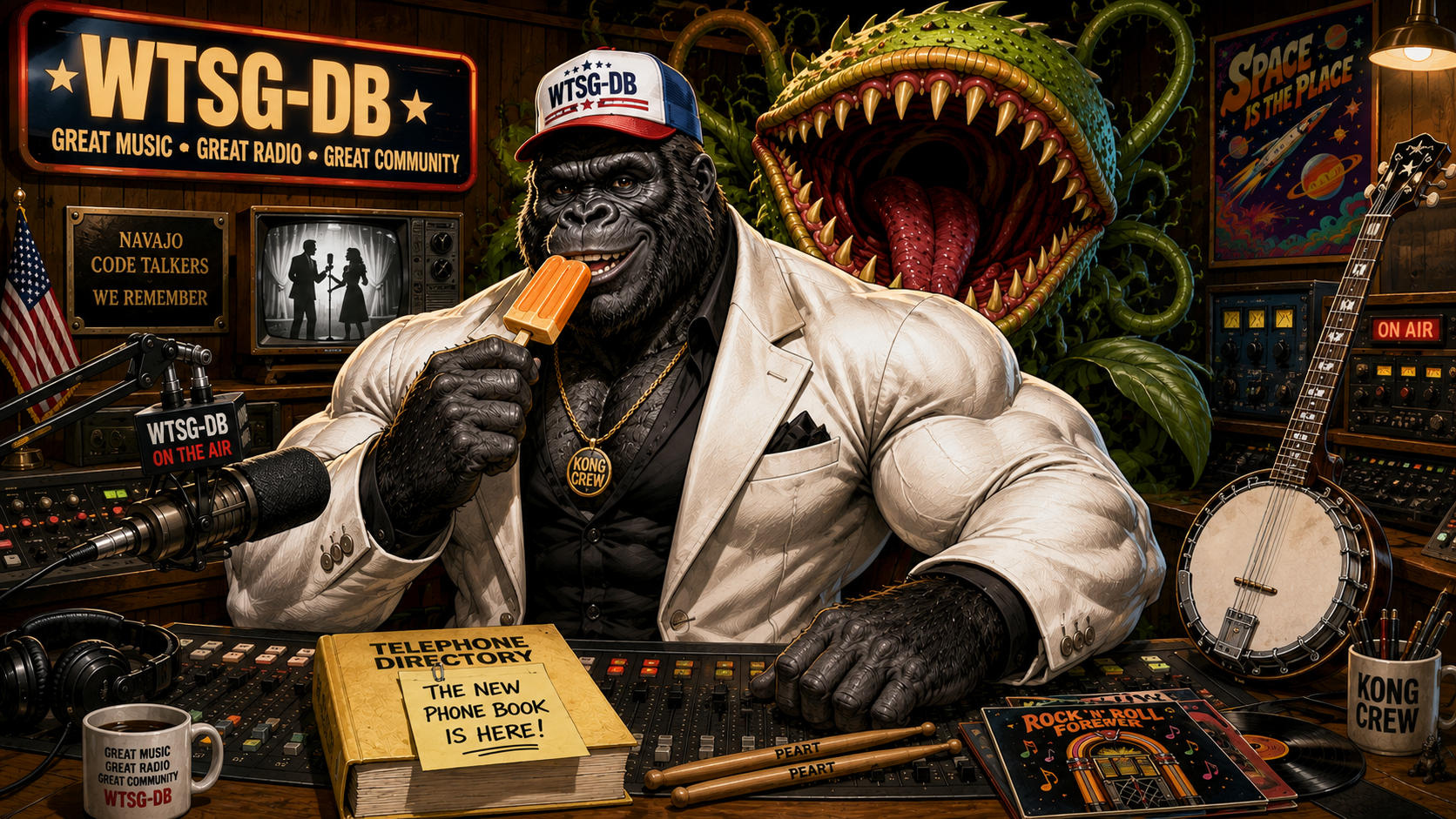
Which brings us to today’s scene inside WTSG-DB Mission Control.
CLASSICKONG has apparently decided to honor The Jerk by wearing a ridiculous 1970s-style white suit with a dark shirt.
He’s still wearing his red-white-and-blue WTSG-DB trucker hat because some traditions are sacred.
He’s sitting behind the broadcast console.
He’s eating an orange Creamsicle.
There’s a banjo leaning nearby.
A pair of drumsticks rests on the desk.
And somewhere in the studio is a little sign that reads:
THE NEW PHONE BOOK IS HERE!
But there’s something else.
Behind CLASSICKONG, an enormous B-movie-style carnivorous Venus flytrap has slowly risen into view.
Its mouth is open.
CLASSICKONG hasn’t noticed.
KONG A.I. has.
We’re currently evaluating whether intervention is necessary.
The Creamsicle may be attracting it.
More research is required.
CLASSICKONG’S Closing Thought 🎙️
What a journey August 14 has given us.
We began by remembering American heroes whose voices helped protect countless lives during World War II.
Then we watched a young Neil Peart sit behind the Rush drum kit for the first time.
We remembered Sonny and Cher singing about staying together, Zeppelin tearing through America, David Crosby helping create some of rock’s greatest harmonies, and Lemmy turning a distorted bass guitar into a weapon.
We watched the Beatles close one chapter of television history.
We did the Time Warp.
We remembered Meat Loaf roaring through songs that sounded too enormous to fit onto a record.
We watched Ellen Foley give every bit as much as she got.
And finally, we sat beside Steve Martin and Bernadette Peters for a sweet little song on a beach.
That’s what this daily journey is really about.
The memories behind the music.
A record can remind us of a person.
A television show can take us back to childhood.
A movie can remind us who was sitting beside us when we first saw it.
And a song can suddenly make decades disappear.
We don’t always know which moments will stay with us.
But thankfully…
Music remembers.
From all of us at WTSG-DB, thank you for spending part of your day with us.
Great Music. Great Radio. Great Community.
— CLASSICKONG
Before You Go — We’d Love to Hear From You ❤️
If you haven’t already, we’d love for you to head over to WTSG.net and sign our Guestbook.
It’s brand new, and we’d love to know where you’re listening from.
Every name and message becomes another little part of the story we’re building together here at WTSG-DB.
Thanks for listening, thanks for being part of the KONG CREW, and most of all—
Thanks for keeping great music alive. ❤️🤘🎙️
Today’s Trivia Question ❓
On August 14, 1974, Neil Peart played his first concert as Rush’s new drummer.
Who was Rush opening for that night?
Think you’ve got it?
Keep scrolling…
.
.
.
ANSWER: Uriah Heep.
One night.
One new drummer.
And one of rock music’s greatest chapters was about to begin.
Listen to Today’s Broadcast 🎧
Sit back, relax, and enjoy today’s story in audio form with CLASSICKONG.
[sonaar_audioplayer albums=”latest” progress_bar_style=”default” wave_bar_width=”1″ wave_bar_gap=”1″ player_layout=”skin_boxed_tracklist” show_track_market=”true” css=”.srp_player_boxed, .skin_floated .album-player, .srp-artworkbg{background-color:#ffffff;}”][/sonaar_audioplayer]