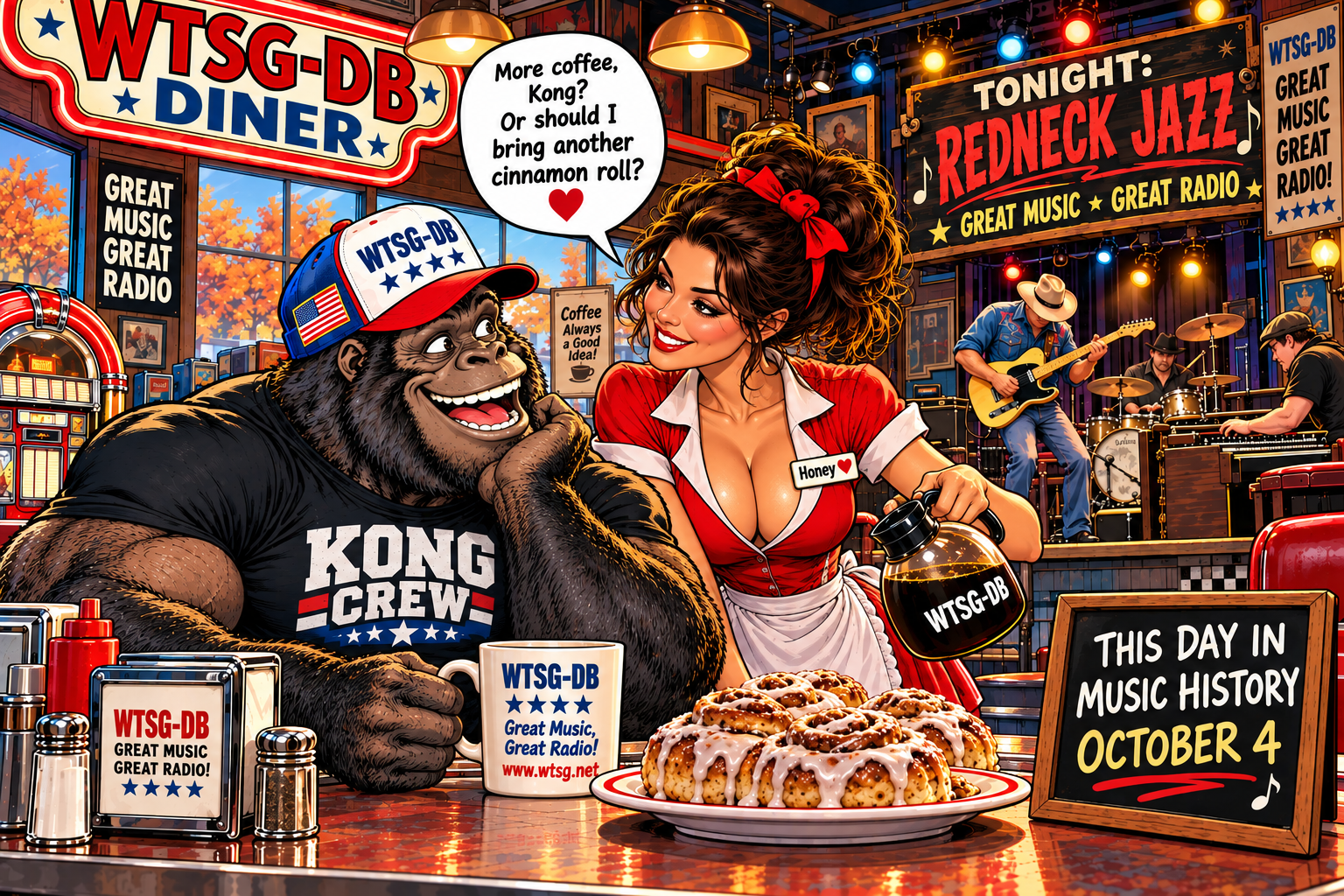
From the Desk of CLASSICKONG
Welcome back, music lovers, to another trip through the records, artists and moments that built the soundtrack of our lives.
Before we spin the first record, WTSG-DB proudly sends our thanks to the men and women of the United States Armed Forces—past and present—and to the families who stand beside them. Your service and sacrifice are never forgotten.
Today’s National Days
October 4 is World Animal Day and National Cinnamon Roll Day.
Now THERE’S a combination CLASSICKONG can support.
Be kind to the animals…
and somebody pass the cinnamon rolls.
We’ll provide the coffee.
October has settled in, the coffee is hot, and October 4 gives us one heck of a musical road to travel.
Today we’ll find The Beatles on one of Britain’s coolest television programs, Cream beginning to say goodbye while four other musicians prepare to become Led Zeppelin, Creedence Clearwater Revival and The Beatles ruling the album charts, Queen proving that sometimes the quiet guy writes the monster hit, and Van Halen appearing twice on the same date—nineteen years apart.
We’ll also spend some time with Dream Theater, Dio and Exodus, celebrate some birthdays, remember Janis Joplin, and discover an extraordinary guitarist named Danny Gatton who described his musical melting pot with two words I absolutely love:
“Redneck jazz.”
Grab another cup.
Let’s spin some history.
The Beatles Are Ready to Go
October 4, 1963
We’ve been here before.
Just a few days ago, we were talking about “Twist and Shout,” the Isley Brothers, The Beatles and Chubby Checker’s completely different hit “The Twist.”
Funny how music history circles back around.
On October 4, 1963, The Beatles made their first appearance on the British television program Ready Steady Go!
John Lennon, Paul McCartney, George Harrison and Ringo Starr mimed “Twist and Shout” from Please Please Me (1963, Parlophone), “I’ll Get You” (1963, Parlophone), and “She Loves You” (1963, Parlophone).
And here’s where this story gets really interesting.
One of the guest presenters was Dusty Springfield.
For anyone unfamiliar with Dusty, don’t let that name simply pass by.
Dusty had already become well known as a member of The Springfields and was about to launch one of the great British solo careers of the 1960s. Before long, that unmistakable voice would give us records including “I Only Want to Be with You,” “You Don’t Have to Say You Love Me,” and later “Son of a Preacher Man” from Dusty in Memphis (1969, Atlantic).
Dusty Springfield wasn’t merely somebody standing around interviewing The Beatles.
She was a serious talent who was about to become a huge star herself.
But there’s another remarkable connection from that October afternoon.
During the program, Paul McCartney judged a competition in which teenage girls mimed to a Brenda Lee record.
Paul selected a young girl named Melanie Coe as the winner.
Remember that name.
Several years later, McCartney read a newspaper story about a teenage girl who had run away from home. That story helped inspire John Lennon and Paul McCartney to write the beautiful “She’s Leaving Home” from Sgt. Pepper’s Lonely Hearts Club Band (1967, Parlophone).
The girl in the newspaper was Melanie Coe.
Paul initially didn’t realize she was the same girl he’d met years earlier.
What a song “She’s Leaving Home” is.
And here’s a CLASSICKONG recommendation.
If you’ve never heard Al Jarreau’s version of “She’s Leaving Home” from All Fly Home (1978, Warner Bros.), seek it out.
Jarreau takes an already beautiful Lennon-McCartney composition and makes it his own.
It can bring tears to your eyes.
Sometimes a great song doesn’t belong to only one generation.
It just keeps finding new voices.
October 4, 1968 — One Goodbye and One Beginning
Now THIS is one hell of a coincidence.
On October 4, 1968, two enormously important chapters in heavy rock were moving in opposite directions.
Cream Begins Saying Goodbye
Cream opened its farewell tour at the Oakland Coliseum Arena in California.
In only a few years together, Eric Clapton, Jack Bruce and Ginger Baker had pushed blues, rock and improvisation into some very heavy territory.
But the volume, touring and tensions within the group had taken their toll.
Their Oakland performance included “White Room” and “Crossroads” from Wheels of Fire (1968, Atco), “Sunshine of Your Love” from Disraeli Gears (1967, Atco), and “Spoonful” from Fresh Cream (1966, Atco).
Fortunately, tape was rolling.
Recordings from Oakland became part of Cream’s official live legacy, and decades later the performance received a much more complete release as part of Goodbye Tour – Live 1968.
Cream was preparing to leave.
Meanwhile, across the Atlantic…
The New Yardbirds Hit the Road
That same night, Jimmy Page, Robert Plant, John Paul Jones and John Bonham began their first UK tour at the Mayfair Ballroom in Newcastle upon Tyne.
But there was one small detail.
They weren’t yet being advertised as Led Zeppelin.
They were still being billed as The New Yardbirds.
Think about that lineup.
Jimmy Page.
Robert Plant.
John Paul Jones.
John Bonham.
Everything was already there except the name.
Within months, Led Zeppelin (1969, Atlantic) would arrive and rock music would never sound quite the same.
So on October 4, 1968, Cream began its farewell tour while the four musicians who would become Led Zeppelin began their first British tour together.
One giant was heading toward the exit.
Another monster was waking up.
Abbey Road and Green River Rule the Charts
October 4, 1969
One year later, two monumental albums were sitting atop the charts on opposite sides of the Atlantic.
In Britain, The Beatles’ Abbey Road (1969, Apple) reached No. 1.
We’ve spent plenty of time around here with this album.
And yes, Professor CLASSICKONG has already investigated those infamous “Paul Is Dead” clues.
Case closed?
Probably.
Maybe.
We’re keeping the file cabinet unlocked.
Meanwhile, Creedence Clearwater Revival’s Green River (1969, Fantasy) began a four-week run atop the U.S. album chart.
That album gave us “Green River,” “Bad Moon Rising,” and one of John Fogerty’s great portraits of frustration and life away from the spotlight, “Lodi,” all from Green River (1969, Fantasy).
The Beatles at No. 1 in Britain.
CCR at No. 1 in America.
Imagine walking into the record store that weekend.
Janis Joplin — One of the Originals
October 4, 1970
Janis Joplin died on this date in 1970.
She was only 27 years old.
The circumstances of Janis’ death have been documented countless times.
Today, we’re more interested in talking about what happened while she was here.
Because Janis Joplin mattered.
Long before “women in rock” became its own conversation, women like Grace Slick and Janis Joplin were already standing at the front of some of America’s most powerful rock bands.
They weren’t waiting for somebody to create a place for women in rock and roll.
They were already helping shape the music.
And Janis created a blueprint that became unmistakable afterward.
She could be loud.
Raw.
Sexual.
Funny.
Vulnerable.
Wounded.
Powerful.
And completely uninhibited.
She didn’t walk onto a rock stage and try to fit comfortably into somebody else’s idea of how a female singer should behave.
She let it all hang out.
And generations of women followed.
Every generation produced women who found their own voices and pushed rock in different directions. But every once in a while, it’s worth looking backward and remembering who was already kicking those doors open in the 1960s.
Grace Slick was there.
Janis Joplin was there.
They were among the originals.
And Janis’ voice?
There was nothing careful about it.
She could sound powerful and absolutely heartbroken during the same song.
Only three days before her death, Janis stepped to a microphone and recorded “Mercedes Benz,” later released on Pearl (1971, Columbia).
No elaborate arrangement.
No wall of instruments.
Just Janis.
Pearl was released posthumously in January 1971 and also included “Me and Bobby McGee” from Pearl (1971, Columbia), which became a No. 1 single.
Janis Joplin’s life was painfully short.
Her influence wasn’t.
If imitation really is the highest form of flattery, Janis has received an awful lot of compliments over the past half-century.
Give her the credit.
Rest in peace, Janis.
October 4 and Van Halen — Nineteen Years Apart
Van Halen appears twice in today’s story.
And the two events happened exactly nineteen years apart.
October 4, 1977 — The Dynamite Is Packed
Recording sessions for Van Halen’s debut album concluded at Sunset Sound Recorders in Hollywood on October 4, 1977.
The result was Van Halen (1978, Warner Bros.).
“Runnin’ with the Devil.”
Van Halen (1978, Warner Bros.).
“Ain’t Talkin’ ’bout Love.”
Van Halen (1978, Warner Bros.).
“Jamie’s Cryin’.”
Van Halen (1978, Warner Bros.).
And then there was “Eruption.”
Good grief.
Eddie Van Halen didn’t invent every guitar technique heard on that recording, but the way he combined tapping, speed, articulation, tone and musical personality made guitar players everywhere stop and ask:
“What in the hell was THAT?”
Then add David Lee Roth’s personality, Michael Anthony’s bass and unmistakable backing vocals, and Alex Van Halen absolutely pounding those drums.
The album eventually earned Diamond certification in the United States.
October 4 wasn’t the day Van Halen hit the stores.
It was the day the recording sessions ended.
The dynamite had been packed.
All Warner Bros. had to do was light the fuse.
October 4, 1996 — Enter Gary Cherone
Exactly nineteen years later, Eddie and Alex Van Halen appeared on Los Angeles radio station KLOS and announced Van Halen’s new lead singer.
Gary Cherone.
And let’s get something straight.
Gary Cherone could SING.
Extreme became enormously famous in the mainstream for the beautiful acoustic ballad “More Than Words” from Pornograffitti (1990, A&M).
Great song.
But if that’s all you know about Extreme, you don’t really know Extreme.
That band could ROCK.
Gary Cherone was a legitimate hard-rock frontman, and Nuno Bettencourt was—and remains—an absolute monster guitar player.
Extreme could mix hard rock, funk, harmony and serious musicianship into the same record.
Cherone’s tenure with Van Halen produced one studio album, Van Halen III (1998, Warner Bros.).
It wasn’t a long chapter in Van Halen history.
But on October 4, 1996, one hell of a singer landed one hell of a job.
Nineteen years earlier, Van Halen was finishing the record that introduced them to the world.
Now they were trying to begin again.
Same date.
Very different Van Halen.
John Deacon Makes Queen Bite the Dust
October 4, 1980
Listen to this:
Dum…dum…dum…
You already know the song.
Queen’s “Another One Bites the Dust” from The Game (1980, Elektra) reached No. 1 on the Billboard Hot 100.
And the man responsible was Queen’s famously quiet bass player:
John Deacon.
In a band containing one of rock’s greatest frontmen in Freddie Mercury, Brian May’s unmistakable guitar sound and Roger Taylor’s powerful drumming and voice, Deacon didn’t need to compete for the spotlight.
He simply wrote songs.
And occasionally he wrote monsters.
“Another One Bites the Dust” is built around one of the most recognizable bass lines in popular music.
You barely need two seconds.
Deacon also wrote Queen favorites including “You’re My Best Friend” from A Night at the Opera (1975, Elektra) and “I Want to Break Free” from The Works (1984, Capitol).
The quiet guy wasn’t merely holding down the bottom.
He was writing hits.
“Another One Bites the Dust” spent three weeks at No. 1 in America.
Take a bow, Mr. Deacon.
Dream Theater Awakens
October 4, 1994
Progressive metal fans received a serious piece of work when Dream Theater released Awake (1994, EastWest).
This was the band’s third studio album and the final Dream Theater studio album featuring original keyboardist Kevin Moore.
And Kevin sometimes gets lost in the shuffle when people discuss Dream Theater today.
He shouldn’t.
Moore helped establish the keyboard sound of early Dream Theater and was part of the band for When Dream and Day Unite (1989, Mechanic), the breakthrough Images and Words (1992, Atco), and Awake (1994, EastWest).
After Kevin came Derek Sherinian, another terrific player.
Then came Jordan Rudess, whose extraordinary technical ability has become an enormous part of Dream Theater’s modern identity.
Around here, we’ve always had a particular soft spot for the Kevin Moore and Derek Sherinian eras.
Awake gave us “6:00,” “Caught in a Web,” “The Mirror,” “Lie,” and “Space-Dye Vest,” all from Awake (1994, EastWest).
Odd meters.
Extended arrangements.
Heavy riffs.
Virtuoso musicianship.
Dream Theater was never interested in giving you three chords and getting out of the way.
And behind that enormous drum kit sat Mike Portnoy, one of progressive metal’s defining drummers, driving all those shifting meters while never losing the muscle underneath them.
CLASSICKONG Must Haves — Dream Theater
Images and Words — 1992 — Atco
Awake — 1994 — EastWest
Metropolis Pt. 2: Scenes from a Memory — 1999 — Elektra
Six Degrees of Inner Turbulence — 2002 — Elektra
Progressive metal with absolutely no fear of taking the long way home.
Ronnie James Dio and Angry Machines
Also on October 4, 1996, Dio released Angry Machines (1996, Mayhem).
Our man Ronnie.
By this point, Ronnie James Dio had already built a career most singers could only dream about.
Elf.
Rainbow.
Black Sabbath.
Dio.
By 1996, the musical landscape had changed dramatically from the heavy-metal world of the previous decade.
Ronnie kept going.
Angry Machines included “Institutional Man,” “Don’t Tell the Kids,” “Hunter of the Heart,” and “This Is Your Life,” all from Angry Machines (1996, Mayhem).
Trends come.
Trends go.
Ronnie James Dio remained Ronnie James Dio.
Around here, that means something.
CLASSICKONG Must Haves — Dio
Holy Diver — 1983 — Warner Bros.
The Last in Line — 1984 — Warner Bros.
Sacred Heart — 1985 — Warner Bros.
Dream Evil — 1987 — Warner Bros.
Turn it up.
RIP Ronnie.
Ozzy Has Had Enough
October 4, 1999
This one makes us laugh.
After Black Sabbath had repeatedly been nominated for the Rock & Roll Hall of Fame without being inducted, Ozzy Osbourne finally had enough.
His message essentially came down to:
Take our name off the list.
Ozzy argued that the nomination was meaningless to him because it wasn’t decided by the fans who had supported Black Sabbath and its music.
Now…
CLASSICKONG may have expressed an opinion or two about the Rock & Roll Hall of Fame over the years.
So we’ll simply say:
We understand the frustration, Ozzy.
But here’s the funny ending.
Black Sabbath was finally inducted in 2006.
And yes…
Ozzy showed up.
So did Tony Iommi, Geezer Butler and Bill Ward.
And who inducted Black Sabbath?
James Hetfield and Lars Ulrich of Metallica.
Metallica performed Sabbath music in tribute while Black Sabbath accepted the honor.
Seven years after telling the Hall to take their name off the list, Ozzy walked through the door.
Never say never.
Exodus — Don’t Forget Who Was There
October 4, 2005
Time for some thrash.
Exodus released Shovel Headed Kill Machine (2005, Nuclear Blast).
The record represented a substantially different Exodus lineup.
Rob Dukes was now behind the microphone, Lee Altus joined Gary Holt on guitar, and former Slayer drummer Paul Bostaph was behind the kit.
The album included “Raze,” “Karma’s Messenger,” “Shudder to Think,” and “Shovel Headed Kill Machine,” all from Shovel Headed Kill Machine (2005, Nuclear Blast).
But talking about Exodus gives us an opportunity to clear something up.
You’ve probably heard of thrash metal’s so-called “Big Four.”
Metallica.
Megadeth.
Slayer.
Anthrax.
And there’s absolutely no questioning the importance of those four bands.
But don’t make the mistake of thinking the phrase “Big Four” means those were the only bands responsible for creating thrash metal.
Because there’s another name that belongs very close to the beginning of this story:
Exodus.
Exodus formed in the San Francisco Bay Area before Metallica relocated there.
And here’s another connection.
Before Kirk Hammett joined Metallica, he was a founding member of Exodus.
Exodus helped establish the Bay Area thrash-metal scene, and their debut album Bonded by Blood (1985, Torrid) became one of the genre’s foundational records.
There will probably never be universal agreement about who “invented” thrash metal.
Music doesn’t usually develop that neatly.
But you cannot honestly tell the story of thrash metal’s birth without talking about Exodus.
Gary Holt has even argued that instead of a Big Four, perhaps we ought to be talking about a Big Five.
Around here, we’re not interested in rewriting history.
We’re interested in making sure everybody who helped write it gets mentioned.
Call Metallica, Megadeth, Slayer and Anthrax the Big Four if you like.
But if you’re talking about where thrash came from and Exodus isn’t in the conversation…
you’re leaving out one hell of an important chapter.
CLASSICKONG Must Haves — Exodus
Bonded by Blood — 1985 — Torrid
Pleasures of the Flesh — 1987 — Combat
Fabulous Disaster — 1989 — Combat
Tempo of the Damned — 2004 — Nuclear Blast
Shovel Headed Kill Machine — 2005 — Nuclear Blast
Give Exodus their due.
Danny Gatton — Redneck Jazz and The Humbler
October 4, 1994
Every once in a while, researching This Day in Music History introduces us to somebody who makes us stop and say:
“How in the world did I miss this guy?”
Danny Gatton is one of those musicians.
Gatton was a guitarist’s guitarist—a Telecaster master capable of moving through country, jazz, blues, rockabilly and rock almost effortlessly.
He worked with artists including Robert Gordon and Roger Miller and later recorded with Hammond B3 monster Joey DeFrancesco.
And you know we love Joey around here.
Give that man a Hammond B3 and a Leslie cabinet and get out of the way.
Gatton’s influences included some serious company:
Chet Atkins.
Les Paul.
Scotty Moore.
Charlie Christian.
And Merle Travis.
That last name especially caught our attention.
Merle Travis’ guitar playing was also a major influence on my dad.
Gatton sometimes described the musical stew he created from those influences with a term that sounds like something Dad might have said himself:
“Redneck jazz.”
I love that.
Gatton became so respected among musicians that he earned the nickname “The Humbler.”
Think about the musicians who surround a guy like this.
When people who can really play start talking about how well you can play…
pay attention.
His 1991 album 88 Elmira St. (1991, Elektra) earned a Grammy nomination, yet widespread mainstream fame never quite caught up with Gatton’s reputation among fellow musicians.
Danny Gatton died on October 4, 1994.
He was only 49.
We’ll leave the circumstances there.
Today we’d rather celebrate what the man did while he was here.
He left behind his wife Jan, daughter Holly and one extraordinary musical reputation.
And if, like us, you’re discovering Danny Gatton today, there’s something else worth seeking out.
The Humbler – Danny Gatton is a documentary built around archival footage and interviews, with the support and participation of Jan and Holly and musicians who understood exactly how special Danny was.
That’s going on our watch list.
Sometimes This Day in Music History isn’t about revisiting somebody we’ve loved for fifty years.
Sometimes it’s about finding somebody we should have heard fifty years ago.
Today, Danny Gatton is that guy.
CLASSICKONG Must Haves — Danny Gatton
Redneck Jazz — 1978 — NRG
Unfinished Business — 1987 — NRG
88 Elmira St. — 1991 — Elektra
Cruisin’ Deuces — 1993 — Elektra
Relentless with Joey DeFrancesco — 1994 — Big Mo
If “redneck jazz” doesn’t make you curious enough to hit PLAY, I don’t know what will.
RIP Danny.
October 4 Birthdays
Leroy Van Dyke — Born October 4, 1929
Happy birthday to country singer Leroy Van Dyke.
Van Dyke became famous with “The Auctioneer” (1956, Dot), inspired by his auctioneer cousin Ray Sims.
Then came the enormous “Walk on By” (1961, Mercury).
And no—this is not the Burt Bacharach and Hal David song that Dionne Warwick would record a few years later.
Completely different song.
Leroy Van Dyke’s “Walk on By,” written by Kendall Hayes, became a country phenomenon, spending an extraordinary 19 weeks at No. 1.
Before show business, Van Dyke studied agriculture and journalism at the University of Missouri and served in the U.S. Army Counter-Intelligence Corps during the Korean War.
Country singer.
Journalist.
Soldier.
And, appropriately enough, an actual auctioneer.
Happy birthday, Leroy.
Jim Fielder — Born October 4, 1947
Bassist Jim Fielder became an important member of the classic Blood, Sweat & Tears lineup.
That means you’re hearing him in the rhythm section on music including “Spinning Wheel” from Blood, Sweat & Tears (1968, Columbia).
Fielder’s résumé also includes early connections with Buffalo Springfield and Frank Zappa’s Mothers of Invention.
That’s one heck of a musical road.
And yes…
CLASSICKONG always notices the bass player.
Jody Stephens — Born October 4, 1952
Happy birthday to drummer Jody Stephens of Big Star.
And if you’re sitting there saying:
“Big Star? I don’t know Big Star.”
Here’s your doorway.
Big Star was a Memphis rock band built around melody, jangling guitars, strong vocal harmonies and enormous hooks, drawing from The Beatles, The Byrds, British Invasion rock and the musical atmosphere of Memphis.
Today they’re widely regarded as one of the foundational bands of what became known as power pop.
But here’s a connection you probably DO know.
Big Star singer and guitarist Alex Chilton had previously been the teenage lead singer of The Box Tops.
Remember “The Letter”?
“Gimme a ticket for an aeroplane…”
THAT’S Alex Chilton.
Now we’ve got you.
Big Star never achieved anything close to the commercial success their music deserved during their original run. Distribution problems made their records notoriously difficult to find.
But musicians found them.
And those musicians told other musicians.
Over time, Big Star became enormously influential, with artists including R.E.M., The Replacements, The Bangles and Teenage Fanclub among those associated with their musical legacy.
The Replacements even recorded a song called “Alex Chilton.”
If you’re discovering Big Star today, try “The Ballad of El Goodo,” “Thirteen,” and “In the Street” from #1 Record (1972, Ardent), followed by “September Gurls” from Radio City (1974, Ardent).
Sometimes the record that doesn’t sell millions is the record that inspires the people who eventually do.
And behind those Big Star records was drummer Jody Stephens.
Happy birthday, Jody.
CLASSICKONG Must Haves — Big Star
#1 Record — 1972 — Ardent
Radio City — 1974 — Ardent
Third/Sister Lovers — 1978 — PVC
Start with #1 Record.
Then keep going.
Chris Lowe — Born October 4, 1959
Happy birthday to Chris Lowe of Pet Shop Boys.
Lowe and Neil Tennant created one of the defining synth-pop partnerships of the 1980s.
Tennant generally stood out front delivering those unmistakably dry vocals while Lowe stood behind the keyboards looking like absolutely nothing happening around him could possibly impress him.
And somehow…
that became part of the magic. 😂
Together they gave us records including “West End Girls” from Please (1986, Parlophone), “It’s a Sin” from Actually (1987, Parlophone), “Always on My Mind” from Introspective (1988, Parlophone), and “Being Boring” from Behaviour (1990, Parlophone).
Electronic music.
Great melodies.
Smart songwriting.
And a wonderfully British sense of cool.
Happy birthday, Chris.
CLASSICKONG Must Haves — Pet Shop Boys
Please — 1986 — Parlophone
Actually — 1987 — Parlophone
Introspective — 1988 — Parlophone
Behaviour — 1990 — Parlophone
Very — 1993 — Parlophone
That’s one heck of a five-album run.
Jon Secada — Born October 4, 1961
Happy birthday to Jon Secada.
Born in Havana, Cuba, Secada built a career combining pop, soul, R&B and Latin influences.
His breakthrough included “Just Another Day” from Jon Secada (1992, SBK).
Before establishing his solo career, Secada worked extensively with Gloria Estefan as a backing vocalist and songwriter.
He would go on to win two Grammy Awards and work with artists ranging from Frank Sinatra to Olivia Newton-John.
That’s some serious company.
Happy birthday, Jon.
Final Spin
There’s a funny thing about music history.
Fame and influence aren’t always the same thing.
Sometimes the person who changes the music isn’t the person whose name history prints in the biggest letters.
John Deacon didn’t need to stand at the front of Queen to write a bass line recognized around the world.
Kevin Moore doesn’t need to be Dream Theater’s current keyboard player for his fingerprints to remain all over the foundation of that band.
Exodus doesn’t need to be included in a marketing nickname for us to recognize that they were standing there when thrash metal was being born.
Danny Gatton didn’t need stadiums full of people to earn the nickname “The Humbler” from musicians who understood what he could do with a guitar.
And Janis Joplin didn’t need anybody’s permission to walk onto a rock-and-roll stage, take command of the room and leave absolutely nothing behind.
Neither did Grace Slick.
They were already doing it.
Sometimes history catches up.
Sometimes it doesn’t.
Maybe that’s part of our responsibility as music fans.
Not simply remembering who sold the most records.
Not simply repeating whichever names somebody decided belong on a list.
Listen.
Discover.
Ask questions.
And when somebody deserves their flowers…
give them their flowers.
Because there will always be another great musician we somehow missed along the way.
Another record we haven’t heard.
Another story we didn’t know.
And sometimes all it takes is hearing one song to wonder where that music has been all our lives.
Music history doesn’t always get everything right the first time.
Sometimes you’ve got to go back, listen again and give credit where credit is due.
And if some committee somewhere doesn’t agree?
Well…
Ozzy probably had the right idea.
Take us off your bloody list.
Until tomorrow, take care of yourself, take care of others, and keep the music playing.
We’ll see you down the road.
Listen to Today’s Broadcast/Podcast
Want to hear today’s stories instead of reading them?
Join CLASSICKONG and WTSG-DB for the spoken-word edition of This Day in Music History, where we take another trip through the artists, records and moments that built the soundtrack of our lives.
Great Music. Great Radio.
WTSG-DB
References
The Beatles Bible — The Beatles on Ready Steady Go!, October 4, 1963
The Paul McCartney Project — Ready Steady Go!, October 4, 1963
Grand Ole Opry — Leroy Van Dyke
GRAMMY — Thrash Metal and the Big Four
Rock & Roll Hall of Fame — Black Sabbath