
From the Desk of CLASSICKONG
Good morning, music lovers, and welcome to another edition of This Day in Music History from WTSG Digital Broadcasting.
Before we turn the first record today, we send our thanks and respect to the men and women of the United States Armed Forces — past and present. Your service and sacrifice are never forgotten here at WTSG-DB. 🇺🇸
September 13 gives us one of those days where the deeper we dig, the more roads begin to appear.
KISS brings the fire. Lynyrd Skynyrd takes us inside Atlanta’s Fox Theatre. The Isley Brothers reach the top. Bill Monroe takes us back to the roots of bluegrass. John Lennon assembles a band almost overnight. King Diamond opens the doors to the House of Amon.
And then there are birthdays belonging to Dave Mustaine, Vinny Appice, Peter Cetera, Don Was and Mel Tormé.
But before any of that, today gives us an opportunity to remember some of the people who helped us find our way.
National Grandparents Day — The People Who Help Give Us Our Compass
Today, September 13, is National Grandparents Day, observed each year on the first Sunday following Labor Day.
This one means something to me.
My grandparents helped raise me. They came from a generation very different from mine, but so many of the lessons they taught me never became outdated.
Work hard.
Respect people.
Take responsibility.
Keep your word.
Do the right thing even when nobody is watching.
My grandparents were more than family.
They were a compass.
Every family story is different, and not everyone had the same relationship with their grandparents. But if you were fortunate enough to have grandparents, parents, teachers, mentors or other people who helped point you in the right direction, today is a good day to remember them.
And if some of those people are part of your life today, give them their roses. 🌹
Tell them what they mean to you.
KISS — Animalize Brings the Fire
On September 13, 1984, KISS released Animalize in the United States through Mercury/PolyGram.
It was the band’s 12th studio album and arrived during a period of almost constant change in the KISS guitar position.
Animalize became the only KISS studio album to feature Mark St. John as lead guitarist. Paul Stanley handled much of the album’s production while Gene Simmons was increasingly occupied with projects outside the band.
The record’s signature song became “Heaven’s on Fire,” with other standouts including “I’ve Had Enough (Into the Fire),” “Under the Gun,” and “Thrills in the Night.”
For those of us who grew up in the KISS Army, every era of this band tells a different story. The original lineup will always occupy its own special place, but Animalize helped prove that KISS could survive lineup changes, changing musical fashions and the very different landscape of 1980s rock.
Must-Have KISS
If you’re discovering KISS, start with:
- KISS (1974, Casablanca)
- Hotter Than Hell (1974, Casablanca)
- Alive! (1975, Casablanca)
- Destroyer (1976, Casablanca)
- Love Gun (1977, Casablanca)
- Creatures of the Night (1982, Casablanca)
- Animalize (1984, Mercury)
And yes, around here Alive! and Destroyer have some miles on them.
Lynyrd Skynyrd — One More from the Road
On September 13, 1976, Lynyrd Skynyrd released One More from the Road on MCA Records.
This wasn’t simply another live album.
The performances were recorded July 7–9, 1976, at Atlanta’s historic Fox Theatre, with legendary producer Tom Dowd overseeing the project.
The album captured the classic-era Skynyrd machine doing what it did best: playing live.
It also arrived during the only period when guitarist Steve Gaines shared the stage with Ronnie Van Zant and the band before the tragedy of October 1977.
The album became a cornerstone of the Skynyrd catalog and has been certified 3× Platinum by the RIAA.
There are plenty of studio records that tell you what Lynyrd Skynyrd was.
One More from the Road lets you hear what they felt like.
Must-Have Lynyrd Skynyrd
Start here:
- (Pronounced ‘Lĕh-‘nérd ‘Skin-‘nérd) (1973, MCA)
- Second Helping (1974, MCA)
- Nuthin’ Fancy (1975, MCA)
- Gimme Back My Bullets (1976, MCA)
- One More from the Road (1976, MCA)
- Street Survivors (1977, MCA)
If you want to understand one of America’s great rock bands, that’s a mighty good road to travel.
The Isley Brothers — The Heat Is On Reaches No. 1
Here’s an important date distinction.
The Isley Brothers released The Heat Is On on June 7, 1975, through T-Neck/Epic.
But on the Billboard chart dated September 13, 1975, the album reached No. 1, becoming the group’s first and only No. 1 album on the U.S. pop album chart.
And what an album.
One side hits with funk and rock muscle, while the other settles into some of the smoothest soul music of the decade.
You get “Fight the Power,” “The Heat Is On,” “For the Love of You,” “Sensuality,” and “Make Me Say It Again Girl.”
Then there’s Ernie Isley.
Listen closely to his guitar work and you understand why simply calling the Isleys an R&B vocal group doesn’t begin to describe them. Rock, funk, soul, gospel and beautiful harmony all lived under the same roof.
Must-Have Isley Brothers
A strong starting shelf:
- 3 + 3 (1973, T-Neck)
- Live It Up (1974, T-Neck)
- The Heat Is On (1975, T-Neck/Epic)
- Harvest for the World (1976, T-Neck)
- Go for Your Guns (1977, T-Neck)
- Showdown (1978, T-Neck)
If you’ve only heard the Isleys through their biggest singles, there’s a whole lot more waiting for you.
Bill Monroe — The Father of Bluegrass
William Smith Monroe was born September 13, 1911, near Rosine, Kentucky, and died September 9, 1996, at age 84.
Calling Bill Monroe influential almost seems inadequate.
He became known as the Father of Bluegrass Music, and his band, the Blue Grass Boys, helped give the entire genre its name.
Monroe was the youngest of eight children. Music surrounded his family, and one of the important figures in his development was his uncle, fiddler Pendleton “Uncle Pen” Vandiver.
After Monroe’s parents died while he was still young, Uncle Pen became an especially important influence.
Monroe eventually transformed the mandolin into a powerful lead instrument. Add his high, lonesome singing, hard-driving tempos and the remarkable musicians who passed through the Blue Grass Boys, and a new American musical language emerged.
That language would eventually reach far beyond bluegrass.
Country musicians heard it.
Rock musicians heard it.
Folk musicians heard it.
And generations of mandolin players certainly heard it.
Must-Have Bill Monroe
For a road into Monroe’s music:
- Knee Deep in Blue Grass (1958, Decca)
- I Saw the Light (1958, Decca)
- Mr. Blue Grass (1961, Decca)
- Bluegrass Ramble (1962, Decca)
- Uncle Pen (1972, Decca)
- Southern Flavor (1988, MCA)
For listeners wanting to go even deeper, collections of Monroe’s 1940s and 1950s recordings are essential because that’s where you’ll hear some of the music that helped establish the blueprint.
Bill, thank you for patiently waiting downstairs with that mandolin.
We got sidetracked.
The Toronto Rock & Roll Revival — One Wild Day in 1969
On September 13, 1969, Toronto’s Varsity Stadium hosted the Toronto Rock & Roll Revival.
And what a lineup.
Chuck Berry.
Little Richard.
Jerry Lee Lewis.
Bo Diddley.
Gene Vincent.
The Doors.
Chicago Transit Authority.
Alice Cooper.
Tony Joe White.
And then something historically important happened.
John Lennon arrived with a hastily assembled Plastic Ono Band featuring Eric Clapton on guitar, Klaus Voormann on bass and Alan White on drums, alongside Lennon and Yoko Ono.
They had barely rehearsed. In fact, much of their preparation took place acoustically during the flight to Toronto.
The performance was recorded and became Live Peace in Toronto 1969.
The Doors were there as well, performing material including “Break On Through,” “The Crystal Ship,” “Light My Fire,” and “The End.”
This wasn’t merely another festival.
It was one of those strange crossroads where the pioneers of early rock and roll, the stars of the 1960s and musicians who would shape the 1970s all occupied the same field.
The Beatles — America Gets “Yesterday” as a Single
On September 13, 1965, Capitol Records released “Yesterday” as a Beatles single in the United States, backed with “Act Naturally.”
Written by Paul McCartney but credited to Lennon–McCartney, “Yesterday” had already appeared on the Help! album.
The recording itself was unusual for the Beatles.
McCartney performed the vocal and acoustic guitar accompanied by a string quartet, without the other Beatles performing on the finished track.
It became one of the most frequently covered compositions in popular-music history.
And on the flip side?
Ringo Starr singing “Act Naturally,” the Johnny Russell and Voni Morrison composition previously made famous by Buck Owens.
That’s a pretty remarkable little piece of vinyl.
Must-Have Beatles
Trying to reduce the Beatles to a handful of records is almost silly, but for the newcomer:
- A Hard Day’s Night (1964)
- Help! (1965)
- Rubber Soul (1965)
- Revolver (1966)
- Sgt. Pepper’s Lonely Hearts Club Band (1967)
- The Beatles — “The White Album” (1968)
- Abbey Road (1969)
Then go backward, forward and sideways.
You’ll find something.
King Diamond — “Them”
On September 13, 1988, King Diamond’s “Them” received its U.S. release through Roadracer, following its earlier European release through Roadrunner.
This was King Diamond’s third studio album, following Fatal Portrait and the magnificent Abigail.
“Them” continued King’s gift for combining heavy metal with theatrical horror storytelling.
Songs such as “Welcome Home,” “The Invisible Guests,” “Tea,” and “The Accusation Chair” unfold as pieces of a larger narrative involving King, his grandmother and the mysterious forces inside the House of Amon.
The musicianship underneath the story is equally important. King Diamond records demand attention—not only because of King’s unmistakable voice, but because the arrangements, guitar work and shifting moods help turn the albums into something closer to heavy-metal theater.
Must-Have King Diamond
Start with:
- Fatal Portrait (1986)
- Abigail (1987)
- “Them” (1988)
- Conspiracy (1989)
- The Eye (1990)
And if you want the larger family tree, head backward into Mercyful Fate.
Dave Mustaine — A Thrash-Metal Original
Dave Mustaine was born September 13, 1961, in La Mesa, California.
After an early tenure with Metallica, Mustaine founded Megadeth, becoming one of thrash metal’s defining guitarists, songwriters and frontmen.
Whatever chapter of his career you’re discussing, that right hand is unmistakable.
The precision, aggression and complexity of Mustaine’s rhythm playing became part of Megadeth’s identity, while the band’s constantly evolving lineup produced some extraordinary musicians along the way.
Must-Have Megadeth
If you’re new to Megadeth:
- Peace Sells… but Who’s Buying? (1986, Capitol)
- So Far, So Good… So What! (1988, Capitol)
- Rust in Peace (1990, Capitol)
- Countdown to Extinction (1992, Capitol)
- Youthanasia (1994, Capitol)
Rust in Peace alone should keep the air-guitar department occupied for a while.
Vinny Appice — Power Behind the Kit
Born September 13, 1957, in Brooklyn, New York, drummer Vinny Appice became one of the great heavy-rock drummers of his generation.
And yes — the Appice family apparently received more than its fair share of drumming ability.
Vinny is the younger brother of legendary drummer Carmine Appice, but he carved out a formidable identity of his own.
Vinny joined Black Sabbath during the Ronnie James Dio era and played on Mob Rules before appearing on Live Evil.
When Dio left Sabbath and formed Dio, Vinny went with him.
That put his drums underneath some monumental heavy-metal records.
Essential Vinny Appice
Listen to:
- Black Sabbath — Mob Rules (1981, Warner Bros./Vertigo)
- Black Sabbath — Live Evil (1982, Warner Bros./Vertigo)
- Dio — Holy Diver (1983, Warner Bros.)
- Dio — The Last in Line (1984, Warner Bros.)
- Dio — Sacred Heart (1985, Warner Bros.)
- Heaven & Hell — The Devil You Know (2009, Rhino/Roadrunner)
Big drums. Big songs.
Legend.
Peter Cetera — Don’t Forget the Bass Player
Peter Cetera was born September 13, 1944, in Chicago, Illinois.
Most listeners immediately recognize the voice.
Cetera became one of the defining singers of Chicago, delivering vocals on records including “If You Leave Me Now,” “Hard to Say I’m Sorry,” and “You’re the Inspiration.”
But here’s something worth remembering:
Peter Cetera was also Chicago’s bass player.
And a very good one.
His melodic bass work can sometimes get overlooked because that unmistakable tenor voice became so famous, particularly as Chicago moved further toward ballads and adult-contemporary radio.
Cetera left Chicago in 1985 and built a successful solo career that included “Glory of Love” and “The Next Time I Fall,” his duet with Amy Grant.
Must-Have Peter Cetera / Chicago
For the Chicago years:
- Chicago Transit Authority (1969, Columbia)
- Chicago II (1970, Columbia)
- Chicago V (1972, Columbia)
- Chicago VII (1974, Columbia)
- Chicago X (1976, Columbia)
- Chicago 16 (1982, Full Moon/Warner Bros.)
- Chicago 17 (1984, Full Moon/Warner Bros.)
For solo Cetera:
- Solitude/Solitaire (1986, Warner Bros.)
Listen to the voice.
But every once in a while, turn your attention downward and listen to that bass.
Don Was — The Name You May Not Know Behind Music You Definitely Do
Here’s today’s rabbit hole.
Don Was, born Donald Fagenson on September 13, 1952, in Detroit, Michigan, is one of those people whose fingerprints are scattered across an enormous amount of music.
He grew up absorbing Detroit’s jazz, blues, soul and rock culture and eventually formed Was (Not Was) with longtime friend David Weiss, who became David Was.
No — they weren’t brothers.
Was (Not Was) became known internationally through songs such as “Walk the Dinosaur,” but stopping there misses much of the story.
Their 1988 album What Up, Dog? is an eclectic mixture of funk, soul, rock, dance music, jazz-minded weirdness and sharp songwriting.
And sometimes digging into music history sends you somewhere you weren’t expecting.
That’s exactly what happened while researching today’s show.
One question — “Who is Don Was?” — led back to “Walk the Dinosaur.” That led to What Up, Dog?. Then came “Spy in the House of Love.”
Fantastic.
Then “Somewhere in America There’s a Street Named After My Dad.”
Beautiful.
Before long, a copy of What Up, Dog? was ordered and Was (Not Was) had earned some serious consideration for WTSG-DB rotation.
That’s why we do these shows.
But Don Was’s story gets much bigger.
As a producer, he’s worked with artists including Bonnie Raitt, The Rolling Stones, Bob Dylan, The B-52s, Willie Nelson, Elton John, Iggy Pop, John Mayer and many others.
He helped produce Bonnie Raitt’s landmark Nick of Time and Luck of the Draw and became a longtime collaborator with the Rolling Stones.
In 2012, Don Was became president of Blue Note Records, bringing the story right back around to one of his earliest loves: jazz.
Must-Have Was (Not Was)
Start with:
- Was (Not Was) (1981)
- Born to Laugh at Tornadoes (1983)
- What Up, Dog? (1988)
- Are You Okay? (1990)
And from What Up, Dog?, don’t stop at “Walk the Dinosaur.”
Try “Spy in the House of Love” and “Somewhere in America There’s a Street Named After My Dad.”
Don Was — Behind the Glass
Then listen to some records bearing his production touch:
- Bonnie Raitt — Nick of Time (1989, Capitol)
- Bonnie Raitt — Luck of the Draw (1991, Capitol)
- The Rolling Stones — Voodoo Lounge (1994, Virgin)
Once you start looking for Don Was in album credits, you’ll be looking for quite a while.
Mel Tormé — Much More Than “The Velvet Fog”
Melvin Howard Tormé was born September 13, 1925, in Chicago, Illinois, and died June 5, 1999, at age 73.
Many people remember the nickname:
“The Velvet Fog.”
Tormé wasn’t particularly fond of it.
And reducing him to a smooth voice doesn’t come close to describing the musician.
Tormé was a singer, songwriter, arranger, composer, pianist and drummer. He began performing remarkably young, singing publicly at only four years old. By nine he was working in radio, and at 15 he had his first song published.
He later worked with Chico Marx’s band as a singer, arranger and drummer before forming the vocal group The Mel-Tones.
Then came one of the great songs in American popular music.
Tormé and Bob Wells wrote “The Christmas Song.”
Nat King Cole’s recording helped make it immortal.
That song alone would have secured Tormé a place in American songwriting history.
But there was much more.
As a vocalist, Tormé possessed tremendous control, rhythmic sophistication and the ability to improvise. He could swing, scat, phrase behind the beat and navigate complex harmony without losing the lyric.
One of his signature recordings became “Comin’ Home Baby,” a performance that helped demonstrate how naturally Tormé could move between jazz, pop and R&B territory.
Later in his career, something special happened when Tormé joined forces with pianist George Shearing.
Shearing’s rich chords, elegant progressions and unmistakable harmonic language left enormous room for a singer with Tormé’s ears and improvisational ability.
Their recordings weren’t simply a vocalist accompanied by a pianist.
They were conversations between two master musicians.
That partnership produced An Evening with George Shearing & Mel Tormé and Top Drawer, both of which earned Tormé Grammy Awards.
Across his career, Mel Tormé received 14 Grammy nominations and two wins.
And Shearing’s music brings back another memory for me.
When I was younger and still studying piano — although I suppose we’re always students — I had a George Shearing songbook.
Those chords.
Those progressions.
Beautiful music.
That appreciation never left.
Must-Have Mel Tormé
If you’d like to discover what made Tormé special, start with:
- Mel Tormé Sings Fred Astaire (1956)
- Mel Tormé and the Marty Paich Dek-Tette (1956)
- Mel Tormé Swings Shubert Alley (1960)
- Comin’ Home Baby! (1962)
- An Evening with George Shearing & Mel Tormé (1982, Concord Jazz)
- Top Drawer (1983, Concord Jazz)
And don’t overlook Tormé’s later Concord recordings. His voice matured, but the musicianship never went anywhere.
The deeper you dig into Mel Tormé, the less appropriate the word “crooner” begins to feel.
He was a jazz musician who happened to possess one extraordinary voice.
Dream Theater — A Dramatic Turn of Events
On September 13, 2011, Dream Theater released A Dramatic Turn of Events in North America through Roadrunner Records, following its September 12 European release.
It marked a genuine turning point for the band.
The album was Dream Theater’s first studio release following the departure of founding drummer Mike Portnoy, with Mike Mangini taking over the drum chair.
The record included “On the Backs of Angels” and reached the Top 10 of the Billboard 200.
Whatever side listeners took during that enormously emotional period in Dream Theater history, there’s no denying one thing:
They certainly gave the album an appropriate title.
A Dramatic Turn of Events indeed.
Birthday Turntable
A few more September 13 birthdays worth spinning:
Bill Monroe — born September 13, 1911; died September 9, 1996.
Mel Tormé — born September 13, 1925; died June 5, 1999.
Peter Cetera — born September 13, 1944.
Don Was — born September 13, 1952.
Vinny Appice — born September 13, 1957.
Dave Mustaine — born September 13, 1961.
Different generations. Different genres.
Bluegrass, jazz, rock, funk, metal and pop all sharing the same square on the calendar.
Final Spin
Maybe that’s what September 13 is really reminding us today: never forget where you came from, but never stop discovering where you might go next.
On National Grandparents Day, I can’t help but think about my own grandparents. They helped raise me, shaped the man I became, and gave me something I’ve carried throughout my life — a compass. They came from another time and another generation, but the lessons they taught me about hard work, respect, responsibility, and treating people right never went out of style.
Music works a little like that, too. We carry the records and artists we grew up loving, but there’s always another road waiting to be explored.
Sometimes all it takes is asking one simple question:
“Who is Don Was?”
Before long, an old song comes rushing back, a forgotten album gets rediscovered, and music that has been sitting there for decades suddenly feels brand new again.
That’s why we do these shows.
Remember the people who helped point you in the right direction.
Give them their roses. 🌹
Tell them what they mean to you, and thank them for the lessons, the stories and the love they gave you.
And keep exploring.
Keep asking questions.
Keep opening doors.
No matter how many miles you’ve traveled or how much music you’ve heard, never convince yourself that you’ve already heard everything worth hearing.
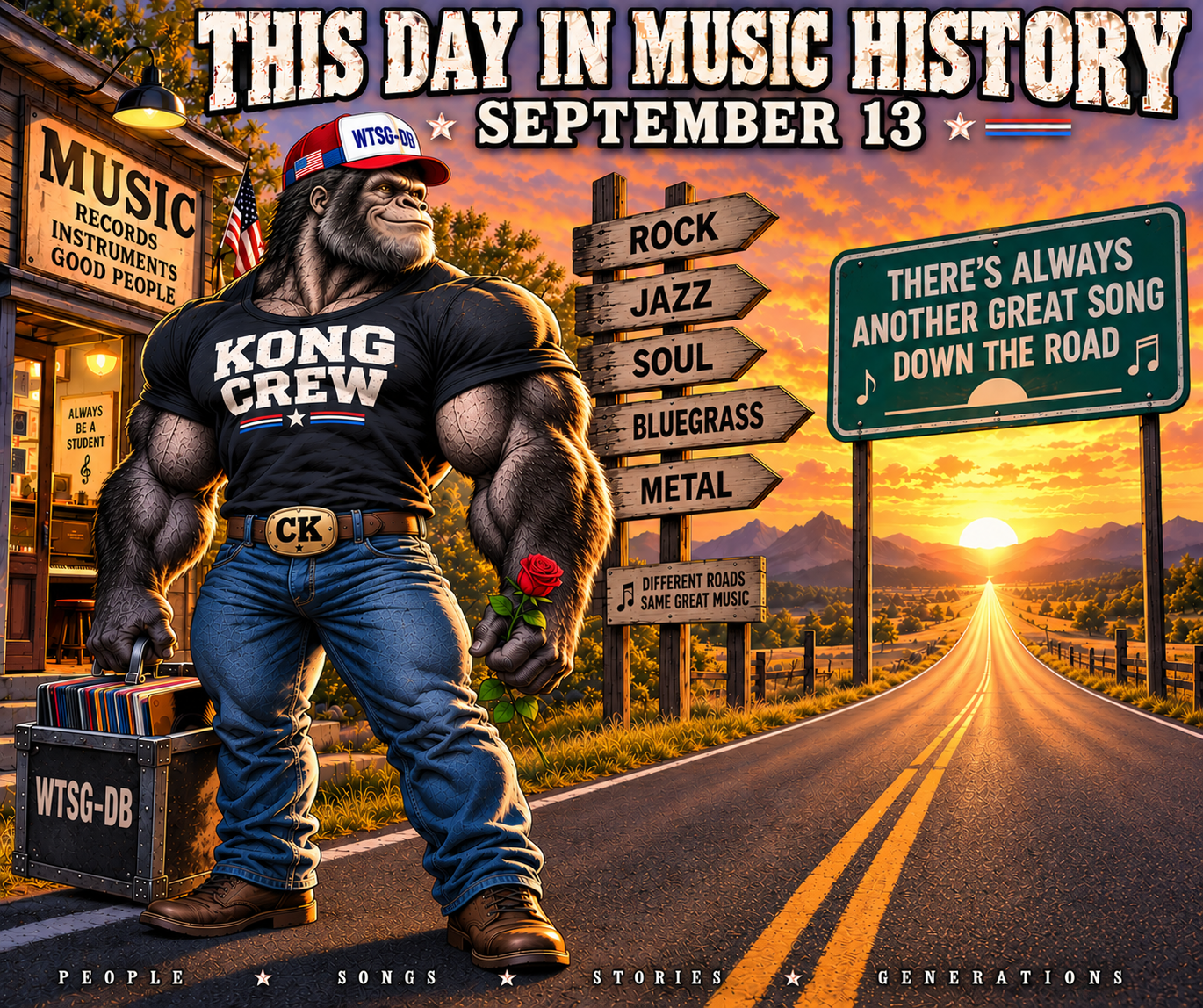
There is always another great song waiting somewhere down the road.
Until next time, keep listening, keep discovering, and keep the music playing.
— CLASSICKONG
Listen to Today’s Broadcast
Prefer to hear today’s trip through music history?
Listen to the WTSG-DB This Day in Music History Podcast and let CLASSICKONG take you through the stories behind the music.
And if you enjoy what we’re doing, share the show with another music lover.
Join the WTSG-DB Community
Music has always been better when people share it.
Stop by the WTSG-DB Guestbook and tell us what you’re listening to, share a memory, or simply say hello.
Great Music. Great Radio. Great Community.
WTSG Digital Broadcasting
Veteran-Owned Independent Radio 🇺🇸
References
- National Grandparents Day — Timeanddate.com
- KISS — Animalize Discography, KISS Concert History Online
- Lynyrd Skynyrd — Official Discography
- Bill Monroe — Country Music Hall of Fame and Museum
- The Beatles — “Yesterday”
- John Lennon — Live Peace in Toronto 1969
- King Diamond — “Them”
- The Isley Brothers — The Heat Is On
- Don Was — Detroit Historical Society
- Mel Tormé — Songwriters Hall of Fame
- Mel Tormé — Grammy Awards
- Peter Cetera — AllMusic Biography