From the Desk of CLASSICKONG 🦍🎙️
Good Thursday morning from all of us at WTSG-DB*, where the music never stops and the memories are always welcome.*
Before we turn up the volume today, we begin where we always should—with a heartfelt thank-you to the men and women of the United States Armed Forces.
To those serving today, to our veterans, and to the families who stand behind them: thank you for your courage, sacrifice, and service to this great nation.
We enjoy the freedom to turn on a radio, pick up an instrument, attend a concert, and share the music we love because generations of Americans have stood watch over that freedom.
We remember. We appreciate you. And we thank you. 🇺🇸
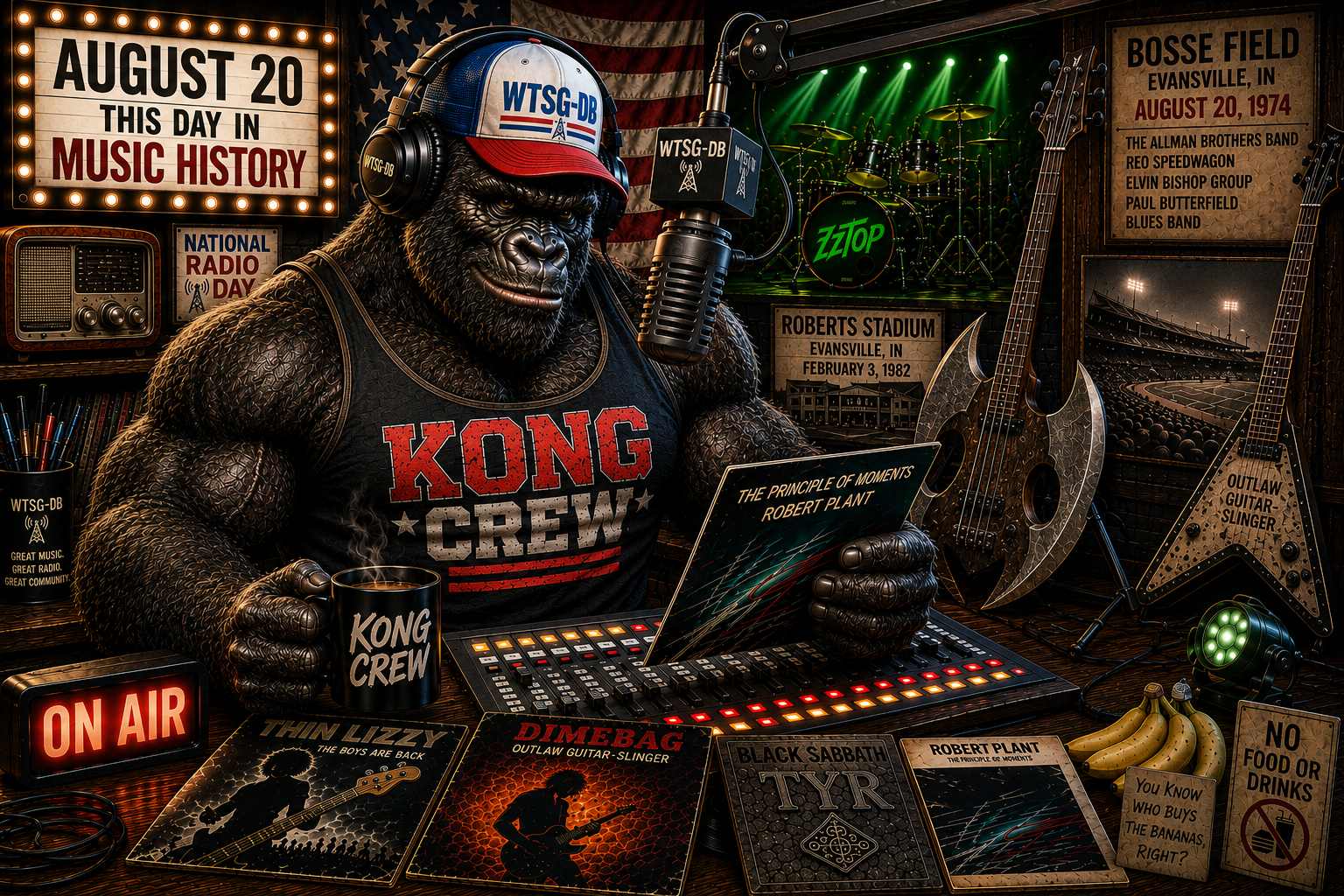
August 20, 1974 — A Night of Rock & Roll at Bosse Field
Sometimes music history happens in London.
Sometimes it happens in New York.
And sometimes it happens right here at home.
On August 20, 1974, historic Bosse Field in Evansville, Indiana, became the setting for one incredible night of American rock and blues.
The bill included:
The Allman Brothers Band
REO Speedwagon
The Elvin Bishop Group
The Paul Butterfield Blues Band
Yes, you read that correctly.
At Bosse Field. In Evansville.
And what a collection of musicians that was.
The Allman Brothers Band was already one of the defining groups of Southern rock, having released classics including At Fillmore East (1971), Eat a Peach (1972), and Brothers and Sisters (1973).
REO Speedwagon was still years away from the enormous commercial success that would come with albums such as Hi Infidelity, while Elvin Bishop and Paul Butterfield brought serious blues credentials to the field.
Surviving setlist information for the Allman Brothers’ performance includes some heavyweight material:
“Statesboro Blues”
“Trouble No More”
“Ramblin’ Man”
“Jessica”
“You Don’t Love Me”
“Les Brers in A Minor”
Just imagine hearing “Jessica” echoing across Bosse Field on a summer night in 1974.
CLASSICKONG was still a youngster at the time and doesn’t remember the concert personally—but discovering that this lineup once performed right here in Evansville is exactly why we love digging through music history.
Sometimes an ordinary-looking place you drive past today was once the site of an extraordinary night.
National Radio Day — When a Song Becomes a Memory
Today is National Radio Day, and around here, that means something.
Long before we carried practically the entire recorded history of music around in our pockets, radio was one of the ways we discovered the world.
You heard a song.
Maybe the DJ told you who performed it.
Hopefully you caught the name.
Then you waited to hear it again.
There was no instant search. No streaming service waiting with the entire album. Sometimes you didn’t even know what the people making that wonderful noise looked like.
You went to the record store.
You flipped through albums.
You read magazines.
You stared at album jackets while the record played.
And if there were liner notes, maybe you learned something about the musicians who made it.
Radio wasn’t simply delivering songs.
It was creating memories.
Sometimes those memories become attached to a summer, a car, a first love, a concert—or somebody we loved.
During this week in 1977, while The Emotions were riding high with “Best of My Love,” another beautiful record was also climbing the charts:
Crosby, Stills & Nash — “Just a Song Before I Go.”
That song always reminds CLASSICKONG of his father.
His dad liked that one.
And all these years later, hearing it can still bring him immediately to mind.
That’s one of music’s greatest gifts.
A song written by somebody you’ve never met can somehow become part of your family’s history.
The equipment changes.
The formats change.
The way the signal reaches us changes.
But that moment when the right song comes through the speakers?
That hasn’t changed at all.
Happy National Radio Day from all of us at WTSG-DB.
Keep listening. 📻❤️
August 20, 1969 — The Beatles Together One Last Time
On August 20, 1969, John Lennon, Paul McCartney, George Harrison, and Ringo Starr gathered at EMI Studios during the final stages of work on Abbey Road.
Work that day included mixing and editing John Lennon’s dark, hypnotic “I Want You (She’s So Heavy)”, followed by work assembling the running order of the Abbey Road album.
History would give the day far greater significance.
It became the last time all four Beatles were together in a recording studio.
There would still be Beatles-related studio work afterward.
But never again would John, Paul, George, and Ringo all gather together in the studio as The Beatles.
The remarkable thing is that history rarely announces itself while it’s happening.
Nobody rings a bell and says:
Remember this moment. It’s the last one.
Sometimes you only understand that later.
Happy Birthday, Robert Plant — And Yes, THAT Phil Collins!
Robert Plant was born August 20, 1948.
There isn’t much left to say about his place in Led Zeppelin that hasn’t already been said.
One of rock’s most recognizable voices.
One of its greatest frontmen.
But today we’d like to spend a little more time with Robert Plant the solo artist.
After Led Zeppelin ended, Plant could easily have spent the rest of his career trying to reproduce Zeppelin.
Instead, he moved forward.
His first solo album, Pictures at Eleven, arrived in 1982, followed in 1983 by one of CLASSICKONG’s personal favorites:
The Principle of Moments.
What an album.
“Other Arms”
“In the Mood”
“Big Log”
“Wreckless Love”
“Horizontal Departure”
The entire record has an atmosphere and feel all its own.
And here’s a fact that recently blew CLASSICKONG’s mind:
Phil Collins played drums on much of Plant’s early solo work—including six of the eight tracks on The Principle of Moments.
Yes.
THAT Phil Collins.
Genesis.
“In the Air Tonight.”
That Phil Collins.
Former Jethro Tull drummer Barriemore Barlow handled the drums on the remaining two tracks.
Suddenly some of that record’s rhythmic personality makes even more sense.
CLASSICKONG admits he wasn’t always the guy who studied every album credit. Back then, sometimes you bought the record, put it on, grabbed the album jacket, and simply absorbed the music.
Forty-three years later, you can still discover something that makes you hear an old favorite with brand-new ears.
And that’s pretty wonderful.
Happy 78th birthday, Robert Plant.
Phil Lynott — The Man With the Battle-Axe
Philip Parris Lynott
August 20, 1949 – January 4, 1986
Singer.
Songwriter.
Poet.
Frontman.
And one hell of a bass player.
Phil Lynott co-founded Thin Lizzy and became the unmistakable voice and visual center of the band.
But don’t let that frontman status distract you from what was happening underneath those guitars.
Phil could PLAY.
CLASSICKONG remembers seeing Thin Lizzy perform “The Boys Are Back in Town” on television years ago, and he’s been a fan ever since.
Listen closely to that song sometime.
Everybody understandably hears those glorious twin guitars, but underneath them Lynott’s bass is moving—walking, connecting, pushing the song forward while Phil is simultaneously handling the lead vocal.
And visually?
Phil didn’t merely wear a bass guitar.
He wielded that thing like his own personal battle-axe.
It was part instrument, part weapon, and completely Phil Lynott.
Essential Thin Lizzy
Jailbreak (1976)
Johnny the Fox (1976)
Bad Reputation (1977)
Live and Dangerous (1978)
Black Rose: A Rock Legend (1979)
And of course:
“The Boys Are Back in Town”
“Jailbreak”
“Cowboy Song”
“Dancing in the Moonlight”
“Whiskey in the Jar”
“Waiting for an Alibi”
Phil Lynott left us far too young at only 36.
But that battle-axe still swings every time somebody drops the needle on a Thin Lizzy record.
Dimebag Darrell — The Outlaw Guitar-Slinger
Today would have been Dimebag Darrell’s 60th birthday.
Darrell Lance Abbott
August 20, 1966 – December 8, 2004
How do you describe Dimebag?
We’ve got one.
Outlaw guitar-slinger.
Dime didn’t merely play heavy metal guitar.
He attacked it.
His enormous tone, squealing harmonics, rhythmic precision, bends, whammy-bar abuse, and unmistakable personality gave him a sound that belonged to Dimebag Darrell and nobody else.
Darrell grew up in a musical family. His father, Jerry Abbott, was a country songwriter and record producer, while Darrell and his brother Vinnie Paul Abbott developed into a devastating guitar-and-drum combination.
Together, they helped build Pantera into one of the most important metal bands of the 1990s.
Later came Damageplan.
And underneath Dime’s own musical identity were some serious heroes:
Tony Iommi.
Eddie Van Halen.
Randy Rhoads.
And one that CLASSICKONG especially appreciates…
Ace Frehley.
Dimebag was a monster KISS fan.
Once CLASSICKONG discovered just how much Dime loved KISS and how deeply Ace influenced him, Dime quickly became one of his favorite metal guitarists.
Essential Pantera
Cowboys from Hell (1990)
Vulgar Display of Power (1992)
Far Beyond Driven (1994)
The Great Southern Trendkill (1996)
Damageplan
New Found Power (2004)
Dimebag was murdered while performing onstage in Columbus, Ohio, on December 8, 2004.
He was only 38.
His brother Vinnie Paul died on June 22, 2018, at age 54.
Both Abbott brothers are gone now.
But put on “Cowboys from Hell,” “Walk,” or “Cemetery Gates,” turn it up, and that outlaw guitar-slinger rides again.
GETCHA PULL! 🤘
Black Sabbath Releases TYR — But What Does “TYR” Mean?
On August 20, 1990, Black Sabbath released TYR in the United Kingdom.
American fans received the album shortly afterward, on August 31, 1990.
This was Sabbath during the excellent Tony Martin era, with a formidable lineup:
Tony Martin — vocals
Tony Iommi — guitar
Neil Murray — bass
Cozy Powell — drums
Geoff Nicholls — keyboards
And yes, that’s the mighty Cozy Powell sitting behind the drums.
The album includes:
“Anno Mundi”
“The Law Maker”
“Jerusalem”
“The Sabbath Stones”
“The Battle of Tyr”
“Odin’s Court”
“Valhalla”
“Feels Good to Me”
“Heaven in Black”
So what does TYR mean?
Týr is a god from Norse mythology traditionally associated with war, courage, law, and justice.
That explains titles such as “The Battle of Tyr,” “Odin’s Court,” and “Valhalla.”
The Norse imagery has sometimes caused TYR to be described as a concept album, but bassist Neil Murray has explained that it wasn’t intended as one continuous concept recording.
So don’t go looking for Thor to show up halfway through Side Two.
Although with Tony Iommi playing guitar…
he’d better bring a bigger hammer.
🤘😂
John Hiatt — The Hoosier Behind Songs You Already Know
Here’s today’s “Wait…HE wrote that?” story.
John Hiatt was born August 20, 1952, in Indianapolis, Indiana.
A fellow Hoosier.
Hiatt became a respected singer-songwriter whose songs eventually found their way into the hands of some pretty remarkable musicians.
His acclaimed 1987 album Bring the Family featured an absolutely ridiculous group of players:
John Hiatt
Ry Cooder
Nick Lowe
Jim Keltner
But here’s where things get fun.
Know Bonnie Raitt’s “Thing Called Love”?
John Hiatt wrote it.
And don’t let Bonnie’s beautiful voice and good looks fool you, either.
Bonnie Raitt is one serious slide-guitar gunslinger.
She doesn’t need a hundred notes when five perfectly placed ones will do.
And how about The Jeff Healey Band’s gorgeous “Angel Eyes”?
That song was written by John Hiatt and Fred Koller.
Yep.
Jeff Healey.
One of CLASSICKONG’s favorite outlaw guitar-slingers.
And then there’s “Riding with the King,” which later became the title track of the famous B.B. King and Eric Clapton collaboration.
John Hiatt again.
Suddenly “John Hiatt” becomes:
“WAIT…THAT GUY?”
Yes.
That guy.
And he came from right here in Indiana.
The Emotions Take “Best of My Love” to the Top
On the chart dated August 20, 1977, The Emotions were riding high with the joyous “Best of My Love.”
It’s one of those records that seems almost physically incapable of putting you in a bad mood.
But here’s today’s trivia nugget:
Maurice White and Al McKay of Earth, Wind & Fire wrote it.
Suddenly everything makes sense, doesn’t it?
That groove.
The guitar.
The arrangement.
The rhythmic feel.
That unmistakable sense of joy.
Once you know White and McKay were behind the song, you can hear some of that Earth, Wind & Fire DNA running right through it.
Sometimes learning who wrote a favorite song makes you love it even more.
Remembering Frank Beard — The Engine of ZZ Top
As we prepared today’s edition, some terribly sad news arrived from the world of rock & roll.
Frank Beard, longtime drummer of ZZ Top, has died at age 77.
Beard died while receiving hospice care at his ranch in Richmond, Texas, surrounded by his family. No cause of death had been publicly disclosed when this edition was prepared.
After losing bassist Dusty Hill in 2021, losing Frank is another enormous blow to anyone who grew up with the classic ZZ Top trio.
Billy Gibbons.
Dusty Hill.
Frank Beard.
For more than half a century, that combination was remarkably stable.
And CLASSICKONG always admired something particular about Frank’s playing.
He never seemed interested in being the star.
He left that to Billy and Dusty.
Frank simply became the engine.
Steady.
Tasteful.
Always in the pocket.
And while plenty of rock drummers eventually surrounded themselves with enormous kits that looked like they required their own ZIP code, Frank never seemed to need the spectacle.
Traditional, baby.
Give him the drums.
Give him the groove.
And let him go to work.
Listen to “La Grange.”
Listen to “Tush.”
Listen to “I’m Bad, I’m Nationwide.”
Listen to “Cheap Sunglasses.”
Frank understood something great musicians understand:
You don’t have to play every note you know to make people remember the notes you played.
And for CLASSICKONG, remembering Frank brings back one particular night.
Wednesday, February 3, 1982.
Roberts Stadium. Evansville, Indiana.
ZZ Top was in town on the El Loco-Motion Tour.
CLASSICKONG was still a teenager and didn’t have a car, so a buddy’s sister dropped the guys off at Roberts.
Grand Funk Railroad was expected to be part of the show—and CLASSICKONG’s buddy was especially excited about seeing them.
But Grand Funk didn’t make it.
The surviving concert history indicates they were snowed out.
A band called Taylor Bay Band appeared on the Evansville bill instead—and the guys remember really enjoying them.
Then came ZZ Top.
Billy Gibbons.
Dusty Hill.
And behind them…
Frank Beard.
One moment from that concert has survived more than four decades in CLASSICKONG’s memory.
ZZ Top launched into “Cheap Sunglasses.”
And the green strobe lights went absolutely crazy.
For a teenage musician standing inside Roberts Stadium, it was mind-blowing.
What a show.
Then came the other part of going to a concert in 1982.
There were no cell phones.
When the show ended, the guys walked outside into a bitterly cold Evansville February night and waited for their ride.
And waited.
And waited some more.
They found a payphone.
“Where the heck is our ride? We’re freezing out here!”
Eventually that little car arrived, the doors opened, and at that moment the heater probably felt like the greatest invention in human history.
😂
And since February 3, 1982, was a Wednesday, CLASSICKONG is pretty sure there was school the next morning.
Worth it?
Forty-four years later, he can still see those green lights flashing during “Cheap Sunglasses.”
You bet it was worth it.
Roberts Stadium is gone now.
Dusty Hill is gone.
And now Frank Beard is gone.
But CLASSICKONG got to see Billy, Dusty, and Frank together in his hometown, in their prime.
That’s something he’ll always carry with him.
Frank Beard didn’t need to be the star of ZZ Top.
He was the engine.
And what an engine he was.
Rest easy, Frank.
Thanks for the groove. 🥁❤️
Today’s Birthday Roll Call
Robert Plant — born August 20, 1948
Phil Lynott — August 20, 1949 – January 4, 1986
John Hiatt — born August 20, 1952
Dimebag Darrell — August 20, 1966 – December 8, 2004
And also born on August 20:
Isaac Hayes — August 20, 1942 – August 10, 2008
Jim Reeves — August 20, 1923 – July 31, 1964
Doug Fieger of The Knack — August 20, 1952 – February 14, 2010
We recently spent time with several of these artists, but their contributions deserve another tip of the hat today.
Happy birthday to everyone celebrating on August 20.
CLASSICKONG’s Trivia Question
Today’s question comes from one of our biggest surprises while researching this edition:
Which Genesis superstar played drums on six of the eight tracks on Robert Plant’s 1983 album The Principle of Moments?
No peeking!
Answer at the bottom.
Music history isn’t simply a collection of dates.
It’s people.
It’s Dad’s favorite song coming through the radio.
It’s discovering decades later who actually played drums on an album you’ve loved most of your life.
It’s learning that a fellow Hoosier wrote songs you already knew by heart.
It’s Phil Lynott wielding a bass like a battle-axe.
It’s Dimebag Darrell grabbing a guitar like an outlaw gunslinger.
It’s Frank Beard sitting behind a traditional drum kit and keeping one of America’s greatest rock bands permanently in the pocket.
And sometimes…
It’s three teenagers standing outside Roberts Stadium on a freezing Wednesday night in 1982, hunting for a payphone and wondering where the heck their ride is.
😂
The years move on.
The buildings disappear.
Some of the musicians leave us.
But put on the right record…
and suddenly the lights come back on.
That’s the power of music.
From all of us here at WTSG-DB, thanks for spending part of your Thursday with us.
Keep the music playing.
Keep making memories.
And wherever you are today, take a moment to appreciate the people whose music helped provide the soundtrack to your life.
Trivia Answer: Phil Collins. And yes—THAT Phil Collins. 🥁😂
If you haven’t already, we’d love to have you stop by our Guestbook here at WTSG-DB and say hello.
Let us know where you’re listening from. We love seeing just how far the WTSG-DB signal—and our little community of music lovers—reaches.
Great Music. Great Radio. Great Community.
WTSG-DB
Listen to Today’s Broadcast
Sit back, relax, and enjoy today’s story in audio form with CLASSICKONG.
[sonaar_audioplayer albums=”latest” progress_bar_style=”default” wave_bar_width=”1″ wave_bar_gap=”1″ player_layout=”skin_boxed_tracklist” show_track_market=”true” css=”.srp_player_boxed, .skin_floated .album-player, .srp-artworkbg{background-color:#ffffff;}”][/sonaar_audioplayer]