From the Desk of CLASSICKONG | WTSG-DB Digital Broadcasting
Good morning, friends, and welcome to another edition of This Day in Music History!
November 5 is a particularly interesting day on the musical calendar.
We’ve got eighty-eight keys taking center stage, with some of the finest pianists ever to sit behind a keyboard. We’re also celebrating a remarkable Elton John album, a milestone for Nat King Cole, birthdays for Bryan Adams and several familiar voices, and a little thunder courtesy of Led Zeppelin.
And if that’s not enough, we’ve got the Monkees, Tesla, and a long-awaited ABBA comeback to talk about.
So grab that coffee, get comfortable, and let’s get this musical journey underway!
A Little Something Extra for November 5
Before we get into today’s musical history, let’s recognize a few of the day’s special observances!
It’s Commercial TV Broadcast Day, which fits perfectly with our celebration of the 70th anniversary of The Nat King Cole Show. Television and music have certainly shared some unforgettable moments over the years.
It’s also National Love Your Red Hair Day, so here’s a special salute to all our redheaded friends, including a couple of wonderful musical talents, Bonnie Raitt and Wynonna Judd!
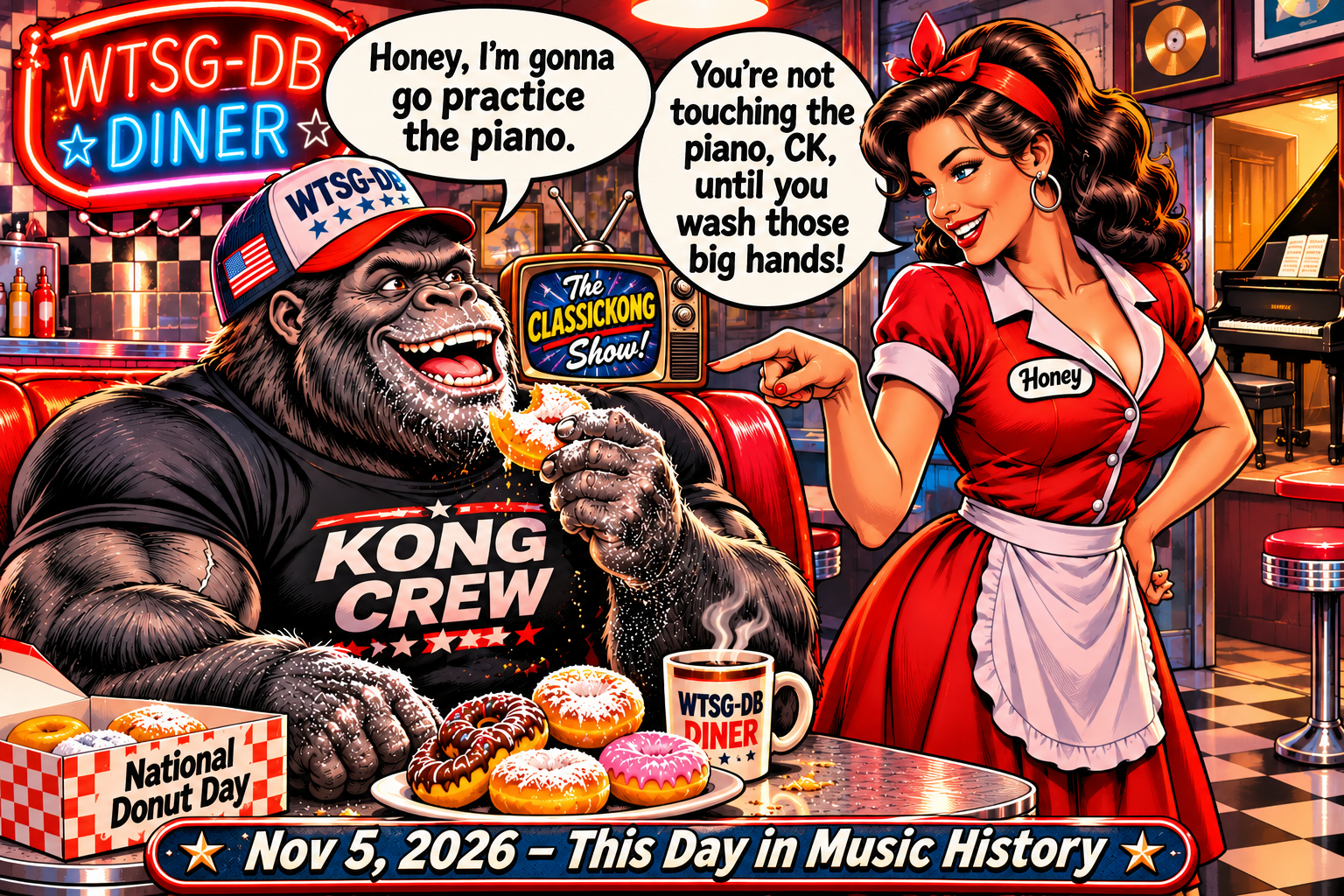
And finally, it’s National Donut Day!
Now there’s a celebration I can get behind. Grab a donut, pour yourself another cup of coffee, and let’s get this musical journey underway!
Just remember, friends, donuts and expensive radio equipment don’t always make the best combination!
1971 – Elton John Releases Madman Across the Water
On November 5, 1971, Elton John released his fourth studio album, Madman Across the Water, in the United Kingdom on DJM Records. The American release followed on November 15 through UNI Records.
Today marks the album’s 55th anniversary.
Produced by Gus Dudgeon, with lyrics by Bernie Taupin and orchestral arrangements by Paul Buckmaster, the album combined Elton’s remarkable piano playing with sophisticated songwriting and beautifully constructed arrangements.
And what an album it was!
“Tiny Dancer,” “Levon,” “Razor Face,” “Indian Sunset,” and the magnificent title track are just a few of its highlights.
There’s something special about the relationship between Elton’s piano and Buckmaster’s orchestral arrangements. Neither overwhelms the other. Instead, they work together to create an atmosphere that gives these recordings their unmistakable character.
And let’s not forget the extraordinary songwriting partnership between Elton John and Bernie Taupin.
Bernie could write lyrics that painted pictures, and Elton somehow knew exactly how to bring those pictures to life.
Interestingly, “Tiny Dancer” reached only No. 41 on the Billboard Hot 100 in 1972.
Imagine that!
A song that would eventually become one of Elton John’s signature recordings barely made the Top 40.
Sometimes the charts simply don’t recognize greatness the first time around.
Must-Have Discogs: Madman Across the Water (1971, DJM Records / UNI Records).
Reference: Elton John – Madman Across the Water: In the Studio
1959 – Happy Birthday, Bryan Adams
Happy 67th birthday to Canadian rocker Bryan Adams, born November 5, 1959, in Kingston, Ontario.
With his distinctive raspy voice, energetic performances, and knack for writing memorable rock songs, Adams became one of the most successful recording artists of the 1980s and beyond.
And November 5 happens to be doubly significant in his career.
On his 25th birthday, November 5, 1984, Adams released his fourth studio album, Reckless, on A&M Records.
Talk about a birthday present!
Produced by Adams and Bob Clearmountain, Reckless delivered an impressive collection of hits.
“Run to You,” “Heaven,” “Summer of ’69,” “Somebody,” and “One Night Love Affair” all helped establish the album as a rock classic.
And how about that opening guitar riff on “Run to You”?
Sometimes a great rock song announces itself before the singer even opens his mouth.
Reckless eventually reached No. 1 on the Billboard 200, becoming a defining album of Adams’ career.
Must-Have Discogs: Reckless (1984, A&M Records).
Reference: Bryan Adams Official Website
1956 – The Nat King Cole Show Makes Television History
On November 5, 1956, The Nat King Cole Show premiered on NBC television.
Seventy years later, its place in entertainment history remains significant.
The program became the first nationally broadcast television series hosted by an African American entertainer.
Initially presented as a 15-minute variety program, the show eventually expanded to a half-hour format.
And what an entertainer NBC had!
Born March 17, 1919, Nat King Cole was already an accomplished jazz pianist before his smooth, unmistakable singing voice made him an international superstar.
His recordings of “Unforgettable,” “Mona Lisa,” “Nature Boy,” and “When I Fall in Love” remain timeless examples of musical elegance.
But Nat King Cole was much more than a wonderful singer.
He was an extraordinary pianist.
His work with the King Cole Trio helped establish the piano, guitar, and bass combination as an influential small-group jazz format.
Cole’s touch at the keyboard was tasteful, sophisticated, and wonderfully expressive.
He didn’t need to overwhelm the listener with technical fireworks. Every note seemed to have a purpose.
His television program featured exceptional guests, including Ella Fitzgerald, Peggy Lee, Tony Bennett, and Mahalia Jackson.
Unfortunately, despite its artistic quality, the program struggled to secure major national advertising sponsors and ended in December 1957.
Nat King Cole passed away February 15, 1965, at the age of 45.
What a remarkable musical legacy he left behind.
And what a classy gentleman.
Must-Have Discogs: After Midnight (1957, Capitol Records).
Reference: Smithsonian – Nat King Cole and American Television
1963 – Happy Birthday, Brian Wheat of Tesla
Happy 63rd birthday to Brian Wheat, bassist and founding member of the American hard rock band Tesla!
Wheat was born November 5, 1963, in Sacramento, California.
Tesla emerged during the 1980s with a sound rooted in blues-based hard rock, powerful guitar work, and strong songwriting.
Their debut album, Mechanical Resonance, arrived in 1986 and introduced listeners to songs such as “Modern Day Cowboy” and “Little Suzi.”
The band followed with The Great Radio Controversy in 1989 and Psychotic Supper in 1991.
With Jeff Keith’s distinctive vocals, the guitar work of Frank Hannon and Tommy Skeoch, Troy Luccketta’s drumming, and Wheat’s solid bass playing, Tesla developed a musical identity that stood apart from much of the era’s hard rock scene.
And they could rock!
But Tesla also demonstrated that great musicianship doesn’t always require turning every amplifier up to eleven.
Their acoustic performances, particularly the hit version of “Signs,” revealed another dimension of the band’s abilities.
Incidentally, Wheat also plays keyboards and piano.
Apparently, those eighty-eight keys have a way of showing up everywhere today!
Must-Have Discogs: Psychotic Supper (1991, Geffen Records).
Reference: Tesla – Brian Wheat
1966 – The Monkees Reach Number One with Last Train to Clarksville
On November 5, 1966, The Monkees reached No. 1 on the Billboard Hot 100 with “Last Train to Clarksville.”
Written by Tommy Boyce and Bobby Hart, the group’s debut single featured Micky Dolenz on lead vocals.
And what a catchy record!
That unmistakable guitar introduction, the infectious rhythm, and those terrific vocal harmonies helped turn the song into a pop classic.
The Monkees had originally been assembled for a television series, but their recordings quickly developed an audience far beyond the television screen.
Micky Dolenz, Davy Jones, Michael Nesmith, and Peter Tork became household names.
And while the group’s early recordings relied heavily on professional studio musicians, the members eventually fought for greater creative control over their music.
Here’s another interesting musical connection.
The Monkees’ 1967 hit “Pleasant Valley Sunday” was written by Gerry Goffin and Carole King.
Keep those names in mind. They’re coming up again!
Must-Have Discogs: The Monkees (1966, Colgems Records).
Reference: Billboard Chart History – November 5, 1966
1947 – Happy Birthday, Peter Noone of Herman’s Hermits
Happy 79th birthday to Peter Noone, born November 5, 1947, in Lancashire, England.
As the youthful lead singer of Herman’s Hermits, Noone became one of the familiar faces and voices of the British Invasion.
The group’s memorable recordings included “Mrs. Brown, You’ve Got a Lovely Daughter,” “There’s a Kind of Hush,” “I’m Henry VIII, I Am,” and “I’m Into Something Good.”
And speaking of that last song, here’s a little music-history nugget.
“I’m Into Something Good” was written by Gerry Goffin and Carole King!
Yes, THAT Carole King!
Originally recorded by Earl-Jean in 1964, the song became Herman’s Hermits’ first British No. 1 hit.
Carole King would later become one of the most celebrated singer-songwriters of her generation, especially following the release of Tapestry in 1971.
And there’s another wonderful example of what a great songwriter can accomplish with a piano, a voice, and an honest melody.
As for Herman’s Hermits, their cheerful pop sound remains an enjoyable reminder of the British Invasion.
Sometimes a catchy tune and a little happiness are all you need.
Must-Have Discogs: Introducing Herman’s Hermits (1965, MGM Records).
Reference: Carole King – I’m Into Something Good
1941 – Happy 85th Birthday, Art Garfunkel
Born November 5, 1941, in Queens, New York, Art Garfunkel became one-half of one of popular music’s most celebrated vocal partnerships.
Alongside Paul Simon, Garfunkel helped create recordings that remain among the finest examples of folk-rock and vocal harmony.
“The Sound of Silence,” “Scarborough Fair/Canticle,” “America,” and “The Boxer” are just a few of the duo’s enduring classics.
But perhaps Garfunkel’s most extraordinary vocal performance came with “Bridge Over Troubled Water.”
Released in 1970, the recording showcased his remarkable vocal clarity and emotional sensitivity.
And let’s not overlook the beautiful piano accompaniment by Larry Knechtel.
It’s a perfect example of how a great piano arrangement and an exceptional voice can work together to create something unforgettable.
Following Simon & Garfunkel’s separation, Art enjoyed a successful solo career with songs such as “All I Know,” “I Only Have Eyes for You,” and “Bright Eyes.”
Some singers have enormous vocal power.
Others have a gift for making the quietest passage feel deeply personal.
Art Garfunkel has always possessed that special gift.
Must-Have Discogs: Bridge Over Troubled Water (1970, Columbia Records).
Reference: Art Garfunkel Official Website
1970 – Led Zeppelin Unleashes Immigrant Song
On November 5, 1970, Led Zeppelin released “Immigrant Song” as a single in the United States on Atlantic Records.
Originally appearing on Led Zeppelin III, the recording became one of the band’s most recognizable performances.
Inspired by the group’s visit to Iceland earlier that year, the song featured Robert Plant’s unmistakable opening vocal cry, Jimmy Page’s thunderous guitar riff, John Paul Jones’ powerful bass, and the mighty John Bonham behind the drums.
And GOOD GRAVY, what a sound!
Bonham’s drumming gave Led Zeppelin a rhythmic power that was unmistakably their own.
His playing wasn’t simply loud.
It had weight, feel, and an extraordinary sense of groove.
The single also featured “Hey, Hey, What Can I Do” on its B-side, a recording that became a favorite among Zeppelin collectors.
“Immigrant Song” reached No. 16 on the Billboard Hot 100.
And more than five decades later, those opening moments can still make you reach for the volume control.
From the velvet sounds of Nat King Cole to the thunder of Led Zeppelin.
Now THAT’S musical variety, friends!
Must-Have Discogs: Led Zeppelin III (1970, Atlantic Records).
Reference: Led Zeppelin Official Website
1989 – Remembering Vladimir Horowitz
On November 5, 1989, the classical music world lost one of its most extraordinary pianists, Vladimir Horowitz.
Born October 1, 1903, in Kyiv, then part of the Russian Empire, Horowitz became internationally renowned for his astonishing technique, dramatic interpretations, and remarkable command of the piano.
His performances of works by Chopin, Liszt, Schumann, Rachmaninoff, and Scriabin demonstrated an extraordinary combination of power, sensitivity, and musical imagination.
Horowitz could produce enormous sound from the instrument, yet moments later play with remarkable delicacy.
His return to Carnegie Hall in 1965, following a lengthy absence from public performances, became one of the most celebrated events in classical music.
But there was something more to Horowitz than technical brilliance.
He possessed an unmistakable musical personality.
His interpretations could be bold, unconventional, and intensely personal.
And that brings us to something important.
Great musicians don’t necessarily interpret the same composition in the same way.
Two pianists can sit at identical instruments, play the same written notes, and produce remarkably different musical experiences.
That’s part of the beauty of music.
Must-Have Discogs: Horowitz at Carnegie Hall: An Historic Return (1965, Columbia Masterworks).
Reference: Encyclopaedia Britannica – Vladimir Horowitz
1956 – Remembering Jazz Piano Legend Art Tatum
November 5 also marks the passing of one of jazz music’s most extraordinary pianists, Art Tatum, who died on this date in 1956.
Born October 13, 1909, in Toledo, Ohio, Tatum developed a piano style that astonished fellow musicians and audiences alike.
His technical command of the instrument was remarkable.
But what truly distinguished Tatum was his harmonic imagination, rhythmic creativity, and extraordinary ability to transform familiar melodies.
His interpretations of songs such as “Tea for Two” and “Tiger Rag” demonstrated possibilities that many pianists had scarcely imagined.
Tatum could fill a performance with dazzling runs, unexpected harmonies, and rhythmic surprises.
Yet beneath all that technical brilliance was a musician with a deep understanding of melody.
And isn’t it interesting?
Art Tatum and Vladimir Horowitz passed away on the same calendar date, thirty-three years apart.
One became a giant of jazz piano.
The other became a legend of classical performance.
Both played instruments with the same eighty-eight keys.
Yet their musical worlds were wonderfully different.
And both helped demonstrate just how limitless the piano can be in the hands of a gifted musician.
Must-Have Discogs: The Genius of Art Tatum (1953–1955 recordings, Clef Records).
Reference: Encyclopaedia Britannica – Art Tatum
2021 – ABBA Returns with Voyage
On November 5, 2021, Swedish pop legends ABBA released Voyage, their first studio album of new material in forty years.
The release reunited Agnetha Fältskog, Björn Ulvaeus, Benny Andersson, and Anni-Frid Lyngstad for a new collection of original recordings.
And after four decades, expectations were understandably high.
Released through Polar Music, Voyage included “I Still Have Faith in You,” “Don’t Shut Me Down,” and “Just a Notion.”
The album received a mixture of enthusiastic and more reserved critical reviews.
Some praised its nostalgic atmosphere, familiar harmonies, and mature songwriting. Others felt it lacked some of the irresistible pop energy that characterized ABBA’s classic recordings.
Personally, I was hoping for a few more of those instantly memorable hooks that made albums such as Arrival and The Album so enjoyable.
But that’s simply one listener’s opinion.
There was certainly something special about hearing those four familiar voices together again after so many years.
And we shouldn’t overlook Benny Andersson’s musicianship.
His keyboards, melodic instincts, and sophisticated arrangements have always been essential ingredients in ABBA’s sound.
Even when an album doesn’t quite meet our expectations, it can still remind us why we appreciated an artist in the first place.
Must-Have Discogs: Arrival (1976, Polar Music).
Reference: ABBA Official Website
Reference: ABBA Voyage – Critical Reviews
Final Spin
Eighty-eight keys.
That’s all a piano has. Yet think of the countless stories that have been told with those same eighty-eight keys.
Some hands bring thunder. Others bring tenderness. Some leave us marveling at what seems impossible, while others can break our hearts with the simplest melody.
Add the beauty of a great singing voice, the harmony of voices together, the unmistakable sound of a guitar, or the thunder of a drum kit, and suddenly the possibilities seem endless.
And whether it’s the velvet sounds of Mr. Nat King Cole or the hard-thumping sounds of “The Zeppelin,” somehow, the music has a way of bringing us all back to center.
Different styles. Different generations. Different interpretations.
But that wonderful feeling when a piece of music reaches something deep inside us? That’s something we all understand.
Because the real magic isn’t just in the instrument.
It’s in the person who brings it to life, and the hearts it reaches along the way.
And that’s gonna do it for today, friends. Hopefully I’ve maybe put a smile on your face, and a song in your heart. Take care of yourselves, help others when you can, and always, always, keep the music playing.
Listen to Today’s Broadcast/Podcast
Listen to today’s edition of This Day in Music History with CLASSICKONG on WTSG-DB Digital Broadcasting.
Enjoy the show? Follow This Day in Music History on Spotify, and join us for another journey through the music and memories that never grow old.
GREAT MUSIC. GREAT RADIO. GREAT COMMUNITY.
References and Further Reading
- Elton John – Madman Across the Water
- Bryan Adams – Official Website
- Smithsonian – Nat King Cole and American Television
- Tesla – Brian Wheat
- The Monkees – November 5, 1966 Billboard Chart
- Carole King – I’m Into Something Good
- Art Garfunkel – Official Website
- Led Zeppelin – Official Website
- Encyclopaedia Britannica – Vladimir Horowitz
- Encyclopaedia Britannica – Art Tatum
- ABBA – Official Website
- ABBA Voyage – Critical Reviews