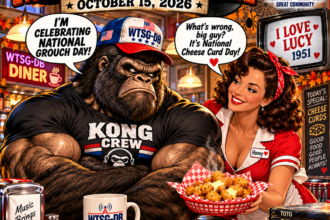

From the Desk of CLASSICKONG
Happy Friday, music lovers!
Welcome to another edition of This Day in Music History, brought to you by WTSG-DB — Great Music, Great Radio, Great Community!
Today we’re traveling from Nashville to the swamps of Creedence Clearwater Revival, visiting two of the greatest drummers jazz ever produced, and celebrating a pair of remarkable albums released in 1990.
But there’s something else connecting today’s stories.
Time.
The time we spend making music. The time we spend with people we love. The time it takes to build something worthwhile. And the realization that none of us knows exactly how much time we have.
We’ll get to that, because today’s music has a way of reminding us what really matters.
First, though, we’ve got a couple of special observances to celebrate!
Today’s National and International Days 🐈🍞
Global Cat Day
October 16 is Global Cat Day, a day dedicated to recognizing and protecting cats, including the countless community cats living outdoors.
And with Halloween approaching, let’s give a little extra love to our black cats.
Those beautiful animals have spent centuries getting blamed for everything from bad luck to witchcraft.
Personally, I think the only bad luck involved is what happens when you try to move a sleeping cat out of your favorite chair.
And if Honey catches CLASSICKONG trying to blame the cat for something he broke at the diner?
Well, I wouldn’t want to be the gorilla explaining THAT one!
World Bread Day
It’s also World Bread Day, celebrating one of the oldest and most beloved foods on the planet.
Fresh bread, warm from the oven, with a little butter?
Buddy, that’s hard to beat.
Of course, if Honey brings a basket of fresh rolls to the diner, CLASSICKONG will probably eat the entire basket before she gets back with the coffee.
Some things never change.
Now, let’s get to the music!
1961 — Patsy Cline Releases “Crazy”
On October 16, 1961, Patsy Cline released one of the most beautiful recordings in country music history.
“Crazy.”
Written by a young songwriter named Willie Nelson, the song became one of Patsy’s signature performances and helped introduce Willie’s extraordinary songwriting talent to a much larger audience.
The single was released by Decca Records, produced by Owen Bradley, and appeared on Patsy’s 1961 album Showcase.
It reached No. 2 on Billboard’s country singles chart and No. 9 on the pop chart.
But chart positions hardly tell the whole story.
What makes “Crazy” so extraordinary is Patsy’s voice.
That warmth. That control. The way she could deliver a line with such tenderness that you could practically hear the heartbreak behind every word.
And let’s not overlook the musicians, including pianist Floyd Cramer, whose beautiful playing helped give those Nashville recordings their unmistakable character.
Patsy didn’t need vocal gymnastics to communicate emotion. She understood something that every great musician eventually learns.
Sometimes the notes you don’t play are just as important as the ones you do.
Sadly, Patsy Cline died on March 5, 1963, at just 30 years old.
But more than six decades after “Crazy” was released, her voice continues to touch hearts.
That’s not merely a hit record.
That’s a timeless performance.
CLASSICKONG’s Must Have: Showcase (1961, Decca Records)
Essential listening: “Crazy,” “I Fall to Pieces,” “Walkin’ After Midnight,” and “She’s Got You.”
Explore Patsy Cline on Discogs
1972 — Creedence Clearwater Revival Calls It Quits
On October 16, 1972, the breakup of Creedence Clearwater Revival was officially announced.
And buddy, what a run they had.
In just a few short years, CCR delivered some of the most recognizable songs in American rock history.
“Proud Mary.”
“Bad Moon Rising.”
“Green River.”
“Fortunate Son.”
“Who’ll Stop the Rain.”
“Have You Ever Seen the Rain.”
The list goes on.
But behind those incredible records, tensions had been building.
John Fogerty was the band’s principal songwriter, lead singer, guitarist, and creative driving force. His vision was central to the sound that made CCR successful.
But being the creative leader of a band isn’t always easy.
When one person is responsible for so much of the music, the others can begin to feel that their contributions aren’t being heard or appreciated.
And from the leader’s perspective, there’s another side to the story.
Somebody has to make the decisions.
Somebody has to decide which songs are ready, how the arrangements should sound, and what direction the band should take.
Sometimes those decisions are unpopular.
Sometimes feelings get hurt.
And sometimes, despite everybody’s best intentions, the relationships simply don’t survive.
John’s brother Tom Fogerty had already left the band in 1971. The remaining trio released Mardi Gras in 1972, an album that reflected a very different creative arrangement and received a troubled reception.
By October, it was over.
“Someday Never Comes” — A Song That Says More Than You Might Think
There’s one CCR song I particularly want to talk about today.
“Someday Never Comes,” from Mardi Gras (1972, Fantasy Records).
This is one of John Fogerty’s most personal songs.
It’s a reflection on growing up, family relationships, the passing of time, and the painful realization that the answers we expect to receive someday don’t always arrive.
As children, we often assume there will be plenty of time to understand our parents.
Plenty of time to ask questions.
Plenty of time to say the things we’ve been meaning to say.
But life doesn’t always cooperate with our plans.
And sometimes that promised someday never comes.
That’s a powerful message, especially when you consider the circumstances surrounding CCR’s final album.
The band may have ended, but the music they created together remains extraordinary.
And I think there’s an important lesson here.
Leadership is difficult. Friendship is difficult. Working together creatively can be difficult.
The real challenge is learning how to respect one another even when we disagree.
Because at the end of the day, the people matter more than the arguments.
CLASSICKONG’s Must Have: Cosmo’s Factory (1970, Fantasy Records)
Also essential: Green River (1969), Willy and the Poor Boys (1969), Pendulum (1970), and Mardi Gras (1972).
Explore Creedence Clearwater Revival on Discogs
1973 — Remembering Gene Krupa
On October 16, 1973, the world lost one of the most influential drummers in the history of music.
Gene Krupa, born January 15, 1909, died at the age of 64.
For generations of drummers, Krupa was more than a musician.
He was an inspiration.
During the swing era, drummers were often expected to remain in the background, keeping time while the horns and singers received most of the attention.
Gene Krupa helped change that.
His explosive performances with the Benny Goodman Orchestra, particularly “Sing, Sing, Sing,” brought the drums front and center.
Suddenly, the drummer wasn’t merely accompanying the band.
He was a star.
And what a performer!
The rolling toms, the cymbal work, the energy, the showmanship — Krupa made the entire drum kit come alive.
He also helped influence the development of modern drum equipment and playing techniques.
As somebody who grew up behind a drum kit, I have tremendous respect for what Gene Krupa accomplished.
Every drummer who has ever taken a solo, stepped into the spotlight, or discovered the sheer joy of playing with a great band owes something to the pioneers who came before us.
And Gene Krupa was one of the biggest.
CLASSICKONG’s Must Have: The Drum Battle — Gene Krupa and Buddy Rich (1952, Clef Records)
Essential listening: “Sing, Sing, Sing,” “Drum Boogie,” and “Let Me Off Uptown.”
1990 — Remembering Art Blakey
Seventeen years after Gene Krupa’s passing, October 16 brought another tremendous loss to the drumming world.
On October 16, 1990, Art Blakey died at the age of 71.
If Gene Krupa helped bring the drummer into the spotlight, Art Blakey demonstrated how a drummer could lead an entire musical movement.
Blakey was a driving force behind hard bop, a powerful style of jazz that combined the complexity of bebop with blues, gospel, and an unmistakable rhythmic punch.
And buddy, that man could PLAY.
His work with Art Blakey and the Jazz Messengers was absolutely remarkable.
But here’s what made Blakey especially important.
He didn’t simply lead a band.
He helped develop generations of extraordinary musicians.
Wayne Shorter, Lee Morgan, Freddie Hubbard, Wynton Marsalis, and countless others passed through the Jazz Messengers.
Blakey gave talented young players the opportunity to develop their skills, find their musical voices, and eventually become leaders themselves.
That’s a legacy worth celebrating.
And listen to the way Blakey played the drums.
The power of his snare drum. The thunder of his bass drum. The way he could drive a band forward while still leaving room for the other musicians to breathe.
He wasn’t merely keeping time.
He was shaping the music.
CLASSICKONG’s Must Have: Moanin’ — Art Blakey and the Jazz Messengers (1958, Blue Note Records)
Essential listening: “Moanin’,” “Blues March,” and “Along Came Betty.”
A Father’s Lessons About Time
There’s something about remembering Gene Krupa and Art Blakey on the same date that makes me think about my own experiences as a musician.
And particularly about my father.
My dad was a musician, a bandleader, and a preacher.
He taught me a great deal about music, but some of his most important lessons had very little to do with playing an instrument.
They had to do with life.
And one of those lessons was the importance of time.
As a young drummer, I had the privilege of playing music with my father.
There were moments when we’d be right in the middle of a song, locked into the groove, and we’d look at each other.
We didn’t have to say a word.
We knew.
The rhythm was right. The music was breathing. Everything was exactly where it needed to be.
Those are moments a musician never forgets.
But as I’ve gotten older, I’ve come to appreciate something beyond the music itself.
I wasn’t simply playing drums with a bandleader.
I was playing music with my dad.
And while I was sitting behind that drum kit keeping time, he was teaching me how precious time really is.
My father often turned to Scripture when he wanted to explain something important.
In Ecclesiastes 3:1, we’re reminded:
“To every thing there is a season, and a time to every purpose under the heaven.”
And in James 4:14, life is described as a vapor that appears for a little while and then vanishes away.
Those words mean something different to me today than they did when I was a young man.
Back then, I thought there would always be another song.
Another rehearsal.
Another conversation.
Another opportunity to sit down with Dad and talk about music, life, or whatever happened to be on our minds.
But time has a way of teaching us lessons we don’t fully understand until we’ve lived a little longer.
I miss my father.
I miss his wisdom, his musicianship, his sense of determination, and those moments when we’d look at each other across the bandstand.
And yet, I’m grateful.
Grateful that I had those experiences.
Grateful for the lessons.
And grateful that music has a remarkable way of bringing those memories back to life.
Sometimes all it takes is the sound of a familiar song.
And suddenly, for a few precious moments, you’re right back there again.
Sitting behind the drums.
Watching your dad.
Keeping time.
1990 — Paul Simon Releases The Rhythm of the Saints
October 16, 1990, also brought the release of Paul Simon’s remarkable album The Rhythm of the Saints on Warner Bros. Records.
Following the enormous success of Graceland in 1986, Simon continued exploring musical traditions from around the world.
This time, Brazilian rhythms played a major role in shaping the sound.
And the results were fascinating.
Songs like “The Obvious Child,” “The Coast,” “Born at the Right Time,” and “The Cool, Cool River” demonstrated Simon’s ability to combine thoughtful songwriting with rich, complex arrangements.
As a drummer, I particularly appreciate the percussion throughout this album.
The rhythms aren’t merely background accompaniment.
They’re essential to the character of the songs.
And there’s something wonderful about that.
Paul Simon has always been a gifted storyteller, but on this album, the rhythm itself becomes part of the storytelling.
“The Obvious Child” is a perfect example.
The driving percussion immediately grabs your attention, but underneath that powerful rhythm is a song concerned with aging, memory, and the passage of time.
Sound familiar?
Once again, today’s music seems to be reminding us that the clock never stops.
CLASSICKONG’s Must Have: The Rhythm of the Saints (1990, Warner Bros. Records)
Essential listening: “The Obvious Child,” “The Coast,” “Born at the Right Time,” and “The Cool, Cool River.”
1990 — ZZ Top Releases Recycler
And now, let’s turn up the amplifiers!
Also released on October 16, 1990, was ZZ Top’s Recycler, issued by Warner Bros. Records.
Billy Gibbons, Dusty Hill, and Frank Beard had already enjoyed tremendous success with Eliminator and Afterburner.
With Recycler, the Texas trio continued blending their blues-rock roots with the polished production that had helped make them international stars.
The album delivered songs like “Concrete and Steel,” “My Head’s in Mississippi,” “Give It Up,” and “Doubleback.”
And buddy, there’s something about ZZ Top that I’ve always loved.
They knew how to find a groove and stay in it.
Billy Gibbons could make a guitar riff sound like it had been dragged straight out of a Texas roadhouse.
Dusty Hill anchored the low end with that unmistakable feel.
And Frank Beard?
He understood one of the most important lessons a drummer can learn.
You don’t have to play a thousand notes when a great groove will do the job.
I had the pleasure of seeing ZZ Top live back in the early 1980s, and let me tell you, those guys knew how to put on a show.
There was nothing quite like hearing that Texas blues-rock sound coming through a wall of amplifiers.
Sadly, we’ve now lost two members of that legendary rhythm section.
Dusty Hill passed away on July 28, 2021, at the age of 72.
And Frank Beard passed away on August 17, 2026, at the age of 77.
Two musicians who helped define the sound of one of rock’s most recognizable bands.
Their music will continue to be played, enjoyed, and celebrated for generations.
And if you’re looking for an excuse to turn up some ZZ Top today?
Buddy, you’ve got one!
CLASSICKONG’s Must Have: Recycler (1990, Warner Bros. Records)
Also essential: Tres Hombres (1973, London Records), Degüello (1979, Warner Bros. Records), and Eliminator (1983, Warner Bros. Records).
Final Spin — The Time We’re Given
There’s a reason today’s music history has stayed with me.
We began with Patsy Cline, a remarkable voice taken from us far too soon.
We remembered the end of Creedence Clearwater Revival, a band whose members created extraordinary music together but couldn’t find a way to keep the partnership alive.
We honored Gene Krupa and Art Blakey, two drummers who helped change the course of music.
And we celebrated artists who understood that rhythm, like life itself, is constantly moving forward.
But somewhere along the way, my thoughts returned to my father.
And to a lesson he spent much of his life trying to teach me.
Time matters.
When we’re young, we sometimes behave as though tomorrow is guaranteed.
There will always be another opportunity to call someone.
Another chance to say thank you.
Another chance to forgive an old disagreement.
Another chance to tell somebody how much they mean to us.
But the truth is, none of us has been promised tomorrow.
In Matthew 6:34, Jesus reminds us not to be consumed by worry about the future.
That’s not a suggestion to stop planning or stop caring.
It’s a reminder that we shouldn’t become so preoccupied with tomorrow that we forget to appreciate today.
And I think that’s a lesson worth carrying with us.
If somebody has made a difference in your life, tell them.
If you’ve been carrying an old disagreement, consider whether it’s worth the time you’re giving it.
And if you’re fortunate enough to have people who love you, make sure they know how much they mean to you.
You don’t need a special occasion.
You don’t need the perfect words.
Sometimes a phone call, a conversation, or a few minutes spent together is enough.
My father taught me many things about music.
But one of the greatest lessons he left me was that the time we share with people we love is more valuable than anything we could ever own.
And sometimes I think about those nights when we played music together.
Dad out front.
Me behind the drums.
Two musicians keeping the same beat.
I wish I could have just one more song with him.
But I’m grateful for every song we had.
So today, take a little time for somebody you love.
Enjoy the music.
Appreciate the moments.
And remember that the most important things in life aren’t always the things we can hold in our hands.
Sometimes they’re the things we carry in our hearts.
Until next time, keep the music playing.
— CLASSICKONG ❤️🥁
Listen to Today’s Broadcast/Podcast 🎙️
Join CLASSICKONG on WTSG-DB for the spoken-word edition of This Day in Music History, featuring more stories, musical memories, a little humor, and reflections on the songs and artists who shaped our lives.
References and Further Listening
- Patsy Cline — “Crazy” single and recording history
- Creedence Clearwater Revival — The 1972 breakup
- Gene Krupa — Biography and musical legacy
- Art Blakey — National Endowment for the Arts
- Art Blakey — Smithsonian Music
- Paul Simon — The Rhythm of the Saints
- ZZ Top — Recycler release information
- Frank Beard — Obituary
- Global Cat Day — Official website
- World Bread Day — October 16
© 2026 WTSG-DB / CLASSICKONG. All rights reserved.