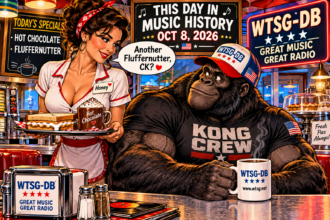

From the Desk of CLASSICKONG
Happy Sunday, music lovers, and welcome back to This Day in Music History!
October has a way of making us reflective. The leaves change, the air grows cooler, and familiar songs sometimes bring back memories we haven’t visited in years.
But there’s plenty of celebrating to do today, too!
We’ve got a golden anniversary for ABBA, Kansas and Montrose delivering two very different kinds of rock brilliance, Rush exploring new musical territory, and Santana taking one of the boldest turns of its career.
We’re also celebrating Daryl Hall’s 80th birthday, remembering a landmark moment for Elton John, and honoring two remarkable soul singers we’ve lost in recent days.
So settle in, pour yourself another cup of coffee, and turn up the volume.
Honey’s keeping the coffee fresh down at the WTSG-DB diner, and we’ve got some GREAT MUSIC to talk about!
October 11, 1976 — ABBA Releases Arrival
Fifty years ago today, ABBA released Arrival in Sweden on Polar Records.
And what an extraordinary record it was.
By 1976, Benny Andersson, Björn Ulvaeus, Agnetha Fältskog, and Anni-Frid Lyngstad had already demonstrated that they knew how to write and perform unforgettable pop music. But Arrival brought their artistry to another level.
Consider “Dancing Queen” (Arrival, 1976, Polar Records).
It’s one of those rare recordings where nearly everything seems to fall perfectly into place. The piano, the rhythm section, the shimmering arrangement, and those magnificent vocal harmonies combine to create something almost magical.
Agnetha and Frida didn’t simply sing together. Their voices complemented each other in ways that made the resulting harmonies sound larger than either voice alone.
And behind them were Benny and Björn, two gifted songwriters and arrangers who understood that sophistication and accessibility didn’t have to be opposites.
Then there’s “Knowing Me, Knowing You” (Arrival, 1976, Polar Records).
What a beautiful, heartbreaking song.
Its melancholy melody and rich vocal arrangement demonstrate that ABBA could be just as compelling when exploring sadness as when filling dance floors.
And “Money, Money, Money” (Arrival, 1976, Polar Records) shows another side of the group, with theatrical drama and a memorable lead vocal from Frida.
It’s easy to take ABBA’s records for granted because the songs are so familiar. But listen closely, especially through a good pair of headphones, and the craftsmanship becomes impossible to ignore.
Fifty years later, Arrival remains an extraordinary achievement.
CLASSICKONG’s Must-Have ABBA Albums
- Arrival — 1976, Polar
- The Album — 1977, Polar
- Voulez-Vous — 1979, Polar
- Super Trouper — 1980, Polar
- The Visitors — 1981, Polar
October 11, 1977 — Kansas Reaches the Point of Know Return
On this date in 1977, Kansas released its fifth studio album, Point of Know Return, on Kirshner Records.
And buddy, what an album!
Kansas occupied a fascinating place in American rock music. They could deliver the energy of a hard rock band while incorporating progressive arrangements, shifting rhythms, keyboards, and Robby Steinhardt’s distinctive violin.
At the center of it all stood vocalist Steve Walsh.
Walsh possessed one of rock music’s truly remarkable voices. His tone was powerful, his phrasing melodic, and his ability to navigate complex arrangements without sacrificing emotional expression was extraordinary.
Listen to “Point of Know Return” (Point of Know Return, 1977, Kirshner Records).
The song moves with tremendous urgency, yet Walsh sounds completely at home above the intricate instrumental arrangement.
Then comes a remarkable contrast.
“Dust in the Wind” (Point of Know Return, 1977, Kirshner Records), written by Kerry Livgren, strips away much of the band’s musical complexity.
An acoustic guitar, a beautiful melody, restrained instrumentation, and a deeply reflective lyric about the passing of time.
And Walsh delivers it with exactly the tenderness the song requires.
There are singers who impress us with their range. Others impress us with their power.
Steve Walsh had both, but he also possessed something less easily measured: the ability to make a song feel deeply personal.
For many listeners, Kansas records are connected to family memories and the people who first introduced them to the band.
And that’s one reason this music continues to matter.
CLASSICKONG’s Must-Have Kansas Albums
- Kansas — 1974, Kirshner
- Song for America — 1975, Kirshner
- Masque — 1975, Kirshner
- Leftoverture — 1976, Kirshner
- Point of Know Return — 1977, Kirshner
- Monolith — 1979, Kirshner
October 11, 1974 — Montrose Releases Paper Money
Now we’re talking HARD ROCK!
On October 11, 1974, Montrose released its second studio album, Paper Money, through Warner Bros. Records.
The album featured guitarist Ronnie Montrose, vocalist Sammy Hagar, drummer Denny Carmassi, and bassist Alan Fitzgerald, with production by Ted Templeman and Ronnie Montrose.
It would also be the final Montrose studio album featuring Hagar.
“I Got the Fire” (Paper Money, 1974, Warner Bros.) demonstrates just how powerful this band could be.
Ronnie’s guitar playing was fierce and commanding, Hagar had the vocal firepower to match him, and Carmassi supplied the kind of drumming that gave the music enormous physical impact.
But to appreciate what made Montrose so influential, we have to return briefly to its 1973 self-titled debut.
“Bad Motor Scooter” and “Rock Candy” (Montrose, 1973, Warner Bros.) are two magnificent examples of early American hard rock.
And for drummers, the opening of “Rock Candy” is something special.
That rapid bass-drum figure, the enormous snare sound, and the way Carmassi settles into the groove make the entire band sound absolutely MASSIVE.
And here’s a little something for the old-school drummers out there.
There was a time when players developed those quick bass-drum doubles with one pedal and one bass drum.
No second bass drum required!
HAHAHA!
The point isn’t that one approach is better than another. It’s that great drumming has always depended on technique, feel, and musical judgment—not simply the amount of equipment surrounding the drummer.
Montrose helped establish a hard-rock sound that influenced countless musicians who followed.
They were loud, unapologetic, and extraordinarily talented.
CLASSICKONG’s Must-Have Montrose Albums
- Montrose — 1973, Warner Bros.
- Paper Money — 1974, Warner Bros.
- Warner Bros. Presents Montrose! — 1975, Warner Bros.
- Jump on It — 1976, Warner Bros.
October 11, 1985 — Rush Opens Power Windows
In Canada, October 11, 1985, marked the release of Rush’s eleventh studio album, Power Windows, on Anthem Records. The American Mercury release followed later that month.
For Rush, this was another step into increasingly sophisticated electronic textures and arrangements.
Producer Peter Collins joined Geddy Lee, Alex Lifeson, and Neil Peart in creating an album that emphasized synthesizers, expansive production, and carefully layered instrumentation.
Some longtime fans embraced the direction immediately.
Others weren’t entirely sure what to make of it.
But one thing remained unchanged.
These three musicians were still playing at an extraordinary level.
Consider “The Big Money” (Power Windows, 1985, Anthem/Mercury).
The production sounds unmistakably mid-1980s, but underneath the synthesizers and studio textures is the remarkable interplay that made Rush so special.
Or “Marathon” (Power Windows, 1985, Anthem/Mercury), a song about perseverance and the effort required to keep moving toward something meaningful.
And “Middletown Dreams” (Power Windows, 1985, Anthem/Mercury) explores the quiet aspirations of people longing for lives beyond their everyday circumstances.
Neil Peart’s lyrics were often thoughtful examinations of the human experience, and this album was no exception.
There’s something especially interesting about records that arrive during transitional periods of our lives.
For someone who had recently finished high school in 1985, Power Windows might have accompanied that uncertain, exciting moment when one chapter had ended and another hadn’t quite begun.
And when friends shared those records, debated the band’s changing sound, and listened together, the music became part of the friendship itself.
Decades later, those songs can carry memories far beyond what the musicians originally imagined.
That’s one of music’s most extraordinary gifts.
CLASSICKONG’s Must-Have Rush Albums
- 2112 — 1976, Anthem/Mercury
- A Farewell to Kings — 1977, Anthem/Mercury
- Hemispheres — 1978, Anthem/Mercury
- Permanent Waves — 1980, Anthem/Mercury
- Moving Pictures — 1981, Anthem/Mercury
- Signals — 1982, Anthem/Mercury
- Power Windows — 1985, Anthem/Mercury
October 11, 1972 — Santana Takes a New Direction With Caravanserai
On October 11, 1972, Santana released Caravanserai through Columbia Records.
And what a fascinating departure it was.
The band’s first three studio albums had established a distinctive combination of rock, blues, Latin rhythms, and electrifying percussion.
The self-titled debut gave us “Evil Ways” (Santana, 1969, Columbia).
Abraxas followed with “Black Magic Woman/Gypsy Queen” and “Oye Como Va” (Abraxas, 1970, Columbia).
Then came Santana III (1971, Columbia), a magnificent album featuring the explosive guitar partnership of Carlos Santana and a young Neal Schon.
But Caravanserai moved toward something different.
Jazz fusion, extended instrumental passages, atmospheric textures, and a greater emphasis on musical exploration.
“Song of the Wind” (Caravanserai, 1972, Columbia) is a beautiful example of the album’s expressive guitar work.
And “Every Step of the Way” (Caravanserai, 1972, Columbia) reveals the group’s willingness to stretch its musical imagination.
This was not simply a band trying to reproduce its earlier hits.
Carlos Santana was following his musical curiosity.
Not every listener followed him in the same way, but Caravanserai remains a compelling reminder that artistic growth sometimes requires taking chances.
CLASSICKONG’s Must-Have Santana Albums
- Santana — 1969, Columbia
- Abraxas — 1970, Columbia
- Santana III — 1971, Columbia
- Caravanserai — 1972, Columbia
- Welcome — 1973, Columbia
- Moonflower — 1977, Columbia
October 11, 1946 — Happy 80th Birthday, Daryl Hall!
Happy 80th birthday to Daryl Hall, born October 11, 1946, in Pottstown, Pennsylvania.
What an extraordinary singer and songwriter.
Alongside John Oates, Hall helped create one of the most successful musical partnerships of the late twentieth century.
Their sound drew from Philadelphia soul, rhythm and blues, rock, and pop, producing recordings that remain instantly recognizable.
“Sara Smile” (Daryl Hall & John Oates, 1975, RCA) remains one of their most beautiful performances.
Hall’s vocal delivery is warm, soulful, and wonderfully expressive.
Then there’s “She’s Gone” (Abandoned Luncheonette, 1973, Atlantic), a superb example of the duo’s songwriting and vocal chemistry.
And by the early 1980s, Hall and Oates were everywhere.
“Kiss on My List” (Voices, 1980, RCA), “Private Eyes” (Private Eyes, 1981, RCA), and “Maneater” (H2O, 1982, RCA) demonstrated their remarkable ability to combine memorable melodies with contemporary production.
But Hall’s artistry extends well beyond the hit singles.
His solo recordings and collaborations reveal a musician with a broad creative imagination and a deep appreciation for soul music.
Eighty years young today.
Happy birthday, Daryl!
CLASSICKONG’s Must-Have Hall & Oates Albums
- Abandoned Luncheonette — 1973, Atlantic
- Daryl Hall & John Oates — 1975, RCA
- Bigger Than Both of Us — 1976, RCA
- Voices — 1980, RCA
- Private Eyes — 1981, RCA
- H2O — 1982, RCA
October 11, 1997 — Elton John’s Candle in the Wind Reaches Number One
On October 11, 1997, Elton John’s “Candle in the Wind 1997” reached number one on the Billboard Hot 100.
Originally written by Elton John and Bernie Taupin as a tribute to Marilyn Monroe, “Candle in the Wind” appeared on Goodbye Yellow Brick Road (1973, DJM/MCA).
But in 1997, following the death of Diana, Princess of Wales, Taupin rewrote the lyrics in her memory.
Elton performed the new version at Diana’s funeral before recording it for release as a charity single through Rocket Records.
The recording became an extraordinary worldwide success.
But its historical importance extends beyond the sales figures.
For millions of listeners, the song became an expression of collective grief.
And that’s something music can do remarkably well.
It can give people a way to express feelings that ordinary conversation sometimes struggles to capture.
The original recording honored Marilyn Monroe.
The 1997 version honored Princess Diana.
Two different lives, two different eras, and one unforgettable melody.
October 11, 1919 — Remembering Jazz Drumming Giant Art Blakey
Born on October 11, 1919, in Pittsburgh, Pennsylvania, Art Blakey became one of jazz music’s most influential drummers and bandleaders.
Blakey’s playing was powerful, energetic, and unmistakably expressive.
His drumming could drive a band with tremendous intensity, but he also understood the importance of listening and responding to the musicians around him.
As leader of the Jazz Messengers, he helped nurture generations of extraordinary jazz performers.
Among the musicians associated with the group were Wayne Shorter, Lee Morgan, Freddie Hubbard, Benny Golson, and Wynton Marsalis.
For a wonderful introduction, listen to “Moanin’” (Moanin’, 1958, Blue Note).
The composition, written by pianist Bobby Timmons, became one of the defining recordings of hard bop.
And Blakey’s drumming provides exactly the energy and authority the music demands.
Art Blakey died October 16, 1990, just five days after his 71st birthday.
His influence continues wherever drummers gather to study jazz.
CLASSICKONG’s Must-Have Art Blakey Albums
- A Night at Birdland, Vol. 1 — 1954, Blue Note
- A Night at Birdland, Vol. 2 — 1954, Blue Note
- Moanin’ — 1958, Blue Note
- The Big Beat — 1960, Blue Note
- Buhaina’s Delight — 1963, Blue Note
October 11, 1975 — Saturday Night Live Makes Its Debut
On October 11, 1975, NBC introduced a new late-night television program originally called NBC’s Saturday Night.
The first episode was hosted by George Carlin, with musical guests Billy Preston and Janis Ian.
What a remarkable pairing.
Preston brought his unmistakable keyboard artistry and infectious musical personality to the broadcast, performing “Nothing from Nothing” (The Kids & Me, 1974, A&M Records) and “Fancy Lady” (It’s My Pleasure, 1975, A&M Records).
Janis Ian offered a very different kind of musical experience with “At Seventeen” and “In the Winter” (Between the Lines, 1975, Columbia Records).
The program would eventually become one of American television’s most enduring institutions.
And from the very beginning, music was an essential part of its identity.
October 11, 1986 — Janet Jackson Reaches Number One
On October 11, 1986, Janet Jackson earned her first Billboard Hot 100 number-one single with “When I Think of You” (Control, 1986, A&M Records).
Produced by Jimmy Jam and Terry Lewis, the recording helped establish Janet as a major artist in her own right.
Control represented a significant turning point in her career.
Its rhythmic sophistication, contemporary production, and confident performances gave the album a musical identity distinctly her own.
And “When I Think of You” remains one of its most joyful moments.
That rhythm section, those bright keyboard textures, and Janet’s effortless vocal delivery make it a terrific example of mid-1980s pop and R&B.
Motörhead — Lemmy, Bastards, and Rock Without Compromise
Few bands represented the uncompromising spirit of rock and roll quite like Motörhead.
Their 1993 album Bastards, released through ZYX Music, was another thunderous reminder that Lemmy Kilmister had absolutely no intention of following musical trends.
The record includes “On Your Feet or on Your Knees,” “Born to Raise Hell,” and “Burner” (Bastards, 1993, ZYX Music).
Just look at those titles!
HAHAHA!
Lemmy never seemed particularly interested in asking the music industry what was fashionable.
His approach was considerably simpler.
Play it loud. Play it hard. Mean every note.
And with drummer Mikkey Dee now firmly established in the band, Motörhead had a powerful rhythmic engine behind its relentless sound.
Lemmy died December 28, 2015, but his musical legacy remains unmistakable.
For listeners who value rock and roll with its rough edges intact, Motörhead continues to deliver.
CLASSICKONG’s Must-Have Motörhead Albums
- Overkill — 1979, Bronze
- Bomber — 1979, Bronze
- Ace of Spades — 1980, Bronze
- No Sleep ’til Hammersmith — 1981, Bronze
- 1916 — 1991, WTG
- Bastards — 1993, ZYX Music
October 11, 1962 — Happy Birthday, Andy McCoy
Happy 64th birthday to Finnish guitarist and songwriter Andy McCoy, born October 11, 1962.
As a founding creative force behind Hanoi Rocks, McCoy helped develop a sound that combined glam rock, punk energy, blues, and traditional rock and roll.
Hanoi Rocks never achieved the enormous commercial success their influence might have suggested.
But their impact on the hard-rock scene that followed was substantial.
Albums such as Bangkok Shocks, Saigon Shakes, Hanoi Rocks (1981, Johanna Kustannus), Back to Mystery City (1983, Johanna Kustannus), and Two Steps from the Move (1984, CBS) demonstrate why the band remains so highly regarded by many rock musicians and devoted fans.
McCoy’s guitar playing and songwriting gave Hanoi Rocks a distinctive identity.
A birthday salute to an influential musician whose work deserves to be remembered.
October 11, 1994 — Korn Introduces a New Heavy-Metal Sound
On October 11, 1994, Korn released its self-titled debut album through Immortal/Epic Records.
Produced by Ross Robinson, the record helped introduce a dramatically different sound to the heavy-music landscape.
Downtuned guitars, unusual rhythmic textures, hip-hop influences, and Jonathan Davis’s emotionally intense vocal approach distinguished Korn from many established metal bands.
“Blind” (Korn, 1994, Immortal/Epic) became one of the band’s defining early recordings.
Not every longtime hard-rock or metal listener embraced this new direction.
But Korn’s influence on the development of nu metal and alternative heavy music is undeniable.
Rock music was changing once again.
In Memoriam — Freddie Jackson and Verne Allison
Before we reach today’s Final Spin, we want to remember two remarkable soul singers whose voices enriched the lives of generations of listeners.
Freddie Jackson — October 5, 2026
We were saddened to learn of the passing of Freddie Jackson, one of the most distinctive romantic voices of 1980s and 1990s R&B.
Jackson died October 5, 2026, at the age of 70.
His breakthrough recording, “Rock Me Tonight (For Old Times Sake)” (Rock Me Tonight, 1985, Capitol Records), introduced many listeners to a singer with an extraordinarily smooth and expressive delivery.
Then came “You Are My Lady” (Rock Me Tonight, 1985, Capitol Records).
What a magnificent love song.
And “Have You Ever Loved Somebody” (Just Like the First Time, 1986, Capitol Records) demonstrated his remarkable ability to bring genuine emotion to a memorable melody.
Freddie Jackson made music for people in love, people remembering love, and people who simply appreciated the beauty of a wonderful voice.
His recordings will continue to bring comfort and joy.
Rest in peace, Freddie.
CLASSICKONG’s Must-Have Freddie Jackson Albums
- Rock Me Tonight — 1985, Capitol
- Just Like the First Time — 1986, Capitol
- Don’t Let Love Slip Away — 1988, Capitol
- Do Me Again — 1990, Capitol
- Time for Love — 1992, Capitol
Verne Allison — October 7, 2026
We also remember Verne Allison, a founding member of the legendary vocal group the Dells, who died October 7, 2026, at the age of 90.
The Dells were among the great vocal harmony groups of American popular music.
Their recordings combined gospel-rooted expression, sophisticated arrangements, and the kind of vocal blend that could make a familiar melody feel extraordinary.
“Stay in My Corner” (There Is, 1968, Cadet Records) remains a magnificent example of their artistry.
And “Give Your Baby a Standing Ovation” (Give Your Baby a Standing Ovation, 1973, Cadet Records) captures the group’s enduring appeal.
The Dells were inducted into the Rock & Roll Hall of Fame in 2004, a fitting recognition of their extraordinary contribution to rhythm and blues.
Verne Allison helped create a musical legacy that will continue long after his passing.
Rest in peace, Verne.
Final Spin — The Music That Stays With Us
October has a way of reminding us how quickly life moves.
The seasons change. The years pass. We grow older, and the world around us becomes a little different from the one we remember.
Sometimes we hear a familiar record and find ourselves thinking about people who once listened to it beside us.
Old friends. Family members. People whose laughter we can still hear and whose smiles we can still picture.
Some are no longer with us.
And that hurts, no matter how many years have passed.
But there’s something beautiful about the way music holds those memories.
A song begins, and suddenly we’re young again. We’re sitting with friends, talking about a new album, wondering what the future might hold.
For a few precious minutes, the years don’t seem quite so far apart.
Perhaps that’s why the music we love becomes such an important part of who we are.
It’s more than entertainment.
It’s a connection to the people, places, and moments that helped shape our lives.
And while we can’t stop the seasons from changing, we can appreciate the memories they bring.
So if a favorite record reminds you of someone special today, give it another listen.
Remember the good times.
Remember the laughter.
And if you find yourself smiling through a few tears, that’s all right, too.
Some friendships are simply too beautiful to forget.
Until tomorrow, take care of yourself, help others when you can, and always keep the music playing.
We’ll see ya down the road!
— CLASSICKONG
Listen to Today’s Broadcast/Podcast
Join CLASSICKONG on WTSG-DB for the spoken-word edition of This Day in Music History, featuring the stories, musicians, and memories behind today’s remarkable musical anniversaries.
Join the Conversation
If you enjoyed today’s podcast, we’d sure appreciate a follow on Spotify and a comment to let us know what you think.
And don’t forget, our written blog goes even deeper into the stories behind the music. You’re always welcome to leave a comment right here on WTSG.NET and share your own memories, favorite records, or thoughts about today’s artists.
Every follow, comment, and kind word helps support WTSG-DB and the work we put into bringing you these stories.
Thank you for listening, reading, and being part of our musical family!
References
- ABBA Official — Arrival
- Kansas — Point of Know Return
- Montrose — Paper Money
- Rush Official — Power Windows
- Santana Official — Caravanserai Anniversary
- AllMusic — Daryl Hall Biography
- This Day in Music — October 11
- National Endowment for the Arts — Art Blakey
- Paley Center — Saturday Night Live Series Premiere
- Motörhead — Bastards
- Loudwire — Korn’s Debut Album
- Associated Press — Remembering Freddie Jackson
- Legacy — Verne Allison
© 2026 WTSG-DB. Original editorial commentary by CLASSICKONG. All artist names, song titles, and album titles belong to their respective rights holders.