From the Desk of CLASSICKONG
Good morning, music lovers, and welcome to another edition of This Day in Music History from WTSG-DB.
Before we spin the first record, we send our gratitude to the men and women of the United States Armed Forces — past and present. Thank you for your service, your sacrifice, and the freedoms we enjoy because of you.
September 20 turned out to be one of those days where the deeper we dug, the more everything seemed to connect.
Brothers.
Family.
Music.
Memories.
And ultimately…
time.
But before we contemplate the meaning of life, CLASSICKONG has discovered something requiring our immediate attention.
Today is…
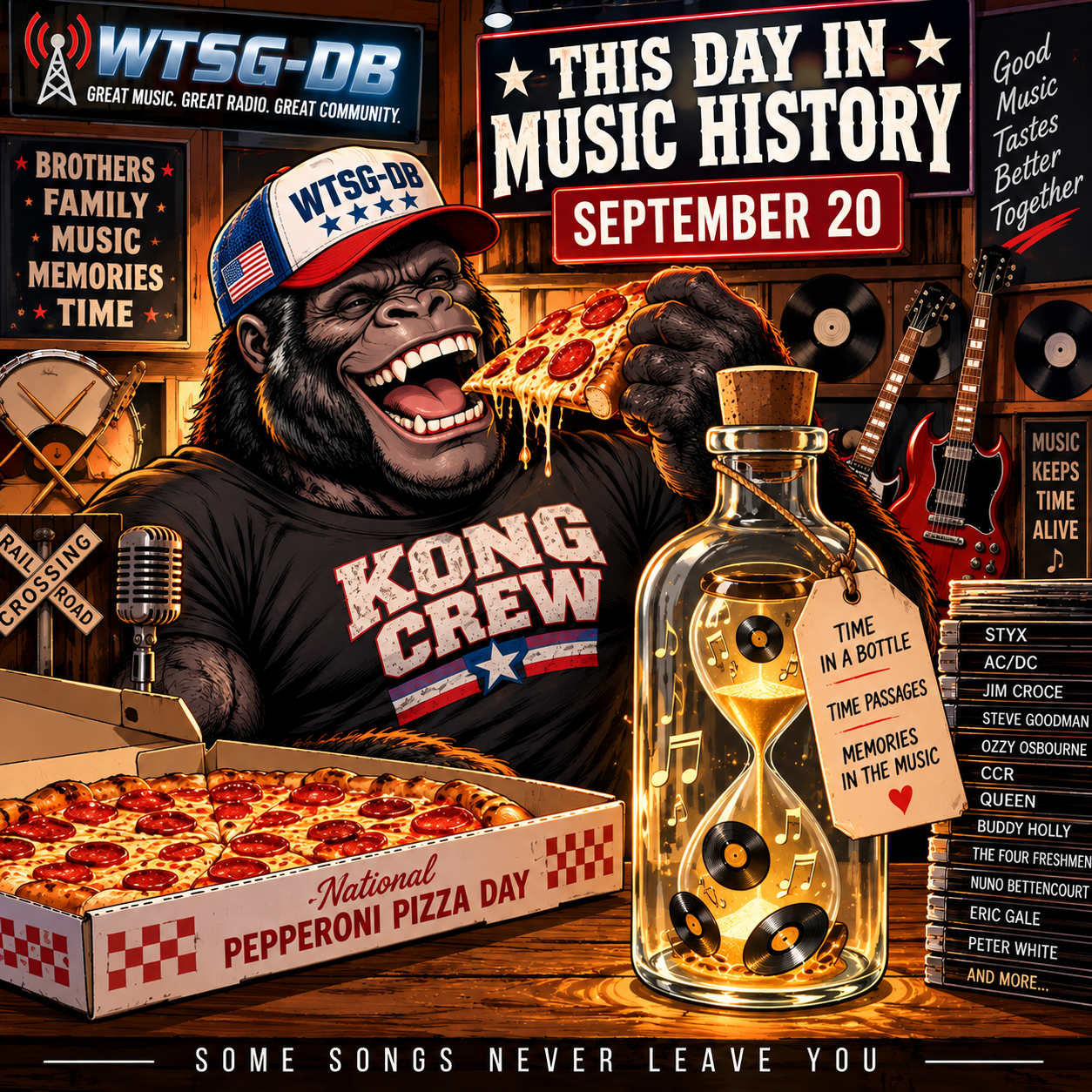
National Pepperoni Pizza Day
Yes, indeed.
September 20 is National Pepperoni Pizza Day.
CLASSICKONG has reviewed the evidence and determined that further historical research will require one large pepperoni pizza.
Extra cheese would be appreciated.
Today we’re going to talk about brothers who built bands together, family connections that lasted generations, records that became part of our lives, songs that somehow preserve our memories and the one thing all of us wish we could occasionally slow down:
Time.
Heavy stuff.
So let’s not do it hungry.
Order the pizza.
Now let’s drop the needle.
Chuck and John Panozzo — Before Styx, There Were Brothers in a Basement
On September 20, 1948, fraternal twin brothers Chuck and John Panozzo were born in Chicago, Illinois, only twenty minutes apart.
Long before The Grand Illusion.
Long before “Renegade.”
Long before “Come Sail Away.”
Long before platinum records and packed arenas, there were two brothers learning to make music.
And this part of the Styx story deserves to be remembered.
Dennis DeYoung and twin brothers Chuck and John Panozzo formed the foundation from which Styx grew.
Dennis and the Panozzo brothers began making music together as kids on Chicago’s South Side. Their group evolved through names including The Tradewinds and TW4 before eventually becoming Styx.
Chuck moved to bass.
John played drums.
James “JY” Young became another essential part of the developing band.
Tommy Shaw joined in 1975 after John Curulewski departed following Equinox.
Tommy would become indispensable to the classic Styx sound.
But the origin story matters.
Before Tommy.
Before the platinum records.
Before the arenas.
There were Dennis DeYoung and Chuck and John Panozzo making music together as kids.
Never forget where it started.
John Panozzo — Serve the Song
John Anthony Panozzo
Born: September 20, 1948
Died: July 16, 1996
Instrument: Drums
Something we discovered while researching today’s history really struck home here at WTSG-DB.
People close to John remembered how seriously he took being the drummer in Styx and how deeply he cared about the band.
As a drummer myself, I understand that.
When I played drums for my parents, I didn’t want to overpower them. I didn’t want to turn every song into an excuse for a drum solo.
I wanted to be the best drummer I could possibly be for them.
That’s the job.
Serve the song.
Sometimes serving the song requires something difficult.
Sometimes it requires sitting on the simplest groove imaginable because that’s exactly what the music needs.
The drummer doesn’t ask the song to serve him.
The drummer serves the song.
And John’s rhythm-section partner happened to be his twin brother.
Chuck on bass. John on drums.
Imagine the musical instincts two brothers could develop after growing up together and playing together for decades.
Actually, we don’t have to imagine it.
Listen to those records.
Underneath the enormous harmonies, Dennis’s keyboards, Tommy and JY’s guitars and those elaborate Styx arrangements, Chuck and John are holding down the foundation.
CLASSICKONG’s Must-Have Styx Discography
The Grand Illusion — 1977, A&M Records
“Come Sail Away,” “Fooling Yourself (The Angry Young Man),” “Miss America,” “Castle Walls.”
Pieces of Eight — 1978, A&M Records
“Renegade,” “Blue Collar Man (Long Nights),” “Queen of Spades,” “Sing for the Day.”
Cornerstone — 1979, A&M Records
“Babe,” “Lights,” “Boat on the River,” “Borrowed Time.”
Paradise Theatre — 1981, A&M Records
“The Best of Times,” “Too Much Time on My Hands,” “Rockin’ the Paradise,” “Snowblind.”
Kilroy Was Here — 1983, A&M Records
“Mr. Roboto,” “Don’t Let It End,” “Heavy Metal Poisoning,” “Haven’t We Been Here Before.”
And while we’re here…
CLASSICKONG needs to get something off his chest.
I have always loved Kilroy Was Here.
There.
I said it.
I remember when that album arrived. I remember the whole Kilroy concept.
And while some longtime Styx fans were yelling:
“It doesn’t sound like old Styx!”
Young CLASSICKONG was apparently sitting somewhere going:
“I’M KILROY! THIS THING IS FREAKIN’ GREAT!”
HAHAHAHA!
Music doesn’t have to stay frozen in one place to mean something to us.
Sometimes an album arrives during exactly the right chapter of our lives, and once that happens, nobody else’s review gets to take that connection away.
John’s later years were difficult. Long-term alcoholism contributed to severe liver disease, and he died in Chicago on July 16, 1996, at only 47.
But that isn’t where we’re leaving him today.
We’re remembering the kid in the basement.
We’re remembering the drummer.
We’re remembering someone who cared deeply about the band he’d helped build.
And we’re celebrating his brother.
Chuck Panozzo turns 78 today.
CLASSICKONG Superhero Trading Card — The Panozzo Brothers
Heroes: Chuck & John Panozzo
Born: September 20, 1948
Home Base: Chicago, Illinois
Weapons: Bass & Drums
Origin Story: Two brothers, Dennis DeYoung and a basement
Special Power: Twin-powered rhythm-section lock
Battle Cry: SERVE THE SONG
Legacy: FOUNDATIONAL
Nelson — Another Pair of Brothers, Another Musical Family
September 20 gives us another pair of twins.
Matthew and Gunnar Nelson, born September 20, 1967.
And talk about family history.
Their father was Ricky Nelson, while their grandparents were Ozzie and Harriet Nelson.
Matthew and Gunnar eventually formed Nelson and broke through with:
After the Rain — 1990, DGC Records
featuring:
“(Can’t Live Without Your) Love and Affection,”
“After the Rain,”
“More Than Ever,”
“Only Time Will Tell.”
Another pair of brothers.
Another family bound together by music.
And we’re not finished.
AC/DC — The Young Brothers and Some Dirty Deeds
On September 20, 1976, AC/DC released Dirty Deeds Done Dirt Cheap in Australia on Albert Productions/EMI.
And there’s another set of brothers.
Malcolm and Angus Young.
Their older brother George Young, along with Harry Vanda, produced the record and played an enormous role in shaping early AC/DC.
This is prime Bon Scott-era AC/DC — dangerous, funny, dirty, mischievous and unmistakable.
The original Australian edition differs from the later international configuration and includes “Jailbreak” and “R.I.P. (Rock in Peace).”
The album wouldn’t receive its official U.S. release until 1981.
Which brings CLASSICKONG into the story.
I owned Dirty Deeds Done Dirt Cheap on cassette.
Around my freshman/sophomore year, I remember heading to a marching-band function.
We’re in the back of the bus.
We’ve got a boombox.
Somebody puts on AC/DC.
Then Bon Scott begins singing…
“Big Balls.”
WHAT?!
HAHAHAHAHAHA!
We laughed until we practically cried.
If you’ve heard Bon deliver that song with his exaggerated upper-crust sophistication, you understand exactly why a group of teenage marching-band kids would completely lose it.
Some memories are profound.
Some are deeply emotional.
And some involve Bon Scott, an AC/DC cassette, a boombox and a bunch of teenagers laughing uncontrollably in the back of a bus.
They all count.
CLASSICKONG’s Must-Have AC/DC Discography
Dirty Deeds Done Dirt Cheap — 1976, Albert Productions
Bon Scott mischief at full strength.
Let There Be Rock — 1977, Albert Productions
Raw, loud and relentless.
Powerage — 1978, Albert Productions
“Rock ‘n’ Roll Damnation,” “Riff Raff,” “Sin City,” “Gone Shootin’.”
Highway to Hell — 1979, Albert Productions
The final Bon Scott studio album and an essential AC/DC record.
Back in Black — 1980, Albert/Atlantic
The extraordinary beginning of the Brian Johnson era.
CLASSICKONG Superhero Trading Card — The Young Brothers
Heroes: Malcolm & Angus Young
Weapons: Rhythm & Lead Guitar
Family Reinforcement: George Young
1976 Mission: Dirty Deeds Done Dirt Cheap
Special Attack: Angus Duckwalk
Power Source: A guitar riff plugged directly into a nuclear reactor
Warning: Never underestimate the balls.
Jim Croce — Time in a Bottle
Jim Croce
January 10, 1943 – September 20, 1973
On September 20, 1973, Jim Croce performed at Northwestern State University in Natchitoches, Louisiana.
After the concert, Croce boarded a chartered aircraft with his close friend and guitarist Maury Muehleisen and several others.
Seconds after takeoff, the plane crashed.
There were no survivors.
Jim Croce was only 30 years old.
His next album, I Got a Name, would arrive posthumously.
Croce was one of those rare writers who could make ordinary life feel important.
He could make you laugh with “Bad, Bad Leroy Brown” or “You Don’t Mess Around with Jim,” then quietly break your heart with “Operator,” “Photographs and Memories” or “Time in a Bottle.”
CLASSICKONG’s Must-Have Jim Croce Discography
You Don’t Mess Around with Jim — 1972, ABC Records
Includes “Operator,” “Time in a Bottle” and “Photographs and Memories.”
Life and Times — 1973, ABC Records
Includes “Bad, Bad Leroy Brown.”
I Got a Name — 1973, ABC Records
Released posthumously and featuring the unforgettable title track.
Jim’s music carries profound memories for me.
Before I left home to join the military, I was listening to a lot of Croce.
Looking back, I think part of me was taking everything in because I knew I was going to be gone for a while.
Before leaving, I hugged my grandfather.
Somewhere inside, I knew there was a possibility I might not see him again.
I didn’t.
He died the following February.
That’s one reason songs like “Time in a Bottle” and “Photographs and Memories” mean more to me now than they ever could have when I first heard them.
Some songs grow older with us.
And sometimes we finally grow old enough to understand what they were telling us all along.
Remember “Time in a Bottle.”
We’re coming back to it.
Steve Goodman — The Train Keeps Rolling
Steve Goodman
July 25, 1948 – September 20, 1984
Chicago-born Steve Goodman wrote “City of New Orleans” after traveling aboard the Illinois Central train of the same name with his wife.
Goodman recorded the song himself before Arlo Guthrie turned it into a hit.
Willie Nelson later recorded it, and Goodman posthumously received the Grammy for Best Country Song as its songwriter.
Goodman had been diagnosed with leukemia as a very young man and lived with the disease for years while continuing to write and perform.
He died in Seattle on September 20, 1984.
He was only 36.
Goodman was also a devoted Chicago Cubs fan, writing both “A Dying Cub Fan’s Last Request” and “Go, Cubs, Go.”
Four days after his death, the Cubs clinched their division and reached the postseason for the first time since 1945.
Goodman had been expected to sing the national anthem at their first postseason game.
Instead, his friend Jimmy Buffett performed it and dedicated the moment to Steve.
CLASSICKONG’s Must-Have Steve Goodman Discography
Steve Goodman — 1971, Buddah Records
Contains Goodman’s original “City of New Orleans.”
Somebody Else’s Troubles — 1972, Buddah Records
Goodman’s humor and storytelling on full display.
Jessie’s Jig & Other Favorites — 1975, Asylum Records
A beautiful meeting of songwriting and roots musicianship.
Affordable Art — 1984, Red Pajamas Records
A late-career showcase for Goodman’s wit and humanity.
If Steve Goodman is a new name to you today, don’t stop at “City of New Orleans.”
There’s a songwriter waiting for you.
Ozzy Osbourne — Blizzard of Ozz
September 1980 brought one of heavy metal’s landmark records:
Blizzard of Ozz — 1980, Jet Records.
Sources differ on the precise original UK release date, so rather than pretend the historical record is unanimous, we’ll stick with what we know:
September 1980 changed Ozzy Osbourne’s career.
Look at this band:
Ozzy Osbourne — vocals
Randy Rhoads — guitar
Bob Daisley — bass
Lee Kerslake — drums
Don Airey — keyboards
“I Don’t Know.”
“Crazy Train.”
“Goodbye to Romance.”
“Mr. Crowley.”
“Revelation (Mother Earth).”
This wasn’t merely Ozzy surviving life after Black Sabbath.
It was the beginning of another enormous chapter.
And Randy Rhoads…
Good grief.
CLASSICKONG’s Must-Have Ozzy Discography
Blizzard of Ozz — 1980, Jet Records
Mandatory.
Diary of a Madman — 1981, Jet Records
Randy Rhoads’ second and final studio album with Ozzy.
Tribute — 1987, Epic/CBS Associated
The essential live memorial to Randy Rhoads.
No More Tears — 1991, Epic Associated
A monster from the Zakk Wylde era.
CLASSICKONG Superhero Trading Card — Randy Rhoads
Hero: Randy Rhoads
Born: December 6, 1956
Died: March 19, 1982
Weapon: Guitar
Power: Classical precision meeting heavy-metal fire
Special Attacks: “Crazy Train” and “Mr. Crowley”
Status: LEGEND
CCR — There’s a Bad Moon on the Rise
During the UK chart week ending September 20, 1969, Creedence Clearwater Revival’s “Bad Moon Rising” sat at No. 1.
CCR.
American Treasure.
The song appeared on:
Green River — 1969, Fantasy Records.
And I can’t hear “Bad Moon Rising” without thinking about the 1981 John Landis movie An American Werewolf in London.
With Halloween approaching, it’s practically mandatory listening.
Cue CCR.
Watch the moon.
And maybe stay off the moors.
CLASSICKONG’s Must-Have CCR Discography
Bayou Country — 1969, Fantasy Records
“Proud Mary,” “Born on the Bayou.”
Green River — 1969, Fantasy Records
“Green River,” “Bad Moon Rising,” “Lodi.”
Willy and the Poor Boys — 1969, Fantasy Records
“Down on the Corner,” “Fortunate Son.”
Cosmo’s Factory — 1970, Fantasy Records
“Travelin’ Band,” “Who’ll Stop the Rain,” “Run Through the Jungle,” “Up Around the Bend.”
What a run.
Queen — The Game Takes the American Crown
On September 20, 1980, Queen’s The Game — 1980, Elektra Records in the United States — began a five-week run at No. 1 on the American album chart.
The record contained two U.S. No. 1 singles:
“Crazy Little Thing Called Love”
and
“Another One Bites the Dust.”
Freddie Mercury.
Brian May.
Roger Taylor.
John Deacon.
Four very different musicians creating one unmistakable musical identity.
CLASSICKONG’s Must-Have Queen Discography
Sheer Heart Attack — 1974, EMI/Elektra
The bridge between early Queen and the monster that was coming.
A Night at the Opera — 1975, EMI/Elektra
“Bohemian Rhapsody,” “You’re My Best Friend,” “Love of My Life,” “’39.”
News of the World — 1977, EMI/Elektra
“We Will Rock You,” “We Are the Champions,” “Spread Your Wings.”
The Game — 1980, EMI/Elektra
Queen entered a new decade without standing still.
Buddy Holly — Peggy Sue…and What Did Peggy Sue Think?
On September 20, 1957, Buddy Holly released “Peggy Sue” on Coral Records, backed with “Everyday.”
The recording featured Crickets musicians including bassist Joe B. Mauldin and drummer Jerry Allison, whose paradiddle-driven drum part became one of the record’s signatures.
The song had originally been called “Cindy Lou,” after Holly’s niece.
Its title was changed to “Peggy Sue” for Peggy Sue Gerron, Jerry Allison’s girlfriend and later wife.
Which raises a question I’ve wondered about for years:
What happens when somebody puts your actual name into a famous song?
Do you love it?
Do you hate it?
Do you eventually get tired of strangers singing your name back to you?
The real Peggy Sue later remembered the first time she heard Buddy perform the song in Sacramento.
She was a teenager standing in the audience when suddenly…
Buddy Holly started singing her name.
Peggy Sue later wrote that she was so embarrassed she could have died.
But in later years she also remembered being delighted by the record and recognized the extraordinary place it gave her in rock-and-roll history.
Imagine that legacy.
Millions of people who never met Peggy Sue Gerron nevertheless know her name.
Sometimes a songwriter puts a person’s name into a song…
and music carries that name through generations.
Buddy even recorded the sequel:
“Peggy Sue Got Married.”
Now THAT is commitment to continuity.
CLASSICKONG’s Must-Have Buddy Holly Discography
The “Chirping” Crickets — 1957, Brunswick Records
“That’ll Be the Day,” “Oh, Boy!,” “Not Fade Away,” “Maybe Baby.”
Buddy Holly — 1958, Coral Records
“Peggy Sue,” “I’m Gonna Love You Too,” “Rave On,” “Words of Love.”
For such a tragically short recording career, the amount of foundational music Buddy Holly left behind is astonishing.
The Four Freshmen — Brothers, Harmony and an Indiana Beginning
And would you look at this?
More brothers.
The original Four Freshmen were:
Don Barbour — vocals and guitar
Ross Barbour — Don’s brother, vocals and drums
Bob Flanigan — their cousin, vocals and trombone/bass
Hal Kratzsch — vocals and trumpet
On September 20, 1948, the Four Freshmen played their first professional engagement at the 113 Club in Fort Wayne, Indiana.
Indiana!
Their sophisticated four-part jazz harmony drew inspiration from the sound of Stan Kenton’s trombone section.
Kenton eventually heard the group, became an enthusiastic supporter and helped bring them to the attention of Capitol Records, which signed them in 1950.
Their first Capitol hit was:
“It’s a Blue World.”
Other favorites include:
“Graduation Day,”
“Day by Day,”
“Poinciana,”
“Route 66,”
“Angel Eyes.”
None of the four original members are still with us, but the remarkable part of the story is that The Four Freshmen continue as a performing group with later generations carrying the harmony forward.
Think about that.
A sound that began with four young men in 1948 has outlived every one of its founders.
The people change.
The music continues.
CLASSICKONG’s Must-Have Four Freshmen Discography
Voices in Modern — 1955, Capitol Records
Four Freshmen and Five Trombones — 1955, Capitol Records
Freshmen Favorites — 1956, Capitol Records
Four Freshmen and Five Saxes — 1957, Capitol Records
So on the very day Chuck and John Panozzo were born in Chicago…
another pair of brothers was helping begin a musical story in Fort Wayne, Indiana.
September 20 really does seem determined to tell us something about brothers.
Birthday Spotlight — Nuno Bettencourt
Born September 20, 1966
Happy 60th birthday to Extreme guitarist Nuno Bettencourt.
If somebody knows Extreme only through “More Than Words,” they haven’t heard the whole story.
Must-Have Nuno / Extreme
Extreme — 1989, A&M Records
Pornograffitti — 1990, A&M Records
III Sides to Every Story — 1992, A&M Records
Nuno combines technique, rhythm, funk, melody and horsepower without sounding like somebody merely demonstrating exercises.
CLASSICKONG Superhero Trading Card — Nuno Bettencourt
Hero: Nuno Bettencourt
Born: September 20, 1966
Weapon: Guitar
Power: Funk-powered fretboard devastation
Essential Mission: Pornograffitti
Danger Level: EXTREME
Eric Gale — The Guitarist You’ve Probably Heard
Eric Gale
September 20, 1938 – May 25, 1994
Brooklyn-born guitarist Eric Gale became one of those remarkable session musicians whose name might not be familiar to every casual listener even though millions have heard his playing.
Gale moved comfortably through jazz, soul, R&B and fusion and became a member of the superb group Stuff.
CLASSICKONG’s Must-Have Eric Gale Discography
Ginseng Woman — 1977, Columbia Records
Multiplication — 1977, Columbia Records
Touch of Silk — 1980, Columbia Records
Eric Gale is one of those musicians where digging through the credits quickly becomes:
“WAIT…HE PLAYED ON THAT TOO?”
Exactly our kind of rabbit hole.
Peter White — Wait…THAT Peter White?
Born September 20, 1954
Happy 72nd birthday to guitarist Peter White, born in Luton, England.
And if the name Peter White didn’t immediately ring a bell…
hang on a minute.
Remember Al Stewart?
Of course you do.
Remember Year of the Cat?
Yep.
THAT Al Stewart.
Peter White joined Al Stewart’s touring band in 1975, initially playing keyboards.
He was only about 20 years old.
The tour took White through Britain and America, opening for artists including Linda Ronstadt, Billy Joel and Queen.
Then Stewart invited Peter into one of the most famous recording studios on Earth:
Abbey Road Studios.
There Peter played keyboards and acoustic guitar during the sessions for:
Year of the Cat — 1976.
Produced by Alan Parsons.
The album became a major success, and what began as a touring job developed into a musical association between Peter White and Al Stewart lasting roughly twenty years.
White’s own official biography says they wrote and recorded numerous songs together.
And then we discovered this:
Peter White Co-Wrote “Time Passages”
YES.
That “Time Passages.”
In 1977, Peter White and Al Stewart wrote “Time Passages” together.
White returned to Abbey Road during the process, then moved to Los Angeles in 1978 to help Stewart complete:
Time Passages — 1978.
The title song became one of Al Stewart’s signature recordings.
Suddenly Peter White isn’t merely an interesting September 20 jazz birthday.
He’s standing right in the middle of today’s story.
Think about what we’ve already encountered.
Jim Croce gave us:
“Time in a Bottle.”
Peter White and Al Stewart gave us:
“Time Passages.”
Two completely different songs.
Two different writers.
Two different moments in music history.
And yet both titles point toward the very thing September 20 keeps bringing us back to.
Time.
The time we have.
The time that passes.
The time we wish we could preserve.
And the memories that somehow survive it.
How in the world did all of THAT land in the same day’s music history?
Sometimes the stars really do align.
And Peter White’s Story Keeps Going
By the early 1980s, White and Stewart were both based in Los Angeles.
Peter also formed Shot in the Dark, which backed Stewart.
His younger brother Danny White later became part of Matt Bianco and worked with singer Basia.
And there’s another family connection.
Peter subsequently played guitar on Basia’s breakthrough solo album:
Time and Tide — 1987.
There’s that word again.
Time.
Eventually, after roughly fifteen years working largely as a backing and session musician, Peter launched his own solo career with:
Reveillez-Vous — 1990.
He developed into one of contemporary jazz’s most recognizable acoustic guitarists.
And his approach fits something we’ve already talked about today.
Peter White doesn’t need to turn every song into a guitar Olympics competition.
His playing is melodic.
Tasteful.
Recognizable.
The technique serves the music.
Sound familiar?
CLASSICKONG’s Must-Have Peter White Discography
Reveillez-Vous — 1990
The beginning of Peter’s solo recording career.
Caravan of Dreams — 1996, Columbia Records
A wonderful entry point into White’s melodic contemporary-jazz sound.
Perfect Moment — 1998, Columbia Records
Includes “Midnight in Manhattan.”
Glow — 2001, Columbia Records
Includes “Bueno Funk,” “Who’s That Lady” and the title track.
Confidential — 2004, Columbia Records
Another excellent showcase for White’s warm acoustic-guitar voice.
But if Peter White is a new name to you, perhaps your first assignment isn’t one of his solo albums.
Go back and listen to Year of the Cat.
Then play “Time Passages.”
Because suddenly you know one of the musicians—and one of the writers—behind the music.
And that changes the way you hear it.
Final Spin — Time in a Bottle, Time Passages
Today’s history started with brothers and their love for music.
Chuck and John Panozzo were twin brothers who learned music together and became the rhythm section beneath Styx.
Malcolm and Angus Young were brothers whose guitars became the engine of AC/DC, with older brother George helping guide the band during its formative years.
Don and Ross Barbour were brothers standing beside their cousin Bob Flanigan and friend Hal Kratzsch when the Four Freshmen began their professional journey in Fort Wayne.
Matthew and Gunnar Nelson were twin brothers carrying another musical family’s story into another generation.
And somewhere along the way, today’s story stopped being only about brothers.
It became about family.
Family led us to memories.
And memories eventually led us somewhere else.
Time.
Jim Croce gave us “Time in a Bottle.”
Peter White and Al Stewart gave us “Time Passages.”
Even Peter’s later work with Basia brought him onto an album called Time and Tide.
At some point you have to look at all of that and smile.
The stars really did align today.
Because isn’t that what so many of our memories are?
Passages through time.
When we’re young, time can seem almost endless.
There will always be another rehearsal.
Another school bus ride.
Another record.
Another afternoon at home.
Another conversation.
Another hug.
Then the years begin moving faster.
And eventually we discover something Jim Croce understood beautifully:
There never seems to be enough time.
Before I left home for the military, I hugged my grandfather.
I knew there was a chance I might not see him again.
I didn’t.
He died the following February.
And somewhere around that same chapter of my life, Jim Croce’s music was playing.
“Time in a Bottle.”
“Photographs and Memories.”
Years later, those songs don’t merely remind me of that period.
In a strange way…
they carry part of it.
That’s what music does.
A Styx record can take you back to the room where you first heard it.
AC/DC can put you in the back of a school bus with your friends, laughing until your stomach hurts.
A Jim Croce song can bring back the feeling of preparing to leave home.
And sometimes a song can even preserve someone’s name.
Peggy Sue Gerron was once simply a teenage girl standing in an audience, embarrassed because Buddy Holly was suddenly singing her name.
More than half a century later…
the world still knows Peggy Sue.
The Four Freshmen give us another version of the same lesson.
Don Barbour.
Ross Barbour.
Bob Flanigan.
Hal Kratzsch.
All four original members are gone.
But the Four Freshmen are still singing.
Different people.
Same name.
Same musical tradition traveling through another generation.
Maybe that’s the part we sometimes miss.
Time takes things from us.
People grow older.
Bands change.
Children leave home.
Parents and grandparents pass away.
Friends move on.
Rooms become memories.
And none of us gets to stop that passage.
We cannot put time in a bottle.
We cannot hold back the tide.
And we cannot make the clock run backward.
But music can do something extraordinary.
Music can carry pieces of us through time.
A voice.
A laugh.
A place.
A feeling.
A person.
A seventeen-year-old kid sitting in the back of a bus.
A drummer playing behind his parents.
Three kids making music in a basement without knowing they’re beginning Styx.
Four young men harmonizing in Indiana without knowing people will still be singing their arrangements generations later.
For three or four minutes, the distance disappears.
You’re not simply remembering.
You’re there again.
Maybe that’s why these old records become more valuable to us as the years pass.
They aren’t merely songs anymore.
They’re little containers.
Little passages.
Places where pieces of our lives have somehow been stored.
Jim Croce called one of his songs “Time in a Bottle.”
Peter White and Al Stewart called another “Time Passages.”
And maybe somewhere between those two titles lies the message September 20 has been trying to tell us all along:
We can’t keep time.
But we can fill the time we’re given with people we love, music worth hearing, laughter worth remembering and moments worth carrying with us.
So play the old records.
Tell the family stories.
Laugh about the ridiculous memories.
Hold onto the beautiful ones.
And while you’re doing all of that…
remember to make some new ones.
Because somewhere in the middle of an ordinary day — maybe even today — something may be happening that you’ll remember for the rest of your life.
You just don’t know it yet.
Until tomorrow, take care of one another, enjoy the time you’ve been given…
and keep the music playing.
Great Music. Great Radio. Great Community.
WTSG-DB
Listen to Today’s Broadcast
Hear today’s spoken-word edition of This Day in Music History right here on WTSG-DB.
And while you’re visiting, stop by our Guestbook and say hello. Tell us which of today’s songs, albums or artists carries a memory for you. We’d love to hear your story.
Welcome as well to everyone listening through Spotify. Thanks for riding along with us.
References
Styx / Panozzo Brothers
Styx Official — Music & History
https://styxworld.com/
AC/DC
AC/DC Official — Music
https://www.acdc.com/music/
Jim Croce
Jim Croce Official
https://jimcroce.com/
Steve Goodman
Steve Goodman Official
https://www.stevegoodman.net/
Ozzy Osbourne / Randy Rhoads
Ozzy Osbourne Official
https://www.ozzy.com/
Creedence Clearwater Revival
CCR Official
https://creedence-revisited.com/
Queen
Queen Official
https://www.queenonline.com/
Buddy Holly / Peggy Sue
Buddy Holly — Official
https://www.buddyholly.com/
The Four Freshmen
The Four Freshmen — Official History
https://www.fourfreshmen.com/history
Peter White
Peter White — Official Biography
https://peterwhite.com/bio.php
Peter White — Official Timeline
https://peterwhite.com/biography.php?page=timeline