From the Desk of CLASSICKONG
Welcome back, music lovers, record collectors, musicians, and fellow travelers through the grooves of music history.
September 3 brings us one heck of a record shelf.
We’ve got two landmark heavy-metal albums separated by exactly six years, an extraordinary George Michael record that showed just how deep his musicianship really went, a remembrance of one half of the musical brain trust behind Steely Dan, an outlaw-country pioneer worth discovering, a jazz session featuring a harpsichord of all things, and one absolutely loaded birthday list.
Before we turn up the amplifiers, CLASSICKONG and everyone at WTSG-DB sends our heartfelt thanks to the men and women of the United States Armed Forces—past and present. Thank you for your service and sacrifice. ❤️🇺🇸
Let’s drop the needle.
Iron Maiden Unleashes Powerslave
On September 3, 1984, Iron Maiden released its fifth studio album, Powerslave.
And buddy, what an album.
Released through EMI Records, with Capitol Records handling the United States release, Powerslave was produced by longtime Maiden collaborator Martin Birch and recorded at Compass Point Studios in Nassau, Bahamas.
It followed Piece of Mind (1983) and captured what many fans consider one of the definitive Iron Maiden lineups:
Bruce Dickinson — vocals
Dave Murray — guitar
Adrian Smith — guitar
Steve Harris — bass
Nicko McBrain — drums
The album opens with the air-raid intensity of “Aces High,” immediately followed by “2 Minutes to Midnight.”
That’s one heck of a one-two punch.
But Powerslave keeps going.
The complete album takes us through “Losfer Words (Big ‘Orra),” “Flash of the Blade,” “The Duellists,” “Back in the Village,” the epic title track and finally Steve Harris’s enormous “Rime of the Ancient Mariner,” inspired by Samuel Taylor Coleridge’s famous poem.
At nearly fourteen minutes, “Rime of the Ancient Mariner” demonstrated just how far heavy metal could stretch without losing its power.
The album launched Maiden into the massive World Slavery Tour, which stretched across 1984 and 1985 and helped provide material for one of heavy metal’s essential concert albums, Live After Death (1985), released through EMI/Capitol.
CLASSICKONG Must-Haves — Iron Maiden
- The Number of the Beast (1982)
- Piece of Mind (1983)
- Powerslave (1984)
- Live After Death (1985)
- Somewhere in Time (1986)
- Seventh Son of a Seventh Son (1988)
There are bands that make great albums.
Then there are albums that seem to define exactly what a band is capable of.
For me, Powerslave belongs in that second category.
Turn up “Aces High” and tell me that record has lost an ounce of power.
It hasn’t. 🤘
Six Years Later: Judas Priest Brings the Painkiller
Here’s one of those beautiful little calendar coincidences that makes music history so much fun.
Six years after Powerslave, September 3 again became a very good day to be a metalhead.
The UK release of Judas Priest’s twelfth studio album, Painkiller, arrived on September 3, 1990, through CBS Records. Release dates differed by territory, with the album reaching the United States later that month through Columbia Records.
And the first few seconds told you something had changed.
Scott Travis had arrived.
Travis joined:
Rob Halford — vocals
Glenn Tipton — guitar
K.K. Downing — guitar
Ian Hill — bass
The album was produced by Chris Tsangarides and Judas Priest.
Then Travis opened the title track, “Painkiller,” with that thunderous drum introduction.
Good grief.
For a band that had already been making records since the 1970s, Painkiller didn’t sound like musicians settling comfortably into veteran status.
It sounded like Priest had decided to attack.
The album gave us “Painkiller,” “Hell Patrol,” “All Guns Blazing,” “Leather Rebel,” “Metal Meltdown,” “Night Crawler,” “Between the Hammer & the Anvil,” “A Touch of Evil,” “Battle Hymn” and “One Shot at Glory.”
Rob Halford sounds absolutely possessed. Tipton and Downing trade blazing guitar work, Ian Hill anchors the entire machine, and Travis brought a new rhythmic aggression to the band.
Painkiller was also the final Judas Priest studio album featuring Halford before his departure in the early 1990s. Thankfully, Halford eventually returned home to Priest.
CLASSICKONG Must-Haves — Judas Priest
- Sad Wings of Destiny (1976)
- Stained Class (1978)
- British Steel (1980)
- Screaming for Vengeance (1982)
- Defenders of the Faith (1984)
- Painkiller (1990)
September 3, 1984: Powerslave.
September 3, 1990: Painkiller begins its release story in Britain.
Six years apart.
Two British metal institutions.
Two records that still sound absolutely lethal.
That’s a pretty good September 3.
George Michael Asks Us to Listen Without Prejudice
On September 3, 1990, George Michael (June 25, 1963 – December 25, 2016) released his second solo studio album, Listen Without Prejudice Vol. 1, through Epic Records in the UK and Columbia Records in the United States.
What a record.
Following the enormous worldwide success of Faith (1987), Michael could easily have tried to repeat the formula.
Instead, he made something more introspective.
The album included:
“Praying for Time”
“Freedom! ’90”
“They Won’t Go When I Go”
“Something to Save”
“Cowboys and Angels”
“Waiting for That Day”
“Mothers Pride”
“Heal the Pain”
“Soul Free”
“Waiting (Reprise)”
And here’s something that deserves far more attention:
George Michael wasn’t merely the singer.
He produced the album and played keyboards, acoustic guitar, keyboard bass, bass guitar and percussion while also contributing programming, backing vocals and arrangements.
He didn’t literally play everything. The record included talented musicians such as bassist Deon Estus, guitarist Phil Palmer, drummer Ian Thomas, keyboardist, pianist and arranger Chris Cameron, percussionist Danny Cummings, saxophonist Andy Hamilton and others.
But George Michael was deeply involved in constructing the music itself.
And he was only 27 years old when the album appeared.
Think about that.
The superstar image sometimes obscured the musician underneath it.
George Michael could write.
He could arrange.
He could produce.
He could play.
And Lord knows the man could sing.
The opening track, “Praying for Time,” became a No. 1 single on the Billboard Hot 100 and immediately demonstrated that Michael was interested in something deeper than simply following Faith with another collection of radio-ready pop hits.
Then there’s “Cowboys and Angels.”
Beautiful song.
Beautiful arrangement.
Beautiful record. ❤️
CLASSICKONG Must-Haves — George Michael
- Faith (1987)
- Listen Without Prejudice Vol. 1 (1990)
- Older (1996)
And don’t forget the Wham! years either. Michael’s evolution makes much more sense when you hear the whole journey.
Listen Without Prejudice Vol. 1 wasn’t George Michael running away from being a pop star.
It was George Michael asking listeners to hear the artist behind the fame.
Remembering Walter Becker
Walter Carl Becker
February 20, 1950 – September 3, 2017
This one hurts.
Walter Becker was a guitarist, bassist, songwriter and producer—and alongside Donald Fagen, one half of the musical partnership at the heart of Steely Dan.
What a one-two punch those two were.
Becker and Fagen met while attending Bard College and eventually built one of the most unusual catalogs in popular music.
Rock?
Jazz?
R&B?
Pop?
Studio perfectionism?
Dark humor?
Yes.
All of it.
And while Steely Dan became famous for using some of the greatest session musicians imaginable, never overlook Walter Becker the player.
The man could PLAY guitar.
But what I love about Becker is that he didn’t always need to remind you of it.
His playing could be restrained, sly, angular and incredibly tasteful. He understood space and phrasing. He understood that sometimes the perfect guitar part isn’t the one containing the most notes.
That’s musicianship.
Steely Dan’s classic album run on ABC Records included:
Can’t Buy a Thrill (1972)
Countdown to Ecstasy (1973)
Pretzel Logic (1974)
Katy Lied (1975)
The Royal Scam (1976)
Aja (1977)
Then came Gaucho (1980) through MCA Records.
Becker and Fagen eventually reunited, and Steely Dan released Two Against Nature (2000) through Giant Records. The album won four Grammy Awards, including Album of the Year.
But don’t stop with Steely Dan.
Walter gave us two solo studio albums:
11 Tracks of Whack (1994) — Giant Records
Circus Money (2008) — Mailboat Records
If you’ve spent years listening to Steely Dan but never explored Walter Becker’s solo records, there’s your homework.
CLASSICKONG Must-Haves — Walter Becker & Steely Dan
- Countdown to Ecstasy (1973)
- The Royal Scam (1976)
- Aja (1977)
- Gaucho (1980)
- Two Against Nature (2000)
- Walter Becker — 11 Tracks of Whack (1994)
- Walter Becker — Circus Money (2008)
Walter Becker died on September 3, 2017, at age 67.
Nine years later, those records remain.
So today I’m not interested in dwelling on losing Walter.
I’d rather put on a record and listen again to what he left us.
Style.
Taste.
Intelligence.
And one half of one of the greatest musical partnerships ever put onto tape.
Rest easy, Walter. ❤️
Tompall Glaser and the Outlaws Who Wanted Their Music Back
Here’s today’s rabbit hole.
Thomas Paul “Tompall” Glaser was born September 3, 1933, in Spalding, Nebraska, and died August 12, 2013, in Nashville, Tennessee.
Along with his brothers Chuck and Jim, Tompall formed Tompall & the Glaser Brothers.
The brothers worked with Marty Robbins, toured with Johnny Cash and became successful recording artists themselves.
But Tompall’s importance goes beyond his own records.
He helped challenge the way Nashville did business.
During this period, Nashville’s established recording system could exert enormous control over an artist’s records—producers, musicians, arrangements, songs and the overall direction of a session.
A growing number of artists wanted something different.
They wanted control of their own music.
The Glasers operated Glaser Sound Studios, a Nashville studio that became affectionately—and famously—known as Hillbilly Central.
Hillbilly Central became a gathering place for musicians who didn’t necessarily fit Nashville’s established mold.
Names such as Waylon Jennings, Willie Nelson, Billy Joe Shaver and Kinky Friedman passed through its orbit.
This wasn’t rebellion simply for the sake of looking rebellious.
It was about creative freedom.
Let musicians choose musicians.
Let songwriters maintain greater control over their songs.
Let artists make the records they actually wanted to make.
Now we’re talking.
Tompall also appeared alongside Waylon Jennings, Willie Nelson and Jessi Colter on the landmark RCA compilation Wanted! The Outlaws (1976).
The record became the first country album certified platinum by the Recording Industry Association of America.
And here’s another connection I love.
Tompall’s biggest solo country hit was his recording of Kris Kristofferson’s “Loving Her Was Easier (Than Anything I’ll Ever Do Again),” which reached No. 2 on Billboard’s country chart in 1981.
There you go.
Waylon.
Willie.
Kristofferson.
Tompall.
Suddenly the picture starts coming together.
Where to Start — Tompall Glaser
- Wanted! The Outlaws (1976) — with Waylon Jennings, Willie Nelson and Jessi Colter
- The Great Tompall and His Outlaw Band (1976)
- “Loving Her Was Easier (Than Anything I’ll Ever Do Again)”
- And for the family sound, explore recordings by Tompall & the Glaser Brothers
Sometimes these history pages introduce us to somebody worth investigating.
Tompall Glaser is today’s guy.
Artie Shaw Brings a Harpsichord to a Jazz Session
September 3, 1940.
Hollywood.
Clarinetist and bandleader Artie Shaw (May 23, 1910 – December 30, 2004) brought his smaller ensemble, Artie Shaw and His Gramercy Five, into the recording studio.
Among the music recorded that day was an instrumental called “Summit Ridge Drive.”
And to be clear, “Summit Ridge Drive” was a song, not an album.
This was 1940, before the modern LP era. The recording was originally issued by Victor Records as a 78-rpm record, Victor 26763, backed with “Keepin’ Myself for You.”
“Summit Ridge Drive” became a hit, reaching the national charts and helping establish the Gramercy Five as much more than simply a side project.
Now check out the musicians on that September 3 session:
Artie Shaw — clarinet
Billy Butterfield — trumpet
Johnny Guarnieri — harpsichord
Al Hendrickson — guitar
Jud DeNaut — bass
Nick Fatool — drums
Wait.
Back up.
Harpsichord?
On a jazz record?
In 1940?
Yep. 😂
Johnny Guarnieri’s harpsichord gave the Gramercy Five an immediately recognizable texture—bright, percussive and completely different from the piano sound listeners might expect from a small jazz group.
And that’s what makes music history so much fun.
Somebody, somewhere, has to be the person who says:
“What happens if we try THIS?”
More than eight decades later, we’re still talking about it.
Give “Summit Ridge Drive” a listen.
Your ears will immediately understand why that harpsichord mattered.
Happy Birthday, Eric Bell
Eric Robin Bell — born September 3, 1947
Well, look what followed yesterday’s Phil Lynott story.
Another founding member of Thin Lizzy.
Before the famous twin-guitar era associated with later Thin Lizzy, there was the original trio:
Phil Lynott — bass and vocals
Eric Bell — guitar
Brian Downey — drums
Bell was Thin Lizzy’s original guitarist from 1969 through 1973 and brought a blues-heavy style to those early recordings.
His principal Thin Lizzy studio albums were:
Thin Lizzy (1971) — Decca Records
Shades of a Blue Orphanage (1972) — Decca Records
Vagabonds of the Western World (1973) — Decca Records
And, of course, Bell played on Thin Lizzy’s breakthrough recording of the traditional Irish song “Whiskey in the Jar,” released as a Decca single in 1972.
Before helping form Thin Lizzy, Bell briefly spent time playing with the Belfast band, Them.
And if that name is new to you, here’s the connection.
Them was the band originally fronted by Van Morrison and responsible for the garage-rock classic “Gloria.” Their early albums included The Angry Young Them (1965)—issued simply as Them in the United States—and Them Again (1966), released through Decca in the UK.
Bell’s brief tenure with the band came after Van Morrison had departed, so don’t go searching those classic early Van Morrison-era recordings expecting to hear Eric.
After leaving Thin Lizzy, Bell’s musical road continued through projects including the Noel Redding Band and his own recordings.
CLASSICKONG Must-Haves — Eric Bell-Era Thin Lizzy
- Thin Lizzy (1971)
- Shades of a Blue Orphanage (1972)
- Vagabonds of the Western World (1973)
- “Whiskey in the Jar” (1972 single)
For listeners who primarily know the Gorham/Robertson era of Thin Lizzy, go backward.
Listen to those first three records.
You’ll hear the band finding itself—and you’ll hear Eric Bell helping build the foundation.
Happy birthday, Eric.
Thin Lizzy forever. ❤️🤘
Happy Birthday to Grand Funk’s Don Brewer
Donald George Brewer — born September 3, 1948
Now we’re talking.
The drummer.
The singer.
The songwriter.
And one of the engines behind Grand Funk Railroad.
Brewer co-founded Grand Funk Railroad with Mark Farner and Mel Schacher in 1969, creating one of America’s great hard-rock power trios.
And Brewer wasn’t hiding behind the drum kit.
He wrote and sang lead on “We’re an American Band,” the title track from Grand Funk’s seventh studio album, We’re an American Band (1973), released through Capitol Records and produced by Todd Rundgren.
The single became Grand Funk’s first No. 1 hit on the Billboard Hot 100.
And Brewer was doing all of this while delivering those enormous drums.
He also sang lead on Grand Funk’s hit version of “Some Kind of Wonderful,” released on the Capitol album All the Girls in the World Beware!!! (1974).
Grand Funk was LOUD.
Grand Funk was muscular.
Grand Funk was American hard rock without apologies.
And Don Brewer’s drumming, songwriting and voice were all essential pieces of that identity.
CLASSICKONG Must-Haves — Grand Funk Railroad
- On Time (1969) — Capitol
- Grand Funk (1969) — Capitol
- Closer to Home (1970) — Capitol
- E Pluribus Funk (1971) — Capitol
- We’re an American Band (1973) — Capitol
- Shinin’ On (1974) — Capitol
- Caught in the Act (1975) — Capitol
Grand Funk Railroad are legends around this desk.
Happy birthday, Don.
And thanks for helping put one of the biggest drum sounds in American hard rock behind one hell of a band. ❤️🥁
More September 3 Birthdays
Al Jardine — born September 3, 1942
Founding member of The Beach Boys, rhythm guitarist, vocalist and an essential piece of those legendary harmonies.
Jardine also stepped to the front vocally on recordings including “Help Me, Rhonda,” heard on the Beach Boys’ Capitol Records album Summer Days (And Summer Nights!!) (1965).
If somebody wants to understand why the Beach Boys were far more than surf songs and striped shirts, start exploring the albums—especially Pet Sounds (1966), Sunflower (1970) and Surf’s Up (1971).
Happy birthday, Al. ❤️
Steve Jones — born September 3, 1955
Guitarist and founding member of the Sex Pistols.
Jones helped define the band’s thick, aggressive guitar sound and, interestingly enough, originally started out as a singer before moving to guitar.
The essential album is obvious:
Never Mind the Bollocks, Here’s the Sex Pistols (1977) — Virgin Records in the UK and Warner Bros. Records in the United States.
One studio album from the original era.
That was enough to change rock music.
Happy birthday, Steve.
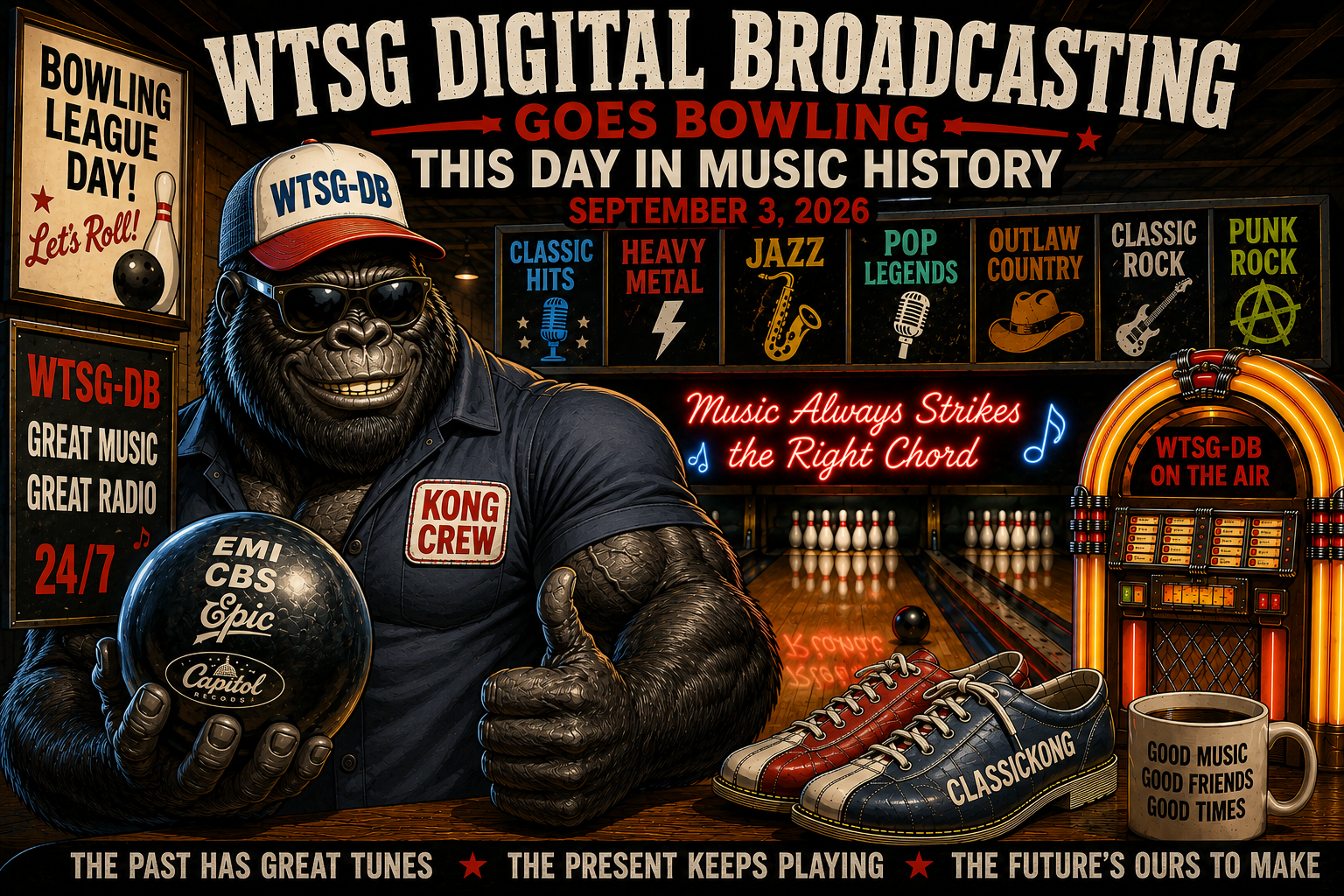
U.S. Bowling League Day
Okay, now THIS we can work with.
September 3 is U.S. Bowling League Day, celebrating that great American tradition of getting together with friends, putting on shoes nobody would voluntarily wear anywhere else and trying not to send the ball into the gutter. 😂
But there’s also something wonderfully nostalgic about the old neighborhood bowling alley.
The crashing pins.
The handwritten score sheets.
The league shirts.
The snack bar.
And somewhere nearby, quite often, a jukebox.
Those jukeboxes were little musical treasure chests. Drop in a coin, punch a couple of buttons and suddenly your favorite record became the soundtrack for the whole room.
Bowling alleys, diners, skating rinks, arcades—music lived in all of those places.
And for many of us, so do the memories. ❤️
CLASSICKONG’s Music Trivia
QUESTION: Before helping form Thin Lizzy, Eric Bell briefly played with what Belfast band that had earlier been fronted by Van Morrison?
No cheating.
The answer is waiting at the bottom of today’s page.
Final Spin
September 3 gives us musicians from completely different worlds, but the deeper we dig, the more they seem to have something in common.
Iron Maiden didn’t play it safe with Powerslave.
Judas Priest didn’t coast on its reputation with Painkiller.
George Michael stepped beyond the expectations surrounding his superstar image and made the record he wanted to make.
Walter Becker showed us that great musicianship is about taste—knowing what to play, what not to play, and finding the notes that make the whole song better.
Tompall Glaser pushed against Nashville’s established system because artists deserved greater control over their own music.
Artie Shaw put a harpsichord in a jazz combo because he heard something different.
Eric Bell helped establish the original musical identity of Thin Lizzy before the band evolved into the powerhouse much of the world would later know.
And Don Brewer proved that the drummer didn’t have to live in the background. He could drive Grand Funk Railroad from behind the kit while singing and writing songs that became part of the band’s identity.
Maybe that’s today’s lesson.
The musicians we remember aren’t always the ones who followed the safest road.
They’re the ones who learned to trust what they heard inside themselves.
Sometimes that meant making a heavier record.
Sometimes it meant walking away from an image.
Sometimes it meant fighting an established recording system for creative freedom.
Sometimes it meant understanding that one perfectly chosen note can say more than twenty unnecessary ones.
And sometimes, apparently, it meant looking at a perfectly good piano and saying:
“Nah. Bring me a harpsichord.” 😂
So here’s today’s Final Spin:
Trust your ears. Trust your instincts. Find your own voice—and when you find it, don’t let somebody else tell you what it’s supposed to sound like.
That’s a lesson that reaches far beyond music.
Until tomorrow, keep listening, keep discovering, and keep supporting the musicians who make our lives sound better.
— CLASSICKONG ❤️
Listen to Today’s Broadcast
Hear today’s This Day in Music History spoken-word edition from WTSG-DB:
Trivia Answer
The band, Them.
The Belfast group was originally fronted by Van Morrison and gave us recordings including “Gloria.” Eric Bell’s brief tenure came later, after Morrison had left the band.
References
Judas Priest — Official Website
MusicBrainz — Painkiller Release Information
George Michael — Official Website
AllMusic — Listen Without Prejudice Vol. 1
GRAMMY — Remembering Walter Becker
Los Angeles Times — Tompall Glaser
Artie Shaw — “Summit Ridge Drive”
Grand Funk Railroad — Don Brewer Biography
Sex Pistols — Steve Jones Biography