From the Desk of CLASSICKONG 🦍🎙️
Good Wednesday morning from all of us at WTSG-DB*, where the music never stops and the memories are always welcome.*
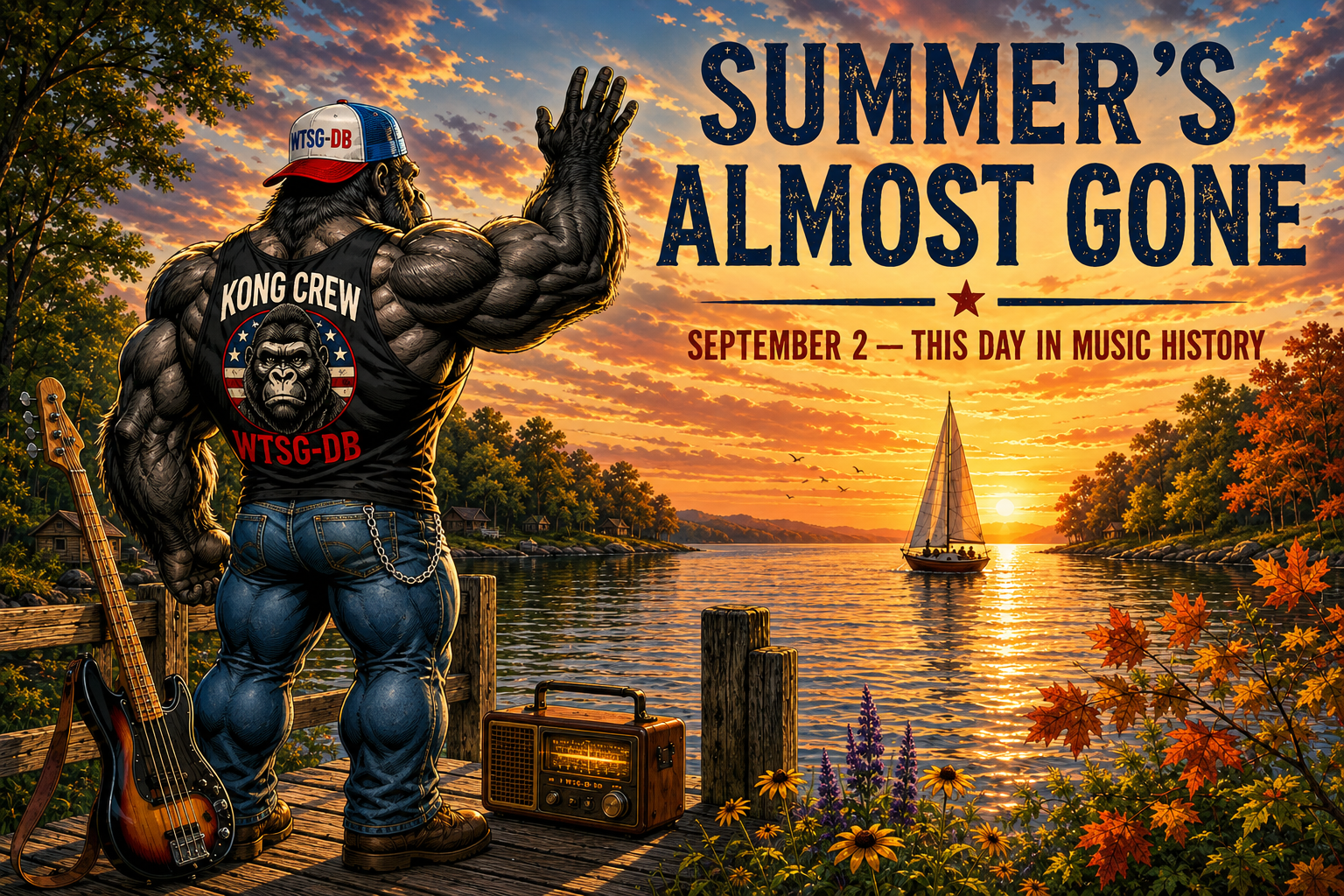
There is something different about these first few days of September.
Summer isn’t really gone. The afternoon sun can still feel like August, the grass is still green, and there are plenty of warm evenings left ahead of us.
But you can feel something changing.
The daylight is getting a little shorter. The calendar has turned another page. Somewhere out there, autumn is waiting.
And maybe that’s why today’s first story feels almost too perfect.
Yesterday, I was talking with my pal Jarvis about how much I hate seeing summer slip away. We laughed about how summers seemed to last forever when we were kids and how quickly they seem to disappear now.
Then we opened the music-history books for September 2.
And there they were.
The Doors.
Recording a song called…
“Summer’s Almost Gone.”
You can’t make this stuff up. ☀️🍂
Before we begin, WTSG-DB sends our love and gratitude to the men and women of the United States Armed Forces—past and present—and to their families.
Thank you for your service. 🇺🇸
The Doors Record “Summer’s Almost Gone” — September 2, 1965
On September 2, 1965, a young group of musicians entered World Pacific Jazz Studios in Los Angeles and recorded a six-song demo session.
This was an early version of the group that would soon become The Doors.
The recordings included:
“Moonlight Drive”
“Hello, I Love You”
“Summer’s Almost Gone”
“My Eyes Have Seen You”
“End of the Night”
“Go Insane (A Little Game)”
Jim Morrison was there on vocals, Ray Manzarek on keyboards, John Densmore on drums, and Patty Sullivan on bass. Robby Krieger had not yet joined the group.
These were musicians still finding their identity, recording demos in hopes of getting somebody in the record business to listen.
Think about what was still ahead of them.
The Doors — January 4, 1967 — Elektra
Strange Days — September 25, 1967 — Elektra
Waiting for the Sun — July 3, 1968 — Elektra
The Soft Parade — July 18, 1969 — Elektra
Morrison Hotel — February 9, 1970 — Elektra
L.A. Woman — April 19, 1971 — Elektra
The familiar studio version of “Summer’s Almost Gone” eventually appeared on Waiting for the Sun in 1968.
Sixty-one years later, we arrive at September 2 again.
Summer’s almost gone.
Apparently Jim Morrison tried to warn us.
We just weren’t listening. ☀️🍂
Billy Preston — A Musician Who Put Joy Into the Room
Billy Preston was born September 2, 1946, in Houston, Texas.
Oh buddy.
Where do you even begin with Billy Preston?
Singer. Pianist. Organist. Songwriter. Session musician.
And one seriously cool cat.
Billy was one of those musicians who seemed incapable of sitting behind a keyboard without putting some kind of life into it.
He grew from gospel roots into a career that crossed musical boundaries almost effortlessly. Along the way, he worked with an astonishing collection of artists including Little Richard, Sam Cooke, Ray Charles, the Beatles and the Rolling Stones.
His connection with the Beatles became particularly historic. Their 1969 single “Get Back” was credited to The Beatles with Billy Preston, making him one of the very few outside musicians ever given that kind of billing on a Beatles release.
But Billy Preston was never merely somebody else’s keyboard player.
Listen to:
“That’s the Way God Planned It”
“Outa-Space”
“Will It Go Round in Circles”
“Space Race”
“Nothing from Nothing”
And then there’s “You Are So Beautiful.”
Billy Preston and Bruce Fisher wrote the song, and Billy recorded it for his 1974 album The Kids & Me on A&M Records. Joe Cocker would subsequently turn it into one of the most famous ballads of the 1970s, but the song began with Preston and Fisher.
That makes a later performance I’ve always loved even more meaningful.
Billy performed “You Are So Beautiful” with the Italian group Novecento, and it may be the most beautiful version I’ve ever heard.
Listen to Billy’s voice.
Then listen underneath it.
His piano touch. His voicings. The space he leaves between the notes.
That’s musicianship.
I became a Billy Preston fan when I was just a young keyboard player myself, and all these years later I still hear the same thing in his playing that attracted me then.
Joy.
Billy could play sophisticated voicings and beautiful melodic ideas without ever making the music feel like an academic exercise. He played from somewhere deeper.
Earlier today, Billy’s music reminded me of the biblical story of King Saul and David. When Saul was deeply troubled, David would take up his lyre and play, and the music would soothe him.
Thousands of years later, music still has that power.
Sometimes you don’t need somebody to explain anything.
Sometimes you just need somebody to play.
Billy Preston could do that.
Billy died June 6, 2006, at only 59 years old.
But every time somebody drops the needle, presses play, or sits down at a keyboard and finds that gospel-soaked groove, some of Billy’s joy comes back into the room.
Billy Preston was one of America’s musical treasures.
RIP, Billy.
We love you, buddy. ❤️🎹
Thin Lizzy Earns a Bad Reputation — 1977
On September 2, 1977, Thin Lizzy released their eighth studio album, Bad Reputation, on Vertigo Records.
Produced by Thin Lizzy and Tony Visconti, the album followed the tremendous one-two punch of Jailbreak and Johnny the Fox, both released in 1976.
And if there was ever a band that looked and sounded like rock ‘n’ roll superheroes, it was Thin Lizzy.
Phil Lynott had charisma to burn.
Scott Gorham had the guitar.
Brian Downey had that tremendous feel behind the drums.
And although Brian Robertson’s involvement with Bad Reputation was reduced during a turbulent period for the band, when those musicians came together, Thin Lizzy had an identity nobody else could duplicate.
And then there was Phil with that bass.
Phil Lynott didn’t merely hold a bass guitar.
The man wielded the damn thing like a battle-axe.
Slung low, standing out front, commanding the stage—Phil looked like he’d walked straight out of a rock ‘n’ roll comic book.
The album included:
“Soldier of Fortune”
“Bad Reputation”
“Opium Trail”
“Southbound”
“Dancing in the Moonlight (It’s Caught Me in Its Spotlight)”
“Killer Without a Cause”
“Dear Lord”
Bad Reputation reached No. 4 on the UK Albums Chart.
And speaking of comic books…
If you’ve never spent some time simply looking at the artwork on Thin Lizzy albums such as Vagabonds of the Western World — released September 21, 1973 on Decca — and Jailbreak — released March 26, 1976 on Vertigo — do yourself a favor.
That artwork was part of the experience.
Those weren’t little pictures on a streaming service.
Those album covers made Phil Lynott and the boys look like they had stepped directly out of some strange psychedelic comic-book universe.
Which, honestly, wasn’t far from the truth.
Thin Lizzy didn’t merely play rock ‘n’ roll.
They looked like rock ‘n’ roll.
Phil Lynott died January 4, 1986, at only 36 years old.
There will never be another Phil.
Turn this one up. ❤️🤘
Horace Silver — The Soul of Hard Bop
Pianist and composer Horace Silver was born September 2, 1928, in Norwalk, Connecticut.
If you’ve ever wondered what happens when bebop meets blues, gospel, funk and an irresistible rhythmic piano attack…
Welcome to Horace Silver.
Silver helped form the Jazz Messengers and became one of the defining musicians and composers of the hard-bop movement.
His father’s Cape Verdean heritage also became an important part of his musical vocabulary, particularly on recordings such as Song for My Father and The Cape Verdean Blues.
Silver’s compositions became jazz standards:
“Song for My Father”
“Señor Blues”
“The Preacher”
“Nica’s Dream”
“Peace”
And that last title feels particularly appropriate today.
Peace.
Maybe that’s part of what we’re searching for when we put on a favorite record.
A few minutes when the noise outside disappears.
A familiar melody.
A familiar voice.
A piano.
And peace.
CLASSICKONG’s Horace Silver Essentials
Horace Silver and the Jazz Messengers — 1956 — Blue Note
Six Pieces of Silver — 1956 — Blue Note
Blowin’ the Blues Away — 1959 — Blue Note
Song for My Father — 1965 — Blue Note
The Cape Verdean Blues — 1965 — Blue Note
Horace Silver died June 18, 2014, at age 85.
RIP, Horace. ❤️🎹
John Coltrane and the Classic Quartet Record First Meditations — 1965
Here’s a remarkable coincidence.
While those young musicians who would become the Doors were recording their demos in Los Angeles on September 2, 1965, something very different was happening across the country.
John Coltrane was recording First Meditations (for quartet).
Coltrane entered Rudy Van Gelder’s studio in Englewood Cliffs, New Jersey, with one absolutely astonishing group of musicians:
John Coltrane — tenor saxophone
McCoy Tyner — piano
Jimmy Garrison — bass
Elvin Jones — drums
Look at that lineup again.
Tyner. Garrison. Elvin Jones.
WOW.
This was Coltrane’s classic quartet, one of the great ensembles in the history of jazz, and the September 2 session became the quartet’s final studio recording session together.
The pieces recorded included:
“Love”
“Compassion”
“Joy”
“Consequences”
“Serenity”
The recordings were eventually released posthumously as First Meditations (for quartet) on Impulse! Records in 1977.
The music came from a period when Coltrane was moving farther into the spiritual and exploratory territory that defined his final years.
And just consider September 2, 1965.
In California, a young Jim Morrison was singing “Summer’s Almost Gone.”
In New Jersey, John Coltrane, McCoy Tyner, Jimmy Garrison and Elvin Jones were recording music about love, compassion, joy and serenity.
Two completely different musical universes.
Same day.
What a day for music. ❤️🎷🎹🥁
Led Zeppelin Blasts Oakland — 1970
September 2, 1970.
Oakland Coliseum Arena.
Led Zeppelin.
You can probably already hear the amplifiers warming up. 😂🤘
Zeppelin’s own concert archive documents a massive set that included:
“Immigrant Song”
“Heartbreaker”
“Dazed and Confused”
“Since I’ve Been Loving You”
“Moby Dick”
“Whole Lotta Love”
“Communication Breakdown”
And then came a remarkable run of encores including:
“Train Kept a Rollin’”
“Blueberry Hill”
“Long Tall Sally”
A contemporary review preserved in Zeppelin’s archive described nearly 10,000 people being hit by music of enormous power, force and emotion.
Robert Plant.
Jimmy Page.
John Paul Jones.
John Bonham.
Led Zeppelin in 1970.
Buddy, I’m guessing everybody walked out of Oakland that night…
Dazed and Confused.
Thank you.
I’ll be here all week. 😂🥁🤘
The Rolling Stones Go Back to the Blues — 1964
September 2 also gives us a trip straight into the blues roots of rock ‘n’ roll.
Bill Wyman’s account places the Rolling Stones working on Willie Dixon’s “Little Red Rooster” at Regent Sound Studios around this date in 1964, although surviving session histories differ over exactly when and where the familiar master recording was completed.
So rather than pretend the historical record is cleaner than it is, we’ll simply say this:
The Stones’ version of “Little Red Rooster” came directly from the Chicago blues tradition they loved.
The song was written by Willie Dixon and famously recorded by Howlin’ Wolf, with Hubert Sumlin’s guitar helping define the sound.
The Stones didn’t hide those influences.
They celebrated them.
Brian Jones’ slide guitar became the centerpiece of the Stones’ interpretation, and the record ultimately reached No. 1 in the UK.
That’s an important piece of the Rolling Stones story.
Before the stadiums…
Before the enormous tours…
Before they became one of the biggest rock bands on Earth…
They were young musicians obsessed with American blues records.
And they wanted everybody else to hear them too. 🎸
September 2 Birthdays
Rosalind Ashford — born 1943
Original member of Martha and the Vandellas and part of that magnificent Motown sound behind classics such as “Heat Wave,” “Dancing in the Street” and “Nowhere to Run.”
Happy birthday, Rosalind! ❤️
Billy Preston — born 1946
We’ve already celebrated the man properly today.
Happy heavenly birthday, Billy. ❤️🎹
Mik Kaminski — born 1951
Violinist best known for his work with Electric Light Orchestra. Kaminski helped bring another distinctive orchestral voice to ELO’s already enormous sonic palette.
Happy birthday, Mik! 🎻
Steve Porcaro — born 1957
Founding member and keyboard and synthesizer wizard of Toto.
Steve came from one of music’s extraordinary families alongside his brothers Jeff and Mike Porcaro, and his synthesizer work became an important part of Toto’s sound.
Steve also co-wrote Michael Jackson’s “Human Nature,” one of the most beautiful songs on Thriller — released November 30, 1982 on Epic Records.
And anybody who has spent serious time listening to Toto already knows:
Those guys weren’t merely a rock band.
They were musicians’ musicians.
Happy birthday, Steve.
Much respect. ❤️🎹
Fritz McIntyre — born 1958
Original Simply Red keyboardist Fritz McIntyre was born in Birmingham, England.
McIntyre grew up around music. His father was a church pastor and choirmaster, and Fritz eventually became proficient on keyboards and vocals while also learning other instruments.
He became an important part of Simply Red’s early sound during the band’s enormously successful first decade.
Go back and listen to records such as:
“Money’s Too Tight (to Mention)”
“Holding Back the Years”
“The Right Thing”
“If You Don’t Know Me by Now”
Mick Hucknall’s unmistakable voice may have been out front, but there were some seriously good musicians underneath it.
Fritz McIntyre died August 23, 2021, at age 62.
RIP, Fritz. ❤️🎹
Final Spin
And that brings us back to where we started.
Summer’s almost gone.
I don’t particularly like saying that.
As I’ve gotten older, summers seem to pass faster than they once did. When you’re a kid, three months can feel like an entire lifetime.
Now you blink, and September is standing at the door.
But maybe we don’t have to think of it as losing summer.
Maybe we’re simply carrying it forward.
Today the Doors reminded us that summer eventually slips away.
Horace Silver gave us “Peace.”
And on this very day in 1965, John Coltrane, McCoy Tyner, Jimmy Garrison and Elvin Jones left us music with names like “Love,” “Compassion,” “Joy” and “Serenity.”
Billy Preston reminded us that sometimes music can put that joy right back into our souls.
Thin Lizzy reminded us to turn up the guitars and live a little.
And Led Zeppelin?
Well…
They reminded us to wear hearing protection. 😂🤘
Earlier today, while thinking about all of this, I remembered something from one of my favorite artists and drummers, Phil Collins.
In “We Said Hello Goodbye,” Phil gives us a beautiful little piece of advice:
“Set your sails on a new horizon.”
Maybe that’s what September is asking us to do.
A few days ago, we were talking about Christopher Cross and his beautiful song “Sailing.”
And today another thought occurs to me.
Some of the people we love aren’t sailing beside us anymore.
Maybe they’re simply sailing ahead. ❤️
And someday, somewhere beyond a horizon we can’t quite see yet, perhaps we’ll catch up.
So we’re not going to mourn another summer today.
We’re going to be grateful that we had one.
For the sunshine.
For the laughter.
For the people who shared the journey.
And, always, for the music.
So long, summer.
We’ll miss you.
But we’re taking the music with us. ❤️☀️🍂
This is CLASSICKONG at WTSG-DB.
Keep listening.
Keep remembering.
And keep sailing toward that next horizon.
Listen to our Podcast
Want to hear today’s stories instead?
Listen to the spoken-word edition of This Day in Music History right here on WTSG-DB.
References
The Doors — Waiting for the Sun
Billy Preston — Songwriters Hall of Fame
A&M Records — Billy Preston / “You Are So Beautiful”
National Endowment for the Arts — Horace Silver
Blue Note Records — Horace Silver
Smithsonian National Museum of American History — Today in Jazz History
John Coltrane Discography — September 2, 1965 Session
Led Zeppelin — Oakland Coliseum, September 2, 1970
Steve Porcaro — Official Website