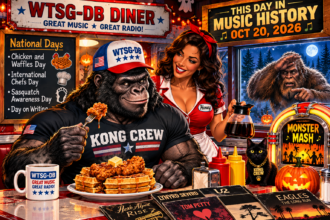
From the Desk of CLASSICKONG 🦍🎙️
Good Wednesday morning from all of us at WTSG-DB*, where the music never stops and the memories are always welcome.*
Before we turn up the amplifiers this morning, we begin where we always should — by remembering the men and women of the United States Armed Forces, past and present.
To those serving today, to our veterans, and to the families standing behind them: thank you for your service, sacrifice and devotion to our country. 🇺🇸
August 19 gives us a particularly fitting reason to look toward the sky.
Today is National Aviation Day, observed on the birthday of aviation pioneer Orville Wright, born August 19, 1871.
By the way, when CLASSICKONG heard me say “Orville,” he suddenly got all excited because he thought I was bringing popcorn into the station.
Sorry, buddy.
Wrong Orville. We’re talking aviation here. 😂🍿✈️
Put the bowl away and get back behind the microphone.
We’ll return to National Aviation Day later, because aviation and music share a remarkable — and heartbreaking — World War II story involving the great Glenn Miller.
But first, let’s spin the records.
The Beatles Launch Their First North American Tour — 1964 🎸
On August 19, 1964, Beatlemania officially hit the road in North America.
Six months after John Lennon, Paul McCartney, George Harrison and Ringo Starr exploded onto American television through The Ed Sullivan Show, the Beatles walked onto the stage of the Cow Palace in San Francisco to begin their first North American performance tour.
Approximately 17,000 fans packed the building.
And after the Beatles were introduced, the screaming continued for an incredible four minutes and 45 seconds before the band could even begin playing.
Cow Palace manager Ed Diran compared the noise to all the jets at San Francisco International Airport taking off simultaneously.
Think about that for a moment.
Today we’re accustomed to enormous tours, stadium video screens, sophisticated sound systems and carefully choreographed productions.
The Beatles were facing something the concert business had barely learned how to handle.
The screaming could become so overwhelming that the musicians sometimes struggled to hear themselves.
Yet there they stood with guitars, drums and comparatively primitive amplification, trying to play rock and roll in the middle of a cultural hurricane.
The tour would take the Beatles across the United States and Canada over the following weeks.
What had begun earlier that year as four young musicians arriving in America had become something much larger.
Beatlemania was now a traveling phenomenon.
And rock concert touring would never quite be the same again.
The Midnight Special Takes America Into the Night — 1972 📺
There was a time when discovering music didn’t mean typing an artist’s name into a search box.
Sometimes you waited for television.
And on August 19, 1972, American television audiences got their first look at something very special.
The Midnight Special.
The original pilot aired on NBC with John Denver serving as guest host.
Just look at this lineup:
Linda Ronstadt
Mama Cass Elliot
Harry Chapin
The Everly Brothers
The Isley Brothers
Argent
War
Helen Reddy
David Clayton-Thomas
And Wolfman Jack was there, too.
That’s not simply a television lineup.
That’s practically an evening of WTSG-DB programming.
John Denver performed “Take Me Home, Country Roads.”
Linda Ronstadt sang “Long Long Time.”
Argent delivered “Hold Your Head Up.”
The Isley Brothers brought the funk.
The Everly Brothers performed “All I Have to Do Is Dream.”
War performed “Slippin’ into Darkness.”
Harry Chapin gave viewers “Taxi.”
And John Denver joined Mama Cass for “Leaving on a Jet Plane.”
The pilot proved successful enough that The Midnight Special returned as a regular weekly series in 1973 and became one of America’s great showcases for popular music.
And importantly, viewers frequently got to see musicians actually performing.
For a generation, programs such as The Ed Sullivan Show, American Bandstand, Soul Train and The Midnight Special weren’t simply entertainment.
They were places where you discovered music.
You heard somebody you had never heard before.
Maybe the next afternoon you went looking for the record.
Maybe you became a fan for life.
There was something special about waiting for those moments.
You couldn’t simply call the performance up whenever you wanted.
You had to be there.
Emerson, Lake & Palmer Welcome Us Back to the Show — 1974 🎹
Progressive-rock fans received one heck of a live album on August 19, 1974.
Emerson, Lake & Palmer released the wonderfully titled:
Welcome Back My Friends to the Show That Never Ends — Ladies and Gentlemen.
And if you’re going to document Emerson, Lake & Palmer in concert, one record simply wasn’t going to contain them.
The original release was a massive three-LP live set.
Keith Emerson — keyboards
Greg Lake — bass, guitar and vocals
Carl Palmer — drums
ELP became one of progressive rock’s great power trios — except instead of building the band around a conventional lead guitarist, they put Emerson’s keyboards right in the center of the storm.
The album contains performances including:
“Hoedown”
“Tarkus”
“Take a Pebble”
“Lucky Man”
“Karn Evil 9”
And Karn Evil 9 becomes an enormous multipart performance.
That’s progressive rock.
Why play something for four minutes when you can take the listener on an expedition? 😂
Essential ELP albums:
Emerson, Lake & Palmer — 1970
Tarkus — 1971
Trilogy — 1972
Brain Salad Surgery — 1973
Welcome Back My Friends to the Show That Never Ends — 1974
Works Volume 1 — 1977
For listeners who love Hammond organ, synthesizers, huge arrangements and musicians unafraid to stretch a composition as far as it can possibly go, ELP remains essential listening.
Fleetwood Mac Reunites for The Dance — 1997 💃
On August 19, 1997, Fleetwood Mac released an album many fans had been waiting years to hear.
The classic lineup was together again:
Mick Fleetwood
John McVie
Christine McVie
Lindsey Buckingham
Stevie Nicks
The resulting live album was The Dance.
Recorded before a live audience at Warner Bros. Studios in Burbank, the project reunited the lineup responsible for one of the greatest commercial runs in rock history.
And what a track list:
“The Chain”
“Dreams”
“Everywhere”
“Rhiannon”
“Big Love”
“Landslide”
“Silver Springs”
“You Make Loving Fun”
“Go Your Own Way”
“Tusk”
“Don’t Stop”
One of the unforgettable moments is “Silver Springs.”
Originally recorded during the Rumours sessions, the song had famously been left off that album. Two decades later, Stevie Nicks’ performance of it on The Dance gave the song an extraordinary second life.
Watching Nicks and Buckingham during that performance is almost like watching decades of Fleetwood Mac history compressed into a few minutes.
That was always part of what made this particular lineup fascinating.
The music was beautiful.
The relationships were complicated.
And somehow those two things frequently fed one another.
The Dance wasn’t merely nostalgia.
It reminded the world just how powerful that combination of five musicians could still be.
Dublin Honors Phil Lynott — 2005 ☘️
On August 19, 2005, one of Ireland’s greatest rock musicians returned symbolically to the streets of Dublin.
A life-size bronze statue of Phil Lynott was unveiled on Harry Street, just off Grafton Street.
Thousands of fans gathered for the ceremony.
And the person who unveiled it was Phil’s mother, Philomena Lynott.
Former friends and bandmates were there as well.
The statue depicts Lynott with his bass and that unmistakable rock-and-roll swagger.
Phil Lynott was born August 20, 1949, and died January 4, 1986, only 36 years old.
The statue was unveiled on the eve of what would have been his 56th birthday.
As singer, bassist and principal songwriter of Thin Lizzy, Lynott helped create a catalog that remains part of classic-rock history:
“The Boys Are Back in Town”
“Jailbreak”
“Whiskey in the Jar”
“Dancing in the Moonlight”
“Waiting for an Alibi”
“Cowboy Song”
“Emerald”
And then there’s that unmistakable Thin Lizzy twin-guitar sound.
Essential Thin Lizzy:
Fighting — 1975
Jailbreak — 1976
Johnny the Fox — 1976
Bad Reputation — 1977
Live and Dangerous — 1978
Black Rose: A Rock Legend — 1979
Thunder and Lightning — 1983
There are monuments to politicians, generals, writers and statesmen.
On Harry Street in Dublin, there’s one to a rock-and-roll bass player.
Somehow, that seems exactly right.
Happy Birthday, Ian Gillan — Born 1945 🎤
Turn this one up.
Ian Gillan was born August 19, 1945, in Hounslow, Middlesex, England.
In 1969, Gillan and bassist Roger Glover joined Deep Purple, completing the legendary Mark II lineup:
Ian Gillan — vocals
Ritchie Blackmore — guitar
Jon Lord — keyboards
Roger Glover — bass
Ian Paice — drums
That lineup helped write the vocabulary of hard rock.
Gillan’s first Deep Purple album appearance came on Concerto for Group and Orchestra, but the records that followed established him as one of rock’s great voices:
Essential Ian Gillan-era Deep Purple:
Deep Purple in Rock — 1970
Fireball — 1971
Machine Head — 1972
Made in Japan — 1972
Who Do We Think We Are — 1973
Perfect Strangers — 1984
And then there are the songs:
“Child in Time.”
“Highway Star.”
“Space Truckin’.”
“Woman from Tokyo.”
“Smoke on the Water.”
Gillan could sing with subtlety, but when he opened that throttle, few rock vocalists could touch him.
After leaving Deep Purple in the 1970s, Gillan pursued the Ian Gillan Band and later Gillan before taking one of hard rock’s strangest detours — becoming the singer for Black Sabbath.
The result was:
Born Again — 1983.
Then came the reunion Deep Purple fans had been hoping for.
The classic Mark II lineup reunited and released Perfect Strangers in 1984.
Suddenly that voice, that Hammond organ, that guitar and that rhythm section — that unmistakable Deep Purple machinery — were running together again.
Deep Purple’s history contains enough lineup changes to require its own filing cabinet. 😂
But when people talk about the band’s defining years, the Mark II lineup remains impossible to ignore.
Happy birthday to Ian Gillan.
One of the voices that helped define hard rock.
Ginger Baker — Rock Drummer With Jazz in His Blood 🥁
Another extraordinary musician was born on August 19.
Peter Edward “Ginger” Baker was born August 19, 1939, and died October 6, 2019.
Most rock listeners immediately associate Baker with Cream:
Eric Clapton — guitar
Jack Bruce — bass and vocals
Ginger Baker — drums
But calling Ginger Baker simply a “rock drummer” doesn’t really explain him.
His playing drew heavily from jazz and African rhythms, and those influences helped create an approach to drumming that sounded different from much of the rock surrounding him.
After Cream came Blind Faith, followed by Ginger Baker’s Air Force, the Baker Gurvitz Army and numerous other musical adventures.
With Cream, Baker helped create classics including:
“Sunshine of Your Love”
“White Room”
“Crossroads”
“Strange Brew”
“Badge”
And then there was “Toad,” which gave Baker room to demonstrate what happened when the drummer stopped being merely the person keeping time and became a featured instrumental voice.
Rock musicians borrowing from blues was nothing new.
Ginger Baker also brought something else into the room:
jazz.
And that’s a perfect bridge into today’s jazz history.
Eddie Durham Helped Plug Jazz Guitar Into the Future — Born 1906 🎸
Long before rock and roll discovered the electric guitar, musicians such as Eddie Durham were helping figure out what the instrument could become.
Durham was born August 19, 1906, in San Marcos, Texas, and died March 6, 1987.
He was a guitarist, trombonist, composer and arranger whose career connected him with major Swing Era figures including Bennie Moten, Jimmie Lunceford and Count Basie.
Most importantly for guitar history, Durham was an early pioneer of electrically amplified jazz guitar.
That may sound ordinary today.
In the 1930s, it wasn’t.
Guitarists had spent years fighting one basic problem: how do you make a guitar heard clearly against horns, drums and an entire big band?
Amplification changed the possibilities.
Once guitarists could be heard, the instrument could increasingly move from rhythm accompaniment toward the front of the band.
Durham’s recording history doesn’t fit neatly into the modern idea of a long solo-album discography. Much of his importance is found in the recordings, arrangements and compositions he contributed to other great bands.
But listeners wanting to hear Durham himself as a leader should seek out:
Blue Bone — 1981
Recorded in London, the album features Durham on guitar and trombone and includes his own compositions such as “Sliding Along,” “Blue Bone,” “Front and Center,” “Guitar Piece No. 2” and “Caribbean Jam.”
His broader musical legacy includes important work as a composer and arranger during the Swing Era.
The road from early amplified jazz guitar to Charlie Christian, T-Bone Walker, Les Paul, Chuck Berry and eventually the electric-guitar revolution of rock didn’t happen overnight.
Musicians such as Eddie Durham helped build that road.
Jimmy Rowles — The Pianist Great Musicians Wanted Beside Them — Born 1918 🎹
Jimmy Rowles was born August 19, 1918, in Spokane, Washington, and died May 28, 1996.
Rowles became one of jazz’s highly respected pianists and accompanists.
His résumé included work with:
Lester Young
Billie Holiday
Benny Goodman
Woody Herman
Tommy Dorsey
Peggy Lee
Ella Fitzgerald
Tony Bennett
That’s some résumé.
Rowles wasn’t necessarily the household name standing in the spotlight.
He was something musicians understand just as well:
the musician other great musicians wanted beside them.
And unlike Eddie Durham, Rowles left us a substantial catalog as a leader and collaborator.
Essential Jimmy Rowles albums:
Rare, But Well Done — 1954
Weather in a Jazz Vane — 1958
Kinda Groovy — 1963
Jazz Is a Fleeting Moment — 1974
The Peacocks — 1975, with Stan Getz
Heavy Love — 1977, with Al Cohn
Tasty! — 1979
Plays Ellington and Billy Strayhorn — 1981
Lilac Time — 1994
One composition in particular deserves special mention:
“The Peacocks.”
Rowles wrote the haunting piece that eventually became a modern jazz standard, interpreted by generations of musicians.
So if Jimmy Rowles is a new name to you today, there’s your starting point.
Put on The Peacocks, settle back and listen.
Sometimes the best discoveries in music history are the musicians we didn’t know we were looking for.
Happy Birthday to Queen’s John Deacon — Born 1951 👑
John Richard Deacon was born August 19, 1951, in Leicester, England.
Freddie Mercury commanded the stage.
Brian May had that unmistakable guitar sound.
Roger Taylor brought the drums and another powerful voice.
And John Deacon frequently stood quietly with his bass and simply made Queen better.
But don’t mistake quiet for unimportant.
Deacon wrote some enormous Queen songs:
“You’re My Best Friend”
“Spread Your Wings”
“Another One Bites the Dust”
“I Want to Break Free”
Following Freddie Mercury’s death in 1991, Deacon gradually withdrew from public performance and eventually retired from the music business.
There is something rather fitting about John Deacon.
In a band containing some enormous personalities, the quietest member still managed to write songs heard around the world.
Happy birthday, John.
One More for the Record Shelf — CSNY’s So Far — 1974 🌼
August 19, 1974 also brought So Far from Crosby, Stills, Nash & Young.
The compilation gathered an extraordinary collection of songs including:
“Déjà Vu”
“Helplessly Hoping”
“Wooden Ships”
“Teach Your Children”
“Ohio”
“Woodstock”
“Our House”
“Helpless”
“Suite: Judy Blue Eyes”
The album reached No. 1 and became one of the biggest-selling releases associated with the group.
Sometimes a greatest-hits collection is simply a convenient package of familiar songs.
Sometimes you look at the track listing and realize you’re staring at a piece of an era.
So Far is one of those records.
National Aviation Day — Orville Wright and the Mystery of Glenn Miller ✈️
All right, CLASSICKONG.
You can bring the popcorn back now. 😂🍿
Earlier we mentioned that August 19 is National Aviation Day, observed on the birthday of Orville Wright, born August 19, 1871.
Orville and his brother Wilbur helped change human history when they achieved controlled powered flight in 1903.
But before we leave aviation behind today, there’s another story we need to tell.
Because aviation and American music share one of the most heartbreaking mysteries of World War II.
Glenn Miller.
By the early 1940s, Miller was one of America’s biggest musical stars.
His orchestra had given the country recordings including:
“Moonlight Serenade”
“In the Mood”
“Chattanooga Choo Choo”
“A String of Pearls”
“Tuxedo Junction”
“American Patrol”
“Little Brown Jug”
Miller was 38 years old, married, enormously successful and too old to be drafted.
But World War II was raging.
And Glenn Miller believed he should do more than simply remain home and sell records.
He volunteered for military service.
Miller eventually became a major in the United States Army Air Forces and organized an extraordinary military orchestra whose mission included entertaining American servicemen and boosting morale.
He wanted to take that music overseas.
And he did.
The band performed and broadcast for Allied forces in Europe, bringing American music to servicemen thousands of miles from home.
By December 1944, Paris had been liberated and Miller’s orchestra was preparing for performances on the European continent, including a Christmas Day broadcast.
Miller needed to get to Paris ahead of the band to finish preparations.
On December 15, 1944, with regular transportation disrupted by terrible weather, Miller accepted a seat aboard a small UC-64 Norseman aircraft flying from England to France.
The weather was cold and foggy.
The airplane departed England.
Glenn Miller never arrived in Paris.
The aircraft disappeared somewhere after departure, and neither Miller nor the other men aboard were ever recovered.
Over the decades, theories have attempted to explain what happened.
But no confirmed wreckage has provided the final answer.
More than eight decades later, the disappearance of Major Glenn Miller remains one of the enduring mysteries connecting American music and World War II.
And perhaps the saddest part is remembering why he was aboard that airplane in the first place.
He wasn’t chasing another hit record.
He wasn’t heading toward some glamorous Hollywood engagement.
He was trying to get ahead of his military orchestra and prepare for performances for American and Allied servicemen.
For listeners who would like to explore Glenn Miller, don’t worry so much about finding a conventional modern studio-album discography. His career belonged to the era of 78-rpm records, radio broadcasts and big-band performances.
Instead, look for good collections of the original Glenn Miller recordings and recordings of his Army Air Forces Band.
CLASSICKONG’s Glenn Miller Listening Recommendations:
Look for collections containing the original RCA/Bluebird-era performances, particularly:
“Moonlight Serenade”
“In the Mood”
“Chattanooga Choo Choo”
“A String of Pearls”
“Tuxedo Junction”
“American Patrol”
“Little Brown Jug”
And don’t overlook recordings of the Glenn Miller Army Air Forces Band. They capture another side of Miller’s legacy — the music he created while wearing the uniform of his country.
More than eight decades later, there may still be a mystery surrounding exactly what happened to Glenn Miller’s airplane.
But there’s no mystery about where he was going.
He was going to play music for the troops. 🇺🇸
Major Glenn Miller…
We remember you.
CLASSICKONG’s Music Trivia 🦍❓
Today’s question:
Which member of Queen wrote “Another One Bites the Dust”?
Was it:
A) Freddie Mercury
B) Brian May
C) Roger Taylor
D) John Deacon
Don’t peek.
The answer is waiting below.
Final Spin 🎙️
From The Beatles and The Midnight Special, through ELP, Fleetwood Mac, Thin Lizzy and Deep Purple, and all the way back to jazz musicians like Eddie Durham and Jimmy Rowles, today’s stories remind us just how many different roads helped create the music we still love.
Different generations.
Different styles.
Different stories.
One incredible musical history.
And we’re glad you spent a little part of your day sharing it with us.
Oh — and today’s trivia answer?
D — John Deacon.
Keep the music playing, keep the memories alive, and wherever today takes you…
We’ll meet you right back here tomorrow.
Great Music. Great Radio. Great Community.
WTSG-DB 🎙️🇺🇸
Listen to Today’s Broadcast
Sit back, relax, and enjoy today’s story in audio form with CLASSICKONG.
[sonaar_audioplayer albums=”latest” progress_bar_style=”default” wave_bar_width=”1″ wave_bar_gap=”1″ player_layout=”skin_boxed_tracklist” show_track_market=”true” css=”.srp_player_boxed, .skin_floated .album-player, .srp-artworkbg{background-color:#ffffff;}”][/sonaar_audioplayer]
And if you haven’t already, we’d love for you to head over to wtsg.net and sign our Guestbook.
It’s brand new, and we’d love to know where you’re listening from.
Thanks for spending part of your day with us.
We’ll keep the music playing. ❤️🎙️