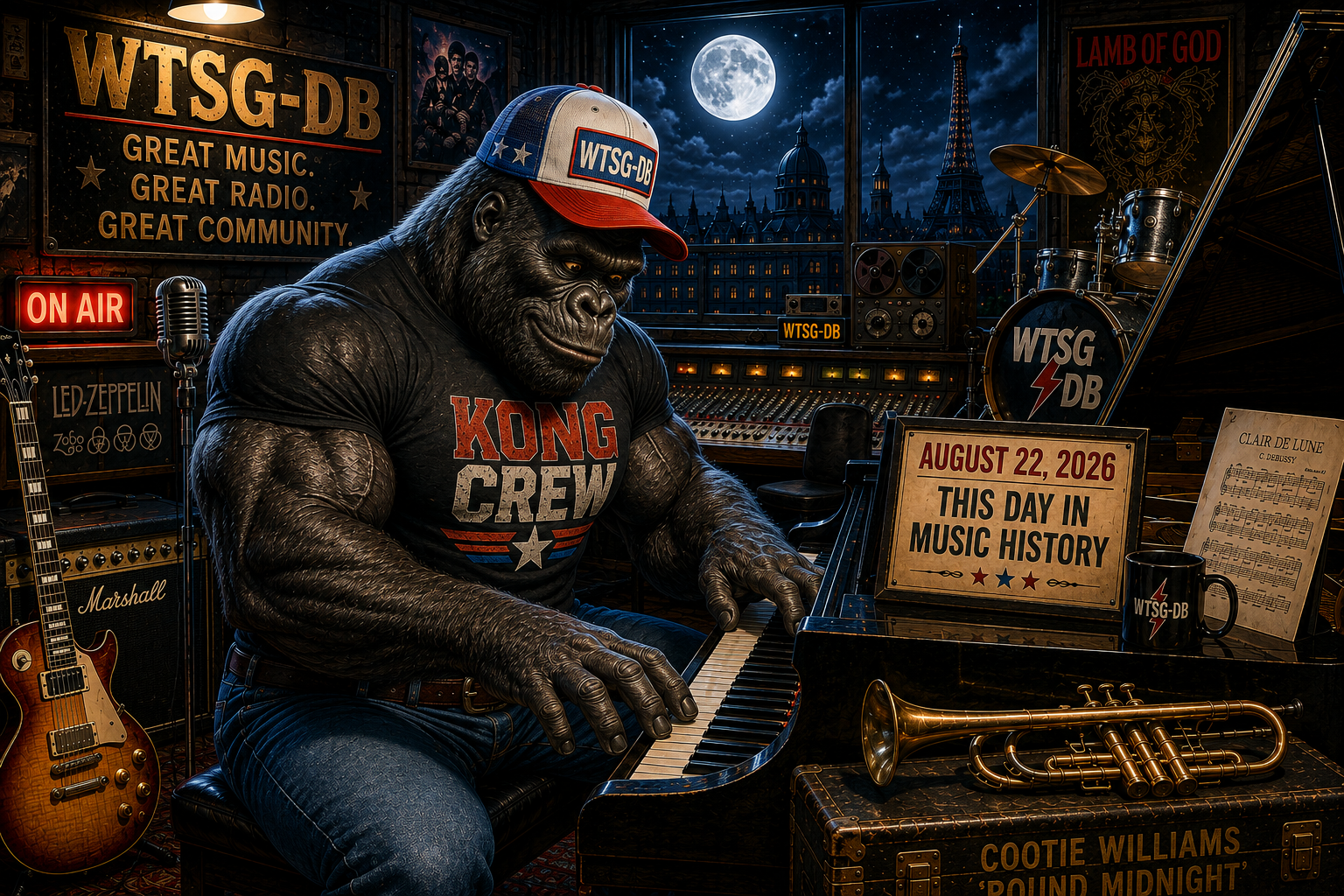
From the Desk of CLASSICKONG 🦍🎙️
Good Saturday morning from all of us at WTSG-DB*, where the music never stops and the memories are always welcome.*
Before we turn up the music, we begin as we always do—with gratitude.
To the men and women of the United States Armed Forces, past and present: thank you for your service, your sacrifice, and your willingness to stand watch so the rest of us can enjoy the freedoms we sometimes take for granted.
From all of us at WTSG-DB, we salute you. 🇺🇸
August 22 gives us one heck of a musical journey. Led Zeppelin delivers its final studio album during John Bonham’s lifetime, Ringo Starr temporarily walks away from The Beatles, Santana arrives with a debut album just days after Woodstock, Foreigner rules America with one of the biggest albums of the early ’80s, and Metallica gives us a nice follow-up to yesterday’s trip into the garage.
We’ll also visit Motown, turn up Lamb of God, remember Layne Staley, salute some extraordinary jazz musicians, and eventually turn everything down and sit quietly at the piano with Claude Debussy and a composition some admirers consider among the most beautiful pieces of music ever written.
Let’s get started.
Led Zeppelin Opens the Door One Last Time — 1979
On August 22, 1979, Led Zeppelin released In Through the Out Door in the United States, the band’s eighth studio album and ultimately its final studio record released during drummer John Bonham’s lifetime.
The album was recorded primarily at Polar Studios in Stockholm, Sweden, the recording studio founded and owned by members of the legendary Swedish pop group ABBA.
Led Zeppelin was in a very different place from the band that had made Led Zeppelin IV or Physical Graffiti.
John Paul Jones took an especially important creative role, making extensive use of keyboards and synthesizers and helping push Zeppelin into new musical territory.
The album gave us “In the Evening,” “Fool in the Rain,” “South Bound Saurez,” “Hot Dog,” “Carouselambra” and one of Robert Plant’s most deeply personal songs, “All My Love.”
Written by Plant and Jones, “All My Love” was inspired by the tragic death of Plant’s young son Karac in 1977.
Then there’s “Fool in the Rain.”
John Bonham’s famous half-time shuffle remains a master class in groove and feel. Decades later, drummers are still studying what Bonzo did behind that kit.
The album was memorable before you even placed it on the turntable. In Through the Out Door appeared with six different outer sleeve variations hidden inside a plain brown paper wrapper, so buyers didn’t necessarily know which version they were getting.
Nobody buying that record during the summer of 1979 knew that the original Led Zeppelin story was nearing its end.
John Bonham died unexpectedly on September 25, 1980, at only 32 years old.
Rather than replace him, Jimmy Page, Robert Plant and John Paul Jones decided Led Zeppelin could not continue without their friend and drummer.
That makes In Through the Out Door more than simply another Zeppelin album.
It became the final studio chapter of the original four.
Ringo Starr Walks Away from The Beatles — 1968
On August 22, 1968, during the increasingly difficult sessions for The Beatles—better known as the White Album—Ringo Starr temporarily quit the band.
Ringo had become frustrated and insecure about his playing. He felt disconnected from the others and believed the other three Beatles might actually be happier playing without him.
But when he spoke individually with his bandmates, Ringo discovered something remarkable:
They didn’t agree.
The Beatles wanted their drummer.
Ringo left for a brief holiday with his family aboard actor Peter Sellers’ yacht.
During his absence, Paul McCartney played drums on “Back in the U.S.S.R.”, with additional drum work developed during the sessions.
When Ringo returned, he discovered his drum kit decorated with flowers.
The message was pretty clear.
Welcome home, Ringo.
Exactly one year later, on August 22, 1969, John Lennon, Paul McCartney, George Harrison and Ringo Starr gathered at Lennon’s Tittenhurst Park estate for what became the final professional photo session of all four Beatles together.
The photographs show four Beatles still standing together.
Behind those photographs, however, the end was approaching.
Santana Arrives — 1969
On August 22, 1969, Santana released its self-titled debut studio album.
And talk about timing.
Only days earlier, Carlos Santana and the band had delivered their now-legendary performance at Woodstock, introducing a massive audience to an explosive mixture of rock, blues, improvisation and Latin percussion.
The debut included “Evil Ways,” “Jingo” and “Soul Sacrifice.”
Santana didn’t sound quite like anybody else.
Carlos Santana’s unmistakable guitar tone soared above congas, timbales, organ, bass and drums, creating music that could be heavy, hypnotic and beautiful all at once.
Woodstock opened the door.
Santana walked right through it.
Foreigner Turns 4 Into a Blockbuster — 1981
On August 22, 1981, Foreigner’s 4 reached No. 1 on the Billboard 200.
It would spend an incredible 10 weeks at the top.
And what an album.
“Urgent.”
“Juke Box Hero.”
“Waiting for a Girl Like You.”
“Luanne.”
At the center of it all was the remarkable voice of Lou Gramm.
Gramm possessed one of rock’s great combinations of range, power, clarity and soul. He could tear into “Juke Box Hero” like the roof was coming off the building and then turn around and deliver the tenderness of “Waiting for a Girl Like You.”
Then add producer Robert John “Mutt” Lange.
What can you say?
The guy is a legend.
Lange helped give 4 its enormous, polished sound. His remarkable production career would also include work with AC/DC, Def Leppard, Bryan Adams and later Shania Twain, among others.
And don’t overlook saxophone great Junior Walker.
That’s Walker delivering the unforgettable sax solo on “Urgent.”
4 represented a transition for Foreigner. Founding members Ian McDonald and Al Greenwood were no longer in the lineup, leaving the band officially operating as a quartet and moving toward the streamlined sound heard throughout the record.
But there was absolutely no question about the man standing behind that microphone.
Lou Gramm could flat-out SING.
Metallica — “The Day That Never Comes” — 2008
Yesterday we visited Metallica in 1987 with The $5.98 E.P. — Garage Days Re-Revisited.
Today we jump forward 21 years.
On August 22, 2008, Metallica released “The Day That Never Comes,” the first single from the upcoming album Death Magnetic.
The lengthy track represented something of a return to the multi-section arrangements associated with earlier Metallica records.
Following the controversial sound and production of St. Anger, Death Magnetic felt to many longtime listeners like Metallica reconnecting with elements of its past while continuing to move forward.
Consider this our little Metallica follow-up from yesterday.
Yesterday we went into the garage. Today we came out with Death Magnetic.
Lamb of God Releases Sacrament — 2006
On August 22, 2006, Lamb of God released Sacrament.
The album included “Redneck,” “Walk with Me in Hell,” “Again We Rise” and “Descending.”
At the time, Lamb of God featured the formidable lineup of Randy Blythe, Mark Morton, Willie Adler, John Campbell and Chris Adler.
And we need to talk about that drummer.
Chris Adler was phenomenal.
His precision, double-bass work, unusual accents and ability to weave technically demanding parts into brutally heavy music made him one of the most recognizable metal drummers of his generation.
But here’s the part of Adler’s story some listeners may not know.
He wasn’t originally a drummer.
Adler had played bass guitar in several bands before buying a drum kit at around 21 years old, largely for fun.
According to Adler himself, the first song he learned to play behind the kit was The Police’s “Message in a Bottle.”
The developing band that became Burn the Priest—and ultimately Lamb of God—became the environment in which Adler developed as a drummer.
Think about that for a moment.
Bass player.
Buys himself some drums.
Learns “Message in a Bottle.”
And eventually becomes…
CHRIS FREAKING ADLER.
Sometimes you don’t find your instrument.
Your instrument finds you.
Motown Owns the Street — 1964
August 22, 1964, was quite a day for Motown.
The Supremes’ “Where Did Our Love Go” reached No. 1 on the Billboard Hot 100, becoming the group’s first American chart-topper.
Diana Ross, Florence Ballard and Mary Wilson were about to become one of Motown’s defining acts.
Essential Supremes albums include:
Where Did Our Love Go (1964)
More Hits by The Supremes (1965)
I Hear a Symphony (1966)
The Supremes A’ Go-Go (1966)
Reflections (1968)
And on the very same date, Martha and the Vandellas released “Dancing in the Street.”
Written by Marvin Gaye, William “Mickey” Stevenson and Ivy Jo Hunter, the song became one of the defining recordings of the Motown era.
Essential Martha and the Vandellas albums include:
Heat Wave (1963)
Dance Party (1965)
Watchout! (1966)
Ridin’ High (1968)
And if you’re looking for “Dancing in the Street” on one of their original LPs, you’ll find it on Dance Party.
Detroit wasn’t merely making automobiles.
It was making the soundtrack of America.
Derek and the Dominos and the Road to Layla — 1970
In late August 1970, Derek and the Dominos arrived in Miami and prepared to begin the sessions that would produce Layla and Other Assorted Love Songs.
The band featured Eric Clapton, Bobby Whitlock, Carl Radle and Jim Gordon, with Duane Allman making an extraordinary contribution to the sessions.
And let’s make one thing perfectly clear:
The legendary song “Layla” appears on the 1970 album Layla and Other Assorted Love Songs.
The song was inspired by Clapton’s feelings for Pattie Boyd, who at the time was married to his friend George Harrison.
The meeting between Clapton and Duane Allman became one of the great guitar partnerships in rock history.
Their contrasting guitar voices helped turn Layla and Other Assorted Love Songs into a landmark record.
Derek and the Dominos didn’t last very long.
They didn’t need to.
They left behind one monster of an album.
Bon Jovi Conquers Donington — 1987
On August 22, 1987, Bon Jovi headlined Monsters of Rock at Donington Park in England during the band’s enormous Slippery When Wet era.
But what exactly was Donington—and why did playing there matter?
Donington Park is a famous motor-racing circuit near Castle Donington in Leicestershire, England.
Beginning in 1980, it became home to Monsters of Rock, one of the defining hard-rock and heavy-metal festivals of its era.
Over the years, Donington’s stages hosted giants including AC/DC, Iron Maiden, Judas Priest, Metallica, Ozzy Osbourne and many others.
This wasn’t just another outdoor concert.
For a hard-rock band in the 1980s, headlining Monsters of Rock at Donington meant something.
And in 1987, Bon Jovi was riding the phenomenal success of Slippery When Wet.
“You Give Love a Bad Name.”
“Livin’ on a Prayer.”
“Wanted Dead or Alive.”
Bon Jovi wasn’t merely having a successful year.
They had become one of the biggest rock bands on the planet.
Count Basie Jumps at the Woodside — 1938
On August 22, 1938, Count Basie and his orchestra recorded “Jumpin’ at the Woodside.”
The title referred to Harlem’s Woodside Hotel, where musicians frequently stayed.
The recording became one of the defining examples of Basie’s swinging Kansas City sound.
Basie’s genius wasn’t about filling every available space.
He understood something equally important:
When not to play.
That economical piano style, combined with one of the greatest rhythm sections and big bands in jazz history, created music that seemed to move effortlessly.
And when Basie’s band started swinging…
Everybody knew it.
If this story has you wanting to explore the Count a little further, we listed several of Count Basie’s essential albums in yesterday’s edition of This Day in Music History.
There’s plenty more Basie waiting for you.
Cootie Williams Takes Us “‘Round Midnight” — 1944
Here’s one of our favorite discoveries for today.
On August 22, 1944, trumpeter Cootie Williams and his orchestra recorded the first commercially released version of Thelonious Monk’s “‘Round Midnight.”
Today, “‘Round Midnight” is one of the most famous compositions in the entire jazz repertoire.
Most listeners naturally associate the composition with Monk, while countless jazz musicians—including Miles Davis—would eventually put their own stamp on it.
But the first recording?
Cootie Williams and his orchestra.
Williams was already a major figure in jazz, having established himself as one of the great trumpet voices of Duke Ellington’s orchestra.
His use of the plunger mute helped create some of the distinctive growling and vocal-like trumpet effects associated with the Ellington sound.
Essential Cootie Williams recordings include:
“‘Round Midnight”
“Concerto for Cootie”
“Echoes of Harlem”
“Do Nothing Till You Hear from Me”
“Things Ain’t What They Used to Be”
Cootie Williams died on September 15, 1985, at age 74.
Sometimes music history gives us a wonderful reminder:
The person who writes a standard isn’t necessarily the first person who puts it on record.
John Lee Hooker Brings the Boogie
Blues giant John Lee Hooker was born on August 22, 1917.
Hooker’s hypnotic boogie style became one of the foundational sounds connecting traditional blues with the rock music that followed.
That voice.
That guitar.
That relentless rhythm.
You knew John Lee Hooker when you heard him.
Essential recordings:
“Boogie Chillen'”
“Boom Boom”
“Dimples”
“One Bourbon, One Scotch, One Beer”
“I’m in the Mood”
Essential albums:
Burnin’ (1962)
It Serve You Right to Suffer (1966)
Never Get Out of These Blues Alive (1972)
Free Beer and Chicken (1974)
The Healer (1989)
Mr. Lucky (1991)
Chill Out (1995)
And Never Get Out of These Blues Alive is especially worth exploring, featuring contributions from musicians including Van Morrison, Elvin Bishop and Charlie Musselwhite.
John Lee Hooker died on June 21, 2001, at age 83.
But that boogie?
That never died.
Remembering Layne Staley
Layne Staley was born August 22, 1967.
As the frontman of Alice in Chains, Staley possessed one of the most haunting and instantly recognizable voices to emerge from the Seattle music scene.
Records such as Facelift (1990), Dirt (1992) and the acoustic EP Jar of Flies (1994) remain essential recordings of the era.
“Man in the Box.”
“Would?”
“Rooster.”
“Down in a Hole.”
“No Excuses.”
Alice in Chains could be crushingly heavy one moment and almost painfully vulnerable the next.
Staley died on April 5, 2002, at only 34 years old.
His death, however, was not the end of Alice in Chains.
The band eventually returned with William DuVall joining Jerry Cantrell, along with longtime members Mike Inez and Sean Kinney.
With Cantrell remaining a central creative force and DuVall helping carry the band into its next chapter, Alice in Chains has continued making music and performing for new generations of fans.
Nobody replaces Layne Staley.
But the music he helped create remains very much alive.
A Big WTSG-DB Salute to Vernon Reid
Vernon Reid, born August 22, 1958, is best known as the founder and guitarist of Living Colour.
But simply calling Vernon Reid a “rock guitarist” doesn’t begin to cover it.
Rock.
Metal.
Funk.
Jazz.
Fusion.
Blues.
Avant-garde.
Reid could pull from all of it.
When Living Colour exploded onto MTV with “Cult of Personality,” Reid’s guitar work sounded fearless and amazing.
The band’s Vivid (1988) remains essential listening, followed by albums including Time’s Up (1990) and Stain (1993).
Vernon Reid remains one of those guitarists who can make another guitarist stop what they’re doing and ask:
“What in the world did he just play?”
From all of us at WTSG-DB:
Happy birthday and a BIG salute to Vernon Reid—one fantastic guitarist.
Drummer Spotlight — Lex Humphries
Jazz drummer Lex Humphries was born August 22, 1936.
Humphries worked with an extraordinary collection of musicians, including Dizzy Gillespie, John Coltrane, Donald Byrd, Lee Morgan, Yusef Lateef and the great Wes Montgomery.
And that last name always catches my attention.
Wes Montgomery.
One of the greatest jazz guitarists who ever lived.
Humphries played drums on Montgomery’s wonderful 1961 album So Much Guitar!
And CLASSICKONG knew another great guitarist who truly admired Wes Montgomery’s playing:
Mr. Jerry Glore—my Dad. ❤️🎸
Dad was a huge Wes Montgomery fan, so whenever Wes’s name turns up while I’m digging through one of these stories, I can’t help but think about him.
That’s one of the beautiful things about music.
A record can connect musicians who never met.
And years later, that same record can connect a father and son.
So today, while we’re remembering the tremendous drummer Lex Humphries, I’ll tip my hat to another guitarist who understood just how special Wes Montgomery really was.
This one’s for you too, Dad. ❤️
Lex Humphries died on July 11, 1994, at age 57.
Great drummers don’t merely keep time.
They help define it.
Claude Debussy and the Beauty of Clair de Lune
French composer Claude Debussy was born August 22, 1862.
And today we’re stepping outside our usual rock, jazz and popular-music territory for a very good reason.
Clair de Lune.
But before we get there, it’s worth understanding why Debussy himself was so important.
Debussy became one of the most influential composers of the late 19th and early 20th centuries. His approach to harmony, tonal color, atmosphere, rhythm and musical space helped expand the vocabulary of Western music.
He is frequently associated with Impressionism, although Debussy himself was never particularly comfortable with that label.
Instead of always driving music toward an obvious destination, Debussy could allow harmony and sound itself to create atmosphere.
Sometimes the color of the music was the story.
And nowhere is that more beautifully demonstrated than in Clair de Lune.
The title means “Moonlight” in French.
It is the third movement of Debussy’s Suite bergamasque.
The suite traces its beginnings to around 1890, when Debussy was still a young composer. He later substantially revised the music before its publication in 1905.
And here’s a fascinating detail:
The piece we now know as Clair de Lune originally carried another title—
Promenade sentimentale.
Its eventual title was inspired by French poet Paul Verlaine’s “Clair de lune,” whose poetry was an important influence on Debussy.
That means one of the world’s most beloved piano compositions spent years evolving before reaching the form and title we recognize today.
Debussy apparently wasn’t particularly eager to publish some of this earlier music because his compositional style had developed considerably by the time publication was proposed.
And yet…
More than a century later, Clair de Lune is one of the pieces for which Claude Debussy is most beloved.
Funny how music sometimes knows where it belongs before the composer—or the rest of us—does.
Clair de Lune is delicate.
Spacious.
Romantic.
Dreamlike.
It doesn’t demand your attention.
It quietly draws you in.
Some admirers have described Clair de Lune as one of the most beautiful pieces of music ever written.
Some go even further and call it the most beautiful.
I don’t know how anyone could possibly choose just one.
There are simply too many beautiful pieces of music in this world.
But I do know this:
Clair de Lune is absolutely breathtaking.
Claude Debussy died on March 25, 1918, at age 55.
More than a century later, his music can still quiet a room.
And perhaps that’s the perfect reminder after a day filled with Led Zeppelin, Foreigner, Metallica, Lamb of God and screaming electric guitars:
Music doesn’t have to shake the walls to shake the soul.
So, for all you lovers out there…
This one’s for you. ❤️🎹🌙
Also Born on August 22
Roland Orzabal — born August 22, 1961 — singer, songwriter, guitarist and co-founder of Tears for Fears.
Alongside Curt Smith, Orzabal helped create some of the defining recordings of the 1980s, including “Mad World,” “Change,” “Shout,” “Everybody Wants to Rule the World,” “Head Over Heels” and “Sowing the Seeds of Love.”
Albums such as The Hurting (1983), Songs from the Big Chair (1985) and The Seeds of Love (1989) remain essential Tears for Fears listening.
Tori Amos — born August 22, 1963 — singer, songwriter and pianist whose distinctive voice, songwriting and piano-centered music have created a remarkable career of her own.
CLASSICKONG’s Final Spin
What a journey August 22 turned out to be.
We walked In Through the Out Door with Led Zeppelin, watched Ringo briefly walk out another door, felt Santana’s Latin-rock fire, celebrated the enormous voice of Lou Gramm, turned up Metallica and Lamb of God, danced through Motown and revisited the guitar magic surrounding Layla.
Then we changed gears.
Count Basie started swinging.
Cootie Williams took us “‘Round Midnight.”
John Lee Hooker brought the boogie.
Vernon Reid plugged in.
Lex Humphries sat behind the kit.
And Claude Debussy reminded us that sometimes all you need…
is a piano.
Different generations.
Different instruments.
Different styles.
One universal language: music.
Before I go, thank you for spending a little bit of your day with me.
There are countless places you could spend your time and countless ways you could listen to music, and the fact that you choose to spend some of that time here with us means more than you may realize.
And thank you for supporting independent radio.
WTSG-DB isn’t some giant corporate machine.
We’re here because we love music, we love radio, and we love sharing the stories behind the songs and artists that became part of our lives.
Your listening keeps that spirit alive.
If you haven’t already, we’d also love for you to head over to WTSG.net and sign our Guestbook. Tell us who you are and where you’re listening from. We’d genuinely love to hear from you.
Until tomorrow, keep listening, keep remembering, and keep supporting the music.
From all of us here at WTSG-DB…
Great Music. Great Radio. Great Community.
KONG CREW FOREVER! ❤️🤘🦍🎹🎸🥁🎺🎙️🇺🇸
Listen to Today’s Broadcast
Sit back, relax, and enjoy today’s story in audio form with CLASSICKONG.
[sonaar_audioplayer albums=”latest” progress_bar_style=”default” wave_bar_width=”1″ wave_bar_gap=”1″ player_layout=”skin_boxed_tracklist” show_track_market=”true” css=”.srp_player_boxed, .skin_floated .album-player, .srp-artworkbg{background-color:#ffffff;}”][/sonaar_audioplayer]