From the Desk of CLASSICKONG
Happy Saturday, music lovers, and welcome to another edition of This Day in Music History, brought to you by WTSG-DB — Great Music, Great Radio!
October 17 brings us a little bit of everything. We’ve got KISS turning up the amplifiers, Lynyrd Skynyrd delivering Southern rock greatness, a tribute to a remarkable heavy metal guitarist, and some of the most beautiful songwriting ever committed to tape.
We’ll also celebrate country music legend Alan Jackson, remember two extraordinary jazz musicians, and revisit a few unforgettable radio classics.
So pour yourself a fresh cup of coffee, settle in, and let’s get this Saturday rolling!
National Days — October 17
Before we get to the music, let’s see what the calendar has cooked up for us.
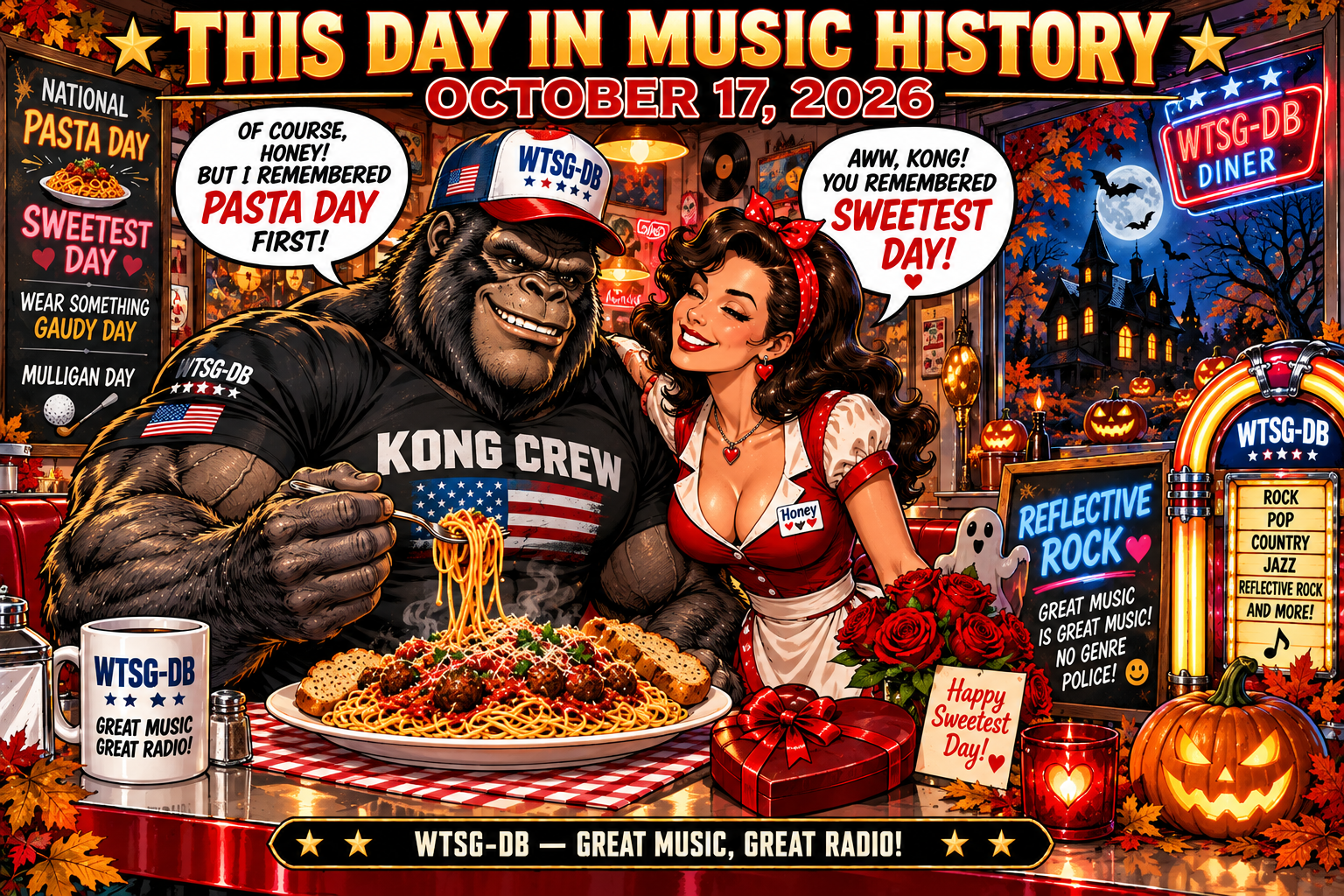
National Pasta Day! Now we’re talking! Spaghetti, lasagna, ravioli, or whatever your favorite happens to be. Personally, I think this calls for a big plate of pasta and some garlic bread.
Sweetest Day! A wonderful opportunity to remind that special someone just how much they mean to you. And gentlemen, here’s a little advice: Don’t wait for a holiday to show somebody you love them.
Wear Something Gaudy Day! HAHAHA! Well, this one shouldn’t be difficult for some of our favorite rock stars. Between the platform boots, glitter, leather, and outrageous stage costumes, rock and roll has been celebrating this holiday for decades!
Mulligan Day! Everybody gets a do-over! Wouldn’t that be nice? Especially for a drummer who drops a stick halfway through a solo.
And with that, let’s turn up the music!
1989 — KISS Releases Hot in the Shade
On October 17, 1989, KISS released their fifteenth studio album, Hot in the Shade, on Mercury Records.
And buddy, this was an interesting chapter in the band’s history.
The lineup featured Paul Stanley on vocals and rhythm guitar, Gene Simmons on bass and vocals, Bruce Kulick on lead guitar, and the wonderful Eric Carr behind the drums.
At fifteen tracks, Hot in the Shade was an unusually long KISS studio album, clocking in at nearly an hour.
The record also marked something of a return to a more straightforward hard-rock sound after the polished production of Crazy Nights in 1987.
“Rise to It” opens the album with plenty of attitude, while “Hide Your Heart” delivers a dramatic story wrapped around a catchy chorus.
Then there’s “Forever.”
Written by Paul Stanley and Michael Bolton, this power ballad became a major hit, reaching No. 8 on the Billboard Hot 100 in 1990.
And let’s not forget “Little Caesar,” featuring Eric Carr on lead vocals.
As a drummer, I’ve always appreciated Eric Carr. He brought tremendous power, personality, and musicality to KISS. His playing was solid, his sound was enormous, and he had a way of making those drums feel like an essential part of the band’s identity.
Sadly, Hot in the Shade would be the last complete KISS studio album recorded with Carr, who passed away on November 24, 1991, at just 41 years old.
For longtime KISS fans, that gives this album a special place in the band’s history.
CLASSICKONG’S MUST HAVES:
- “Rise to It”
- “Hide Your Heart”
- “Forever”
- “Little Caesar”
- “Betrayed”
Album: Hot in the Shade (1989) — Mercury Records
Discogs: KISS — Hot in the Shade
1977 — Lynyrd Skynyrd Releases Street Survivors
On October 17, 1977, Southern rock legends Lynyrd Skynyrd released Street Survivors on MCA Records.
What an extraordinary album, and what a heartbreaking chapter in rock history.
The album featured Ronnie Van Zant on lead vocals, Gary Rossington, Allen Collins, and Steve Gaines on guitars, Leon Wilkeson on bass, Artimus Pyle on drums, and Billy Powell on keyboards.
Steve Gaines had become an increasingly important contributor to the band’s sound, and his guitar work and vocals helped give Street Survivors a distinctive energy.
The opening track, “What’s Your Name,” became one of Skynyrd’s signature radio hits.
Then there’s “That Smell,” a powerful warning about the dangers of destructive living, delivered with unmistakable Southern-rock grit.
And “I Know a Little”? GOOD GRIEF!
That song is a guitar player’s playground. Fast, lively, and filled with the kind of musicianship that made Lynyrd Skynyrd such an incredible band.
But just three days after the album’s release, tragedy struck.
On October 20, 1977, a plane carrying the band crashed in Mississippi, taking the lives of Ronnie Van Zant, Steve Gaines, backup singer Cassie Gaines, and three others.
The loss devastated the band, their families, and the music world.
Yet nearly five decades later, the music remains.
There’s something timeless about Lynyrd Skynyrd. Their sound wasn’t manufactured in some corporate boardroom. It came from musicians who understood blues, country, rock and roll, and the power of playing together.
Southern rock royalty, buddy. Absolute legends.
CLASSICKONG’S MUST HAVES:
- “What’s Your Name”
- “That Smell”
- “I Know a Little”
- “You Got That Right”
- “One More Time”
Album: Street Survivors (1977) — MCA Records
Discogs: Lynyrd Skynyrd — Street Survivors
1993 — Remembering Criss Oliva of Savatage
October 17 also marks the anniversary of the passing of Criss Oliva, the brilliant guitarist and co-founder of American heavy metal band Savatage.
Criss and his brother Jon Oliva were the creative foundation of a band that developed one of the most distinctive sounds in heavy metal.
Jon brought powerful, theatrical vocals and songwriting ability. Criss brought extraordinary guitar technique, melody, and expression.
Together, they helped create something special.
Criss was only 30 years old when he was killed in a traffic collision on October 17, 1993.
For those unfamiliar with Savatage, I strongly recommend exploring their early work, especially 1985’s Power of the Night.
Released on Atlantic Records and produced by Max Norman, the album featured Jon Oliva on vocals and keyboards, Criss Oliva on guitar, Keith Collins on bass, and Steve Wacholz on drums.
The title track, “Power of the Night,” is an absolute heavy metal powerhouse.
And “Warriors”? That’s another terrific example of the band’s early intensity.
What made Criss special wasn’t simply his speed. It was his ability to combine aggressive rhythm playing with melodic leads that served the music.
As Savatage evolved, that gift became even more apparent on albums such as Hall of the Mountain King (1987), Gutter Ballet (1989), Streets: A Rock Opera (1991), and Edge of Thorns (1993).
His guitar playing could be fierce one moment and beautifully expressive the next.
Savatage would continue making music after his passing, but Criss Oliva’s contribution to the band’s identity remains irreplaceable.
Rest in peace, Criss. Your music continues to speak for itself.
CLASSICKONG’S MUST HAVES:
- “Power of the Night”
- “Warriors”
- “Hall of the Mountain King”
- “Gutter Ballet”
- “Edge of Thorns”
Albums: Power of the Night (1985), Hall of the Mountain King (1987), Gutter Ballet (1989), Edge of Thorns (1993) — Atlantic Records
Discogs: Savatage — Power of the Night
1981 — Christopher Cross Takes “Arthur’s Theme” to No. 1
On October 17, 1981, Christopher Cross reached No. 1 on the Billboard Hot 100 with “Arthur’s Theme (Best That You Can Do).”
And what a beautiful record.
Written by Christopher Cross, Burt Bacharach, Carole Bayer Sager, and Peter Allen, the song was recorded for the 1981 motion picture Arthur, starring Dudley Moore, Liza Minnelli, and John Gielgud.
Released on Warner Bros. Records, the song spent three weeks at No. 1 and went on to win the Academy Award for Best Original Song.
But let’s talk about that movie for a moment.
Arthur is a wonderful comedy, with Dudley Moore portraying a wealthy, irresponsible, but strangely lovable man whose life changes when he falls in love.
Moore was a remarkable actor and comedian, but here’s something some listeners might not know.
Dudley Moore was also an accomplished jazz pianist!
Long before Arthur, Moore had demonstrated serious musical ability, performing and recording jazz with his own trio.
And he wasn’t simply an actor who knew a few piano chords. The man could PLAY!
His combination of musical talent and comedic timing made him a particularly gifted entertainer.
As for Christopher Cross, his smooth vocals and the song’s gorgeous arrangement helped create one of the defining adult contemporary recordings of the early 1980s.
The melody is graceful, the production is beautiful, and the performance never feels forced.
It’s the kind of song that reminds us why great songwriting and great radio have always belonged together.
CLASSICKONG’S MUST HAVES:
- “Arthur’s Theme (Best That You Can Do)”
- “Sailing”
- “Ride Like the Wind”
- “Never Be the Same”
- “Think of Laura”
Album: Arthur — The Album (1981) — Warner Bros. Records
Discogs: Christopher Cross — Arthur’s Theme
1987 — The Bee Gees Win Again!
On October 17, 1987, the Bee Gees reached No. 1 on the UK Singles Chart with “You Win Again.”
Released on Warner Bros. Records and featured on their album E.S.P., the song marked a major return to chart-topping success for Barry, Robin, and Maurice Gibb.
And buddy, what a record!
From that unmistakable pounding rhythm at the beginning to those magnificent vocal harmonies, “You Win Again” is a master class in pop songwriting.
The Gibb brothers understood melody and vocal arrangement in a way few artists ever have.
They could write dance music, ballads, pop, soul, and beautifully crafted songs for other performers.
And while many listeners associate the Bee Gees primarily with the disco era, their career was so much bigger than that.
Think about “To Love Somebody,” “How Can You Mend a Broken Heart,” “Words,” and “Massachusetts.”
Then consider their later work.
The Bee Gees never lost their ability to write a memorable melody.
And those harmonies?
Absolutely unmistakable.
Now, for those wondering about the album title, E.S.P. refers to extrasensory perception — the supposed ability to sense things beyond our ordinary five senses.
Personally, I think those Gibb brothers had a sixth sense for writing hit records!
They certainly knew how to read an audience.
The Bee Gees weren’t simply hitmakers. They were among the great songwriters and vocal groups of popular music.
And for decades, they were RADIO STAPLES!
CLASSICKONG’S MUST HAVES:
- “You Win Again”
- “How Can You Mend a Broken Heart”
- “To Love Somebody”
- “Words”
- “Too Much Heaven”
Album: E.S.P. (1987) — Warner Bros. Records
Discogs: Bee Gees — E.S.P.
1978 — Neil Diamond and Barbra Streisand Release “You Don’t Bring Me Flowers”
October 17, 1978, is associated with the release of Neil Diamond and Barbra Streisand’s unforgettable duet, “You Don’t Bring Me Flowers.”
And folks, there are beautiful songs, there are great performances, and then there are recordings that deserve to be called masterpieces.
This is one of them.
Written by Neil Diamond with the legendary husband-and-wife songwriting team Alan and Marilyn Bergman, the song tells the heartbreaking story of a relationship in which the little expressions of love have gradually disappeared.
But here’s a fascinating piece of radio history.
Neil Diamond and Barbra Streisand had originally recorded separate versions of the song.
Radio program director Gary Guthrie combined their recordings into an unofficial duet.
Listeners loved it.
The response helped convince the two stars to record an official version together.
Think about that!
A radio man’s creative idea helped inspire one of the most memorable duets in popular music history.
The official recording was produced by Bob Gaudio and released on Columbia Records.
It went on to reach No. 1 on the Billboard Hot 100.
But chart positions only tell part of the story.
Listen to the way Neil and Barbra perform this song.
There’s tenderness, disappointment, regret, and an unmistakable sense of longing.
Neither performer needs to overpower the other. Their voices complement one another beautifully.
And those lyrics by the Bergmans?
Extraordinary.
The flowers aren’t really the point.
They’re a symbol of those little gestures that tell another person they’re loved, appreciated, and remembered.
Sometimes the smallest things carry the greatest meaning.
CLASSICKONG’S MUST HAVES:
- “You Don’t Bring Me Flowers” — Neil Diamond & Barbra Streisand
- “The Way We Were” — Barbra Streisand
- “Love on the Rocks” — Neil Diamond
- “What Are You Doing the Rest of Your Life?” — Barbra Streisand
- “September Morn” — Neil Diamond
Albums: You Don’t Bring Me Flowers (1978) — Neil Diamond; Barbra Streisand’s Greatest Hits Volume 2 (1978) — Columbia Records
Discogs: Neil Diamond & Barbra Streisand — You Don’t Bring Me Flowers
Happy Birthday, Alan Jackson! Born October 17, 1958
Happy birthday to one of country music’s finest gentlemen, Alan Jackson, born October 17, 1958, in Newnan, Georgia.
Jackson became one of the leading voices of traditional country music during an era when Nashville was experiencing enormous commercial growth and change.
His music has always emphasized strong melodies, honest storytelling, and an unmistakable respect for country music’s roots.
Songs like “Chattahoochee,” “Remember When,” “Drive (For Daddy Gene),” and “Where Were You (When the World Stopped Turning)” demonstrate his remarkable range as a songwriter and performer.
But there’s one Alan Jackson recording that has become especially meaningful to me.
“The Older I Get.”
Released in 2017, the song reflects on aging, wisdom, gratitude, and learning to appreciate the things that truly matter.
And as I approach another birthday myself, I find its message particularly moving.
There’s something about getting older that changes the way you look at life.
You begin to understand that time is precious.
You appreciate the people who have stood beside you.
You remember the lessons your parents taught you.
And perhaps most importantly, you learn that happiness isn’t always found in the things you once thought were so important.
Alan Jackson delivers that message with the warmth, honesty, and quiet confidence that have defined his career.
I’ve always admired his professionalism and the importance he places on faith and family.
Happy birthday, Alan. Thank you for the wonderful music.
CLASSICKONG’S MUST HAVES:
- “The Older I Get”
- “Remember When”
- “Drive (For Daddy Gene)”
- “Chattahoochee”
- “Where Were You (When the World Stopped Turning)”
Featured release: The Older I Get (2017) — ACR Records / EMI Records Nashville
Also recommended: Where Have You Gone (2021) — EMI Records Nashville
Discogs: Alan Jackson — Discography
Happy Birthday, Gary Puckett! Born October 17, 1942
Happy birthday to Gary Puckett, born October 17, 1942.
As the lead singer of Gary Puckett & The Union Gap, he helped create some of the most recognizable pop recordings of the late 1960s.
And what a voice!
Powerful, dramatic, expressive, and instantly recognizable.
Songs like “Woman, Woman,” “Young Girl,” “Lady Willpower,” and “Over You” became major radio hits.
The group’s recordings were released on Columbia Records, with producer Jerry Fuller playing an important role in developing their polished sound.
Gary Puckett had a remarkable ability to deliver emotional material with conviction.
And those records remain wonderful examples of the kind of dramatic pop music that dominated AM radio during the late 1960s.
CLASSICKONG’S MUST HAVES:
- “Woman, Woman”
- “Young Girl”
- “Lady Willpower”
- “Over You”
Album: Young Girl (1968) — Columbia Records
Discogs: Gary Puckett & The Union Gap
Remembering Jim Seals — Born October 17, 1942
October 17 also marks the birthday of Jim Seals, one half of the beloved duo Seals & Crofts.
Alongside Dash Crofts, Seals helped create some of the most memorable recordings of the 1970s.
Their beautiful harmonies and thoughtful arrangements produced classics including “Summer Breeze,” “Diamond Girl,” and “Get Closer.”
Those recordings were everywhere on the radio, and for good reason.
They had a warmth and musical sophistication that made them immediately recognizable.
Now, some people like to call this music soft rock.
Personally, I prefer REFLECTIVE ROCK!
Think about it. There’s nothing soft about great songwriting, beautiful harmonies, and music that stays with you for a lifetime.
And to all my heavy metal friends who insist they don’t listen to this stuff, don’t worry.
Your secret is safe with me!
I can just picture it now.
Some big, tattooed headbanger pulls into the parking lot blasting Slayer, giving everybody the devil horns.
Then he drives around the corner.
CLICK! Windows up. Doors locked.
And suddenly…
“Summer Breeze” — Seals & Crofts!
He’s singing every word, harmonizing with the chorus, and getting a little misty-eyed.
Then his buddy pulls up alongside him at the traffic light.
“SLAYER! SLAYER! QUICK! PUT SLAYER BACK ON!”
ROFLMAO!
Folks, you can love Savatage, Slayer, KISS, Christopher Cross, and Seals & Crofts. Nobody’s going to revoke your rock-and-roll membership card.
Great music is great music. PERIOD!
And that brings us back to Jim Seals.
He was a gifted singer, songwriter, and multi-instrumentalist whose contributions helped define an entire era of popular music.
Jim passed away on June 6, 2022, at age 79.
Today, we remember his music, his remarkable partnership with Dash Crofts, and those wonderful songs that continue to make us smile.
CLASSICKONG’S MUST HAVES:
- “Summer Breeze”
- “Diamond Girl”
- “Get Closer”
- “We May Never Pass This Way (Again)”
- “Hummingbird”
Albums: Summer Breeze (1972), Diamond Girl (1973) — Warner Bros. Records
Discogs: Seals & Crofts — Discography
Jazz Spotlight — Barney Kessel, Born October 17, 1923
Born October 17, 1923, in Muskogee, Oklahoma, Barney Kessel became one of the most respected jazz guitarists of his generation.
Kessel possessed an extraordinary command of harmony, chord voicings, improvisation, and melodic phrasing.
He worked with some of jazz’s finest musicians, including Oscar Peterson, Ray Brown, and Shelly Manne.
His recordings with Brown and Manne as The Poll Winners remain wonderful examples of small-group jazz.
Kessel also became an important studio musician, contributing to numerous popular recordings as part of Los Angeles’s legendary session-musician community.
But Barney Kessel holds a special place in my own musical memories.
My father introduced me to his music many years ago.
Later, while serving overseas in the late 1980s, I owned several Barney Kessel recordings on cassette.
Sadly, much of my music collection was lost during shipment when I returned home, along with irreplaceable family photographs.
I can’t remember exactly which Barney Kessel albums I owned.
But I remember the music.
And more importantly, I remember the man who introduced me to it.
My dad.
It’s remarkable how a familiar guitar sound can bring back memories of another time, another place, and someone who meant so much to you.
Barney Kessel passed away on May 6, 2004, at age 80.
His extraordinary musical legacy continues to inspire guitarists and jazz enthusiasts around the world.
CLASSICKONG’S MUST HAVES:
- “Satin Doll”
- “On Green Dolphin Street”
- “Autumn Leaves”
- “Jordu”
Recommended album: The Poll Winners (1957) — Contemporary Records
Discogs: Barney Kessel — Discography
Jazz Remembrance — Carla Bley (1936–2023)
October 17 also marks the passing of Carla Bley, the extraordinary jazz composer, pianist, arranger, and bandleader who died on this date in 2023 at age 87.
Born May 11, 1936, in Oakland, California, Bley became one of the most distinctive creative voices in modern jazz.
Her music combined jazz improvisation, orchestral composition, experimental ideas, and an often playful sense of humor.
She was a composer who refused to be confined by conventional musical boundaries.
One of her most ambitious projects was Escalator Over the Hill (1971), an extraordinary jazz opera featuring a remarkable collection of musicians, including Jack Bruce, Linda Ronstadt, and John McLaughlin.
And here’s another fascinating connection.
Carla Bley composed the music for Nick Mason’s Fictitious Sports, released in 1981.
That’s right — Nick Mason of Pink Floyd!
The album brought together an unusual collection of musicians and musical ideas, demonstrating just how far Bley’s creative influence extended beyond traditional jazz.
For listeners unfamiliar with her work, Carla Bley is certainly worth exploring.
Her contributions helped expand the possibilities of jazz composition, and her influence continues to be felt.
CLASSICKONG’S MUST HAVES:
- “Ida Lupino”
- “Escalator Over the Hill”
- “Reactionary Tango”
- “Lawns”
Albums: Escalator Over the Hill (1971) — JCOA Records; Social Studies (1981) — WATT Records
Also recommended: Nick Mason’s Fictitious Sports (1981) — Harvest Records
Discogs: Carla Bley — Discography
Final Spin — A Sentimental Heart
You know, folks, something I’ve learned over the years is that life has a way of teaching us lessons we never expected to learn.
Sometimes those lessons come through happiness and celebration.
Other times, they come through loss, disappointment, and the realization that not everyone we admire will live up to the image we’ve carried of them.
I’ve had people tell me I’m too sentimental.
Well, I’ve never really understood what that’s supposed to mean.
If a song reminds me of my father, if an old photograph brings back a memory, or if a beautiful piece of music puts a lump in my throat, I’m not going to apologize for it.
That’s what you call being alive. That’s what you call love.
I’ve served my country. I’ve been married to the same beautiful woman for nearly 42 years. I’ve raised a family, welcomed grandchildren, and experienced enough of life’s joys and sorrows to understand that the things that matter most aren’t always the things we can hold in our hands.
Sometimes they’re the memories we carry in our hearts.
And sometimes they’re the kindnesses we never forget.
I’ve also learned that the people who make the greatest difference in our lives aren’t always the people we expected to be there.
Sometimes they’re the ones who simply show up when it matters.
We spend our lives making memories with the people we love. Why on earth would we want to forget how those moments made us feel?
I’ll take a sentimental heart over a cold one any day of the week.
Because at least I care.
And as far as I’m concerned, there’s nothing wrong with that.
So on this Sweetest Day, take a moment to appreciate somebody who matters to you.
Make that phone call. Share that memory. Say those three little words.
You never know how much they might mean to someone.
And remember, folks:
You can have a sentimental heart and still have a backbone made of steel.
Keep loving, keep remembering, and above all, keep the music playing.
Listen to Today’s Broadcast/Podcast
🎙️ This Day in Music History — October 17, 2026
Join CLASSICKONG for another journey through the music, memories, and remarkable artists who helped create the soundtrack of our lives.
References
- KISS — Hot in the Shade, Discogs
- Lynyrd Skynyrd — Street Survivors, Discogs
- Savatage — Power of the Night, Discogs
- Christopher Cross — Arthur’s Theme, Discogs
- Official Charts — Bee Gees, You Win Again
- Rhino — The Bee Gees’ Warner Bros. Years
- Barbra Archives — You Don’t Bring Me Flowers
- Country Music Hall of Fame — Alan Jackson
- Gary Puckett & The Union Gap — Discogs
- Seals & Crofts — Discogs
- Barney Kessel — Discogs
- Carla Bley — National Endowment for the Arts
- October 17 Holidays and Observances
© 2026 WTSG-DB / CLASSICKONG. All rights reserved.