From the Desk of CLASSICKONG
A Century of Swing, Rock and Roll Thunder, and the Music That Stays With Us
Tuesday, October 13, 2026
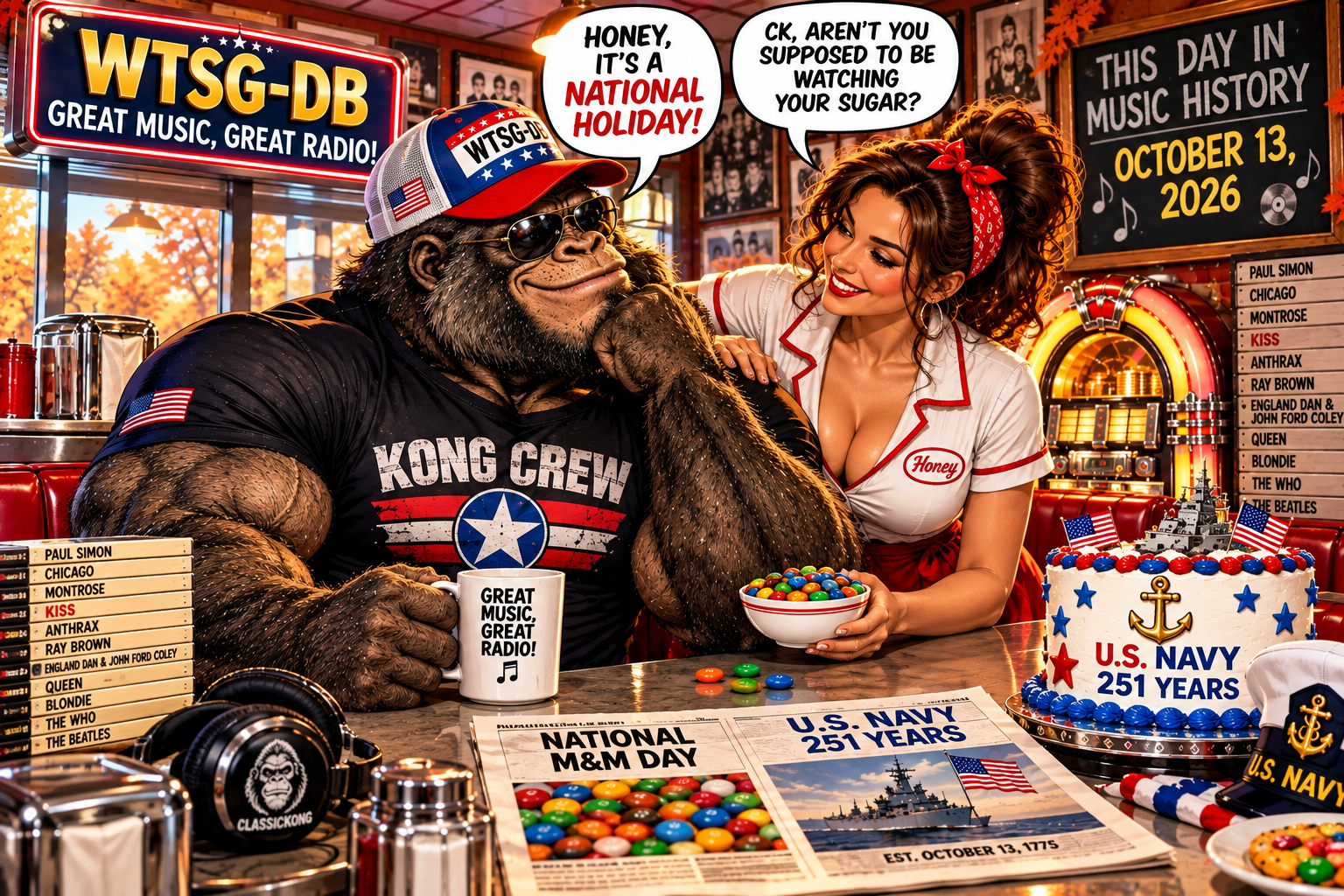
Welcome back, friends, to another edition of This Day in Music History, brought to you by WTSG-DB — GREAT MUSIC, GREAT RADIO!
Some days in music history are filled with fascinating little discoveries. Others come roaring through the door with enough musical firepower to shake the walls.
Today, we’ve got both!
We’re celebrating Paul Simon’s 85th birthday, Robert Lamm’s unforgettable contributions to Chicago, the hard rock legacy of Sammy Hagar, and the 100th anniversary of jazz legend Ray Brown’s birth.
We’ve also got some beautiful seventies radio memories courtesy of England Dan & John Ford Coley, the explosive energy of Anthrax, Blondie’s extraordinary rhythm section, Queen’s musical imagination, and The Who helping define the sound of a generation.
And for the KISS Army? Oh, buddy, we’ve got something special! We’re celebrating 44 years of Creatures of the Night, one of the heaviest albums KISS ever recorded.
Through it all, there’s a common thread: the musicians who understand that great music isn’t always about playing the most notes.
Sometimes it’s about playing exactly the right ones.
So pour yourself another cup of coffee, settle in, and let’s turn back the clock!
Paul Simon — An American Treasure Turns 85
Born October 13, 1941 — Newark, New Jersey
Happy 85th birthday to one of America’s greatest songwriters, Paul Simon!
There are songwriters who produce hit records, and then there are songwriters who seem capable of capturing entire chapters of our lives in three or four minutes.
Paul Simon belongs firmly in that second category.
From his legendary partnership with Art Garfunkel to an extraordinary solo career, Simon has demonstrated a rare ability to combine thoughtful lyrics, memorable melodies, and musical exploration.
Consider “Me and Julio Down by the Schoolyard” from Paul Simon (1972, Columbia Records). It’s playful, rhythmic, and wonderfully mysterious. More than five decades later, listeners still debate what Mama Pajama witnessed!
Then there’s “Kodachrome” from There Goes Rhymin’ Simon (1973, Columbia Records). That song is practically a musical photograph album, filled with nostalgia, humor, and memories of younger days.
And who could forget “Still Crazy After All These Years”, the title track from Simon’s 1975 Columbia album? It’s reflective, sophisticated, and beautifully arranged.
But today, let’s spend a little extra time with a drummer’s favorite.
The Magic of “50 Ways to Leave Your Lover”
From Still Crazy After All These Years (1975, Columbia Records), “50 Ways to Leave Your Lover” became one of Simon’s biggest solo hits, reaching number one on the Billboard Hot 100 in 1976.
And buddy, that drum groove!
Legendary session drummer Steve Gadd created one of the most recognizable rhythmic introductions in popular music.
The snare drum pattern has an almost military character, but Gadd’s delicate ghost notes, accents, and remarkable sense of time give it a personality all its own.
What’s particularly fascinating is that the groove grew out of musical experimentation during the recording sessions.
It wasn’t simply a matter of reading notes from a page. It was a great musician finding something special and helping shape the identity of the song.
And then there’s Simon’s songwriting.
The verses explore the difficulties of ending a relationship, while the chorus turns that complicated emotional situation into something surprisingly playful.
It’s clever, memorable, and unmistakably Paul Simon.
CLASSICKONG’s Must-Have Paul Simon Albums
- Paul Simon (1972, Columbia) — “Me and Julio Down by the Schoolyard”
- There Goes Rhymin’ Simon (1973, Columbia) — “Kodachrome”
- Still Crazy After All These Years (1975, Columbia) — “50 Ways to Leave Your Lover”
- Graceland (1986, Warner Bros.) — “You Can Call Me Al”
- The Rhythm of the Saints (1990, Warner Bros.) — “The Obvious Child”
Paul Simon has never been content to remain in one musical place. Folk, rock, gospel, jazz, African rhythms, and countless other influences have found their way into his recordings.
And through all that exploration, the songwriting has remained unmistakably his.
An American treasure, indeed. Happy birthday, Paul!
Robert Lamm — Saturday in the Park and the Memories We Keep
Born October 13, 1944 — Brooklyn, New York
Happy 82nd birthday to Robert Lamm, keyboardist, vocalist, songwriter, and founding member of Chicago!
When people talk about Chicago, the band’s extraordinary horn section often receives much of the attention.
And deservedly so!
But Robert Lamm’s piano playing, songwriting, and vocals were just as essential to the group’s musical identity.
He helped create some of the most recognizable recordings of the 1970s, including “Beginnings” from Chicago Transit Authority (1969, Columbia Records), “Does Anybody Really Know What Time It Is?” from that same debut album, and “25 or 6 to 4” from Chicago (1970, Columbia Records).
But there’s one particular song that means something special around here.
“Saturday in the Park” — A Musical Memory of Dad
From Chicago V (1972, Columbia Records), “Saturday in the Park” is one of those records that seems to carry an entire summer afternoon inside its grooves.
The opening piano immediately establishes a feeling of warmth and possibility.
Then the horns arrive, the rhythm section settles in, and suddenly you’re transported to another time.
Lamm drew inspiration from scenes of everyday life in New York’s Central Park, transforming those observations into a celebration of community and simple pleasures.
For CLASSICKONG, the song carries something even more personal.
It brings back memories of Dad.
And isn’t that one of music’s greatest gifts?
A song can take us back to the seventies, to family, to childhood, to ordinary afternoons that we didn’t realize would someday become precious memories.
We hear those familiar notes, and for a few wonderful minutes, yesterday doesn’t seem quite so far away.
CLASSICKONG’s Must-Have Chicago Albums
- Chicago Transit Authority (1969, Columbia)
- Chicago (1970, Columbia)
- Chicago III (1971, Columbia)
- Chicago V (1972, Columbia)
- Chicago VII (1974, Columbia)
Happy birthday, Robert Lamm, and thank you for helping create the soundtrack to so many lives.
Sammy Hagar — The Red Rocker Turns 79
Born October 13, 1947 — Salinas, California
Happy 79th birthday to Sammy Hagar!
THE RED ROCKER!
Now, longtime rock fans know Sammy as the powerhouse vocalist who helped usher Van Halen into a new era beginning in 1985.
Or, as fans affectionately call that period, VAN HAGAR!
But let’s get something straight.
Sammy Hagar was a bona fide hard rock star long before he ever stepped into Eddie Van Halen’s world.
First Came Montrose
In 1973, Sammy joined guitarist Ronnie Montrose, bassist Bill Church, and drummer Denny Carmassi for the explosive debut album Montrose (1973, Warner Bros. Records).
The record gave us classics like “Rock Candy,” “Bad Motor Scooter,” and “Rock the Nation.”
And let’s talk about “Rock Candy” for a moment.
Denny Carmassi’s enormous bass drum groove is one of the great introductions in hard rock.
It’s slow, deliberate, and absolutely commanding.
The beauty of that performance isn’t technical flash. It’s the authority behind every beat.
Carmassi establishes the foundation, the band locks into it, and the result is pure hard rock magic.
Sammy Establishes His Own Identity
After Montrose, Sammy developed an impressive solo career.
“Three Lock Box” from Three Lock Box (1982, Geffen Records) demonstrated his gift for muscular guitar-driven rock.
And “I Can’t Drive 55” from VOA (1984, Geffen Records) became one of his defining anthems.
That song wasn’t just catchy. It had attitude!
By the time Sammy joined Van Halen, he had already spent years earning his reputation as one of rock’s great voices.
Albums like 5150 (1986, Warner Bros.) and OU812 (1988, Warner Bros.) introduced another chapter of his career, but they didn’t create the Red Rocker.
They simply gave him another enormous stage.
CLASSICKONG’s Must-Have Sammy Hagar Albums
- Montrose — Montrose (1973, Warner Bros.)
- Standing Hampton (1982, Geffen)
- Three Lock Box (1982, Geffen)
- VOA (1984, Geffen)
- 5150 — Van Halen (1986, Warner Bros.)
Happy birthday, Sammy!
And whatever your favorite Van Halen era might be, there’s no denying the musical firepower this man brought to rock and roll.
KISS — 44 Years of Creatures of the Night
October 1982 — Casablanca Records
ALL RIGHT, KISS ARMY!
Now we’re getting serious!
This month marks 44 years since the release of Creatures of the Night. Discographies differ on the precise October 1982 release date, with October 13 and October 25 both appearing in published references.
And what an album!
By 1982, KISS had endured a difficult period of changing musical directions, declining commercial momentum, and turmoil within the band.
Their previous studio album, Music from “The Elder” (1981, Casablanca Records), had taken the group into ambitious concept-album territory.
But with Creatures of the Night, KISS came roaring back with a much heavier sound.
For CLASSICKONG, this remains arguably the heaviest studio album KISS ever recorded.
And one of its greatest strengths was sitting behind the drums.
Eric Carr — The Sound of Thunder
Eric Carr joined KISS in 1980, replacing original drummer Peter Criss.
By the time Creatures of the Night arrived, Carr had become an essential part of the band’s changing musical identity.
His playing on this record is enormous.
The drums sound powerful, deep, and aggressive, providing a thunderous foundation for the album’s heavy guitar riffs.
The recording team captured Carr’s drums at Record One in Los Angeles, while Bob Clearmountain was involved in the album’s mixing at New York’s Power Station.
The result remains one of the most memorable drum sounds in KISS history.
“War Machine” — Hard Rock Drumming 101
“War Machine”, from Creatures of the Night (1982, Casablanca Records), is a personal CLASSICKONG favorite.
And for good reason.
Gene Simmons delivers one of his most menacing vocal performances, supported by a grinding, heavy guitar riff.
But listen closely to Eric Carr.
His kick and snare establish a slow, commanding groove, while those enormous floor toms give the performance additional weight and drama.
This is a dream song for a hard rock drummer.
There’s room to breathe, room to establish a powerful pocket, and room to make every single note count.
And that brings us to an important lesson.
A slow groove can expose a drummer’s weaknesses faster than a complicated fill.
When there’s space between the notes, timing becomes everything.
You can’t disguise an inconsistent pocket with speed.
You have to own the groove.
And Eric Carr absolutely owns “War Machine.”
The Drummer’s Perspective — Groove Over Glory
Earlier, we celebrated Sammy Hagar and Denny Carmassi’s remarkable performance on Montrose’s “Rock Candy” from Montrose (1973, Warner Bros.).
Now listen to Eric Carr on “War Machine.”
Different recordings. Different musical personalities. But the same fundamental lesson.
Both drummers understand the power of a slow, solid groove.
Neither performance needs endless fills or unnecessary complexity.
The objective is to make the band sound enormous.
It’s something every drummer should learn early in their musical journey.
Serve the song.
Technical ability is important. Speed can be impressive. But knowing when to play, what to play, and when to leave space is what separates musical maturity from simply demonstrating technique.
Sometimes the most powerful statement a drummer can make is a perfectly placed bass drum and snare.
The Mystery of the Musicians
Here’s where the story gets especially interesting.
The original Creatures of the Night cover featured Gene Simmons, Paul Stanley, Eric Carr, and Ace Frehley.
But Ace’s appearance created a misleading impression about the recording lineup.
Although Frehley appeared on the cover and in promotional material, the generally accepted session history credits other guitarists with the album’s performances.
Among the musicians associated with the sessions were Vinnie Vincent, Robben Ford, Steve Farris, and Adam Mitchell.
And some individual guitar credits remain disputed, even among dedicated KISS historians.
The album wasn’t simply the work of the four musicians pictured on its sleeve.
Yet somehow, despite the personnel changes and complicated recording history, the finished record has a remarkably powerful identity.
Bryan Adams Helped Write “War Machine”!
Here’s one of our favorite surprises.
“War Machine” was co-written by Gene Simmons, Bryan Adams, and Jim Vallance.
Yes, THAT Bryan Adams!
The same songwriter who would become internationally famous for hits like “Heaven” and “Summer of ’69” helped create one of KISS’s heaviest songs.
Adams and Vallance also share writing credit with Simmons on “Rock and Roll Hell”, another Creatures of the Night track.
And here’s another fascinating connection: “Rock and Roll Hell” originated with Jim Vallance and was previously recorded by Bachman-Turner Overdrive on Rock n’ Roll Nights (1979, Mercury Records), before being substantially reworked for KISS.
Talk about musical worlds colliding!
CLASSICKONG’s Must-Have KISS Albums
- Kiss (1974, Casablanca)
- Hotter Than Hell (1974, Casablanca)
- Dressed to Kill (1975, Casablanca)
- Alive! (1975, Casablanca)
- Destroyer (1976, Casablanca)
- Rock and Roll Over (1976, Casablanca)
- Love Gun (1977, Casablanca)
- Creatures of the Night (1982, Casablanca)
Forty-four years later, Creatures of the Night still sounds like a monster.
And for Eric Carr, who passed away November 24, 1991, at just 41 years old, the album remains a magnificent testament to his power and musical personality.
Rest in peace, Eric. Your thunder still rolls.
Joey Belladonna — Anthrax and the Power of Thrash
Born October 13, 1960 — Oswego, New York
AND SPEAKING OF HEAVY!
If you thought KISS brought the thunder with Creatures of the Night, let’s crank up the intensity another notch!
Happy 66th birthday to Joey Belladonna, the unmistakable voice of Anthrax!
When discussing the legendary thrash metal movement of the 1980s, Anthrax deserves a prominent place alongside Metallica, Megadeth, and Slayer.
But Anthrax brought a personality all its own.
Belladonna’s powerful, melodic vocals created an interesting contrast with the band’s aggressive guitar riffs and explosive rhythms.
The Thunder of Among the Living
The album Among the Living (1987, Megaforce/Island Records) gave us some absolute bangers.
“Caught in a Mosh,” “Indians,” and “I Am the Law” remain among the group’s defining recordings.
And let’s give some serious recognition to drummer Charlie Benante and bassist Frank Bello.
Those two provide a rhythmic foundation that can be fast, aggressive, and surprisingly funky.
Even at breakneck tempos, the groove matters.
And Anthrax understood something that sometimes gets overlooked in heavy music.
You can be incredibly powerful and still have fun!
Happy birthday, Joey!
Ray Brown — A Centennial Salute to a Jazz Legend
October 13, 1926 – July 2, 2002
Now, after all that thunder, let’s change gears and celebrate a musician who could make an entire room swing with four strings and an extraordinary sense of time.
One hundred years ago today, one of the greatest bassists in jazz history was born in Pittsburgh, Pennsylvania.
Ray Brown.
And sometimes, friends, the word legend gets thrown around a little too casually.
But when it comes to Ray Brown?
When the shoe fits, wear it!
Talent. Feel. Class. Professionalism.
Those qualities barely begin to describe his contributions to music.
The Heartbeat of Jazz
Brown became one of the most respected upright bassists in the world, performing with artists including Dizzy Gillespie, Ella Fitzgerald, and Oscar Peterson.
His work with the Oscar Peterson Trio remains among the finest examples of rhythm-section artistry in jazz.
Listen to the way Brown plays a walking bass line.
There’s tremendous precision, but never a feeling of stiffness.
Every note seems to move naturally toward the next.
He could propel an entire ensemble forward without rushing, overwhelming, or drawing unnecessary attention away from the music.
Ray Brown made time feel good.
And for a rhythm-section musician, that’s about as high a compliment as anyone can receive.
A Lifetime of Excellence
Brown’s career extended far beyond his work as a sideman.
He became a celebrated bandleader, recording artist, educator, and mentor.
In 1995, he received the National Endowment for the Arts Jazz Masters Fellowship, one of America’s highest honors in jazz.
His influence reached generations of younger bassists, including musicians who would carry his standards of musicianship into the twenty-first century.
CLASSICKONG’s Must-Have Ray Brown Recordings
- The Poll Winners — Barney Kessel, Shelly Manne & Ray Brown (1957, Contemporary)
- This One’s for Blanton! — Duke Ellington & Ray Brown (1975, Pablo)
- Soular Energy — Ray Brown Trio (1984, Concord Jazz)
- The Very Tall Band — Oscar Peterson, Milt Jackson & Ray Brown (1999, Telarc)
Today, as we celebrate the centennial of his birth, let’s remember something important.
Ray Brown didn’t merely play bass.
He helped define what great musical accompaniment could be.
He listened, supported, inspired, and elevated the musicians around him.
One hundred years later, that’s a legacy worth celebrating.
John Ford Coley — The Magic of Seventies Radio Nights
Born October 13, 1951 — Dallas, Texas
Happy 75th birthday to John Ford Coley!
For anyone who remembers the beautiful melodic sounds of seventies radio, the partnership of England Dan Seals and John Ford Coley occupies a very special place.
Their music had warmth, romance, and a kind of effortless elegance.
It was music for lovers, for long drives, for quiet evenings, and for those moments when a great song seemed to understand exactly what you were feeling.
“I’d Really Love to See You Tonight”
From Nights Are Forever (1976, Big Tree Records), “I’d Really Love to See You Tonight” remains one of the duo’s most beloved recordings.
Written by Parker McGee, the song combines conversational lyrics with an irresistible melody and beautiful vocal harmonies.
It’s gentle without being boring, romantic without becoming overly sentimental.
And when those familiar opening notes come across the radio, suddenly it’s 1976 again.
Then there’s “Nights Are Forever Without You”, also from Nights Are Forever (1976, Big Tree Records), another Parker McGee composition that captures the ache of missing someone.
And “We’ll Never Have to Say Goodbye Again” from Some Things Don’t Come Easy (1978, Big Tree Records) carries that same beautiful sense of longing.
Radio Nights Magic
There’s something wonderfully special about this era of popular music.
These records didn’t need enormous production tricks or musical fireworks.
They relied on strong melodies, excellent performances, and songs that connected directly with listeners.
England Dan & John Ford Coley helped create the soundtrack to countless romantic evenings and treasured memories.
Sadly, Dan Seals passed away March 25, 2009, at age 61.
But the music he created with John Ford Coley continues to find new listeners.
And that’s the beauty of a great love song.
The years may pass, but the feelings remain.
Queen — Two Sides of Musical Imagination
October 1978
Queen released one of the most unusual and entertaining double A-side singles of the seventies: “Bicycle Race” and “Fat Bottomed Girls.”
Both songs appeared on Jazz (1978, EMI/Elektra Records).
Freddie Mercury wrote “Bicycle Race,” while Brian May wrote “Fat Bottomed Girls.”
Musically, the two recordings demonstrate Queen’s extraordinary versatility.
“Bicycle Race” features unexpected rhythmic changes, layered vocals, and the kind of adventurous arrangement that made Queen so distinctive.
“Fat Bottomed Girls” moves in another direction, combining a bluesy hard rock groove with Brian May’s unmistakable guitar sound.
And the two songs even reference one another, creating a playful musical connection.
Roger Taylor’s powerful drumming and John Deacon’s solid bass work help anchor both performances.
That’s what made Queen special.
They could take seemingly unrelated musical ideas and turn them into something unmistakably their own.
Four exceptionally talented musicians, never afraid to experiment.
Blondie — Clem Burke and the Joy of Drumming
October 13, 1979 — Eat to the Beat at Number One in Britain
Blondie’s Eat to the Beat (1979, Chrysalis Records) reached number one on the UK Albums Chart.
And buddy, what a terrific record!
With Debbie Harry’s unmistakable voice leading the way, Blondie blended new wave, rock, pop, and dance music into a sound that was instantly recognizable.
But today, let’s spend a little time behind the drum kit.
Clem Burke — Having the Time of His Life
Clem Burke was one of rock’s most exciting drummers.
Listen to “Dreaming” from Eat to the Beat (1979, Chrysalis Records).
Those rolling fills, driving rhythms, and seemingly endless bursts of energy give the song an extraordinary sense of motion.
Burke later recalled that his remarkable performance grew out of an early run-through of the song.
Sometimes the magic happens when musicians simply let themselves play.
Then there’s “Atomic”, also from Eat to the Beat, with its hypnotic rhythm and powerful dance-rock arrangement.
And “Union City Blue”, another standout from the same album, demonstrates the band’s ability to combine atmosphere, melody, and rhythmic excitement.
Fun on the Drum Kit
Here’s a simple philosophy worth remembering.
If you’re not having fun, go do something else!
Clem Burke’s performances remind us that great musicianship doesn’t have to be joyless or overly serious.
There’s a wonderful sense of excitement in his playing.
He attacks the drums with energy, imagination, and enthusiasm.
And his admiration for drummers like Keith Moon helps explain some of that explosive musical personality.
Sadly, Clem Burke passed away April 6, 2025, at age 70.
But put on “Dreaming,” and that incredible energy is still right there.
Rest in peace, Clem. Thanks for making those drums sing!
The Who — My Generation
October 13, 1965
On this date in 1965, The Who recorded one of rock’s defining anthems, “My Generation,” at IBC Studios in London.
Written by Pete Townshend and produced by Shel Talmy, the recording was released later that month on Brunswick Records in the UK and appeared on My Generation (1965, Brunswick).
And what a recording!
Roger Daltrey’s defiant vocal, Pete Townshend’s aggressive guitar, John Entwistle’s remarkable bass playing, and Keith Moon’s explosive drumming combined to create something that sounded genuinely revolutionary.
A Rhythm Section Unlike Any Other
John Entwistle’s bass solo was an extraordinary moment for a rock single in 1965.
But Keith Moon’s drumming deserves equal attention.
Moon rarely approached the drums like a conventional timekeeper.
His fills and accents seemed to tumble through the music, constantly challenging and responding to the other musicians.
And somehow, it worked beautifully.
We’ve talked today about Eric Carr and Denny Carmassi using restraint and deliberate grooves to create enormous power.
Keith Moon demonstrates another approach.
Sometimes the music calls for controlled chaos.
The important thing isn’t whether a drummer plays a little or a lot.
It’s whether the performance serves the identity of the song.
And “My Generation” wouldn’t be the same without Keith Moon.
The Beatles — Beatlemania at the London Palladium
October 13, 1963
On this date, The Beatles appeared on the British television program Sunday Night at the London Palladium.
The broadcast attracted an estimated audience of 15 million viewers and became one of the landmark moments of early Beatlemania.
John Lennon, Paul McCartney, George Harrison, and Ringo Starr were rapidly becoming more than a successful British pop group.
They were becoming a cultural phenomenon.
The performance helped establish just how enormous their popularity had become in Britain, months before their historic American television breakthrough on The Ed Sullivan Show in February 1964.
And within a few short years, popular music would never be quite the same.
More October 13 Birthdays
A few more musical names deserve recognition today.
Art Tatum (1909–1956) — One of jazz’s most astonishing pianists, whose extraordinary technique and harmonic imagination influenced generations of musicians.
Pharoah Sanders (1940–2022) — The adventurous jazz saxophonist whose work with John Coltrane and later solo recordings helped expand the possibilities of spiritual and free jazz.
Nana Mouskouri (born 1934) — The internationally celebrated Greek singer whose extraordinary recording career crossed languages, cultures, and musical styles.
Marie Osmond (born 1959) — Singer, entertainer, and television personality whose career has spanned country, pop, and stage performance.
Happy birthday to all those celebrating today!
Final Spin — The Music Between the Notes
You know, friends, there’s something about today’s collection of musicians that really stays with me.
We’ve celebrated extraordinary talent across jazz, rock, pop, folk, and heavy metal.
But the more I think about these artists, the more I’m reminded that music isn’t simply about technical ability.
It’s about what we do with it.
Ray Brown could make a bass line swing with effortless grace.
Eric Carr could make a slow hard rock groove feel like thunder rolling across the countryside.
Steve Gadd could turn a few carefully placed drum notes into something the whole world would recognize.
And Robert Lamm could write a song that, more than fifty years later, still brings back memories of Dad.
That’s the remarkable thing about music.
Sometimes it’s the notes we remember.
Sometimes it’s the people.
And sometimes it’s a feeling we can’t quite explain, but recognize the instant a familiar song begins.
The greatest musicians understand that they don’t have to fill every moment with sound.
They just have to make the moments count.
And somewhere along the way, we should remember to enjoy ourselves.
Because music is supposed to bring something wonderful into our lives.
Serve the song. Cherish the memories. And never forget to have fun.
That’s a pretty good philosophy for music.
And maybe for life, too.
Listen to Today’s Broadcast/Podcast
Join CLASSICKONG for the October 13, 2026, edition of This Day in Music History on WTSG-DB!
We’re celebrating Paul Simon, Robert Lamm, Sammy Hagar, Ray Brown, KISS, Blondie, Queen, The Who, Anthrax, and more.
Hear the stories behind the recordings, the musicians who made them unforgettable, and the memories that keep the music alive.
WTSG-DB — GREAT MUSIC, GREAT RADIO!
References
- This Day in Music — October 13 music history
- KISS — Creatures of the Night: MusicBrainz release and recording credits
- KISS FAQ — Creatures of the Night discography
- KISS Concert History — Creatures of the Night recording and personnel details
- Queen — Bicycle Race single history
- Queen — Fat Bottomed Girls single history
- The Who — My Generation recording history
© 2026 WTSG-DB. Original commentary and editorial content by CLASSICKONG. All artist names, song titles, album titles, and trademarks remain the property of their respective owners.