From the Desk of CLASSICKONG
Welcome back, friends, to another trip through the grooves, studios, stages and wonderfully strange rabbit holes of music history.
As always, before we turn up the volume, WTSG-DB sends our heartfelt thanks to the men and women of the United States Armed Forces — past and present — and to their families. Your service and sacrifice are never taken for granted.
September 19 turned out to be one of those dates that gets better the deeper you dig.
Today we’ll encounter an album title from Megadeth that still asks a haunting question 40 years later. We’ll meet a pioneering jazz musician who decided the harp belonged right alongside the horns and rhythm section. We’ll celebrate Lita Ford and trace the women of the Runaways beyond that legendary band. We’ll follow Nile Rodgers’ musical DNA through an astonishing amount of popular music, untangle the wonderfully creative family tree of 10cc and Godley & Creme, celebrate Janet Jackson becoming an undeniable superstar, and give roses to several other musicians who made September 19 their own.
Let’s drop the needle.
September 19 — National Days
Before the music, September 19 gives us a few fun observances.
It’s International Talk Like a Pirate Day, so apparently today’s broadcast is legally required to contain at least one “Arrr!”
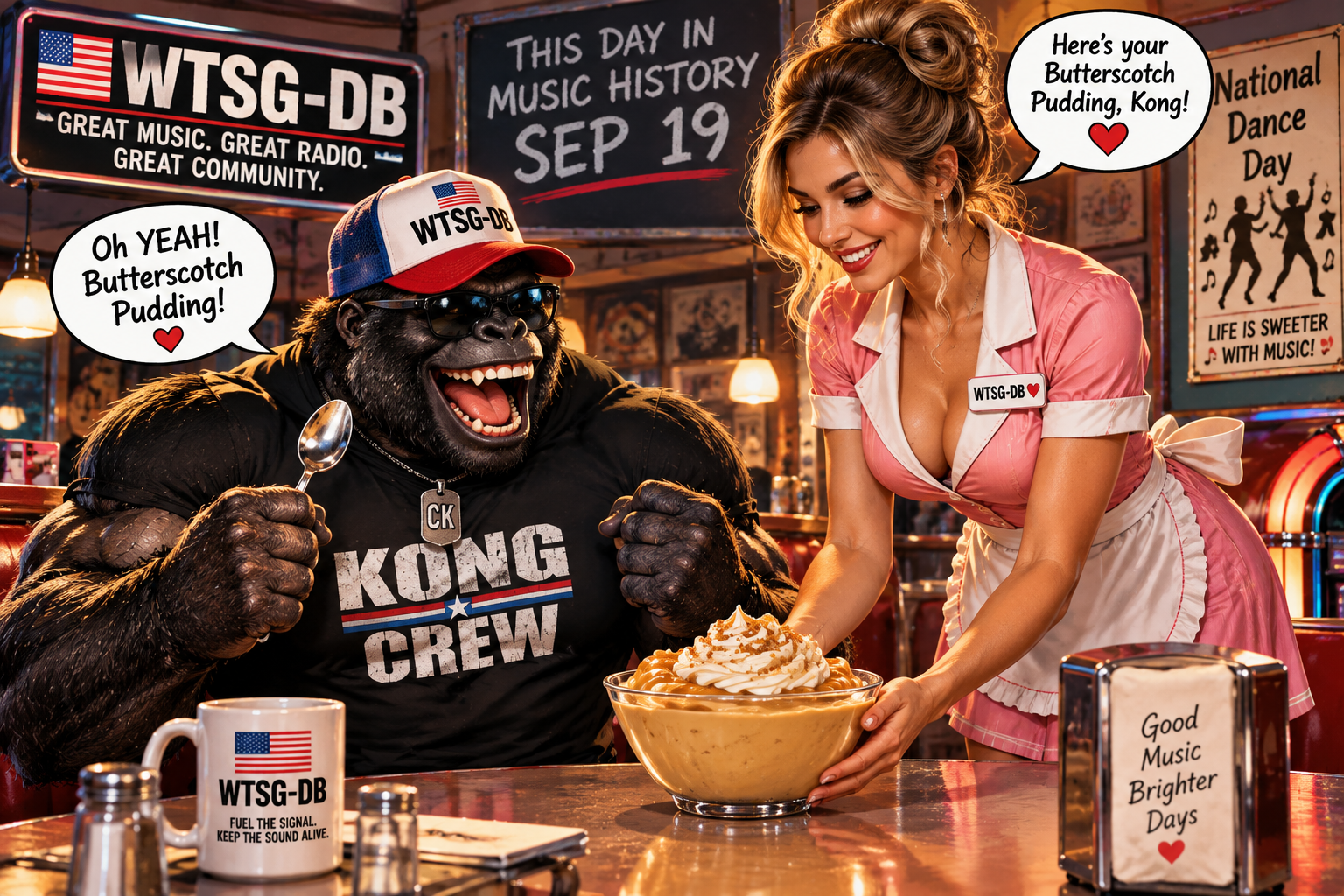
It is also National Butterscotch Pudding Day.
And because September 19 falls on the third Saturday of September in 2026, it is also National Dance Day.
So dance around the kitchen while eating butterscotch pudding and talking like a pirate.
WTSG-DB accepts no responsibility for what happens next.
Arrr.
1986 — Megadeth Releases Peace Sells… but Who’s Buying?
Forty years ago today, Megadeth released one of the defining albums of early thrash metal.
Peace Sells… but Who’s Buying? arrived on September 19, 1986 through Capitol Records.
And what a title.
Four decades later, the question still carries weight.
Peace is one of those things almost everybody says they want. Yet humanity has spent centuries demonstrating how difficult it can be to actually achieve and preserve.
No political argument is necessary here.
Just read the title again.
Peace Sells… but Who’s Buying?
Sometimes great art asks a question that outlives the moment in which it was created.
Musically, this album also represents one of the most fascinating versions of Megadeth.
The lineup was:
Dave Mustaine — guitar, vocals
David Ellefson — bass
Chris Poland — guitar
Gar Samuelson — drums
And here’s where things get particularly interesting for musicians.
Chris Poland and Gar Samuelson came into Megadeth with strong jazz and fusion backgrounds. That musical vocabulary helped give this incarnation of the band a rhythmic looseness and complexity that distinguished it from much of the thrash metal surrounding it.
Samuelson especially deserves attention.
Listen beyond the speed.
Listen to the accents, cymbal work, transitions and movement underneath those riffs.
There’s a musician thinking behind that drum kit.
The album delivers eight tracks:
“Wake Up Dead”
“The Conjuring”
“Peace Sells”
“Devils Island”
“Good Mourning/Black Friday”
“Bad Omen”
“I Ain’t Superstitious”
“My Last Words”
And that bass introduction to “Peace Sells” escaped the metal world entirely. For years, part of it was heard by millions as part of MTV News.
You didn’t necessarily have to own a Megadeth album to know that bass line.
CLASSICKONG Trading Card — Peace Sells… but Who’s Buying?
Artist: Megadeth
Album: Peace Sells… but Who’s Buying?
Released: September 19, 1986
Original Major Label: Capitol Records
Genre: Thrash Metal
Lineup: Mustaine / Ellefson / Poland / Samuelson
Essential Cuts: “Wake Up Dead,” “Peace Sells,” “Good Mourning/Black Friday”
Hidden Weapon: Jazz/fusion DNA inside a thrash-metal machine
Anniversary: 40 Years
CLASSICKONG Power Stat: RIFF DAMAGE — 100
Must-Have Megadeth
Killing Is My Business… and Business Is Good! — 1985 — Combat Records
Peace Sells… but Who’s Buying? — 1986 — Capitol Records
So Far, So Good… So What! — 1988 — Capitol Records
Rust in Peace — 1990 — Capitol Records
Countdown to Extinction — 1992 — Capitol Records
For somebody wanting to understand classic Megadeth, that’s one heck of a road map.
Forty years later, Peace Sells… but Who’s Buying? remains ferocious, intelligent and musically fascinating.
And sadly, its title still asks a question worth thinking about.
1958 — Dorothy Ashby Makes the Harp Swing
Now here’s today’s CLASSICKONG discovery.
On September 19, 1958, Dorothy Ashby entered Rudy Van Gelder’s legendary studio in Hackensack, New Jersey and recorded the session that became In a Minor Groove.
The album appeared on New Jazz Records.
The musicians were:
Dorothy Ashby — harp
Frank Wess — flute
Herman Wright — bass
Roy Haynes — drums
Yes.
Harp.
When most people picture a harp, they probably imagine an orchestra, a concert hall or that familiar movie scene where the clouds part and somebody goes…
GLISSANDOOOOOO!
You know the sound.
Angel on a cloud.
BRRRRINNNNG!
Dorothy Ashby had other ideas.
She wanted to play jazz.
Ashby had originally studied piano, which makes her achievement even more impressive to this piano player.
Becoming genuinely accomplished at piano is difficult enough. Then Ashby moved into the world of the concert harp — a massive instrument with dozens of strings, pedals, two busy hands and two busy feet — and decided that apparently wasn’t enough of a challenge.
She was going to improvise jazz on the thing.
That’s musicianship.
Ashby didn’t merely sprinkle pretty harp sounds behind somebody else’s record. She became the featured improvising musician and bandleader.
And on In a Minor Groove, you’ve also got the beautiful flute work of Frank Wess supported by Herman Wright and one of jazz’s great drummers, Roy Haynes.
CLASSICKONG Trading Card — Dorothy Ashby
Born: August 6, 1932
Died: April 13, 1986
Primary Instrument: Harp
Original Instrument: Piano
September 19 Mission: In a Minor Groove session
Studio: Van Gelder Studio, Hackensack, New Jersey
Rhythm Section: Herman Wright / Roy Haynes
Special Ability: Making people reconsider what a jazz instrument can be
CLASSICKONG Power Stat: GLISSANDOOOOOO — OFF THE CHART
Before and After Dorothy — The Jazz Harp Family Tree
Dorothy Ashby wasn’t literally the first musician to bring a harp into jazz.
Casper Reardon was an early jazz-harp pioneer during the swing era, and Adele Girard also helped establish the instrument in jazz.
But Ashby became one of the musicians who demonstrated just how seriously the harp could function as a modern improvising instrument.
Then came another remarkable pianist who embraced the harp:
Alice Coltrane.
Coltrane took the instrument into spiritual, modal and highly exploratory territory on records such as Journey in Satchidananda.
Another name some listeners may remember is Swiss musician Andreas Vollenweider, whose electro-acoustic harp became the center of breathtakingly atmospheric music incorporating elements of jazz, world music, ambient music and other styles.
And today, Brandee Younger continues expanding the possibilities of jazz harp while openly acknowledging the importance of Dorothy Ashby and Alice Coltrane.
These musicians don’t represent one single style or a direct teacher-to-student chain.
What they demonstrate is something better:
There is no rule saying what an instrument is allowed to become.
Must-Have Dorothy Ashby
The Jazz Harpist — 1957 — Regent
Hip Harp — 1958 — Prestige
In a Minor Groove — 1958 — New Jazz
Dorothy Ashby — 1962 — Argo
Afro-Harping — 1968 — Cadet
And if you’ve heard Stevie Wonder’s Songs in the Key of Life, you may already have heard Dorothy Ashby without realizing it.
That’s her harp accompanying Stevie on “If It’s Magic.”
Give Dorothy Ashby her roses.
1958 — Happy Birthday, Lita Ford
Born September 19, 1958 in London, Lita Ford became one of hard rock and heavy metal’s most recognizable female guitarists.
But before Lita, before “Kiss Me Deadly,” and before the Ozzy Osbourne duet “Close My Eyes Forever,” there were…
The Runaways.
The classic lineup featured:
Cherie Currie — lead vocals
Joan Jett — guitar and vocals
Lita Ford — lead guitar
Jackie Fox — bass
Sandy West — drums
Think about the talent that came through that band.
Joan Jett went on to become a major rock star with Joan Jett & the Blackhearts.
Lita Ford built a successful hard-rock and metal solo career of her own.
Cherie Currie continued recording and also pursued acting and other creative work.
And let’s give drummer Sandy West her roses.
West was playing hard rock with real power during an era when women behind the drum kit in that environment were still uncommon.
Nobody needed to give Sandy permission to hit hard.
She simply did it.
By the late 1980s, Lita’s solo career exploded.
Her 1988 album Lita produced “Kiss Me Deadly” and the Ozzy Osbourne duet “Close My Eyes Forever.”
And let’s get the songwriting credit right: Lita Ford and Ozzy Osbourne wrote “Close My Eyes Forever” together.
The duet reached No. 8 on the Billboard Hot 100 and became the biggest pop-chart hit of Lita’s career.
CLASSICKONG Trading Card — Lita Ford
Born: September 19, 1958
Birthplace: London, England
Weapon: Lead Guitar
Original Squad: The Runaways
Solo Breakthrough: Lita
Signature Cuts: “Kiss Me Deadly,” “Close My Eyes Forever”
Special Attack: Marshall stack + attitude
CLASSICKONG Power Stat: BATTLE-AXE — 100
Must-Have Lita Ford
Out for Blood — 1983 — Mercury
Dancin’ on the Edge — 1984 — Mercury
Lita — 1988 — RCA
Stiletto — 1990 — RCA
If you’re new to solo Lita Ford, start with Lita.
Then turn it up.
1988 — Bon Jovi Releases New Jersey
Bon Jovi was already enormous after Slippery When Wet.
On September 19, 1988, New Jersey was released in Europe and Japan; U.S. catalog sources place its American release in September 1988.
Produced by Bruce Fairbairn and recorded at Little Mountain Sound in Vancouver, the album produced an extraordinary five Top 10 singles:
“Bad Medicine”
“Born to Be My Baby”
“I’ll Be There for You”
“Lay Your Hands on Me”
“Living in Sin”
You don’t have to be the world’s biggest Bon Jovi fan to recognize what happened here.
The band was HUGE.
But CLASSICKONG wants you to look underneath the hood.
There’s that name again:
Desmond Child.
Child co-wrote several songs on New Jersey, including “Bad Medicine” and “Born to Be My Baby,” after already helping Bon Jovi create “You Give Love a Bad Name” and “Livin’ on a Prayer” on Slippery When Wet.
We’ve given Desmond Child his roses before, so we don’t need to retell his entire story today.
But you simply cannot ignore him when discussing records like these.
His DNA is all over this thing we love called music.
Different artists.
Different records.
But every so often, you look beneath the song title and there he is again.
Sometimes one of the most important people on a record isn’t standing in the spotlight.
Read the credits.
1952 — Happy Birthday, Nile Rodgers
Now let’s talk about a musical genius whose contribution isn’t always fully appreciated by the casual listener.
Nile Rodgers, born September 19, 1952.
Guitarist.
Songwriter.
Producer.
Arranger.
Co-founder of Chic.
And one-half of one of popular music’s great musical partnerships alongside bassist Bernard Edwards.
Listen to “Good Times.”
Don’t merely hear it.
Listen.
Listen to Edwards’ bass.
Then listen to Nile’s guitar.
The beauty is partly in what Nile doesn’t play.
His guitar work can be economical, percussive and unbelievably precise. He’s leaving space for the bass, drums and vocals while simultaneously creating the rhythmic identity of the record.
That’s maturity as a musician.
Then follow Nile Rodgers beyond Chic.
Sister Sledge.
Diana Ross.
David Bowie.
Madonna.
Duran Duran.
The B-52’s.
INXS.
Daft Punk.
At some point the résumé starts becoming ridiculous.
CLASSICKONG Trading Card — Nile Rodgers
Born: September 19, 1952
Instrument: Guitar
Home Base: Chic
Partner in Groove: Bernard Edwards
Primary Weapon: The Hitmaker Stratocaster
Special Ability: Making rhythm guitar unforgettable
Production DNA: Everywhere
CLASSICKONG Power Stat: GROOVE — 100+
Must-Have Nile Rodgers / Chic
Chic — 1977 — Atlantic
C’est Chic — 1978 — Atlantic
Risqué — 1979 — Atlantic
Diana — Diana Ross — 1980 — Motown — produced by Rodgers and Edwards
Let’s Dance — David Bowie — 1983 — EMI America — produced by Bowie and Rodgers
Like a Virgin — Madonna — 1984 — Sire — produced primarily by Rodgers
If you’ve ever dismissed Nile Rodgers because somebody filed Chic under “disco,” go back and listen again.
Listen as a musician.
Listen to the guitar.
Then listen to the space between the notes.
Give Nile his roses.
1947 — Laurence “Lol” Creme: From 10cc to Godley & Creme
First, let’s clear something up for anybody looking at the name and wondering the same thing CLASSICKONG did.
“Lol” is a nickname.
His full name is Laurence Neil Creme, born September 19, 1947 in Prestwich, Lancashire, England.
So no, we’re not laughing out loud every time we mention the man.
Although knowing 10cc, they probably wouldn’t mind.
Creme grew up near Kevin Godley, and the two were friends and musical collaborators long before fame arrived. Their path eventually crossed with Eric Stewart and songwriter Graham Gouldman.
Those four musicians became the classic original lineup of:
10cc.
And what a collection of talent that was.
Creme could sing and play guitar, keyboards and numerous other instruments. Godley sang and played drums and percussion. Stewart and Gouldman brought still more songwriting, production and instrumental ability.
The result was a band that could be funny, strange, sophisticated, melodic and technically inventive — sometimes during the same song.
Then came 1975’s The Original Soundtrack.
And there sits “I’m Not in Love.”
That record isn’t merely a beautiful song.
It’s an example of musicians using the recording studio itself as an instrument, building its famous floating vocal texture from enormous layers of voices.
After 1976’s How Dare You!, Godley and Creme left 10cc.
Eric Stewart and Graham Gouldman continued the band.
Kevin Godley and Lol Creme became:
Godley & Creme.
Now the family tree makes sense.
And Godley & Creme weren’t finished experimenting.
They created records including “Under Your Thumb,” “An Englishman in New York” and eventually the haunting 1985 hit “Cry.”
Then another career emerged:
Music-video directors.
Godley & Creme went on to direct groundbreaking videos for major artists, carrying their studio experimentation into the visual age.
These guys didn’t merely understand music.
They understood sound, pictures, technology and how those things could work together.
CLASSICKONG Trading Card — Lol Creme
Full Name: Laurence Neil Creme
Born: September 19, 1947
Primary Instruments: Guitar / Keyboards / Vocals
Original Power Unit: 10cc
Creative Partner: Kevin Godley
Second Act: Godley & Creme
Third Act: Innovative music-video director
CLASSICKONG Power Stat: STUDIO WIZARDRY — 100
Must-Have Lol Creme — The Road Map
With 10cc:
Sheet Music — 1974 — UK Records
The Original Soundtrack — 1975 — Mercury
How Dare You! — 1976 — Mercury
With Godley & Creme:
Freeze Frame — 1979 — Polydor
Ismism — 1981 — Polydor
The History Mix Volume 1 — 1985 — Polydor
If you want the easiest doorway into the whole story, begin with The Original Soundtrack.
Put on “I’m Not in Love.”
Headphones recommended.
Lights down.
And then…
You make me want to CRY!
Sorry.
Couldn’t resist.
1989 — Janet Jackson Becomes an Undeniable Superstar with Rhythm Nation 1814
On September 19, 1989, the lovely and hugely talented Janet Jackson released Janet Jackson’s Rhythm Nation 1814 through A&M Records.
And let’s put this record into proper perspective.
Janet was HUGE.
Being Michael Jackson’s younger sister meant comparisons were probably inevitable, especially with Michael operating at a level of global fame few entertainers have ever experienced.
But Janet Jackson didn’t remain in anybody’s shadow.
She built her own.
Control had already announced that Janet had arrived.
Rhythm Nation 1814 made the case undeniable.
Working principally with the brilliant Minneapolis team of Jimmy Jam and Terry Lewis, Janet combined pop, R&B, funk, dance music, industrial textures, rock and social consciousness into something immediately recognizable as her own.
And the results were extraordinary.
Seven singles from one album reached the Billboard Hot 100 Top Five.
That’s not merely successful.
That’s historic.
The run included:
“Miss You Much”
“Rhythm Nation”
“Escapade”
“Alright”
“Come Back to Me”
“Black Cat”
“Love Will Never Do (Without You)”
And for our rock listeners, don’t sleep on “Black Cat.”
Janet wasn’t simply putting a distorted guitar on an R&B record and calling it rock.
She went after it.
The album reached No. 1 on the Billboard 200, its singles dominated radio and MTV, and Janet’s choreography and military-inspired visual presentation became instantly recognizable.
She also earned a Grammy nomination for Producer of the Year, Non-Classical, becoming the first woman nominated in that category.
And here’s a beautiful 2026 footnote:
Rhythm Nation 1814 was inducted into the Grammy Hall of Fame this year.
Thirty-seven years after its release, people are still recognizing what Janet accomplished.
Not Michael Jackson’s little sister.
Not an extension of the Jackson family story.
Janet Jackson.
Major superstar.
Period.
CLASSICKONG Trading Card — Rhythm Nation 1814
Artist: Janet Jackson
Released: September 19, 1989
Label: A&M Records
Primary Production Team: Janet Jackson / Jimmy Jam / Terry Lewis
Billboard 200: No. 1
Historic Stat: Seven Hot 100 Top-Five singles
Rock Weapon: “Black Cat”
2026 Honor: Grammy Hall of Fame
CLASSICKONG Power Stat: PRECISION — 100
Must-Have Janet Jackson
Control — 1986 — A&M
Rhythm Nation 1814 — 1989 — A&M
janet. — 1993 — Virgin
The Velvet Rope — 1997 — Virgin
That’s not somebody living in another superstar’s shadow.
That’s a superstar’s discography.
1988 — Enya Opens the Door with Watermark
On September 19, 1988, Watermark was released in Europe through WEA, introducing millions of listeners to a sound that was difficult to put neatly into any one box.
And perhaps that’s because Enya doesn’t really sound like anybody else.
Born Eithne Pádraigín Ní Bhraonáin in Ireland, Enya built her music through keyboards, synthesizers, piano and — most famously — enormous layers of her own voice.
That’s the key to understanding what she does.
Those choir-like walls of sound you’re hearing?
Often, that’s Enya singing with Enya singing with Enya singing with Enya — vocal parts layered repeatedly until one human voice begins sounding like an entire ensemble.
Working closely with producer and arranger Nicky Ryan and lyricist Roma Ryan, Enya created music incorporating Celtic influences, classical ideas, electronic textures, ambient space and pop melody.
Watermark contains the international breakthrough “Orinoco Flow,” along with “Evening Falls…,” “Storms in Africa” and the beautiful instrumental title track.
This isn’t music built around showing off instrumental chops.
It’s about texture.
Atmosphere.
Space.
Sound as color.
You don’t merely listen to some Enya records.
You almost step inside them.
CLASSICKONG Trading Card — Enya
Born: May 17, 1961
Instrumental Tools: Piano / Keyboards / Synthesizers
Secret Weapon: Her own voice — multiplied
Breakthrough Album: Watermark
Creative Partners: Nicky Ryan / Roma Ryan
Signature Cut: “Orinoco Flow”
Special Ability: Turning one voice into a cathedral
CLASSICKONG Power Stat: ATMOSPHERE — 100
Must-Have Enya
Watermark — 1988 — WEA / Reprise
Shepherd Moons — 1991 — WEA / Reprise
The Memory of Trees — 1995 — WEA / Reprise
A Day Without Rain — 2000 — Reprise
Amarantine — 2005 — Reprise
If Watermark catches your ear, keep going.
There’s an entire sonic world waiting behind it.
1971 — The Allman Brothers Band at Stony Brook
On September 19, 1971, the original Allman Brothers Band played two performances at the Stony Brook University Gym in New York.
Normally we don’t fill these pages with random concert setlists.
This one matters.
These performances came only five weeks before Duane Allman died on October 29, 1971, at age 24.
And fortunately, this music survived.
In 2003, the Allman Brothers Band officially released the recordings as a two-CD archival live album titled:
S.U.N.Y. at Stonybrook: Stonybrook, NY 9/19/71
It was released by The Allman Brothers Band Recording Company as part of the band’s archival concert series.
So yes — this is an official Allman Brothers Band live album, not merely a bootleg circulating among collectors.
The original six-man lineup was:
Duane Allman — guitar, slide guitar
Gregg Allman — vocals, Hammond B3
Dickey Betts — guitar, vocals
Berry Oakley — bass
Butch Trucks — drums
Jaimoe — drums and percussion
That makes this release more than another concert recording.
It’s a surviving document of one of America’s great bands while its original lineup was still intact.
Sometimes an old tape becomes a time machine.
This is one of them.
1981 — Simon & Garfunkel Bring Half a Million People to Central Park
September 19, 1981.
Central Park.
New York City.
Simon & Garfunkel.
An estimated 500,000 people gathered on the Great Lawn to see Paul Simon and Art Garfunkel perform together again.
Read that number again.
Half a million people.
Paul Simon famously greeted the enormous crowd as a “neighborhood concert.”
Technically true.
That’s one heck of a neighborhood.
The performance became The Concert in Central Park album and concert film, preserving one of the great reunion moments in popular music.
But CLASSICKONG has a question for you:
Could they pull this off today?
Not merely Simon & Garfunkel.
Anybody.
Could half a million people gather in Central Park for a free concert today and simply share an evening of music?
Central Park still hosts enormous musical events. But modern festivals operate on a very different scale and under very different crowd-control, security and logistical realities.
And our broader world certainly doesn’t feel less divided than it did in 1981.
Maybe that’s what makes the old footage so remarkable.
Look at that sea of humanity.
Different backgrounds.
Different beliefs.
Different lives.
For a few hours, they had something in common.
The songs.
Five hundred thousand people is difficult to even comprehend.
Maybe the remarkable part isn’t simply that Simon & Garfunkel drew them.
Maybe it’s that music gave them somewhere to meet.
1973 — Remembering Gram Parsons
Gram Parsons
November 5, 1946 — September 19, 1973
Parsons died on this date in 1973 at only 26 years old.
His musical résumé included the International Submarine Band, the Byrds, the Flying Burrito Brothers, and a brief but enormously influential solo career.
Parsons preferred the term “Cosmic American Music” for the mixture of country, rock, soul and other American forms he pursued.
And then there was Emmylou Harris.
Their voices together remain one of the most beautiful parts of his musical legacy.
The bizarre events surrounding Parsons’ remains after his death have become part of rock folklore, but they can sometimes overshadow the thing that actually matters:
the music.
Must-Have Gram Parsons
Safe at Home — International Submarine Band — 1968 — LHI
Sweetheart of the Rodeo — The Byrds — 1968 — Columbia
The Gilded Palace of Sin — Flying Burrito Brothers — 1969 — A&M
G.P. — 1973 — Reprise
Grievous Angel — 1974 — Reprise
Twenty-six years old.
That’s painfully young.
Give Gram Parsons his roses by listening to what he left behind.
More September 19 Birthdays
Trisha Yearwood — Born 1964
Happy birthday to Trisha Yearwood, born September 19, 1964 in Monticello, Georgia.
Her 1991 debut single “She’s in Love with the Boy” became a No. 1 country hit and introduced one of the strongest voices of her generation.
Other essential stops include “Walkaway Joe,” “The Song Remembers When,” “XXX’s and OOO’s” and “Believe Me Baby (I Lied).”
Must-Have Trisha Yearwood
Trisha Yearwood — 1991 — MCA Nashville
Hearts in Armor — 1992 — MCA Nashville
The Song Remembers When — 1993 — MCA Nashville
Thinkin’ About You — 1995 — MCA Nashville
Candy Dulfer — Born 1969
Dutch saxophonist Candy Dulfer was born September 19, 1969 in Amsterdam.
Dulfer grew up around jazz — her father is saxophonist Hans Dulfer — and eventually worked with artists including Dave Stewart, Prince and Van Morrison.
Her instrumental “Lily Was Here” with Dave Stewart became an international breakthrough, and her debut album Saxuality followed in 1990.
Anybody who thinks the saxophone stopped being cool after the classic jazz era needs to meet Candy Dulfer.
1941 — Happy Birthday, Cass Elliot
Cass Elliot
September 19, 1941 — July 29, 1974
Born Ellen Naomi Cohen, Cass Elliot possessed one of the unmistakable voices of The Mamas & the Papas.
But Cass deserves to be remembered as considerably more than one member of a famous group.
Listen to that voice.
Warm.
Powerful.
Expressive.
Immediately recognizable.
After the Mamas & the Papas, Cass built a solo career that gave us recordings including “Dream a Little Dream of Me,” “It’s Getting Better,” “Make Your Own Kind of Music” and “New World Coming.”
She also became a familiar and much-loved television personality.
Cass Elliot died in London on July 29, 1974 at only 32 years old.
And let’s finally retire one ugly old myth while we’re here.
Cass Elliot did not die choking on a ham sandwich.
There was no food obstructing her airway.
The joke survived.
Cass didn’t.
And after more than half a century, she deserves better than having her death reduced to a cruel punchline.
Remember the woman.
Remember the voice.
Remember the music.
CLASSICKONG Trading Card — Cass Elliot
Born: September 19, 1941
Died: July 29, 1974
Born As: Ellen Naomi Cohen
Signature Group: The Mamas & the Papas
Primary Weapon: That magnificent voice
Solo Essentials: “Dream a Little Dream of Me,” “Make Your Own Kind of Music,” “It’s Getting Better”
CLASSICKONG Power Stat: HEART — 100
Must-Have Cass Elliot
Dream a Little Dream — 1968 — Dunhill
Bubblegum, Lemonade, and… Something for Mama — 1969 — Dunhill
Dave Mason & Cass Elliot — 1971 — Blue Thumb
Cass Elliot — 1972 — RCA Victor
The Road Is No Place for a Lady — 1972 — RCA Victor
Give Cass Elliot her roses.
What a singer. What a voice. And what a beautiful warmth she could bring to a song.
Cass could sound powerful one moment and wonderfully tender the next. There was something unmistakably human in that voice — the kind of voice that could make a song feel less like a performance and more like somebody sitting beside you telling you something from the heart.
More than half a century later, people are still listening.
That’s the legacy worth remembering.
Remembering Lee Kerslake
Lee Kerslake
April 16, 1947 — September 19, 2020
Drummer Lee Kerslake left us on this date in 2020 at age 73.
And let’s be precise about his Uriah Heep history, because Lee didn’t play on every Heep album.
Kerslake joined the band in time for one of its greatest periods.
Essential Uriah Heep Featuring Lee Kerslake
Demons and Wizards — 1972 — Bronze
The Magician’s Birthday — 1972 — Bronze
Sweet Freedom — 1973 — Bronze
Wonderworld — 1974 — Bronze
Return to Fantasy — 1975 — Bronze
After leaving the band for a period, Lee eventually returned.
His later Heep work included:
Abominog — 1982 — Bronze
Head First — 1983 — Bronze
Equator — 1985 — Portrait/CBS
and he remained part of Uriah Heep through a substantial later chapter of the band’s history.
But somewhere between those Heep chapters came another little job.
Ozzy Osbourne.
Kerslake joined Ozzy, guitarist Randy Rhoads and bassist Bob Daisley for the sessions that produced two foundational Ozzy solo albums:
Blizzard of Ozz — 1980 — Jet Records
Diary of a Madman — 1981 — Jet Records
Those records contain some serious drumming.
Put on “Over the Mountain.”
That opening drum entrance doesn’t knock politely.
It kicks the door open.
Kerslake’s combination of power and musicality made him an important part of both the Uriah Heep story and the beginning of Ozzy Osbourne’s solo career.
There are complicated business stories surrounding those recordings and the musicians involved.
Today isn’t about that.
Today we give the drummer his roses.
Lee Kerslake — battle tested and thunder approved.
One More Deep Cut — Dave Mason’s Split Coconut
On September 19, 1975, former Traffic guitarist Dave Mason released Split Coconut in the United States through Columbia Records.
And look who’s hiding in the credits.
David Crosby and Graham Nash contributed backing vocals on several tracks.
The Manhattan Transfer also contributed vocals.
Percussion master Emil Richards played marimba.
Mason produced the album with Bruce Botnick.
There’s our lesson again.
Sometimes the most interesting part of an album begins after you turn the jacket over and start reading the small print.
Final Spin
Today’s journey began with one question:
Peace Sells… but Who’s Buying?
Forty years later, that question still hangs in the air.
And strangely enough, the deeper we traveled into September 19, the more today’s stories seemed to answer it in their own way.
Music connects.
Five hundred thousand people once gathered in Central Park to hear Simon & Garfunkel.
Dorothy Ashby looked at an instrument people didn’t associate with bebop and refused to accept somebody else’s definition of what it could do.
Janet Jackson grew up with one of the most famous surnames in music and built an identity powerful enough to stand completely on its own.
The women of the Runaways kicked open doors that weren’t exactly being held open for them.
Cass Elliot showed us what can happen when a magnificent voice is matched with warmth, personality and heart. Decades later, you hear only a few notes and you know exactly who is singing. That’s something special.
And then there are the people hiding inside the records.
Gar Samuelson bringing jazz instincts into Megadeth.
Bernard Edwards locking into the groove beside Nile Rodgers.
Desmond Child helping construct choruses millions of people still know by heart.
Jimmy Jam and Terry Lewis helping Janet build a Rhythm Nation.
Lee Kerslake sitting behind the drums and supplying thunder.
Laurence “Lol” Creme and Kevin Godley discovering that creativity didn’t have to stop at songwriting — it could become recording technology, visual art and filmmaking too.
Music history isn’t merely about the person standing beneath the spotlight.
It’s about musicians, singers, songwriters, producers, engineers, studios, rhythm sections, friendships, experiments and ideas passing from one generation to another.
And maybe that’s where today’s stories ultimately meet.
The world has never had much trouble finding reasons to divide itself.
Music keeps finding reasons to bring people into the same room.
Sometimes that room is a recording studio.
Sometimes it’s a jazz club.
Sometimes it’s your living room with a pair of headphones.
And once in a great while…
it’s Central Park with half a million people.
So keep listening.
Keep digging.
Read the credits.
Remember the people behind the music.
And when somebody’s contribution deserves recognition…
give them their roses.
Maybe peace isn’t such an impossible idea after all.
Maybe sometimes…
we just need something worth listening to together.
Listen to Today’s Broadcast
Hear the spoken-word edition of September 19 — This Day in Music History right here on WTSG-DB.
And to our friends listening on Spotify — welcome! We’re glad you’re riding along with us.
If you enjoy these daily trips through music history, follow the show so you don’t miss tomorrow’s edition.
Join the WTSG-DB Community
Have a musical memory connected to one of today’s artists?
Maybe you bought Peace Sells in 1986.
Maybe you saw Lita Ford or Joan Jett live.
Maybe Dorothy Ashby just sent you down a jazz-harp rabbit hole you never knew existed.
Or maybe you simply want to tell us what you’re listening to.
Sign in and leave us a note in the WTSG-DB Guestbook.
Great Music. Great Radio. Great Community.
WTSG-DB — Fuel the Signal. Keep the Sound Alive.
References
Megadeth — Official: Peace Sells… but Who’s Buying? Anniversary
Jazz Discography Project — Prestige/New Jazz 8200 Series: Dorothy Ashby, In a Minor Groove
Jazz Discography Project — Van Gelder Studio Discography
AllMusic — Lita Ford Biography and Discography
Shazam — Lita Ford & Ozzy Osbourne, “Close My Eyes Forever” Credits
Apple Music — Bon Jovi, New Jersey
MusicBrainz — Bon Jovi, New Jersey Release Information
Nile Rodgers — Official Website
AllMusic — Lol Creme Biography
AllMusic — Godley & Creme Biography and Discography
GRAMMY — Janet Jackson: Career, Albums and Rhythm Nation 1814
The Allman Brothers Band — Official: S.U.N.Y. at Stonybrook: Stonybrook, NY 9/19/71
The Allman Brothers Band — Official Concert Archive: September 19, 1971
Central Park Conservancy — Simon & Garfunkel and Central Park Concert History
History — Gram Parsons Dies on September 19, 1973
PBS — Trisha Yearwood Biography
Candy Dulfer — Official Website
Cass Elliot — Official Biography
Cass Elliot — Official Music and Discography Archive
Uriah Heep — Official Website and Band History
Uriah Heep — Official Discography
Ozzy Osbourne — Official Website