From the Desk of CLASSICKONG
Good morning, music lovers, and welcome back to WTSG Digital Broadcasting.
Before we turn up the amplifiers, we begin with gratitude.
To the men and women of the United States Armed Forces, past and present: thank you for your service. Your sacrifice gives the rest of us the freedom to live our lives, raise our families, chase our dreams—and crank up the music.
September 17 is one of those dates where music history apparently decided there was no such thing as too much.
We’ve got Hank Williams, Ozzy Osbourne, Guns N’ Roses, Scorpions, Judas Priest, Frank Zappa, the Doobie Brothers, Yes, Mark Knopfler, George Thorogood, Phil Lynott, Duke Ellington, Bill Black, Brother Jack McDuff, the 5th Dimension, the Tubes and Doug E. Fresh.
And that’s not even all of it.
Grab the coffee.
We’re going in.
September 17 National Days
Before we start spinning records, September 17 gives us two observances worth recognizing right at the top of today’s show.
Constitution Day and Citizenship Day
On September 17, 1787, delegates to the Constitutional Convention signed the United States Constitution in Philadelphia.
Today, September 17 is officially observed as Constitution Day and Citizenship Day, commemorating the signing of the Constitution and recognizing American citizenship.
At WTSG-DB, we’re proud to remember the day.
International Country Music Day
September 17 is also widely observed as International Country Music Day.
And somebody couldn’t have picked a more appropriate date.
Because one of the most important figures in the history of American country music was born on September 17.
His name was Hank Williams.
1923 — Happy Birthday, Hank Williams
Hank Williams — September 17, 1923 – January 1, 1953.
Twenty-nine years.
That’s all the time Hank Williams got.
Yet within that astonishingly short life, he wrote and recorded songs that became part of the foundation of American music:
“I’m So Lonesome I Could Cry”
“Your Cheatin’ Heart”
“Hey, Good Lookin'”
“I Saw the Light”
“Cold, Cold Heart”
“Jambalaya (On the Bayou)”
“Lovesick Blues”
Hank wasn’t simply writing country hits.
He was writing about loneliness, love, faith, heartbreak, regret and ordinary human beings trying to make sense of their lives.
That’s why the songs survived.
Country heard Hank.
Rock and roll heard Hank.
Folk heard Hank.
Blues musicians heard Hank.
Songwriters everywhere heard Hank.
The man lived only 29 years.
The songs didn’t get the memo.
They’re still here.
CLASSICKONG’s Must-Haves
If you’re new to Hank Williams, don’t stop with a lightweight greatest-hits collection.
40 Greatest Hits is an excellent doorway into Hank’s essential MGM recordings.
For the serious listener, The Complete Hank Williams goes much deeper into the recorded legacy.
Start with the famous songs.
Then keep digging.
Hank Williams deserves more than a greatest-hits glance.
On the Screen — I Saw the Light
There’s also a motion picture worth mentioning.
I Saw the Light stars Tom Hiddleston—yes, Loki from the Marvel films—as Hank Williams, with Elizabeth Olsen portraying Audrey Williams.
Based on Colin Escott’s Hank Williams biography, the film focuses on Hank’s rise to fame and the personal struggles surrounding his brief life and career.
Hiddleston took on the difficult task of portraying one of America’s most recognizable musical figures and performed Hank’s songs for the film.
If Hank’s story interests you, the movie provides another doorway into the man behind those songs.
Today, on International Country Music Day, we give Hank Williams his roses.
1991 — The Day the Record Store Exploded
Imagine walking into your neighborhood record store on September 17, 1991.
On one side:
Guns N’ Roses — Use Your Illusion I.
Beside it:
Guns N’ Roses — Use Your Illusion II.
And then you turn around and see:
Ozzy Osbourne — No More Tears.
Are you kidding me?
All three albums arrived on the same day.
Guns N’ Roses followed Appetite for Destruction and G N’ R Lies by doing something enormous—releasing two full-length albums simultaneously through Geffen Records.
Use Your Illusion I included “Don’t Cry,” “Live and Let Die,” “November Rain,” “Dead Horse” and the epic “Coma.”
Use Your Illusion II brought “Civil War,” “You Could Be Mine,” “Knockin’ on Heaven’s Door,” “Estranged” and another version of “Don’t Cry.”
The two records showed a band stretching far beyond the stripped-down attack of Appetite for Destruction.
But sitting right there in the same record store was the Prince of Darkness.
Ozzy Osbourne — No More Tears
Now we’re talking.
Released September 17, 1991, on Epic Records, No More Tears became one of Ozzy Osbourne’s defining solo albums.
The core personnel included:
Ozzy Osbourne — vocals
Zakk Wylde — guitar
Bob Daisley — bass
Randy Castillo — drums
John Sinclair — keyboards
And another gentleman appears prominently in the songwriting credits:
Lemmy Kilmister.
Lemmy contributed to “Mama, I’m Coming Home,” “I Don’t Want to Change the World,” “Desire” and “Hellraiser.”
That’s some serious firepower.
The album gave us the massive title track “No More Tears,” along with “Mama, I’m Coming Home,” “Road to Nowhere,” “Mr. Tinkertrain” and “I Don’t Want to Change the World.”
No More Tears reached No. 7 on the Billboard 200 and eventually earned quadruple-platinum certification in the United States.
For CLASSICKONG, this isn’t merely another Ozzy anniversary.
I LOVE this record.
That enormous opening to “No More Tears,” Zakk’s guitar work, Ozzy’s voice, the production—everything about this album sounds huge.
September 17, 1991 wasn’t merely a good day to visit the record store.
It was downright dangerous to your wallet.
1975 — Scorpions Fall In Trance
On September 17, 1975, Scorpions released their third studio album, In Trance, on RCA Records.
Produced by Dieter Dierks, the record marked an important step in the evolution of the band.
The lineup included:
Klaus Meine — vocals
Uli Jon Roth — lead guitar
Rudolf Schenker — rhythm guitar
Francis Buchholz — bass
Rudy Lenners — drums
The album includes “Dark Lady,” “In Trance,” “Life’s Like a River,” “Top of the Bill,” “Robot Man” and “Night Lights.”
This was Scorpions sharpening the hard-rock attack that would eventually carry them around the world.
And when Klaus Meine starts singing and Uli Jon Roth starts playing guitar, you know exactly who’s in the room.
CLASSICKONG’s Must-Haves
If you’re exploring early Scorpions, don’t start and stop with the later arena records.
Put In Trance alongside Taken by Force (1977) and the live Tokyo Tapes (1978).
Listen to the foundation being built.
September 1979 — Judas Priest Unleashes the Beast
September 1979 brought Judas Priest’s first live album, Unleashed in the East.
Some discographies cite September 17 as the release date, but the exact day isn’t consistently documented across reliable sources.
We’re not going to manufacture certainty where the historical record doesn’t give it to us.
What isn’t unclear is the importance of the record.
Released through CBS/Columbia and produced by Tom Allom, Unleashed in the East drew from performances recorded during Priest’s 1979 tour of Japan.
Look at the material:
“Exciter”
“Running Wild”
“Sinner”
“The Ripper”
“The Green Manalishi (With the Two-Pronged Crown)”
“Diamonds and Rust”
“Victim of Changes”
“Genocide”
“Tyrant”
That’s not a casual little live record.
That’s Judas Priest walking toward the 1980s with the amplifiers blazing.
Within a year, British Steel would arrive.
Heavy metal was changing.
Priest was helping change it.
CLASSICKONG’s Must-Haves
For this era of Judas Priest:
Sad Wings of Destiny (1976)
Stained Class (1978)
Hell Bent for Leather/Killing Machine (1978)
Unleashed in the East (1979)
British Steel (1980)
There’s your road map.
Turn it up.
1979 — Meanwhile, Mr. Zappa Opens Joe’s Garage
Because September 1979 apparently wasn’t strange enough already, Frank Zappa released Joe’s Garage, Act I on Zappa Records.
Mr. Zappa!
The album became the opening portion of the sprawling Joe’s Garage rock opera, with Zappa’s Central Scrutinizer narrating the increasingly bizarre adventures of Joe.
Trying to summarize Joe’s Garage in two paragraphs is probably grounds for psychiatric evaluation.
So we’re not even going to try.
It’s Frank Zappa.
That should tell you something.
Act I contains “The Central Scrutinizer,” “Joe’s Garage,” “Catholic Girls,” “Crew Slut,” “Fembot in a Wet T-Shirt,” “On the Bus,” “Why Does It Hurt When I Pee?” and “Lucille Has Messed My Mind Up.”
Yes.
Those really are the titles.
Welcome to Frank Zappa.
CLASSICKONG’s Must-Haves
New to Zappa?
There’s no perfect starting point, but try:
Hot Rats (1969)
Apostrophe (‘) (1974)
One Size Fits All (1975)
Joe’s Garage (1979)
Then hold onto something sturdy.
1980 — The Doobie Brothers Take One Step Closer
On September 17, 1980, The Doobie Brothers released their ninth studio album, One Step Closer, on Warner Bros. Records.
Produced by Ted Templeman, the album followed the enormous success of Minute by Minute.
The record produced “Real Love,” which reached No. 5 on the Billboard Hot 100, while the album climbed to No. 3 on the Billboard 200.
It also marked the first Doobie Brothers studio album featuring John McFee as an official member.
That’s a name that means something around here.
Years ago, when I was probably in fifth or sixth grade, my Dad took me to Karma Records on the east side of Evansville, and I bought my first Doobie Brothers album.
That’s another one of those little memories music keeps safely stored away.
One Step Closer became the band’s final studio album before their early-1980s breakup period. Michael McDonald moved into a highly successful solo career, and the Doobies wouldn’t release another new studio album until Cycles in 1989.
I hated seeing that era end.
But great music doesn’t disappear when a band changes direction.
Put the record on again.
Suddenly everybody is back together.
1982 — George Thorogood Is Bad to the Bone
In 1982, George Thorogood and the Destroyers gave rock and roll one of its most recognizable riffs with “Bad to the Bone,” the title track from Bad to the Bone (1982, EMI America).
The album itself was released on July 26, 1982, so we’re not going to pretend September 17 was its album-release date.
But the song and its famous video belong in our story.
And I remember when this thing was everywhere.
I was in high school, and “Bad to the Bone” was a genuine rebel-rouser.
Its music video turned the pool table into a little rock-and-roll Western.
Bo Diddley was the gunslinger.
Legendary billiards champion Willie Mosconi was “Mr. Big.”
And George was “The Kid.”
Mosconi was no Hollywood prop, either. He was one of the great names in billiards history and had even helped Paul Newman prepare his pool game for The Hustler.
And that’s where this record opens another door for me.
My Dad was a terrific billiards player.
When I was young, Dad taught me the game and took me along to a couple of different pool halls.
I tried to beat him.
Never could.
But looking back, beating him wasn’t really the important part.
I got to play with my Dad.
Music has a funny way of opening doors you thought were closed.
One minute you’re watching George Thorogood shoot pool in an old music video.
The next minute you’re a kid again, standing beside your Dad with a pool cue in your hand.
Dad taught me a lot of cool things.
And Dad was pretty darn cool himself.
Dad’s a legend.
Give them their roses.
CLASSICKONG’s Must-Have
Bad to the Bone (1982, EMI America).
Start with the title track, then let the Destroyers do what the Destroyers do.
Rock and roll.
No owner’s manual required.
1982 — Phil Lynott Steps Out Again
September 17, 1982 brought The Philip Lynott Album, the second and final solo studio album from Phil Lynott.
Mr. Battle-Axe Superhero himself!
The Thin Lizzy leader recorded the album across studios in London, Nassau and Dublin, with production involving Lynott, Kit Woolven and Midge Ure.
The record includes “Old Town,” “Together,” “Fatalistic Attitude” and “Ode to Liberty (The Protest Song).”
Confession time:
I own all the Thin Lizzy records.
I do not own The Philip Lynott Album.
Apparently CLASSICKONG has discovered a hole in the record collection.
This situation will have to be investigated.
1984 — Timothy B. Schmit Plays It Cool
On September 17, 1984, Eagles bassist and vocalist Timothy B. Schmit released his debut solo album, Playin’ It Cool, on Asylum Records.
I’ve always loved Schmit’s voice.
It’s immediately recognizable—smooth, high and beautifully musical.
But check out some of the company surrounding him:
Don Henley
Joe Walsh
J.D. Souther
Carl Wilson
Rita Coolidge
David Paich
Jeff Porcaro
And yes…
STEVE LUKATHER.
There he is!
Luke turns up everywhere.
Lukather plays guitar on several tracks, while Jeff Porcaro and David Paich strengthen the Toto connection even further.
This is one of those albums where reading the personnel list alone makes CLASSICKONG reach for his wallet.
And unfortunately…
I don’t own this one either.
The shopping list is getting longer.
1987 — Yes Fires Up the Big Generator
On September 17, 1987, Yes released Big Generator on Atco Records.
Following the enormous success of 90125, the album retained the lineup of:
Jon Anderson
Chris Squire
Trevor Rabin
Tony Kaye
Alan White
The album includes “Rhythm of Love,” “Love Will Find a Way,” “Shoot High Aim Low” and the title track.
Yes had changed considerably from the progressive-rock giants of the early 1970s, but the musicianship remained unmistakable.
Chris Squire’s bass alone could identify the band from across the room.
CLASSICKONG’s Must-Haves
For this chapter of Yes:
90125 (1983, Atco)
Big Generator (1987, Atco)
Then go backward.
Way backward.
And discover just how enormous the Yes universe really is.
2007 — Mark Knopfler Goes Kill to Get Crimson
On September 17, 2007, Mark Knopfler released his fifth solo studio album, Kill to Get Crimson, through Mercury Records internationally and Warner Bros. Records in the United States.
Recorded at Knopfler’s British Grove Studios in London, the album was produced by Knopfler, Chuck Ainlay and Guy Fletcher.
Songs include “True Love Will Never Fade,” “The Scaffolder’s Wife,” “Punish the Monkey” and “Let It All Go.”
And that unusual album title has a story behind it.
Kill to Get Crimson takes its title from a line in the closing song, “Let It All Go.”
The song is written from the perspective of an aging painter reflecting on his work, money, compromise and a changing world. In that setting, crimson is the artist’s color—something needed to create the work.
Suddenly that strange title begins to make sense.
Even the album artwork continues the theme. Its cover uses part of British painter John Bratby’s 1958 work Four Lambrettas and Three Portraits of Janet Churchman.
It’s another reminder of what makes Knopfler such an interesting songwriter.
Sometimes he isn’t simply telling you his story.
He creates a character, puts you inside that character’s world and lets the story unfold.
Which brings us to another song on the album…
“Punish the Monkey.”
Wait a minute.
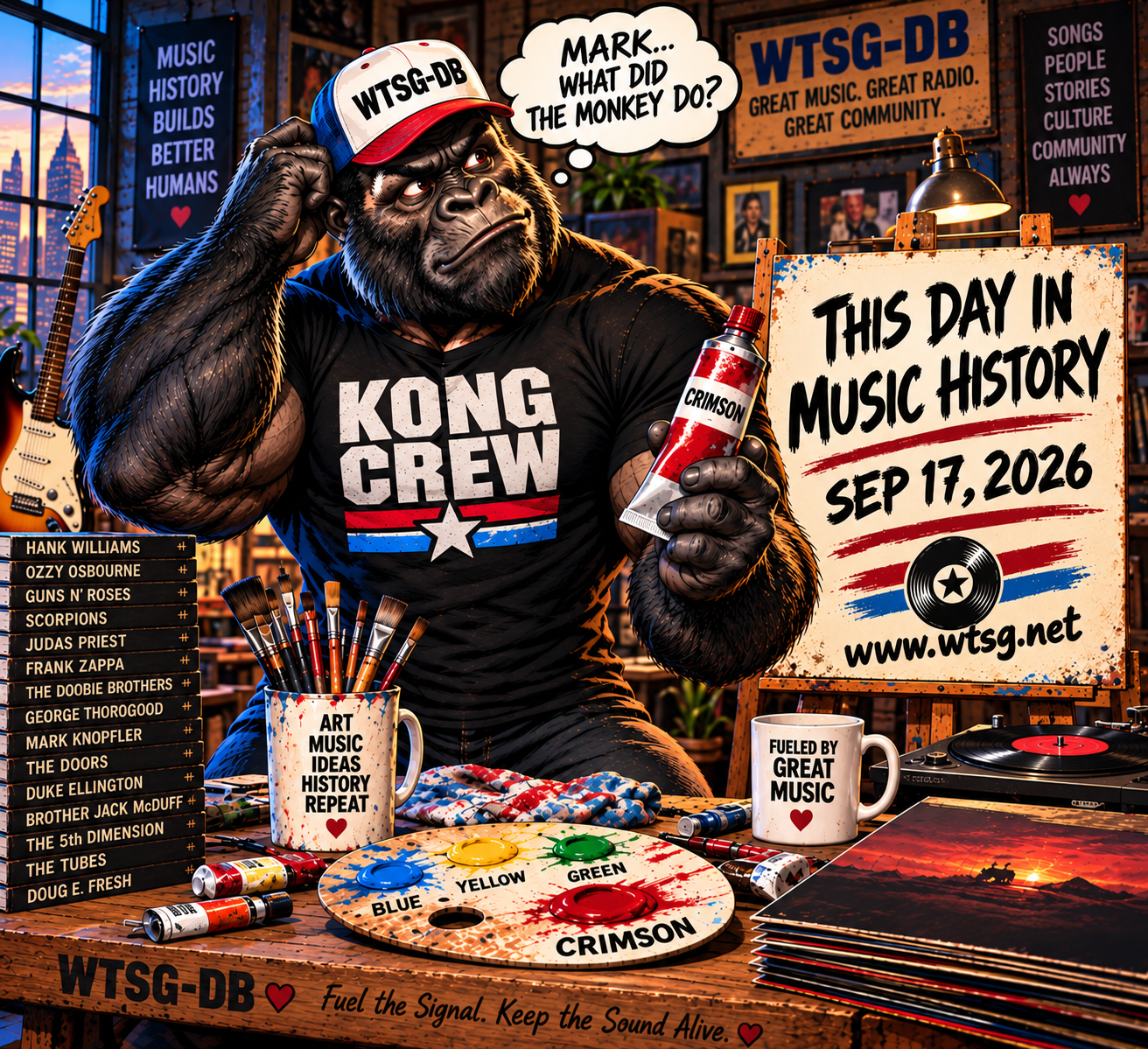
CLASSICKONG scratches his head.
Mark…
What did the monkey do?
🦍
Anyway…
Knopfler doesn’t need to overwhelm a record.
That’s part of the magic.
Sometimes a few beautifully chosen notes from that guitar tell you more than somebody else’s fifty.
One of the great guitar storytellers.
And CLASSICKONG will try to stay on his good side.
Apparently there are consequences.
1967 — Jim Morrison Doesn’t Change the Word
On September 17, 1967, The Doors appeared on The Ed Sullivan Show.
Before the broadcast, the band was asked to change the lyric in “Light My Fire” containing the word “higher” because television executives were concerned about its possible drug connotation.
The band indicated they would make the change.
Then the cameras went live.
Jim Morrison sang the original lyric.
The Doors also performed “People Are Strange.”
Here’s where the story gets even better.
“Light My Fire” appeared on The Doors, released January 4, 1967, on Elektra Records.
But “People Are Strange” would appear on Strange Days.
And Strange Days wasn’t released until September 25, 1967.
That’s eight days after the Sullivan performance.
So television viewers were getting an advance taste of a song from an album they couldn’t even walk into a record store and buy yet.
Pretty cool.
After the broadcast, the Doors were informed that they wouldn’t be invited back to the Sullivan show.
Morrison’s response became part of rock-and-roll folklore:
They’d already done Sullivan.
Point taken.
CLASSICKONG’s Must-Haves
The Doors (1967, Elektra) — “Light My Fire”
Strange Days (1967, Elektra) — “People Are Strange”
Get both albums.
1962 — Duke Ellington, Charles Mingus and Max Roach Enter the Money Jungle
On September 17, 1962, three giants entered Sound Makers studio in New York City:
Duke Ellington — piano
Charles Mingus — bass
Max Roach — drums
They recorded the session that became Money Jungle.
Think about those names for a second.
Duke.
Mingus.
Roach.
Three enormous musical personalities.
And apparently those personalities occasionally collided.
Accounts of the session describe serious friction between Mingus and Roach. At one point, Mingus reportedly packed up his bass and left.
Duke went after him.
Mingus returned.
The session continued.
That’s a side of Duke Ellington worth remembering.
By 1962, Duke had already lived through decades of changing music, changing musicians, changing personalities and changing times.
Experience matters.
Leadership isn’t always about being the loudest person in the room.
Sometimes it’s knowing how to keep everybody focused on why they’re in the room in the first place.
The music.
The original Money Jungle LP, released by United Artists Jazz in 1963, contained:
“Money Jungle”
“Fleurette Africaine”
“Very Special”
“Warm Valley”
“Wig Wise”
“Caravan”
“Solitude”
Duke Ellington.
Charles Mingus.
Max Roach.
That’s not a rhythm section.
That’s Mount Rushmore with instruments.
CLASSICKONG’s Must-Have
Money Jungle.
No complicated instructions required.
Sit down.
Listen.
1931 — RCA Victor Looks Toward the Long-Playing Future
On September 17, 1931, RCA Victor demonstrated an early long-playing record system at New York’s Savoy-Plaza Hotel.
The technology used the familiar 33⅓-rpm speed, although RCA’s early attempt at long-playing records was different from the microgroove LP format that would later become the industry standard.
The system was ahead of what the consumer market was ready to embrace.
But think about what the long-playing idea eventually meant.
More music per side.
Longer compositions.
The album as something more than a collection of individual songs.
Concept albums.
Live albums.
Jazz sessions.
Progressive rock.
Double albums.
And yes…
Eventually somebody would need enough space to contain Frank Zappa.
Technology changes the way music is made because it changes what’s possible.
September 17, 1931 deserves a place in music history.
1926 — Happy Birthday, Bill Black
Bill Black — September 17, 1926 – October 21, 1965.
Now here’s a bass player who deserves some love.
Black played upright bass alongside Elvis Presley and guitarist Scotty Moore during those early Sun Records sessions that helped create the language of rock and roll.
Black’s slap-bass playing wasn’t background decoration.
It was propulsion.
Listen to those early Elvis records and pay attention to what’s happening underneath the vocal and guitar.
Later, Black formed Bill Black’s Combo and built another successful musical identity.
CLASSICKONG’s Must-Hear
Want to hear Bill Black beyond Elvis?
Start with Saxy Jazz (1960, Hi Records).
Look for “Smokie, Part 2,” “White Silver Sands,” “Tuxedo Junction” and “The Wheel.”
Then check out Solid and Raunchy.
The bass players helped build rock and roll too.
Give Bill Black his roses.
1926 — Happy Birthday, Brother Jack McDuff
Eugene McDuffy, better known as Brother Jack McDuff, was born September 17, 1926.
He died January 23, 2001.
Now we’re talking Hammond organ.
McDuff became one of the important figures in soul jazz and hard bop, working extensively with that glorious Hammond B3 sound.
And there’s another connection we love around here:
George Benson.
McDuff gave the young guitarist an important early professional opportunity in his band.
Before George Benson became an international star, he was sharpening his chops beside Brother Jack.
CLASSICKONG’s Must-Haves
Start with:
The Honeydripper (1961, Prestige)
Hot Barbeque (1966, Prestige)
Then keep going.
Turn up the B3.
CLASSICKONG approves.
1939 — Remembering LaMonte McLemore
LaMonte McLemore — September 17, 1939 – February 3, 2026.
McLemore was a founding member of The 5th Dimension, whose beautifully arranged vocal records became fixtures of late-1960s and early-1970s pop.
Think:
“Up, Up and Away.”
And, of course:
“Aquarius/Let the Sunshine In.”
McLemore also lived another remarkable creative life as a professional photographer.
We lost him earlier this year at age 90.
Today, on his birthday, we remember the voice, the photographs and the music.
CLASSICKONG’s Must-Haves
New to the 5th Dimension?
Start with Up, Up and Away (1967, Soul City Records), featuring the Jimmy Webb-penned title song.
Then move to The Age of Aquarius (1969, Soul City Records), home to “Aquarius/Let the Sunshine In,” “Wedding Bell Blues” and “Workin’ on a Groovy Thing.”
Those two records will open the door.
Then walk through it.
Give LaMonte McLemore his roses in remembrance.
1950 — Happy Birthday, Fee Waybill
Fee Waybill, born September 17, 1950.
Lead singer of The Tubes.
And CLASSICKONG has three words:
“She’s a Beauty.”
The song appears on Outside Inside (1983, Capitol Records), produced by David Foster.
And would you look who’s hiding in the songwriting credits?
Fee Waybill.
David Foster.
And…
STEVE LUKATHER.
LUKE!
AGAIN!
At this point I’m convinced Steve Lukather had a cot in every recording studio in America.
“She’s a Beauty” reached the Billboard Hot 100 Top 10 and topped Billboard’s rock chart.
The Tubes could be theatrical, strange, funny, sophisticated and completely over the top.
That’s part of what made them The Tubes.
CLASSICKONG’s Must-Have
Outside Inside (1983, Capitol).
Come for “She’s a Beauty.”
Stay to find out what else these wonderfully strange people were doing.
Happy birthday, Fee.
1966 — Happy Birthday, Doug E. Fresh
Doug E. Fresh, born September 17, 1966.
OH! OH!
OHHH MY GOD!
HAHAHA!
One of hip-hop’s foundational beatbox pioneers, Doug became famous for turning the human voice into a rhythm machine.
And any discussion of those early beatboxing days also deserves a respectful nod toward another pioneer near and dear to CLASSICKONG:
Darren “Buffy” Robinson of the Fat Boys.
Doug E. Fresh and Buffy helped introduce an entire generation to what could be done with nothing more than a microphone, breath, rhythm and imagination.
Those sounds came out of PEOPLE.
No drum machine required.
CLASSICKONG’s Must-Haves — Doug E. Fresh
Start with the essential 1985 single:
“The Show” / “La Di Da Di” — Doug E. Fresh and the Get Fresh Crew featuring MC Ricky D, the young rapper who would become known worldwide as Slick Rick.
Then go to:
Oh, My God! (1986, Reality/Fantasy)
The World’s Greatest Entertainer (1988, Reality/Fantasy)
If you’ve never heard early Doug E. Fresh, that’s your homework.
And Don’t Forget the Fat Boys
If we’re talking human beatboxing, CLASSICKONG isn’t leaving his boys behind.
Start with:
Fat Boys (1984, Sutra Records), produced by Kurtis Blow.
Listen to:
“Jail House Rap”
“Stick ‘Em”
“Can You Feel It?”
“Fat Boys”
“Human Beat Box”
Then continue with:
The Fat Boys Are Back (1985)
and
Crushin’ (1987).
Buffy was special.
The Fat Boys were special.
And Doug E. Fresh is special.
There doesn’t have to be only one chair at the table.
Happy birthday, Doug.
And roses in remembrance for Darren “Buffy” Robinson and Prince Markie Dee.
Final Spin
Today’s history keeps returning to one idea:
What we pass along matters.
RCA engineers experimented with a new way to preserve more music on a record.
Duke Ellington used decades of experience to hold a difficult recording session together.
Hank Williams left songs that survived the man who wrote them.
Bill Black helped lay down a rhythm that became rock and roll.
Brother Jack McDuff helped give a young George Benson room to grow.
Doug E. Fresh and Buffy showed another generation that sometimes the instrument you need is already inside you.
And sometimes the lesson being passed along isn’t on a record at all.
Sometimes it’s a father putting a pool cue in his son’s hands and teaching him how to play.
You may not realize it at the time.
You’re just having fun.
You’re trying to beat Dad.
Years pass.
Then one day an old George Thorogood video comes on, Willie Mosconi walks into a pool hall, and suddenly that memory comes rushing back.
That’s the power of music.
It doesn’t merely preserve sound.
It preserves pieces of our lives.
So teach somebody something.
Share the music.
Tell the stories.
And give people their roses.
Because long after the needle reaches the end of the record, what we gave one another can keep spinning.
From all of us at WTSG Digital Broadcasting:
Great Music. Great Radio. Great Community.
Listen to Today’s Broadcast
Hear the spoken-word edition of This Day in Music History right here on WTSG-DB.
And if today’s trip through music history brought back a memory of your own, we’d love to hear it.
Sign in and visit the WTSG-DB Guestbook to share your story with the community.
And to our listeners joining us through Spotify—welcome to WTSG Digital Broadcasting. Follow the show so tomorrow’s trip through music history is waiting for you.
Fuel the Signal. Keep the Sound Alive.
References
Library of Congress — September 17: The U.S. Constitution
Law Library of Congress — Constitution Day and Citizenship Day
Country Music Hall of Fame and Museum — Hank Williams
Sony Pictures Classics — I Saw the Light
Ozzy Osbourne Official — No More Tears
Judas Priest Official — Discography
George Thorogood Official — The Story Behind Bad to the Bone
The Doors Official — Albums and Discography
The Ed Sullivan Show — The Doors
Charles Mingus Official — Money Jungle
MusicBrainz — George Thorogood & the Destroyers, Bad to the Bone