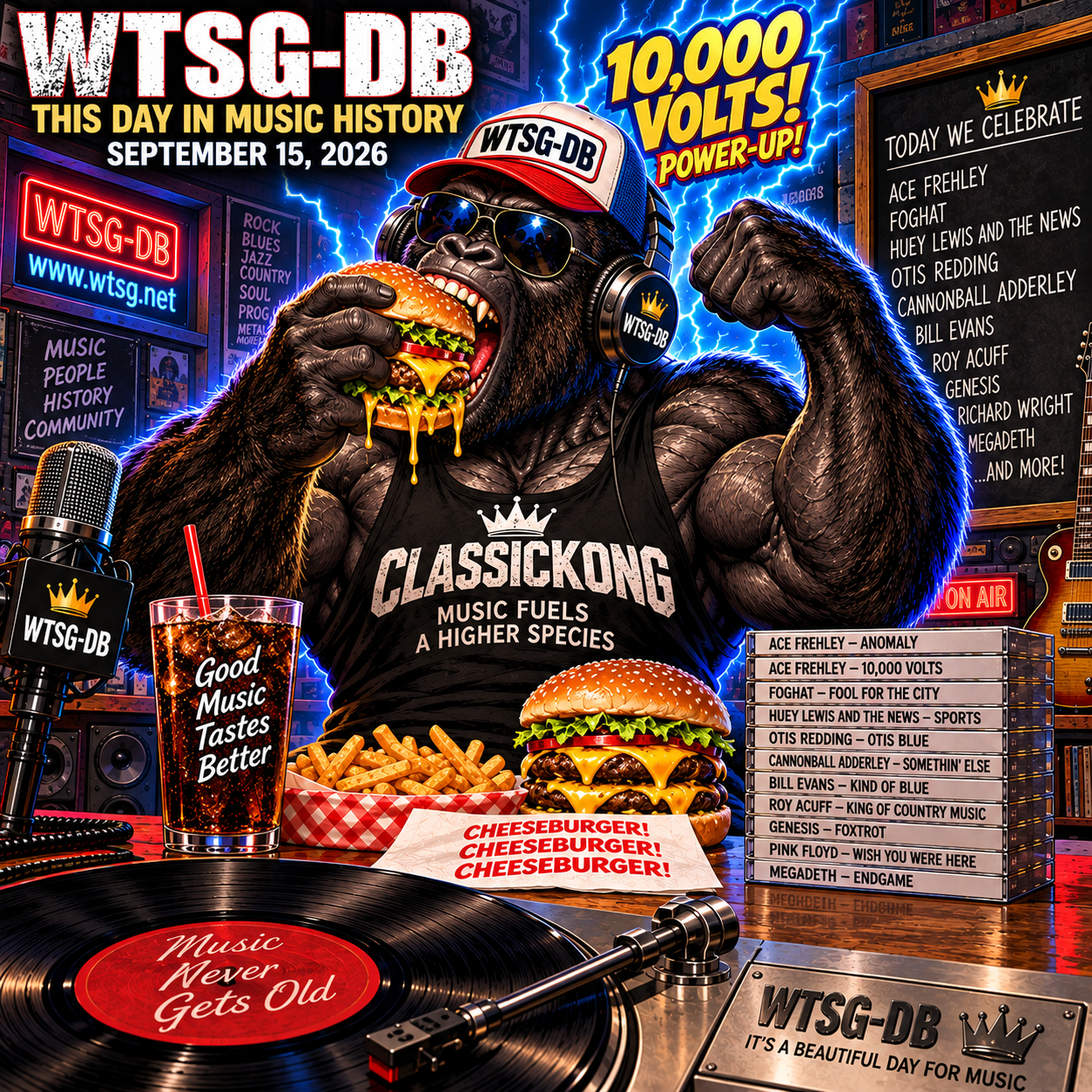
From the Desk of CLASSICKONG
Good morning, music lovers, and welcome back to WTSG Digital Broadcasting.
Before we turn up the volume, we send our thanks to the men and women of the United States Armed Forces—past and present—and to the families who stand beside them. Your service and sacrifice are never taken for granted.
September 15 gives us one of those days where seemingly every turn through the record collection opens another door. We’ve got the Spaceman returning after a twenty-year recording gap, Foghat taking us on a “Slow Ride,” Huey Lewis and the News delivering an album packed with hits, Otis Redding putting his heart into a Sam Cooke masterpiece, two jazz giants forever connected to Kind of Blue, one of country’s founding legends, progressive rock stretching toward the heavens, and a quiet keyboard master who helped give Pink Floyd its unmistakable atmosphere.
And since September 15 is National Double Cheeseburger Day…
Somebody fire up the grill.
CHEESEBURGER! CHEESEBURGER! CHEESEBURGER!
2009 — Ace Frehley Returns with Anomaly
There was only one place CLASSICKONG could start today.
ACE FREHLEY.
On September 15, 2009, original KISS lead guitarist Ace Frehley released Anomaly through Bronx Born Records.
It had been twenty years since Trouble Walkin’ in 1989.
Twenty years.
In the music business, that can feel like several lifetimes. Styles change. Record companies disappear. Audiences change. Entire formats come and go.
But Ace was still Ace.
And today, that comeback carries an emotional weight it didn’t have when Anomaly first arrived.
Paul Daniel “Ace” Frehley was born April 27, 1951, and died October 16, 2025, at age 74 following injuries suffered in an accidental fall.
For those of us who grew up loving KISS—and especially those of us who always had a soft spot for the Spaceman—it’s still difficult to write those words.
But September 15 gives us an opportunity not simply to remember that we lost Ace.
It gives us an opportunity to remember that Ace came back.
Anomaly included “Foxy & Free,” “Outer Space,” “Pain in the Neck,” “Genghis Khan,” “Too Many Faces” and the instrumental “Fractured Quantum,” along with Ace’s take on Sweet’s “Fox on the Run.”
The album debuted at No. 27 on the Billboard 200.
And Ace wasn’t finished.
He followed Anomaly with Space Invader in 2014, Origins Vol. 1 in 2016, Spaceman in 2018 and Origins Vol. 2 in 2020.
Then came one more blast from the amplifier.
In 2024, at 72 years old, Ace released 10,000 Volts through MNRK Heavy.
Produced and co-written with Steve Brown of Trixter, 10,000 Volts wasn’t some ceremonial victory lap. The record topped both the Hard Music and Rock Album charts and showed that Ace still had plenty of electricity running through that Les Paul.
Songs including “10,000 Volts,” “Walkin’ on the Moon,” “Cherry Medicine,” “Cosmic Heart” and the closing instrumental “Stratosphere” gave us one final studio chapter.
10,000 Volts would become Ace Frehley’s final studio album.
And knowing that now makes listening to it different.
Ace didn’t spend his final recording years simply looking backward at what he’d accomplished with KISS.
He was still making records.
Still bending strings.
Still writing songs.
Still being Ace.
His influence was never about playing the most notes possible. Ace’s bends had personality. His vibrato had attitude. His solos had melody.
Millions of kids heard that Les Paul coming through the speakers, saw the smoking-guitar Spaceman standing onstage and thought:
I want to play guitar.
Some of those kids eventually became famous guitar players themselves.
CLASSICKONG’s Classic Weapon — Ace Frehley
Real Name: Paul Daniel Frehley
Born: April 27, 1951
Died: October 16, 2025
Alter Ego: The Spaceman
Weapon of Choice: Gibson Les Paul
Special Ability: Making a guitar solo unforgettable without making it unnecessarily complicated
Signature Sound: Big bends, vibrato, blues-based phrasing and unmistakable swagger
Power Move: “Shock Me”
Solo Anthem: “New York Groove”
Final Transmission: 10,000 Volts
CLASSICKONG Rating: LEGEND. ACCEPT NO SUBSTITUTE.
Must-Have Ace Frehley
** Ace Frehley — 1978 — Casablanca Records**
The essential starting point. “Rip It Out,” “Snow Blind,” “Ozone” and the hit “New York Groove.”
** Frehley’s Comet — 1987 — Megaforce/Atlantic**
Ace returned with a band bearing his name and gave us “Rock Soldiers” and “Into the Night.”
** Trouble Walkin’ — 1989 — Megaforce/Atlantic**
Harder and stripped down, this became Ace’s final solo studio album for twenty years.
** Anomaly — 2009 — Bronx Born Records**
The September 15 record we’re celebrating today. Twenty years later, the Spaceman proved he could still fly.
** Space Invader — 2014 — eOne Music**
Another major comeback statement, taking Ace back into the Billboard Top 10.
** Spaceman — 2018 — eOne Music**
Ace embraced the identity generations of fans had given him while continuing to make new music.
** Origins Vol. 2 — 2020 — eOne Music**
Ace paying tribute to songs and musicians that helped shape him.
** 10,000 Volts — 2024 — MNRK Heavy**
The final studio album. At 72 years old, Ace didn’t quietly ride into the sunset.
He turned the amplifier back up.
There will never be another Ace Frehley.
But maybe that’s the point.
The great ones leave us something that doesn’t leave when they do.
Every time somebody drops the needle on that 1978 solo record…
Every time “Shock Me” comes roaring through the speakers…
Every time some kid picks up a Les Paul because Ace made playing guitar look like the coolest job on Earth…
The Spaceman flies again.
Give Ace his roses. 🌹
And this time, raise one toward the stars.
Paul Daniel “Ace” Frehley — April 27, 1951–October 16, 2025.
Rest easy, Spaceman.
1975 — Foghat Takes a Slow Ride into the City
Now we’re talking.
On September 15, 1975, Foghat released Fool for the City on Bearsville Records.
And sitting right there on the album was one of classic rock’s great invitations:
“Slow Ride.”
That riff.
That groove.
That bass.
Roger Earl laying down the beat while Dave Peverett and Rod Price bring the guitars.
It isn’t complicated.
It doesn’t need to be.
Sometimes rock and roll works because everybody locks into a groove and simply refuses to let go.
Producer Nick Jameson played an especially important role. With original bassist Tony Stevens gone, Jameson handled bass and keyboards in addition to producing the record. The album featured Dave Peverett on vocals and guitar, Rod Price on guitar and Roger Earl on drums.
Fool for the City became Foghat’s first platinum album.
Must-Have Foghat
** Foghat — 1972 — Bearsville Records**
The beginning, including their take on Willie Dixon’s “I Just Want to Make Love to You.”
** Energized — 1974 — Bearsville Records**
Blues-rock Foghat firing on all cylinders.
** Fool for the City — 1975 — Bearsville Records**
“Fool for the City.” “Slow Ride.”
Enough said.
** Foghat Live — 1977 — Bearsville Records**
For many listeners, the sound of Foghat doing what Foghat did best—turning the amps up and going to work.
Turn it up, Big Dawg.
1983 — Huey Lewis and the News Play Sports
On September 15, 1983, Huey Lewis and the News released Sports on Chrysalis Records.
And what a record.
“The Heart of Rock & Roll.”
“Heart and Soul.”
“I Want a New Drug.”
“Walking on a Thin Line.”
“If This Is It.”
Five major radio records from one album.
Sports eventually reached No. 1 on the Billboard 200 and became one of the defining American pop-rock albums of the 1980s.
The band itself was formidable: Huey Lewis on vocals and harmonica, Mario Cipollina on bass, Johnny Colla on guitar and saxophone, Bill Gibson on drums, Chris Hayes on lead guitar and Sean Hopper on keyboards.
There was musicianship underneath all that accessibility—horns, harmonies, tight arrangements and a rhythm section that knew exactly where the pocket was.
And Sports gives us one of today’s recurring lessons:
Great records don’t punch a time clock.
More than forty years later, put on “Heart and Soul” or “The Heart of Rock & Roll” and that record still comes charging out of the speakers.
Must-Have Huey Lewis and the News
** Picture This — 1982 — Chrysalis Records**
The breakthrough, featuring “Do You Believe in Love.”
** Sports — 1983 — Chrysalis Records**
The monster.
** Fore! — 1986 — Chrysalis Records**
Another No. 1 album, arriving after Sports had transformed the band into international stars.
Sometimes an album becomes part of an era.
Sports helped define one.
1965 — Otis Redding Sings Soul
On September 15, 1965, Otis Redding released Otis Blue/Otis Redding Sings Soul on Volt Records.
Look at this collection:
“Ole Man Trouble.”
“Respect.”
“I’ve Been Loving You Too Long.”
“Shake.”
“My Girl.”
“Satisfaction.”
And then there is “A Change Is Gonna Come.”
The song was written and first recorded by Sam Cooke, who died in December 1964. Cooke’s experiences with racism and segregation, along with the Civil Rights struggle unfolding around him, helped shape a song that would become one of the era’s defining musical statements.
Otis admired Sam Cooke deeply.
So when Otis sang “A Change Is Gonna Come,” he wasn’t trying to erase Cooke’s fingerprints.
He was carrying the song forward.
And that’s the beauty of interpretation.
Sam Cooke sounds like Sam Cooke.
Otis Redding sounds like Otis Redding.
Same song.
Same message.
Different human heart delivering it.
Must-Have Otis Redding
** Pain in My Heart — 1964 — Atco Records**
The early foundation.
** Otis Blue/Otis Redding Sings Soul — 1965 — Volt Records**
Essential. Period.
** The Soul Album — 1966 — Volt Records**
Otis continuing to develop into one of soul music’s defining voices.
** The Dock of the Bay — 1968 — Volt Records**
Released after Otis’s death and containing the immortal “(Sittin’ On) The Dock of the Bay.”
Otis Redding — September 9, 1941–December 10, 1967.
Only 26 years old.
What a voice.
What a loss.
1928 — Cannonball Adderley Is Born
Julian Edwin Adderley was born September 15, 1928, in Tampa, Florida, and died August 8, 1975, in Gary, Indiana.
And before we get to that alto saxophone, we need to answer an obvious question:
Where in the world did “Cannonball” come from?
You might assume it described the power coming out of his horn.
Nope.
FOOD.
Adderley himself later explained that as a youngster he had developed quite a reputation for his enormous appetite. A schoolmate tried to nickname him “Cannibal,” mispronounced it, and the other musicians began having some fun with the mistake.
Over time, “Cannibal” morphed into…
Cannonball.
Considering September 15 is also National Double Cheeseburger Day, we have a feeling Cannonball might have approved of today’s menu.
Somewhere, CLASSICKONG just ordered another patty.
Musically, however, there was nothing funny about Cannonball Adderley’s ability.
When he arrived in New York in 1955, he was planning to continue his education. Then came a famous sit-in at Café Bohemia with bassist Oscar Pettiford’s group.
Cannonball started playing.
New York’s jazz community suddenly wanted to know:
Who is THAT?
Eventually Miles Davis wanted to know too.
Cannonball joined Miles and became part of the extraordinary sextet heard on Kind of Blue.
But before Kind of Blue, Cannonball recorded another stone-cold jazz essential: Somethin’ Else for Blue Note, featuring Miles Davis alongside Hank Jones, Sam Jones and Art Blakey.
CLASSICKONG’s Classic Weapon — Cannonball Adderley
Real Name: Julian Edwin Adderley
Born: September 15, 1928
Died: August 8, 1975
Weapon of Choice: Alto saxophone
Special Ability: Combining bebop fire with blues, gospel and soul
Signature Sound: Big, warm and immediately recognizable
Power Move: “Mercy, Mercy, Mercy”
Essential Mission: Somethin’ Else
Fuel of Choice: Apparently anything that wasn’t nailed down
Okay…
We made that last one up. 😂
Must-Have Cannonball Adderley
** Somethin’ Else — 1958 — Blue Note Records**
Cannonball, Miles Davis, Hank Jones, Sam Jones and Art Blakey.
If you’ve never explored Cannonball, start here.
** Cannonball Adderley Quintet in San Francisco — 1959 — Riverside Records**
A landmark in the development of soul jazz.
** Mercy, Mercy, Mercy! Live at “The Club” — 1966 — Capitol Records**
Featuring Joe Zawinul’s unforgettable title composition.
Give Cannonball his roses. 🌹
And maybe a double cheeseburger.
1980 — Remembering Bill Evans
September 15 carries a much sadder jazz anniversary.
Pianist William John Evans was born August 16, 1929, and died September 15, 1980, at only 51.
Bill’s playing was special.
Plenty of pianists can play beautiful chords.
Bill Evans could make you stop and wonder what was inside the chord.
His voicings, inner movement, touch, space and harmonic choices created a language that generations of pianists are still studying.
Nobody really voiced chords like Bill.
And then there’s Miles.
Bill Evans became an essential part of the musical world that produced Miles Davis’s Kind of Blue.
Put Bill and Cannonball together in that lineup and September 15 suddenly gives us remarkable jazz bookends:
Cannonball Adderley was born on September 15.
Bill Evans left us on September 15.
And their paths crossed forever on Kind of Blue.
Bill also made extraordinary music with Tony Bennett.
Strip away the orchestra and production spectacle and leave two master musicians in a room—a singer and a pianist.
Nowhere to hide.
That’s confidence.
CLASSICKONG’s Classic Weapon — Bill Evans
Full Name: William John Evans
Born: August 16, 1929
Died: September 15, 1980
Weapon of Choice: Piano
Special Ability: Harmonic voicing
Signature Sound: Intimate, lyrical and harmonically rich
Power Move: Making silence part of the music
Essential Mission: Sunday at the Village Vanguard
CLASSICKONG Rating: NATIONAL TREASURE
Must-Have Bill Evans
** Portrait in Jazz — 1959 — Riverside Records**
The classic trio with Scott LaFaro and Paul Motian.
** Sunday at the Village Vanguard — 1961 — Riverside Records**
One of the great live jazz recordings.
** Waltz for Debby — 1961 — Riverside Records**
More from those historic Village Vanguard performances.
** The Tony Bennett/Bill Evans Album — 1975 — Fantasy Records**
Two masters and nowhere to hide.
Give Bill Evans his roses. 🌹
1903 — Roy Acuff Is Born
Roy Claxton Acuff was born September 15, 1903, in Maynardville, Tennessee, and died November 23, 1992.
For generations of Grand Ole Opry viewers, Roy Acuff seemed almost inseparable from the institution itself.
And his importance went far beyond performing.
Acuff co-founded Acuff-Rose Publications with songwriter Fred Rose, helping establish one of the foundations of Nashville’s modern music-publishing business.
He also helped create Hickory Records with Fred and Wesley Rose.
Then, in 1962, Roy Acuff became the first living performer elected to the Country Music Hall of Fame.
That’s not simply country-music history.
That’s American music-business history.
Must-Have Roy Acuff
** Songs of the Smoky Mountains — 1947 — Columbia Records**
An early LP-era collection from the King of Country Music.
** Once More — It’s Roy Acuff — 1959 — Hickory Records**
Roy recording for the label he helped establish.
** King of Country Music — 1962 — Hickory Records**
The title wasn’t exactly exaggerating.
And if you grew up watching the Grand Ole Opry, chances are Roy Acuff feels less like somebody from a history book and more like somebody who was simply always there.
Give Roy his roses. 🌹
1972 — Genesis Opens the Door to Foxtrot
September 15, 1972 gives progressive rock one of its landmarks: Genesis and Foxtrot, released on Charisma Records.
The exact release date was disputed for years, with several dates circulating in references. A detailed reconstruction using contemporary advertisements, reviews and period evidence strongly supports September 15, 1972.
And what an album.
“Watcher of the Skies.”
“Get ‘Em Out by Friday.”
Steve Hackett’s beautiful “Horizons.”
And then…
“Supper’s Ready.”
More than twenty minutes of Genesis going completely, gloriously progressive.
Peter Gabriel.
Tony Banks.
Steve Hackett.
Mike Rutherford.
Phil Collins.
This isn’t background music while you’re vacuuming the living room.
Well…
You could.
But you’re probably going to forget what you were doing somewhere around the apocalypse.
Must-Have Genesis
** Nursery Cryme — 1971 — Charisma Records**
The classic five-man lineup finds its footing.
** Foxtrot — 1972 — Charisma Records**
“Watcher of the Skies” and “Supper’s Ready.”
** Selling England by the Pound — 1973 — Charisma Records**
One of progressive rock’s defining albums.
** A Trick of the Tail — 1976 — Charisma Records**
Phil Collins steps to the microphone after Peter Gabriel’s departure—and Genesis proves another chapter is possible.
2008 — Remembering Richard Wright
Pink Floyd keyboardist Richard William Wright was born July 28, 1943, and died September 15, 2008, at age 65.
Richard Wright is another perfect example of why volume and importance are not the same thing.
Listen underneath Pink Floyd.
Listen to the organ.
The piano.
The synthesizers.
The harmonic movement.
The atmosphere.
That’s where Rick lived.
His contributions to records such as The Dark Side of the Moon and Wish You Were Here helped create the space around the notes—the feeling that Pink Floyd’s music existed somewhere larger than the speakers playing it.
You don’t always have to stand at the front of the stage to change the sound of the band.
Sometimes the person quietly coloring the background is holding the entire picture together.
CLASSICKONG’s Classic Weapon — Richard Wright
Full Name: Richard William Wright
Born: July 28, 1943
Died: September 15, 2008
Weapon of Choice: Keyboards
Special Ability: Creating atmosphere around the music
Signature Sound: Hammond organ, piano and synthesizer textures
Power Move: Making space sound musical
Essential Mission: Wish You Were Here
Must-Have Richard Wright / Pink Floyd
** Meddle — 1971 — Harvest Records**
A major step toward the classic Pink Floyd sound.
** The Dark Side of the Moon — 1973 — Harvest Records**
Essential listening, with Wright’s musical fingerprints everywhere.
** Wish You Were Here — 1975 — Harvest Records**
Atmosphere, space and emotion.
** Wet Dream — 1978 — Harvest Records**
Richard Wright outside Pink Floyd and worth hearing for anyone wanting to understand his musical personality more deeply.
Give Richard Wright his roses. 🌹
2009 — Megadeth Reaches the Endgame
Ace Frehley wasn’t the only heavy hitter releasing an album on September 15, 2009.
Megadeth released Endgame through Roadrunner Records on the same day.
The lineup featured Dave Mustaine on vocals and guitar, Chris Broderick on guitar, James LoMenzo on bass and Shawn Drover on drums.
For guitar fans, Endgame offered plenty to chew on: technical riffing, speed, precision and the tightly wound aggression that had long defined Megadeth.
Two very different guitar heroes.
Same release day.
Ace brought the swagger.
Mustaine brought the chainsaw.
September 15, 2009 wasn’t exactly a quiet Tuesday at the record store.
National Double Cheeseburger Day
STOP THE PRESSES.
September 15 is National Double Cheeseburger Day.
CLASSICKONG has conducted extensive scientific research and reached the following conclusion:
One cheeseburger = good.
Two patties = better.
Therefore…
CHEESEBURGER! CHEESEBURGER! CHEESEBURGER!
And today’s music history has provided us with an unexpected honorary spokesman.
Remember why Julian Adderley became “Cannonball”?
The man apparently liked to eat.
So in honor of Cannonball Adderley, CLASSICKONG respectfully proposes that today’s official jazz meal consist of:
A double cheeseburger.
Maybe two.
Research continues.
National IT Professionals Day
September 15, 2026 is also the third Tuesday in September, making it National IT Professionals Day—recognition for the people keeping our computers, servers, networks and assorted blinking boxes alive.
At WTSG-DB, that means websites, streaming, podcasting, audio interfaces, Windows PCs, WordPress, security, networks and the occasional mysterious piece of technology that worked perfectly yesterday and has apparently decided this morning that it no longer recognizes humanity.
To the IT professionals who keep the digital world spinning:
We give you your roses. 🌹
And perhaps a double cheeseburger.
Final Spin
Maybe that’s the lesson spinning through September 15:
Find your own voice, trust it—and remember that it doesn’t come with an expiration date.
Ace Frehley proved that with Anomaly. Twenty years had passed since his previous solo studio album, but the Spaceman still had something to say.
And he kept saying it.
Ace continued making records all the way through 10,000 Volts in 2024. Today, with Ace sadly gone, those later records mean even more. They remind us that his story didn’t stop when one chapter ended.
Huey Lewis and the News have known long stretches between studio records too, but those songs never disappeared. Put on Sports today and the years seem to fall away.
The calendar may keep turning, but great music has a funny way of refusing to grow old.
Maybe that’s because the musicians who stay with us leave something unmistakably their own behind.
Bill Evans could sit down at a piano and voice a chord in a way that belonged to Bill Evans alone.
Cannonball Adderley put his personality through the bell of an alto saxophone.
Richard Wright helped give Pink Floyd its atmosphere without always needing the spotlight.
Foghat didn’t need to reinvent rock and roll—they played it with enough muscle and personality that decades later, “Slow Ride” can still make us reach for the volume knob.
And when Otis Redding sang Sam Cooke’s “A Change Is Gonna Come,” he respected the message while pouring his own heart into every word.
There’s something worth carrying with us from all of that.
Time passing doesn’t mean your story is over. A quiet season doesn’t mean you’ve lost your voice. And great music doesn’t lose its meaning just because the years go by.
Sometimes another chapter comes twenty years later.
Sometimes a record finds a new generation.
And sometimes an artist is no longer here, yet one chord, one riff, one voice or one song brings them right back into the room.
So do the work.
Find what is uniquely yours.
Give people your best.
And when you recognize something special in somebody else, give them their roses.
Because the voices we remember aren’t always the loudest.
They’re the ones we can recognize after the very first note—and no matter how many years pass, somehow the music remains.
Until tomorrow, keep listening, keep learning, keep supporting the music—and never be afraid to sound like yourself.
— CLASSICKONG
Listen to Today’s Broadcast
Hear today’s This Day in Music History broadcast from WTSG Digital Broadcasting using the audio player below.
And if you enjoyed today’s trip through music history, sign in and leave us a note in the WTSG-DB Guestbook. We love hearing from the people keeping this music alive.
Great Music. Great Radio. Great Community.
References
- Ace Frehley — Official Biography
- MNRK Heavy — Ace Frehley, 10,000 Volts
- Foghat — Official Music and Discography
- Huey Lewis and the News — Sports
- Otis Redding — Official Album Archive
- Library of Congress — Sam Cooke and “A Change Is Gonna Come”
- Cannonball Adderley — Biography
- Blue Note Records — Somethin’ Else
- Bill Evans — Official Discography
- Country Music Hall of Fame — Roy Acuff
- Genesis — Foxtrot Release-Date Investigation
- Pink Floyd — Official Historical Timeline
- Megadeth — Official Lineup History
- National Day Calendar — September 15