From the Desk of CLASSICKONG
Welcome back, music lovers, historians, collectors, musicians—and old friends.
Before we get rolling today, CLASSICKONG has a little housekeeping to take care of.
On yesterday’s broadcast, I enthusiastically wished everybody a Happy Thursday.
There was only one small problem.
It was Wednesday.
ROFLMAO!
Apparently, I’ve been living one day in the future all week. I’m usually preparing these shows a day ahead, and somewhere along the way my brain decided to move there permanently.
So to everyone listening yesterday: my apologies for temporarily rearranging the calendar.
I’m getting older, folks. Sometimes I get my days crossed. Thankfully, today really IS Thursday, September 10.
At least…
I checked twice. 😂
And before we go any further, I’d also like to welcome everyone who may be discovering This Day in Music History through Spotify.
We’re glad you found us.
Around here, we don’t just read a list of dates and call it music history. We dig into the records, the musicians, the stories behind the songs, and sometimes the memories those songs bring back.
Whether you’ve been listening to WTSG Digital Broadcasting for years or this is your very first visit, welcome to the KONG CREW.
Pull up a chair. We’ve got plenty of records to talk about.
Now that CLASSICKONG and the calendar have officially been reunited, let’s get down to business.
Before we turn the first record over today, WTSG Digital Broadcasting proudly sends our thanks to the men and women of the United States Armed Forces, past and present. Your service and sacrifice are never forgotten.
September 10 gives us one of those extraordinary trips through music history where seemingly unrelated roads somehow meet.
Today we’ll go from KISS at full volume to the changing face of rock in the early 1990s. We’ll visit Rush, Iron Maiden, Aerosmith, Three Dog Night, country legend George Jones, jazz great Roy Ayers—and, through one unexpected musical rabbit hole, Henry Mancini.
But underneath all those stories, another theme appeared.
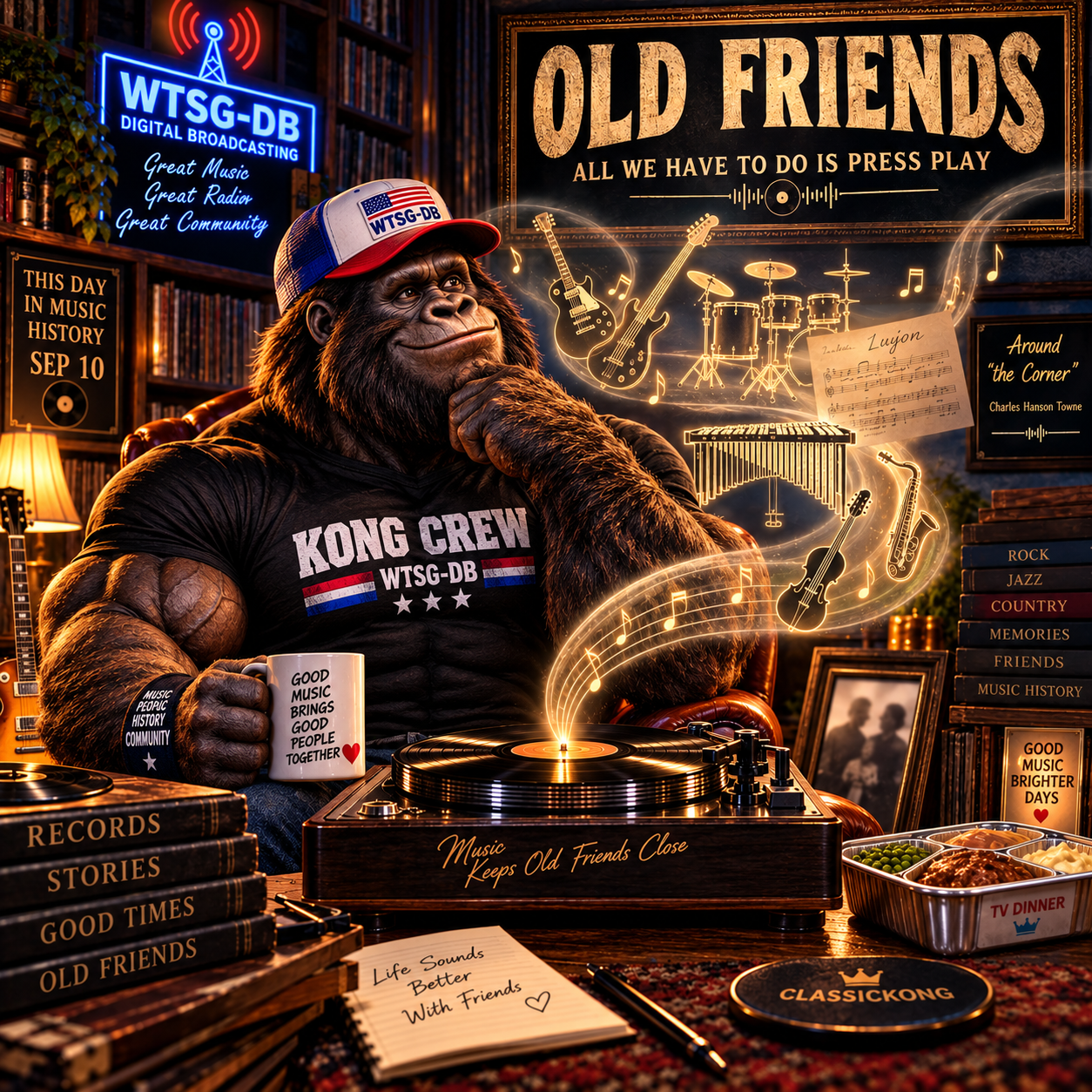
Old friends.
Some are still with us. Some have left us. Some we’ve never personally met, yet their voices, records and instruments have traveled beside us for decades.
Sometimes all it takes is dropping the needle, pressing PLAY or hearing a familiar melody.
And suddenly an old friend is back in the room.
September 10, 1975 — KISS Comes Alive!
Now THIS is how you start September 10.
On September 10, 1975, KISS released the double live album Alive! on Casablanca Records.
Produced by Eddie Kramer, Alive! captured something the band’s first three studio albums had struggled to communicate fully:
KISS was a live band.
The fire, volume, audience interaction and sheer spectacle finally came blasting through the speakers.
The album included live versions of “Deuce,” “Strutter,” “Hotter Than Hell,” “Firehouse,” “Black Diamond,” “Cold Gin” and, of course, “Rock and Roll All Nite.”
For KISS, Alive! became the breakthrough.
CLASSICKONG’s Corner
This one is personal.
I was a member of the KISS Army, and I wore out Alive! and Destroyer.
Eventually, I saw KISS with my parents at Roberts Stadium here in Evansville. I can still remember the spectacle, Gene Simmons coming down from above, and leaving after “Beth.”
Those aren’t simply memories of a band.
They’re memories of being a kid.
They’re memories of Mom and Dad.
And that’s one of the beautiful things about records. Decades later, you can put one on and discover that the people, places and feelings you thought were long gone have been hiding in those grooves the whole time.
CLASSICKONG Must-Haves — KISS
- KISS — 1974, Casablanca Records
- Hotter Than Hell — 1974, Casablanca Records
- Dressed to Kill — 1975, Casablanca Records
- Alive! — 1975, Casablanca Records
- Destroyer — 1976, Casablanca Records
- Rock and Roll Over — 1976, Casablanca Records
- Love Gun — 1977, Casablanca Records
- Alive II — 1977, Casablanca Records
If you’ve never understood why the original KISS Army became so devoted to this band, start with Alive!
Then turn it up.
Way up.
September 10, 1991 — Nirvana Changes the Conversation
On September 10, 1991, Nirvana released “Smells Like Teen Spirit” as the lead single from Nevermind on DGC Records.
Nobody needed to announce that rock music was changing.
You could hear it.
The song initially wasn’t expected to become the massive crossover hit it became. But alternative radio grabbed it, listeners responded, MTV eventually put the video into heavy rotation, and suddenly Nirvana was no longer simply part of an underground movement.
Grunge had entered the mainstream.
Nirvana didn’t create the entire movement by themselves, and rock history is more complicated than saying one song instantly killed everything that came before it.
But there’s no denying the dividing line.
There was popular rock before Nevermind.
And there was popular rock after it.
Kurt Cobain was born February 20, 1967, and died April 5, 1994, at only 27 years old.
Whatever debates continue to surround his life and death, our purpose here is the music.
And the musical history is undeniable.
CLASSICKONG Must-Haves — Nirvana
- Bleach — 1989, Sub Pop
- Nevermind — 1991, DGC Records
- In Utero — 1993, DGC Records
- MTV Unplugged in New York — 1994, DGC Records
Dire Straits — Looking for an Old Friend “On Every Street”
A date correction is important here.
Dire Straits released their sixth and final studio album, On Every Street, on September 9, 1991—one day before today’s history page.
So this isn’t a September 10 anniversary.
But yesterday’s anniversary followed us into today’s story.
And perhaps there’s a reason.
Love Over Gold remains my favorite Dire Straits album, but the song “On Every Street” is simply beautiful.
Mark Knopfler wrote something deeply reflective: a search for traces of someone who seems to be everywhere and nowhere at once.
We aren’t going to pretend Knopfler wrote the song about musicians we’ve lost. He didn’t.
But art has an extraordinary ability to meet us where we are.
After spending years writing these music-history pages and remembering artists who have left us, the song suddenly feels different.
Karen Carpenter.
Ronnie James Dio.
Olivia Newton-John.
Glen Campbell.
Jimi Hendrix.
Frank Beard.
Chuck Negron.
Henry Mancini.
And so many more.
Day after day, we open the history books and go looking.
A familiar voice comes through the speakers.
A guitar tone immediately identifies the player.
A photograph appears.
An anniversary arrives.
A record begins spinning.
And there they are again.
Maybe that’s part of what we’re doing here.
Looking for the faces of old friends…
on every street.
CLASSICKONG Must-Haves — Dire Straits
- Dire Straits — 1978, Vertigo / Warner Bros. (U.S.)
- Communiqué — 1979, Vertigo / Warner Bros. (U.S.)
- Making Movies — 1980, Vertigo / Warner Bros. (U.S.)
- Love Over Gold — 1982, Vertigo / Warner Bros. (U.S.)
- Brothers in Arms — 1985, Vertigo / Warner Bros. (U.S.)
- On Every Street — 1991, Vertigo / Warner Bros. (U.S.)
September 10, 1996 — Rush and Test for Echo
September 1996 brought Rush’s 16th studio album, Test for Echo, released through Anthem/Atlantic.
For some Rush fans, Test for Echo may not sit at the very top of the catalog.
For me?
It absolutely matters.
CLASSICKONG’s Corner
I used to work third shift, and Test for Echo was one of the albums I harnessed energy from during those overnight hours.
That record MOVES.
Listen to Geddy Lee’s bass playing.
Listen to Neil Peart.
Put on the title track. Put on “Driven.” Put on “Time and Motion.” Put on “Resist.”
When you’re trying to find another gear in the middle of the night, that record has one.
It certainly did for me.
There’s another fascinating part of the story.
Before Test for Echo, Neil Peart had been studying with jazz drummer Freddie Gruber, reexamining his technique and approach to the drum kit.
Think about that.
One of the most respected rock drummers who ever sat behind a kit was still willing to become a student.
That’s something worth remembering.
Being great doesn’t mean you’ve finished learning.
Sometimes greatness means remaining teachable.
Neil Peart was born September 12, 1952, and died January 7, 2020.
His chair may be empty.
His lessons aren’t.
CLASSICKONG Must-Haves — Rush
Where do you even stop with Rush?
- 2112 — 1976, Anthem / Mercury
- A Farewell to Kings — 1977, Anthem / Mercury
- Hemispheres — 1978, Anthem / Mercury
- Permanent Waves — 1980, Anthem / Mercury
- Moving Pictures — 1981, Anthem / Mercury
- Signals — 1982, Anthem / Mercury
- Counterparts — 1993, Anthem / Atlantic
- Test for Echo — 1996, Anthem / Atlantic
Drummers should also investigate Peart’s Burning for Buddy projects celebrating the music of Buddy Rich.
September 10, 1981 — Iron Maiden Takes the Killer World Tour to Copenhagen
On September 10, 1981, Iron Maiden brought the Killer World Tour to Copenhagen, Denmark, performing at Odd Fellow.
This was still the Paul Di’Anno era.
Di’Anno supplied the raw, street-level voice heard on Maiden’s first two studio albums:
Iron Maiden and Killers.
The tour continued after Copenhagen, including dates into November, so September 10 was not Di’Anno’s final Maiden performance.
But the end of his chapter with the band was approaching.
Then came Bruce Dickinson.
And everything changed.
The next studio album was The Number of the Beast in 1982, followed by the extraordinary run that would include Piece of Mind, Powerslave, Somewhere in Time and Seventh Son of a Seventh Son.
But Bruce’s arrival shouldn’t erase what Di’Anno contributed.
Those first two records helped build the runway.
Paul Di’Anno was born May 17, 1958, and died October 21, 2024.
Iron Maiden themselves remembered his contribution as immense.
He was there at the beginning.
And beginnings matter.
CLASSICKONG Must-Haves — Iron Maiden
- Iron Maiden — 1980, EMI
- Killers — 1981, EMI
- The Number of the Beast — 1982, EMI
- Piece of Mind — 1983, EMI
- Powerslave — 1984, EMI
- Live After Death — 1985, EMI
- Somewhere in Time — 1986, EMI
- Seventh Son of a Seventh Son — 1988, EMI
UP THE IRONS!
Happy Birthday, Joe Perry — Guitar Hero, Riff Master, Rocker
Joe Perry was born September 10, 1950, in Lawrence, Massachusetts.
Happy Birthday to one seriously COOL guitar player.
Aerosmith has produced an enormous catalog, but around here we have a particular affection for the early, hard-rocking Aerosmith.
And Perry is central to that sound.
“Walk This Way.”
“Same Old Song and Dance.”
“Toys in the Attic.”
“Back in the Saddle.”
Those aren’t simply guitar parts.
They’re riffs.
There are players who can impress you by demonstrating everything they know.
Then there are players who hit a handful of notes and you immediately know who it is.
Joe Perry belongs in that second group.
CLASSICKONG Must-Haves — Aerosmith
- Aerosmith — 1973, Columbia
- Get Your Wings — 1974, Columbia
- Toys in the Attic — 1975, Columbia
- Rocks — 1976, Columbia
- Draw the Line — 1977, Columbia
- Live! Bootleg — 1978, Columbia
If you want the young, hungry, dangerous-sounding Aerosmith, that’s a mighty good shelf.
Happy Birthday, Mr. Perry. Keep rocking.
Happy Birthday, Roy Ayers — The Beautiful Sound of the Vibraphone
Jazz vibraphonist Roy Ayers was born September 10, 1940, in Los Angeles.
Ayers became one of the important bridges between jazz, funk and soul. His music would later echo through acid jazz, hip-hop and neo-soul.
He died March 4, 2025, at age 84.
Many listeners know Ayers through “Everybody Loves the Sunshine.”
But today we’re going deeper.
What Is a Vibraphone?
At first glance, a vibraphone resembles a large metal xylophone.
But listen.
The vibraphone uses metal bars positioned above resonator tubes. A motor rotates discs inside the resonators, producing the instrument’s characteristic pulsating effect. A sustain pedal also allows notes to ring, giving a great vibraphonist an enormous palette of color.
And in the right hands, it is one of the most beautiful instruments in jazz.
Roy Ayers belongs to some remarkable company:
Lionel Hampton.
Milt Jackson.
Red Norvo.
Cal Tjader.
Bobby Hutcherson.
Gary Burton.
Roy Ayers.
As a kid growing up around jazz, I remember Gary Burton’s name being discussed in our little jazz circle.
Burton became famous for his sophisticated four-mallet approach and helped expand what players thought the vibraphone could do.
Vibraphone Must-Haves
If today’s story makes you curious about the instrument, start digging:
- Roy Ayers — West Coast Vibes — 1963, United Artists
- Roy Ayers — Virgo Vibes — 1967, Atlantic
- Roy Ayers Ubiquity — He’s Coming — 1972, Polydor
- Roy Ayers Ubiquity — Everybody Loves the Sunshine — 1976, Polydor
- Gary Burton — Duster — 1967, RCA Victor
- Bobby Hutcherson — Happenings — 1967, Blue Note
- Cal Tjader — Soul Sauce — 1965, Verve
And don’t stop there.
Explore Milt Jackson, affectionately known as “Bags,” including his beautiful work with the Modern Jazz Quartet. Go back to Lionel Hampton, one of the giants who helped establish the vibraphone as a serious jazz instrument.
Put on a good pair of headphones.
And listen.
Rabbit Hole Alert — “Lujon” Is NOT a Vibraphone
And this is where today’s research took one of those wonderful CLASSICKONG turns.
While discussing beautiful vibraphone recordings, I remembered a haunting piece of music used in The Big Lebowski.
I thought it might be Henry Mancini.
It was.
The composition is “Lujon.”
Then came another question.
Is that beautiful metallic sound a vibraphone?
Maybe a xylophone?
Neither.
It’s a lujon.
The lujon is an unusual percussion instrument using metal tongues and resonators to create a deep, mysterious metallic sound.
And here’s the part that stopped us in our tracks:
Materials connected with Mancini’s original arrangement survive, including his original pencil score and the parts associated with the recording.
Think about that.
The musical thoughts that eventually became this gorgeous recording still exist in the handwriting of the man who conceived them.
“Lujon” appeared on Mancini’s 1961 album Mr. Lucky Goes Latin on RCA Victor.
Listen to it today.
The strings.
The horns.
The reeds.
The percussion.
The space between everything.
More than six decades later, it still sounds lush, mysterious and absolutely beautiful.
Henry Mancini — The Melody Serves the Song
Henry Mancini was born April 16, 1924, and died June 14, 1994.
Before becoming one of America’s great film and television composers, Mancini studied piano and arranging. After his own military service during World War II, he worked as a pianist and arranger with the postwar Glenn Miller Orchestra led by Tex Beneke.
An important distinction:
Mancini did not personally study under Glenn Miller. Miller had disappeared during World War II before Mancini joined the orchestra.
But Mancini stepped into that musical tradition.
And perhaps teachers don’t always have to stand directly in front of us.
Sometimes they leave behind a standard.
A sound.
A discipline.
An example.
Teachers teach. That’s what they do, if we’re open enough to learn.
Mancini eventually gave us music for Peter Gunn, Breakfast at Tiffany’s, The Pink Panther, Days of Wine and Roses, Charade and much more.
And yes:
Mancini wrote the music for both “Moon River” and “Days of Wine and Roses.”
The great Johnny Mercer wrote the lyrics.
Those two songs have haunted me—in the best possible way—for most of my life.
I’ve never really known why.
Maybe I don’t need to.
They’re reflective.
They’re beautiful.
They leave room for the listener.
CLASSICKONG Must-Haves — Henry Mancini
- The Music from Peter Gunn — 1959, RCA Victor
- Music from Mr. Lucky — 1960, RCA Victor
- Mr. Lucky Goes Latin — 1961, RCA Victor
- Breakfast at Tiffany’s — 1961, RCA Victor
- Hatari! — 1962, RCA Victor
- Days of Wine and Roses — 1963, RCA Victor
- The Pink Panther — 1964, RCA Victor
Sometimes virtuosity means showing everyone what you can do.
Sometimes maturity means knowing exactly what not to play.
Mancini understood the difference.
Happy Birthday, Danny Hutton — Three Dog Night and a Childhood Memory
Danny Hutton was born September 10, 1942, in Buncrana, County Donegal, Ireland.
He became one of the three original lead vocalists of Three Dog Night, alongside Cory Wells and Chuck Negron.
Three Dog Night became one of the great song-interpreting bands of its era, bringing compositions by writers including Harry Nilsson, Randy Newman, Laura Nyro, Hoyt Axton and Paul Williams to enormous audiences.
And this one brings back another old friend.
CLASSICKONG’s Corner
I can still hear my parents’ band singing “Joy to the World.”
Imagine being a kid and hearing a grown man start singing about Jeremiah being a bullfrog.
ROFLMAO!
What kid isn’t going to pay attention to THAT?
Behind that wonderfully strange opening was a terrific Hoyt Axton song and an unforgettable lead vocal from Chuck Negron.
Sadly, Chuck died February 2, 2026, at age 83.
God Bless him.
What a voice.
But here’s the thing.
I can still hear Chuck singing it.
And I can still hear my parents singing it.
That’s what music can do.
CLASSICKONG Must-Haves — Three Dog Night
- Three Dog Night — 1968, Dunhill
- Suitable for Framing — 1969, Dunhill
- It Ain’t Easy — 1970, Dunhill
- Naturally — 1970, Dunhill
- Harmony — 1971, Dunhill
- Seven Separate Fools — 1972, Dunhill
Happy Birthday, Danny Hutton.
And Chuck…
Thank you for the music. ❤️
George Jones — “I Don’t Need Your Rockin’ Chair”
While digging through our country corner, George Jones came back into the conversation.
The Possum.
One of country music’s truly extraordinary voices.
George Glenn Jones was born September 12, 1931, and died April 26, 2013.
His 1992 recording “I Don’t Need Your Rockin’ Chair,” from Walls Can Fall on MCA Nashville, became something larger than another late-career country single.
It was a declaration.
Getting older does not mean you’re finished.
Your usefulness doesn’t disappear because somebody else thinks your time has passed.
The recording even brought several country stars into the chorus, turning the sentiment into something resembling a salute to Jones himself.
That message fits today’s page.
We keep listening to these artists because great music doesn’t have a retirement age.
CLASSICKONG Must-Haves — George Jones
- The Grand Tour — 1974, Epic
- I Am What I Am — 1980, Epic
- Still the Same Ole Me — 1981, Epic
- Walls Can Fall — 1992, MCA Nashville
And if you’re new to George Jones, don’t stop with albums.
Explore the singles.
That voice tells its own history.
National TV Dinner Day — Cue ZZ Top
September 10 is also observed as National TV Dinner Day.
You KNOW we couldn’t leave that alone.
Because in 1983, ZZ Top gave us “TV Dinners” on Eliminator.
Written by Billy Gibbons, Dusty Hill and Frank Beard, the song even received one of those wonderfully bizarre early-MTV videos involving a creature emerging from a TV dinner.
ROFLMAO!
But this year, the song carries another meaning.
ZZ Top drummer Frank Beard died August 18, 2026, at age 77.
For more than half a century, Beard supplied the backbeat behind one of rock’s most recognizable bands.
So on National TV Dinner Day, crank up “TV Dinners,” smile at one of ZZ Top’s wonderfully strange contributions to the MTV era, and remember the man who kept that Texas groove moving from behind the kit.
CLASSICKONG Must-Haves — ZZ Top
- Tres Hombres — 1973, London Records
- Fandango! — 1975, London Records
- Degüello — 1979, Warner Bros.
- El Loco — 1981, Warner Bros.
- Eliminator — 1983, Warner Bros.
- Afterburner — 1985, Warner Bros.
And track eight on Eliminator?
You guessed it.
“TV Dinners.”
This spin is for you, Frank. ❤️🥁
Final Spin — Old Friends
Today’s history page started with KISS.
Somehow we ended up with Henry Mancini.
ROFLMAO!
But maybe that’s exactly how music is supposed to work.
One record leads to another.
One musician introduces us to another.
One memory unlocks another memory.
And somewhere along the way, people we haven’t thought about in years walk back into the room.
Today I remembered wearing out Alive!
I remembered Test for Echo helping me through third-shift nights.
I remembered my parents singing Three Dog Night.
We remembered Chuck Negron.
We remembered Frank Beard.
Roy Ayers led us to the vibraphone.
The vibraphone led us to “Lujon.”
“Lujon” led us to Henry Mancini.
Mancini led us to “Moon River” and “Days of Wine and Roses.”
And Dire Straits led us back to an idea that seems to tie everything together.
Old friends.
There’s a poem I’ve loved for decades called “Around the Corner,” by Charles Hanson Towne.
Its message has stayed with me because it speaks to something most of us eventually learn.
Life gets busy.
We intend to call.
We intend to visit.
We assume there’s plenty of time.
Until there isn’t.
Maybe that’s another lesson hidden inside all this music history.
Don’t wait.
Call the friend.
Visit Mom and Dad.
Thank the teacher.
Tell the musician you appreciate what they created.
Give people their flowers while they’re still here to receive them.
Because someday we may find ourselves searching for that familiar face around every corner.
And when that day comes, perhaps we’ll discover something wonderful.
They’re not completely gone.
Maybe they’re inside an old photograph.
Maybe they’re in a story somebody told us.
Maybe they’re written in pencil across an old orchestral score.
Maybe they’re hiding in the grooves of a record we’ve owned since childhood.
Maybe they’re in the sound of Mom and Dad singing an old Three Dog Night song.
And sometimes…
all we have to do is press PLAY.
Until tomorrow, take care of one another, remember the people who helped you along the way, and keep listening.
Great Music. Great Radio. Great Community.
— CLASSICKONG
WTSG Digital Broadcasting
Listen to Today’s Broadcast
Hear the spoken-word edition of This Day in Music History right here on WTSG Digital Broadcasting.
And while you’re visiting, stop by our Guestbook and say hello. We always enjoy hearing from the people on the other side of the speakers.
References
- KISS — Alive! release information (MusicBrainz)
- Nirvana — “Smells Like Teen Spirit” release information (MusicBrainz)
- Nirvana — “Smells Like Teen Spirit” history (HISTORY)
- Rush — Test for Echo official album history
- Iron Maiden — Official Killer World Tour archive
- Henry Mancini — Official discography
- Henry Mancini — “Lujon” among his essential recordings
- George Jones — “I Don’t Need Your Rockin’ Chair” recording information
- Roy Ayers — Obituary and career overview