From the Desk of CLASSICKONG
Good morning, music lovers, record collectors, musicians, radio people, and everybody out there who still gets a little thrill when the needle drops, the meters start moving, and a great song comes pouring through the speakers.
Before we turn up the music, WTSG-DB sends our heartfelt thanks to the men and women of the United States Armed Forces—past and present. Thank you for your service, your sacrifice, and for standing watch while the rest of us enjoy the freedoms we sometimes take for granted. ❤️🇺🇸
September 5 is one of those dates where the record shelves seem to open themselves.
Today we celebrate what would have been Freddie Mercury’s 80th birthday, revisit the magnificent music of Al Stewart, remember when Aerosmith conquered the pop charts without forgetting the hard-rock monsters they had always been, spend some time with Stevie Nicks and Bella Donna, crank up some Humble Pie, salute Buddy Miles, and dig through a few more treasures along the way.
So pour another cup of coffee.
CLASSICKONG is going into the record room.
Freddie Mercury at 80 — The Musician Behind the Legend
Freddie Mercury was born Farrokh Bulsara on September 5, 1946, in Zanzibar.
Today would have been his 80th birthday.
There are certain singers whose voices are instantly recognizable. There are certain performers who seem born for the stage. There are certain songwriters who create music that refuses to grow old.
Freddie Mercury somehow managed to be all three.
The costumes, the poses, the enormous concerts and Freddie’s command of an audience have become part of rock mythology. But behind all that spectacle was something even more important:
A remarkable musician.
Freddie studied piano as a boy, and the keyboard remained an important part of his musical identity. Listen beyond the voice and you’ll hear a songwriter who understood melody, harmony, dynamics and drama.
“Somebody to Love.”
“Killer Queen.”
“Don’t Stop Me Now.”
“We Are the Champions.”
“Crazy Little Thing Called Love.”
And then, of course, there is “Bohemian Rhapsody”—a record that seems almost ridiculous on paper. Ballad, opera, hard rock and theatrical spectacle packed together into one composition.
Yet somehow it works.
Not merely works—it became one of the defining recordings of the rock era.
Queen was also a genuine band. Brian May’s unmistakable guitar sound, Roger Taylor’s drums and soaring vocals, John Deacon’s melodic bass playing and Freddie’s voice, piano and imagination combined into something that sounded like nobody else.
Freddie understood that rock and roll didn’t have to choose between being heavy and beautiful. Queen could thunder through “Tie Your Mother Down,” turn around and deliver something as delicate as “Love of My Life,” then build an arena-sized anthem such as “We Are the Champions.”
That range was part of the magic.
CLASSICKONG’s Queen starting shelf
Queen II (1974)
Sheer Heart Attack (1974)
A Night at the Opera (1975)
A Day at the Races (1976)
News of the World (1977)
Jazz (1978)
The Game (1980)
And don’t overlook Freddie’s solo work, including Mr. Bad Guy (1985) and his extraordinary collaboration with Spanish soprano Montserrat Caballé, Barcelona (1988).
Freddie Mercury died November 24, 1991.
Thirty-five years later, we’re still turning up his records.
We’re still studying that voice.
We’re still watching those performances.
And generations who weren’t even alive when Freddie walked onto a stage are discovering Queen for themselves.
That’s not nostalgia.
That’s a legacy.
Happy 80th birthday, Freddie. ❤️
Al Stewart — When the First Piano Chords Pull You In
Al Stewart was born September 5, 1945, in Greenock, Scotland.
And this one is personal.
I’ve loved Al Stewart’s music since I was in grade school.
There are records you enjoy, and then there are records where just a few opening notes can somehow reach across decades.
For me, “Year of the Cat” is one of those songs.
Those opening piano chords begin and I’m immediately pulled into the record.
Every single time.
Released on the 1976 album Year of the Cat, the song became Stewart’s signature recording and one of the great atmospheric singles of the 1970s.
But reducing Al Stewart to one hit would miss what makes his catalog so fascinating.
His songwriting frequently feels like someone turned a history book into music. Characters, places, wars, political upheaval, romance and memory wander through his songs. Stewart wasn’t merely writing catchy choruses; he was building little worlds.
Producer Alan Parsons helped give Year of the Cat its beautifully spacious sound. Parsons returned for Stewart’s 1978 follow-up, Time Passages.
And there is another CLASSICKONG favorite.
“Time Passages.”
What a record.
The title song has that same wonderful ability to make time itself feel like part of the arrangement. There’s something reflective about it without becoming gloomy—a song about passing years that somehow seems to become more meaningful as your own years accumulate.
That’s one of the gifts of great music.
You hear a song when you’re young and think you understand it.
Then you hear it thirty or forty years later and realize the song has been quietly waiting for you to catch up.
CLASSICKONG’s Al Stewart starting shelf
Past, Present and Future (1973)
Modern Times (1975)
Year of the Cat (1976)
Time Passages (1978)
And if “Year of the Cat” is the only Al Stewart song you know, don’t stop there.
Try “On the Border,” “Time Passages,” “Song on the Radio,” “Roads to Moscow”—and start exploring.
There’s a lot of beautiful music waiting behind that famous cat.
Happy birthday, Al. ❤️🎹
Aerosmith — Number One, But Give Me the Dirty Rock and Roll
On September 5, 1998, Aerosmith began a four-week run at No. 1 on the Billboard Hot 100 with “I Don’t Want to Miss a Thing,” from the movie Armageddon.
Remarkably, after decades of hit records, it became Aerosmith’s first No. 1 single on the Hot 100.
It’s a beautiful song.
Steven Tyler absolutely sings the wheels off it.
But CLASSICKONG needs to say something.
Nobody should ever forget what a bad-ass hard-rock band Aerosmith was.
Before the giant power ballads and MTV domination, these guys sounded dangerous.
The self-titled Aerosmith arrived in 1973, followed by Get Your Wings in 1974.
Then came the one-two punch:
Toys in the Attic — 1975.
Rocks — 1976.
Good grief.
Put on “Sweet Emotion.”
That Tom Hamilton bass line creeps out of the speakers. The percussion starts moving underneath it. Joe Perry’s talk box adds that strange texture. Steven Tyler slides into the song—and then the whole damn thing opens up.
That’s Aerosmith.
“Walk This Way.”
“Toys in the Attic.”
“Back in the Saddle.”
“Last Child.”
“Sick as a Dog.”
“Combination.”
“Same Old Song and Dance.”
“Lord of the Thighs.”
That’s American hard rock with dirt under its fingernails.
Aerosmith eventually became one of those rare bands capable of surviving different eras. They stumbled, recovered, reinvented themselves and found an entirely new generation of listeners.
The ballads mattered. “Angel,” “What It Takes,” “Cryin’,” “Amazing” and “I Don’t Want to Miss a Thing” became huge pieces of their story.
But when CLASSICKONG wants Aerosmith?
Give me that nasty guitar tone.
Give me the groove.
Give me Steven Tyler screaming over Joe Perry and Brad Whitford while Tom Hamilton and Joey Kramer drive the whole machine.
CLASSICKONG’s Aerosmith starting shelf
Aerosmith (1973)
Get Your Wings (1974)
Toys in the Attic (1975)
Rocks (1976)
Draw the Line (1977)
Permanent Vacation (1987)
Pump (1989)
Congratulations on the No. 1, boys.
Now crank up “Sweet Emotion.” 🤘❤️
Stevie Nicks — The Beautiful Mystery of Bella Donna
In 1981, Stevie Nicks stepped outside Fleetwood Mac and released her first solo album, Bella Donna.
On September 5 of that year, Bella Donna reached No. 1 on the Billboard 200.
What emerged wasn’t Fleetwood Mac without the other members.
It was unmistakably Stevie.
Beautiful.
Mysterious.
A little dark around the edges.
And absolutely classic.
Produced by Jimmy Iovine and released July 27, 1981, Bella Donna became a major success and established beyond any doubt that Stevie Nicks could carry an entire album under her own name.
Look at the songs:
“Bella Donna.”
“Kind of Woman.”
“Stop Draggin’ My Heart Around.”
“Think About It.”
“After the Glitter Fades.”
“Edge of Seventeen.”
“How Still My Love.”
“Leather and Lace.”
“Outside the Rain.”
“The Highwayman.”
And then look at some of the people who entered Stevie’s musical orbit on the record.
Tom Petty and the Heartbreakers appear on “Stop Draggin’ My Heart Around,” while Don Henley joins Stevie for “Leather and Lace.”
But the centerpiece may be “Edge of Seventeen.”
That relentless guitar figure is played by Waddy Wachtel, one of rock music’s great session and touring guitarists. The riff sounds so precise and hypnotic that it can almost feel like a loop—but Wachtel actually played that figure continuously.
Underneath it, the rhythm section keeps pushing forward while Stevie delivers one of the defining performances of her career.
Bella Donna doesn’t sound like an artist testing the waters outside her famous band.
It sounds like an artist discovering that there was another entire world inside her.
Stevie Nicks — Solo Studio Albums
Bella Donna (1981)
The Wild Heart (1983)
Rock a Little (1985)
The Other Side of the Mirror (1989)
Street Angel (1994)
Trouble in Shangri-La (2001)
In Your Dreams (2011)
24 Karat Gold: Songs from the Vault (2014)
Eight studio albums—and Bella Donna is where that solo journey began.
Forty-five years later, the atmosphere remains.
Put the record on, turn the lights down a little and let Stevie do the rest. ❤️
Clem Clempson and Humble Pie — Now We’re Rockin’ Old School
Guitarist Clem Clempson was born September 5, 1949.
And that gives CLASSICKONG all the excuse he needs to pull some Humble Pie off the shelf.
Clempson had already played with Bakerloo and Colosseum before joining Humble Pie following Peter Frampton’s departure.
That’s an intimidating chair to fill.
But Clempson didn’t arrive to imitate Frampton.
He brought his own muscular blues-rock guitar style into a band fronted by one of the most ferocious singers ever to stand behind a microphone:
Steve Marriott.
Marriott wasn’t a physically imposing guy.
Then he opened his mouth.
Good grief.
That voice could peel paint.
With Clempson aboard, Humble Pie recorded Smokin’ in 1972, featuring:
“Hot ‘n’ Nasty.”
“The Fixer.”
“C’mon Everybody.”
“30 Days in the Hole.”
“I Wonder.”
“Sweet Peace and Time.”
This is rock music that feels like it was recorded in a room where the amplifiers were probably violating several local ordinances.
And if you’re exploring Humble Pie, don’t miss Performance: Rockin’ the Fillmore from 1971, recorded while Peter Frampton was still in the band.
Their version of “I Don’t Need No Doctor” is required listening.
CLASSICKONG’s Humble Pie starting shelf
Rock On (1971)
Performance: Rockin’ the Fillmore (1971)
Smokin’ (1972)
Eat It (1973)
Clem Clempson brought serious fire to an already dangerous band.
Happy birthday, Clem.
Turn that Marshall up another notch. 🤘🔥
Buddy Miles — Drums, Soul and Hendrix
Drummer and singer Buddy Miles was born George Miles on September 5, 1947, in Omaha, Nebraska.
He started playing drums at nine.
By twelve, he was playing in his father’s jazz band.
That should tell you something.
Miles eventually worked with artists including Wilson Pickett and Mike Bloomfield, became part of the Electric Flag, formed the Buddy Miles Express and crossed paths with one of the most important guitarists who ever lived:
Jimi Hendrix.
Buddy played on Hendrix’s Electric Ladyland and later joined Hendrix and bassist Billy Cox in Band of Gypsys.
That trio produced one of the most fascinating chapters of Hendrix’s short career.
Buddy wasn’t simply a drummer hiding behind the guitar player, either.
He sang.
He wrote.
He grooved.
And when Buddy Miles sat behind a drum kit, you knew exactly where the pocket was.
A few records featuring Buddy Miles
Electric Ladyland — The Jimi Hendrix Experience (1968)
Fathers and Sons — Muddy Waters (1969)
Band of Gypsys — Jimi Hendrix (1970)
Devotion — John McLaughlin (1970)
Them Changes — Buddy Miles (1970)
Carlos Santana & Buddy Miles! Live! — Carlos Santana and Buddy Miles (1972)
Freedom — Santana (1987)
If you’ve never explored Buddy beyond Hendrix, start digging into the Buddy Miles Express and his solo work.
And definitely turn up “Them Changes.”
Buddy Miles died February 26, 2008.
He was 60 years old.
Happy birthday, Buddy. ❤️🥁
September 5, 1975 — Meanwhile in the Heavy Record Bin
Imagine walking into a record store on September 5, 1975.
Over in one section sits a brand-new Jethro Tull album:
Minstrel in the Gallery.
Over in another section:
Budgie’s Bandolier.
Now THAT is a good trip to the record store.
Jethro Tull’s Minstrel in the Gallery was the band’s eighth studio album, mixing progressive rock with acoustic, classical and baroque elements while Ian Anderson, Martin Barre and company continued carving out a musical identity that belonged entirely to them.
Then there was Budgie.
The Welsh heavy-rock trio never achieved the household-name status of some of their contemporaries, but musicians and heavy-rock fans know.
Bandolier included:
“Breaking All the House Rules.”
“Slipaway.”
“Who Do You Want for Your Love?”
“I Can’t See My Feelings.”
“I Ain’t No Mountain.”
“Napoleon Bona-Part One / Napoleon Bona-Part Two.”
And here’s a little heavy-metal connection:
Iron Maiden later recorded “I Can’t See My Feelings.”
Budgie’s influence traveled considerably farther than the band’s commercial profile might suggest.
And if Bandolier sends you digging, Budgie left behind 11 studio albums:
Budgie — Studio Albums
Budgie (1971)
Squawk (1972)
Never Turn Your Back on a Friend (1973)
In for the Kill! (1974)
Bandolier (1975)
If I Were Brittania I’d Waive the Rules (1976)
Impeckable (1978)
Power Supply (1980)
Nightflight (1981)
Deliver Us from Evil (1982)
You’re All Living in Cuckooland (2006)
September 5, 1975.
Two very different records.
Two excellent reasons to spend your allowance at the record store. 🤘
The Animals Take an Old Song to No. 1
On September 5, 1964, The Animals reached No. 1 on the Billboard Hot 100 with “The House of the Rising Sun.”
The song itself was already old, with roots stretching deep into folk tradition.
But The Animals transformed it.
Hilton Valentine’s rolling guitar arpeggio opens the door. Alan Price’s organ creates that haunting atmosphere.
Then Eric Burdon starts singing.
And suddenly an old folk song sounds enormous.
“House of the Rising Sun” appeared on the American version of the band’s self-titled debut album, The Animals, released in 1964.
The band’s British and American album configurations differed, which can make exploring their early catalog a little confusing.
Here’s a useful starting path through the original Animals era:
The Animals — Early Album Guide
The Animals (1964)
The Animals on Tour (1965 — U.S.)
Animal Tracks (1965 — with differing UK and U.S. configurations)
Animalisms (1966 — UK)
Animalization (1966 — U.S.)
Animalism (1966 — U.S.)
The later Eric Burdon and the Animals period continued with records including:
Winds of Change (1967)
The Twain Shall Meet (1968)
Every One of Us (1968)
Love Is (1968)
More than sixty years later, those opening guitar notes to “House of the Rising Sun” are still enough to identify the song almost instantly.
That’s how you know a recording has become part of the language of popular music.
The Beatles Begin I Am the Walrus
On September 5, 1967, The Beatles entered EMI Studios in London and began recording “I Am the Walrus.”
The initial session produced the basic rhythm track, with additional overdubs and George Martin’s extraordinary orchestral arrangement still to come.
“I Am the Walrus” ultimately became part of Magical Mystery Tour.
There’s an interesting bit of Beatles catalog history attached to that record.
In Britain, Magical Mystery Tour originally appeared in December 1967 as a six-song double EP.
In America, Capitol Records expanded the material into an 11-track LP, adding recent Beatles singles to Side Two. That American LP configuration was released in November 1967 and eventually became the standard album version familiar to listeners today.
“I Am the Walrus” closes Side One.
Few recordings demonstrate the possibilities of the studio quite like it.
Strings, voices, unusual textures, cryptic lyrics and studio experimentation pile on top of one another until the finished recording feels less like four musicians standing in a room and more like somebody broadcasting from another planet.
And somehow, underneath all that experimentation, there’s still a great rock band holding it together.
More September 5 Birthdays
What a birthday list.
Al Stewart — born 1945.
Freddie Mercury — born 1946; died November 24, 1991.
Loudon Wainwright III — born 1946.
Buddy Miles — born 1947; died February 26, 2008.
Mel Collins — born 1947. Saxophone and flute player whose enormous résumé includes King Crimson, Camel and sessions with numerous major artists.
Chip Davis — born 1947. Composer, musician and the creative force behind Mannheim Steamroller.
Clem Clempson — born 1949.
Dweezil Zappa — born 1969.
That is one seriously musical September 5.
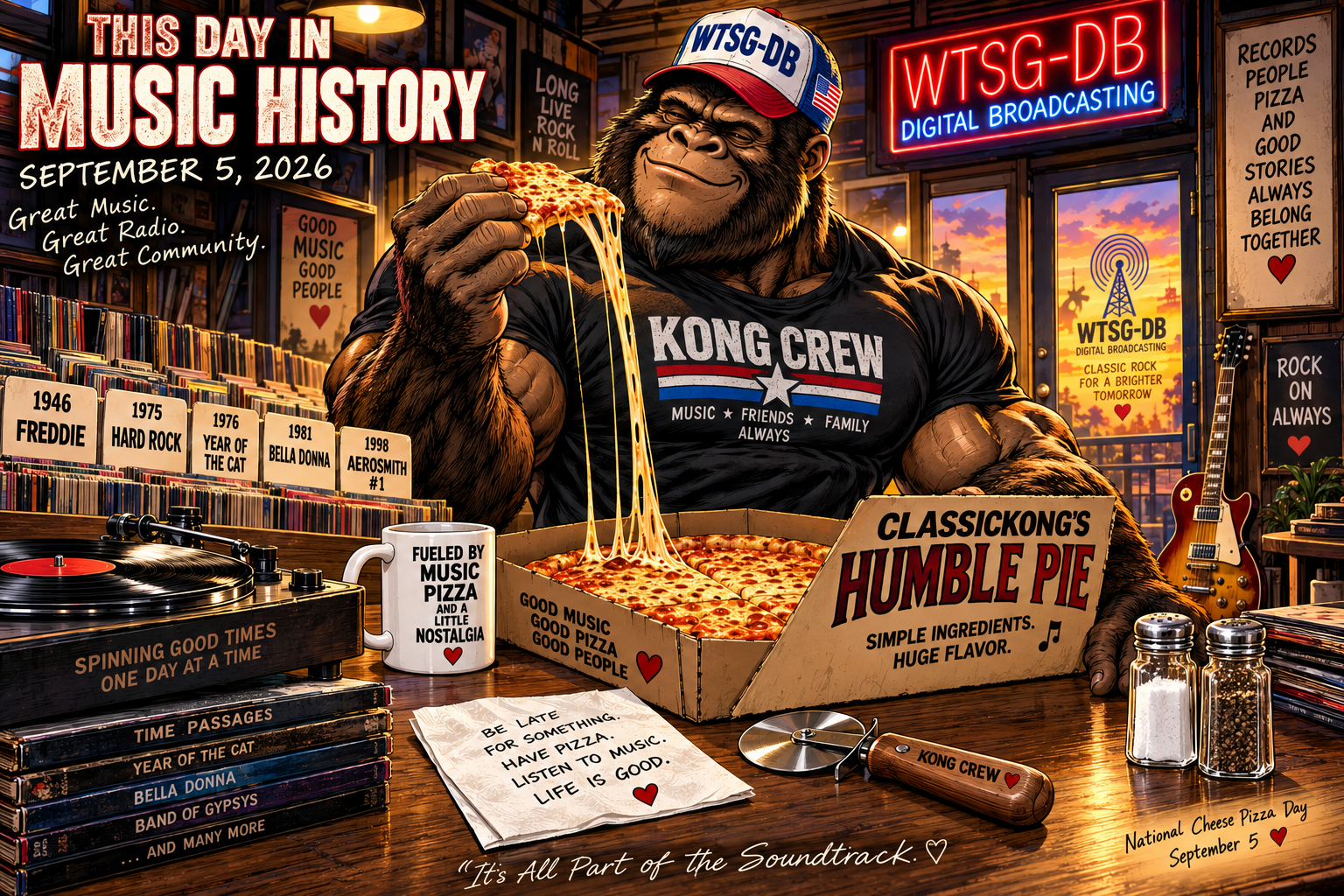
National Cheese Pizza Day
September 5 is National Cheese Pizza Day.
Sometimes simplicity wins.
Real dough.
Good sauce.
Real cheese.
Quality ingredients.
That’s CLASSICKONG’s kind of pizza. 🍕😂
And yes, sometimes life requires reaching into the freezer. CLASSICKONG has a couple of personal favorites there too—Newman’s Own and Amy’s.
As for the rest?
Let’s just say CLASSICKONG prefers pizza that tastes like somebody involved in making it actually cared. 😂
We’re trying to keep the machine running smoothly over here!
September 5 is also Be Late for Something Day.
Which means if you’re late because you stopped for a good cheese pizza…
As far as CLASSICKONG is concerned, you’ve successfully observed two national days at once.
That’s efficiency. 😂🍕
CLASSICKONG’s Music Trivia
Question: Which September 5 birthday musician recorded with Jimi Hendrix in Band of Gypsys?
No peeking.
Answer at the bottom of today’s page.
Final Spin
Maybe the real lesson hiding inside today’s stack of records is something Al Stewart has been singing about all along.
Time passes.
Freddie Mercury would have turned 80 today.
Albums we once called new are now celebrating anniversaries measured in decades.
Musicians leave us. Record stores disappear. The equipment changes. Formats come and go.
And somehow the years keep slipping quietly by.
But then a song begins.
For me, sometimes it’s those opening piano chords of Al Stewart’s “Year of the Cat.”
And suddenly I’m that kid again.
That’s the strange thing about music.
It can’t stop time—but every once in a while, it can give a little of it back.
Maybe that’s why “Time Passages” means more to me today than it ever could have when I was young.
You hear a song differently after you’ve lived awhile.
The melody hasn’t changed.
You have.
And somehow that old record has been sitting there patiently, waiting for you.
Moral of the story?
Don’t spend so much time watching the years go by that you forget to listen while they’re passing.
Play the records.
Share the music.
Tell the stories.
Call the people you love.
And when those familiar opening chords come through the speakers, don’t rush past them.
Stay awhile.
Because someday, the song you’re listening to today may be the one that carries you home. ❤️
Until tomorrow, this is CLASSICKONG for WTSG Digital Broadcasting.
Great Music. Great Radio. Great Community.
Trivia Answer: Buddy Miles.
Listen to Today’s Broadcast
Listen to the spoken-word edition of today’s This Day in Music History below.
And while you’re visiting WTSG-DB, stop by our Guestbook and tell us where you’re listening from. We love seeing how far the signal travels.
References
Freddie Mercury — Official Website
Stevie Nicks — Official Website
Rhino — Stevie Nicks Complete Studio Albums
Clem Clempson — Official Website
Buddy Miles — Official Website
Budgie — Official Website and Discography
Jethro Tull — Official Discography
The Beatles — Official Website
National Day Calendar — National Cheese Pizza Day