From the Desk of CLASSICKONG
Good morning, Kong Crew!
Welcome to another day at WTSG-DB, where the coffee is hot, the records are spinning, and once again somebody forgot to lock the music-history vault.
So naturally…
we went in. 😂🎙️
August 12 is absolutely loaded.
Yesterday we promised we’d come back with a little more Bad Company, and we’re going to keep that promise. We’ve also got Metallica releasing one of the biggest albums in rock history, the beginnings of Led Zeppelin and Fleetwood Mac, the Beatles heading out on what would become their final North American tour, the Commodores taking a beautiful Lionel Richie ballad to No. 1, and birthdays for Mark Knopfler, Pat Metheny and Buck Owens.
And yes, with our kids heading back to school this week, history has also handed us Alice Cooper’s “School’s Out.”
Alice…
Your timing is impeccable. 😂
But before we get to the music, we begin where we always do.
We Salute America’s Armed Forces 🇺🇸
Everyone here at WTSG-DB sends our gratitude to the men and women of the United States Army, Navy, Air Force, Marine Corps, Coast Guard and Space Force, along with our veterans and military families.
Whether you’re serving here at home or thousands of miles away, thank you for standing the watch and protecting the freedoms that allow little independent radio stations like ours to turn on a microphone, play the music we love and share our stories.
To those serving today, those who served before us, and the families who stand beside them:
We remember. We appreciate. And we thank you.
From CLASSICKONG and everyone at WTSG-DB, God bless our troops, our veterans and the United States of America. 🇺🇸
Back-to-School Means Back to Watching the Roads 🚌
School is back in session around our part of the country, and that means our streets are suddenly a whole lot busier.
School buses are back on their routes. Children are walking and riding bicycles. Parents are dropping students off. Morning and afternoon traffic is heavier, and school zones and crosswalks are busy again.
So WTSG-DB asks everyone to slow down, stay alert, watch for children, obey school-zone speed limits and school-bus laws, put the distractions away, and give yourself a little extra time.
There isn’t anywhere we need to get badly enough to put a child’s safety at risk.
We’d also like to offer a special thank you to our law-enforcement officers who protect and serve our communities and help keep our roads and school zones safe. Our appreciation also goes to school resource officers, crossing guards, bus drivers, teachers, administrators and staff members looking after our children every day.
Protect the kids. Watch the roads. And let’s have a safe school year, Kong Crew. ❤️🇺🇸
Now…
Let’s make some noise.
Yesterday We Promised You Bad Company 🎸
And CLASSICKONG keeps his promises.
On August 12, 1974, Bad Company released its debut U.S. single, “Can’t Get Enough.”
Written by guitarist Mick Ralphs (March 31, 1944 – June 23, 2025), the song came roaring out of the band’s self-titled debut album and eventually reached No. 5 on the Billboard Hot 100.
What a way to introduce yourself.
The original Bad Company lineup brought together four musicians who already knew their way around a stage:
Paul Rodgers — vocals
Mick Ralphs (1944–2025) — guitar
Boz Burrell (August 1, 1946 – September 21, 2006) — bass
Simon Kirke — drums
Rodgers and Kirke had been in Free, Ralphs came from Mott the Hoople, and Burrell had played with King Crimson.
Bad Company was managed by Led Zeppelin manager Peter Grant (April 5, 1935 – November 21, 1995) and became the first act signed to Zeppelin’s Swan Song Records.
Then came one heck of a run:
Bad Company — 1974
Straight Shooter — 1975
Run with the Pack — 1976
Burnin’ Sky — 1977
Desolation Angels — 1979
Rough Diamonds — 1982
Later studio albums included:
Fame and Fortune — 1986
Dangerous Age — 1988
Holy Water — 1990
Here Comes Trouble — 1992
Company of Strangers — 1995
Stories Told & Untold — 1996
And those records gave rock radio a permanent supply of ammunition:
“Can’t Get Enough.”
“Bad Company.”
“Ready for Love.”
“Feel Like Makin’ Love.”
“Shooting Star.”
“Rock ‘n’ Roll Fantasy.”
“Silver, Blue & Gold.”
Yesterday we told you we’d have a little more Bad Company waiting.
Promise kept. 😎🤘
Metallica Paints the World Black 🤘
On August 12, 1991, Metallica released its fifth studio album.
Officially, it was simply Metallica.
Everybody else knows it as:
The Black Album.
Working with producer Bob Rock, Metallica created a record with shorter, more focused arrangements and an enormous production sound that opened the band to an audience far beyond thrash metal.
The lineup:
James Hetfield — vocals, rhythm guitar
Lars Ulrich — drums
Kirk Hammett — lead guitar
Jason Newsted — bass
And the songs?
“Enter Sandman.”
“Sad but True.”
“The Unforgiven.”
“Wherever I May Roam.”
“Nothing Else Matters.”
Metallica had already assembled one extraordinary catalog:
Kill ‘Em All — 1983
Ride the Lightning — 1984
Master of Puppets — 1986
…And Justice for All — 1988
Metallica — 1991
Later came:
Load — 1996
Reload — 1997
St. Anger — 2003
Death Magnetic — 2008
Hardwired… to Self-Destruct — 2016
72 Seasons — 2023
And no discussion of those early records is complete without remembering bassist Cliff Burton (February 10, 1962 – September 27, 1986), whose musicianship helped shape Metallica’s early sound.
Metallica fans can argue forever about whether Master of Puppets, Ride the Lightning, …And Justice for All or The Black Album deserves the crown.
That’s half the fun.
But what happened after August 12, 1991, isn’t really debatable.
Metallica became one of the biggest bands on Earth.
Four Musicians Walk Into a Rehearsal Room… ⚡
August 1968.
A basement rehearsal room on Gerrard Street in London.
Four musicians plug in:
Jimmy Page
Robert Plant
John Paul Jones
John Bonham (May 31, 1948 – September 25, 1980)
Around August 12, 1968, the four held what is generally regarded as their first rehearsal together.
They weren’t yet the Led Zeppelin the world would come to know.
One of the songs they reportedly attacked that day was the old Yardbirds concert favorite “Train Kept a Rollin’.”
Imagine standing outside that room.
You hear Bonham.
Then Jones.
Page plugs in.
Plant opens his mouth.
And somewhere in the middle of all that noise, one of the great rock bands in history begins to exist.
Their studio legacy:
Led Zeppelin — 1969
Led Zeppelin II — 1969
Led Zeppelin III — 1970
Led Zeppelin IV — 1971
Houses of the Holy — 1973
Physical Graffiti — 1975
Presence — 1976
In Through the Out Door — 1979
Following Bonham’s death came the posthumous collection:
Coda — 1982
Four musicians.
One room.
And one mighty sound waiting to be unleashed.
Fleetwood Mac — Before Rumours 🎸
On August 12, 1967, the newly formed Fleetwood Mac appeared at Britain’s National Jazz and Blues Festival at Windsor.
This wasn’t yet the Fleetwood Mac of Lindsey Buckingham and Stevie Nicks.
This was a British blues band, centered around the remarkable Peter Green (October 29, 1946 – July 25, 2020).
The earliest performing lineup featured:
Peter Green — guitar/vocals
Mick Fleetwood — drums
Jeremy Spencer — guitar/vocals
Bob Brunning (June 29, 1943 – October 18, 2011) — bass
John McVie soon assumed the bass chair.
Early Fleetwood Mac albums included:
Fleetwood Mac — 1968
Mr. Wonderful — 1968
Then Play On — 1969
But the road from Peter Green’s blues band to Rumours wasn’t a straight line.
And two musicians in particular deserve much more credit for helping build the bridge.
Christine McVie ❤️🎹
Christine McVie (July 12, 1943 – November 30, 2022) brought warmth, melody, a beautiful voice and extraordinary songwriting instincts to Fleetwood Mac.
“Over My Head.”
“Say You Love Me.”
“Songbird.”
“You Make Loving Fun.”
“Think About Me.”
“Hold Me.”
“Little Lies.”
“Everywhere.”
That is one remarkable body of work.
And Christine made outstanding music outside Fleetwood Mac as well.
Her solo and collaborative albums included:
Christine Perfect — 1970
Christine McVie — 1984
In the Meantime — 2004
Lindsey Buckingham Christine McVie — 2017
Her 1984 album produced the hits “Got a Hold on Me” and “Love Will Show Us How.”
There was an elegance to Christine McVie’s music.
She never needed to overpower a song.
She simply seemed to know exactly what it needed.
Bob Welch 🎸
Then there was the mega-talented Bob Welch (August 31, 1945 – June 7, 2012).
Welch’s Fleetwood Mac years are sometimes treated merely as the waiting room before Buckingham and Nicks arrived.
That’s a mistake.
His work on albums such as:
Future Games — 1971
Bare Trees — 1972
Penguin — 1973
Mystery to Me — 1973
Heroes Are Hard to Find — 1974
helped keep Fleetwood Mac alive, productive and evolving.
And songs like “Future Games,” “Sentimental Lady” and “Hypnotized” tell you everything you need to know about his talent.
After Fleetwood Mac, Welch formed the hard-rock group Paris before establishing a successful solo career.
His early solo album run included:
French Kiss — 1977
Three Hearts — 1979
The Other One — 1979
Man Overboard — 1980
Bob Welch — 1981
Eye Contact — 1983
French Kiss is particularly special.
Welch revisited “Sentimental Lady,” which he’d originally recorded with Fleetwood Mac on Bare Trees, and his new version featured Christine McVie and Lindsey Buckingham.
The album also gave us the terrific “Ebony Eyes.”
Think about that connection:
Bob Welch writes “Sentimental Lady” during his Fleetwood Mac years.
Years later he revisits it as a solo artist.
And two members of another Fleetwood Mac era join him.
The family tree circles right back around.
Fleetwood Mac would ultimately travel through numerous incarnations before the lineup of Mick Fleetwood, John McVie, Christine McVie, Lindsey Buckingham and Stevie Nicks produced:
Fleetwood Mac — 1975
Rumours — 1977
Tusk — 1979
Mirage — 1982
Tango in the Night — 1987
Peter Green.
Christine McVie.
Bob Welch.
Buckingham and Nicks.
Different eras. Different sounds.
One extraordinary musical history.
Alice Cooper — School’s Out 🤘🏫
Okay.
We already had our fun about kids going back to school.
Now let’s talk about the record, because School’s Out deserves it.
On August 12, 1972, the title track was sitting atop the British singles chart.
But School’s Out was much more than one famous song.
Released in 1972, it was the fifth studio album by the Alice Cooper band, produced by the brilliant Bob Ezrin.
The Alice Cooper band was:
Alice Cooper — vocals
Glen Buxton (November 10, 1947 – October 19, 1997) — lead guitar
Michael Bruce — rhythm guitar, keyboards
Dennis Dunaway — bass
Neal Smith — drums
Ezrin also contributed keyboards, while additional musicians expanded the record’s palette.
And what a wonderfully strange album it is:
“School’s Out”
“Luney Tune”
“Gutter Cat vs. the Jets”
“Street Fight”
“Blue Turk”
“My Stars”
“Public Animal #9”
“Alma Mater”
“Grande Finale”
There’s hard rock, theatrical music, jazz touches and even a nod toward West Side Story running through the record.
This wasn’t simply a collection built around a hit single.
It was a production.
And Bob Ezrin was perfectly suited for it.
He’d already worked with Alice Cooper on Love It to Death (1971) and Killer (1971), and his ability to combine hard rock with theatrical, cinematic production became an important part of Alice Cooper’s classic sound.
Now, KISS ARMY members, here’s where your ears should perk up.
A few years later, KISS hired Bob Ezrin to produce Destroyer (1976).
Yep.
The producer helping Alice Cooper build these theatrical rock landscapes would later sit behind the console for the album containing:
“Detroit Rock City.”
“King of the Night Time World.”
“God of Thunder.”
“Great Expectations.”
“Beth.”
“Shout It Out Loud.”
That Alice Cooper → Bob Ezrin → KISS connection is one fascinating branch of the hard-rock family tree.
And then there was the School’s Out packaging.
The original album sleeve was designed to resemble an old-fashioned school desk, and early copies famously included a pair of paper panties around the record.
Only Alice Cooper could make buying an LP feel like you were already in trouble with the principal. 😂
The classic Alice Cooper-band album run:
Pretties for You — 1969
Easy Action — 1970
Love It to Death — 1971
Killer — 1971
School’s Out — 1972
Billion Dollar Babies — 1973
Muscle of Love — 1973
So kids, we’re sorry that school has just started again.
But the record?
CLASSICKONG gives School’s Out a passing grade.
🤘😂
The Beatles Begin Their Final North American Tour 🎤
On August 12, 1966, the Beatles performed at Chicago’s International Amphitheatre, beginning what would become their final North American concert tour.
But why did the biggest band in the world quit touring?
By 1966, Beatlemania had become almost unmanageable.
Concert audiences screamed so loudly that the Beatles often struggled to hear themselves play. Stadium amplification was primitive by modern standards and simply wasn’t designed for the enormous crowds rock music was beginning to attract.
Meanwhile, the Beatles’ records were becoming much more sophisticated.
They had just released Revolver.
Songs increasingly employed studio techniques, overdubs, tape manipulation and instrumentation that four musicians standing on a stage couldn’t reasonably reproduce with the concert technology available in 1966.
Touring itself had also become exhausting and increasingly dangerous.
The controversy following John Lennon’s remarks about Christianity produced protests and threats in the United States. Their visit to the Philippines that summer had ended amid frightening circumstances after an unintended diplomatic snub involving the Marcos regime.
The fun was disappearing.
On August 29, 1966, the Beatles performed at Candlestick Park in San Francisco.
They didn’t officially announce to the audience that it was goodbye.
But it became their final paid concert before a paying audience.
And then something remarkable happened.
Free from the demands of touring, the Beatles went back into the studio.
Sgt. Pepper’s Lonely Hearts Club Band — 1967
Magical Mystery Tour — 1967
The Beatles — 1968
Yellow Submarine — 1969
Abbey Road — 1969
Let It Be — 1970
They would, of course, famously perform together again on the Apple Corps rooftop in January 1969.
But the touring Beatles were finished.
The studio Beatles were just getting started.
Commodores — “Three Times a Lady” ❤️
In August 1978, the Commodores reached No. 1 in America with one of their most beautiful recordings:
“Three Times a Lady”
Written by Lionel Richie, the song appeared on the Commodores’ sixth studio album, Natural High (1978).
And that album title matters because “Three Times a Lady” wasn’t some orphaned single floating around the Commodores catalog.
It was part of a band hitting an extraordinary creative stride.
Their album run included:
Machine Gun — 1974
Caught in the Act — 1975
Movin’ On — 1975
Hot on the Tracks — 1976
Commodores — 1977
Natural High — 1978
Midnight Magic — 1979
Heroes — 1980
In the Pocket — 1981
And just consider their range.
“Brick House.”
“Easy.”
“Three Times a Lady.”
“Sail On.”
“Still.”
A band that could fill a dance floor one minute and break your heart the next.
That’s musicianship.
Happy Birthday, Mark Knopfler 🎸🎂
Born August 12, 1949, Mark Knopfler celebrates his 77th birthday today.
And what an unmistakable guitar player.
Knopfler’s fingerstyle technique gave Dire Straits a sound that needed only a few notes before you knew exactly who was playing.
The Dire Straits studio albums:
Dire Straits — 1978
Communiqué — 1979
Making Movies — 1980
Love over Gold — 1982
Brothers in Arms — 1985
On Every Street — 1991
For CLASSICKONG, there are some particular favorites in that catalog:
“Sultans of Swing.”
“Romeo and Juliet.”
“Private Investigations.”
“Brothers in Arms.”
And Love over Gold remains one of CLASSICKONG’s absolute favorite Dire Straits albums.
Only five tracks.
But when one of them is the magnificent “Telegraph Road,” who’s counting?
“Private Investigations” is there too, and the entire record has room to breathe.
Knopfler’s playing reminds us that a guitarist doesn’t always have to play more.
Sometimes it’s knowing exactly what not to play that makes every note matter.
Happy 77th birthday, Mark.
Happy Birthday, Pat Metheny ❤️🎸
Born August 12, 1954, in Lee’s Summit, Missouri, Pat Metheny celebrates his 72nd birthday today.
Now this one is personal.
Metheny has spent decades refusing to stay inside anybody else’s musical boundaries—jazz, fusion, Brazilian influences, electronics, acoustic music, orchestration and sounds that sometimes seem to belong entirely to him.
Among the essential records:
Bright Size Life — 1976
Pat Metheny Group — 1978
American Garage — 1979
Offramp — 1982
First Circle — 1984
Still Life (Talking) — 1987
Letter from Home — 1989
Secret Story — 1992
We Live Here — 1995
Imaginary Day — 1997
The Way Up — 2005
But for CLASSICKONG, this isn’t simply a discography.
Letter from Home. We Live Here. Imaginary Day.
Those records became part of the soundscape of his life.
Metheny’s music accompanied CLASSICKONG during his time serving overseas and became intertwined with memories of his wife, his family and home.
And his Dad was a huge Pat Metheny fan too.
Some albums remind us of a year.
Some remind us of a place.
Some remind us of a person.
And every once in a while, music becomes attached to such a long stretch of living that you can’t separate the songs from the memories anymore.
For CLASSICKONG, Pat Metheny’s music is like that.
It’s been there for a long, long time.
And perhaps that’s one of music’s greatest gifts.
Years later, you hear a few notes…
and suddenly you remember exactly where you were.
Happy 72nd birthday, Pat Metheny. ❤️
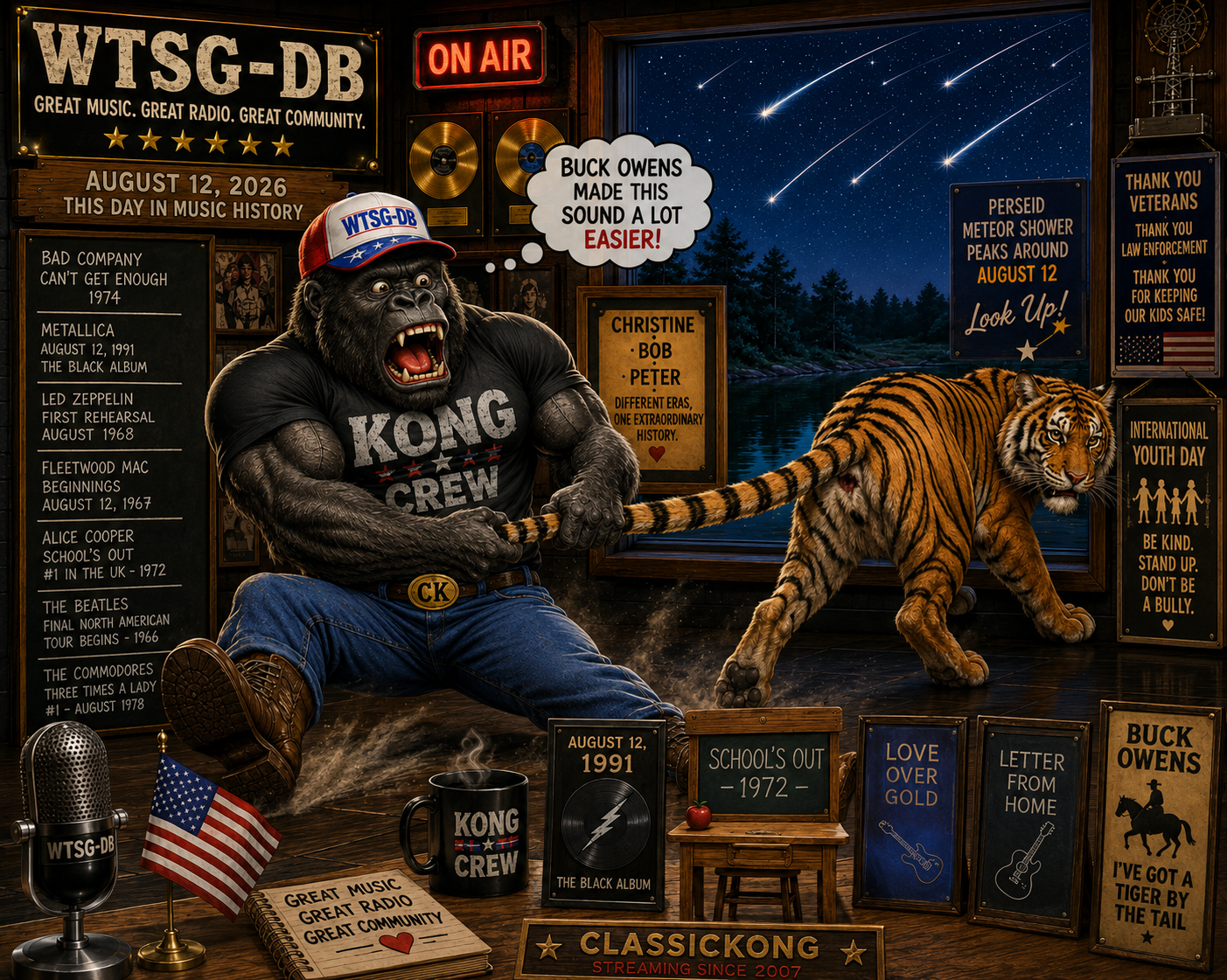
Buck Owens — Tiger by the Tail 🐯🎂
Country legend Buck Owens (August 12, 1929 – March 25, 2006) was born 97 years ago today in Sherman, Texas.
Alongside artists such as Merle Haggard, Buck became one of the architects of the Bakersfield Sound—electric guitars, bright Telecasters, strong backbeats and a tougher edge than much of the polished Nashville sound of the era.
Buck gave us:
“Act Naturally.”
“Love’s Gonna Live Here.”
“Together Again.”
“Buckaroo.”
And, of course…
“I’ve Got a Tiger by the Tail”
Uh-oh.
CLASSICKONG…
PUT THE TIGER DOWN.
🤣🤣🤣🐯
We already let you ride one when we were talking about Dio.
Now you’re grabbing one by the tail?
Somebody call Human Resources.
Actually…
call Animal Control.
ROFLMAO! 😂
Buck Owens also became a familiar face in millions of American homes as co-host, alongside the tremendously talented Roy Clark (April 15, 1933 – November 15, 2018), of Hee Haw.
The program debuted on CBS in 1969, continued in first-run syndication after CBS canceled it, and its original run lasted until 1993.
That’s nearly a quarter-century of country music, comedy, cornfields…
and:
“SAAA-LUTE!” 😂
But behind the television fun was a serious musician and songwriter whose influence on country music remains enormous.
Happy birthday in remembrance to Buck Owens.
And CLASSICKONG…
Seriously.
LET GO OF THE TIGER.
🐯😂
International Youth Day 🌎
August 12 is also International Youth Day, an annual observance established by the United Nations to recognize young people and draw attention to issues affecting them around the world.
With young people around our area beginning another school year, we’d like to leave them with something simple.
Learn.
Ask questions.
Try things.
Find something you love.
Practice.
Make mistakes.
Try again.
You don’t have to know today exactly who you’re going to become tomorrow.
And above everything else:
Be kind.
Don’t make fun of somebody because they’re different.
Don’t pile on because everyone else is doing it.
Don’t be a bully.
You never completely know what another person may be dealing with once they leave that classroom.
If somebody is sitting alone, say hello.
If someone is being picked on, don’t become another voice in the crowd.
Be the person willing to stand beside them.
It doesn’t take strength to tear somebody down.
Real strength is having the courage to help somebody back up.
A little kindness costs absolutely nothing.
And sometimes…
it can mean everything. ❤️
CLASSICKONG’S Music Trivia ❓
All right, Kong Crew.
No Googling. 😂
Which founding member of Fleetwood Mac created the band’s name by combining the surnames of two musicians he hoped would become part of the group?
A. Peter Green
B. Jeremy Spencer
C. Bob Welch
D. Lindsey Buckingham
We’ll give you the answer at the bottom.
Tonight… Look Up 🌠
We’ve spent today talking about stars.
Bad Company.
Metallica.
Led Zeppelin.
Fleetwood Mac.
Alice Cooper.
The Beatles.
The Commodores.
Mark Knopfler.
Pat Metheny.
Buck Owens.
Stars whose music became part of our lives.
But tonight, when the music fades and the day settles down, WTSG-DB has one more recommendation.
Step outside.
And look up.
The Perseid meteor shower reaches its annual peak around August 12, and in 2026 the timing coincides with a new moon, providing beautifully dark skies for viewing where weather and light pollution cooperate.
Find someplace reasonably dark.
Give your eyes a little time to adjust.
And watch.
No ticket.
No subscription.
No backstage pass.
No streaming service.
Just you…
and the universe.
We’ve spent today remembering some of the stars who gave us the music we love.
Tonight, maybe we’ll take a few minutes to appreciate the stars that were shining long before any of us arrived—and will continue shining long after we’re gone.
Sometimes the best show doesn’t require a ticket.
You just have to remember to look up. ❤️🌠
And if you see one streak across the sky, make a wish.
If you see fifty…
Buddy, you better start making a list.
😂🌠
From CLASSICKONG and everyone at WTSG-DB, thank you for spending part of August 12 with us.
Take care of one another.
Watch out for those kids on the roads.
Thank a veteran.
Thank a law-enforcement officer.
Turn up some great music.
Be kind to somebody.
And tonight…
look up.
Great Music. Great Radio. Great Community.
WTSG-DB
Trivia Answer 🎯
A. Peter Green.
Green created the name Fleetwood Mac from the surnames of drummer Mick Fleetwood and bassist John McVie.
Listen to Today’s Broadcast 🎙️
Sit back, relax, and enjoy today’s story in audio form with CLASSICKONG.
[sonaar_audioplayer albums=”latest” progress_bar_style=”default” wave_bar_width=”1″ wave_bar_gap=”1″ player_layout=”skin_boxed_tracklist” show_track_market=”true” css=”.srp_player_boxed, .skin_floated .album-player, .srp-artworkbg{background-color:#ffffff;}”][/sonaar_audioplayer]