From the Desk of CLASSICKONG
Before we turn back the pages of music history today, we begin where we always should—with gratitude.
To the brave men and women serving in the United States Armed Forces, and to every veteran who has worn the uniform before them: thank you.
We remember every veteran and every active-duty service member who has defended and continues to defend the freedoms we enjoy today. Your courage, sacrifice, and service make it possible for the rest of us to live, work, dream—and turn up the music.
From all of us at WTSG-DB and the Kong Crew, we salute you. 🇺🇸
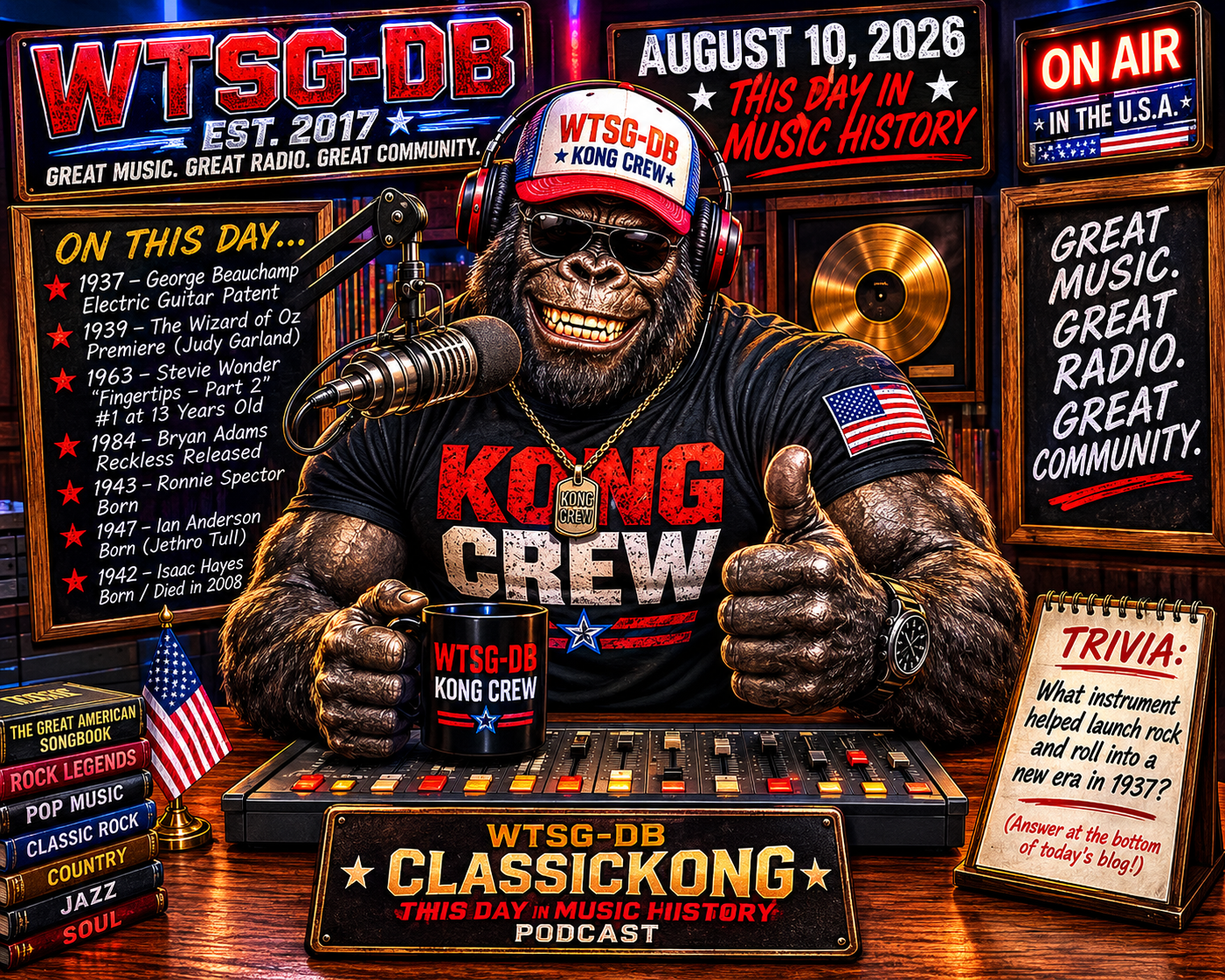
1937 — The Electric Guitar Takes a Giant Step Forward 🎸
Imagine rock and roll without the electric guitar.
No screaming solos. No walls of Marshalls. No Chuck Berry duckwalk. No Hendrix at Woodstock. No Tony Iommi riffs. No Eddie Van Halen tapping his way into another dimension.
And for this old Chet Atkins fan, imagine a world without that beautiful electric guitar tone coming from the hands of Mr. Guitar himself.
Thankfully, we don’t have to.
On August 10, 1937, inventor and musician George Beauchamp was granted U.S. Patent No. 2,089,171 for his electrically amplified stringed instrument.
Beauchamp had worked with Adolph Rickenbacker and the Electro String Instrument Corporation to develop an electromagnetic pickup and one of the earliest commercially successful electric instruments—the unusual lap-steel guitar that became affectionately known as the Rickenbacker “Frying Pan.”
And yes, before somebody hollers from the back of the room:
“What about Les Paul?”
Les absolutely belongs in this story—but in a different chapter.
Beauchamp’s work preceded Les Paul’s famous experiments with “The Log,” which Les constructed around 1940–41. Les became one of the great pioneers and champions of the solid-body electric guitar, helping demonstrate where that technology could go.
They weren’t partners. They were innovators traveling different roads toward a musical revolution.
Beauchamp helped prove that a guitar could be electrically amplified successfully.
Les Paul helped push the solid-body concept toward the instrument that would eventually transform popular music.
Then came Leo Fender and countless other builders, players, and dreamers.
And eventually…
the guitar got LOUD.
Thank goodness for that. 🤘
From jazz and country to blues, rock and roll, hard rock, and heavy metal, it’s nearly impossible to measure what followed from those early experiments.
Sometimes history doesn’t arrive with a roar.
Sometimes it arrives looking like a frying pan. 🎸😂
1939 — Judy Garland Takes Us “Over the Rainbow” 🌈
On August 10, 1939, The Wizard of Oz received its world premiere in Green Bay, Wisconsin, before opening more widely later that month.
At the center of it all was a young Judy Garland as Dorothy Gale.
And then there was that song.
“Over the Rainbow.”
More than eight decades later, Judy’s performance remains one of the defining moments in American film and popular music.
Around here, Judy Garland isn’t simply another name on a list of anniversaries. She was an extraordinary talent whose voice could carry innocence, longing, vulnerability, and strength—sometimes seemingly all at once.
The movie became a landmark.
The song became a standard.
And Judy became unforgettable.
Somewhere over the rainbow indeed. ❤️🌈
1963 — Little Stevie Wonder Makes History 🎹
On this date in 1963, 13-year-old Little Stevie Wonder reached No. 1 on the Billboard Hot 100 with “Fingertips — Pt. 2.”
Think about that for a moment.
Thirteen years old.
Stevie became the youngest solo artist to reach No. 1 on the Hot 100, and what followed became one of the extraordinary careers in American music.
Years later, Stevie released the monumental double album Songs in the Key of Life in 1976.
And this is where today’s history becomes personal.
A CLASSICKONG Memory 🎙️
I owned Songs in the Key of Life when it came out.
But I didn’t stop with the record.
I owned the sheet music, too.
A couple of friends and I had formed a little trio with one of those names that could only have come from young musicians in the 1970s:
The Sunshine Oranges. 🍊😂
We were given an opportunity to perform “Sir Duke” in the 1970s at Pete’s Supper Club in Evansville, Indiana, thanks to my parents, who entertained there at the time.
All these years later, I can still connect that song with those days.
That’s one of the beautiful things about music.
A song can begin as somebody else’s story and somehow become part of yours.
And when Stevie sings about the power of music in “Sir Duke,” I understand exactly what he means.
1968 — Cream Sets the Charts on Fire 🔥
On August 10, 1968, Cream’s Wheels of Fire was sitting atop the American album chart during its four-week run at No. 1.
And what an album.
Eric Clapton. Jack Bruce. Ginger Baker.
Three enormous musical personalities packed into one extraordinarily powerful band.
Released as a double album combining studio recordings and live performances, Wheels of Fire included classics such as “White Room,” “Politician,” and the legendary live recording of “Crossroads.”
Cream didn’t stay together very long, but longevity isn’t always the measure of influence.
Their combination of blues, improvisation, volume, and virtuosity helped lay important groundwork for the hard rock that followed.
Three musicians.
A few short years.
One enormous footprint.
1985 — Bryan Adams Takes Reckless to No. 1 🎸
On this date in 1985, Bryan Adams reached No. 1 on the Billboard 200 with Reckless.
Calling this album successful almost feels inadequate.
Originally released in 1984, Reckless gave us:
“Run to You”
“Somebody”
“Heaven”
“Summer of ’69”
“One Night Love Affair”
and “It’s Only Love,” featuring the incomparable Tina Turner.
That’s not just an album.
That’s practically an FM radio playlist from the mid-1980s.
From CLASSICKONG ❤️
Reckless also happens to be part of the soundtrack of my wife and me.
And I suspect many of you understand exactly what I mean by that.
Eventually certain records stop being associated only with the year they were released.
They become attached to people.
Places.
Cars we drove.
Rooms we lived in.
Someone we loved.
And a particular chapter of our lives.
Then decades later, a familiar opening chord comes through the speakers…
and suddenly you’re there again.
That’s the real power of a great record.
Born on This Day 🎂
Ronnie Spector — Born August 10, 1943 🎤
Born Veronica Bennett on August 10, 1943, Ronnie Spector became one of the unmistakable voices of the 1960s as lead singer of The Ronettes.
Songs including “Be My Baby,” “Baby, I Love You,” and “Walking in the Rain” helped make that voice immortal.
And Ronnie’s story certainly didn’t end with the 1960s.
In 1986, she made one of rock’s great comeback appearances when she joined Eddie Money on “Take Me Home Tonight.”
Money’s song famously calls back to The Ronettes’ “Be My Baby,” and then Ronnie herself answers the call with that unmistakable voice.
The record became a major hit and introduced Ronnie Spector to an entirely new generation of listeners.
Ronnie died on January 12, 2022, at age 78.
But whether it’s “Be My Baby” or hearing her alongside Eddie Money on “Take Me Home Tonight,” there was only one Ronnie Spector.
What a voice. ❤️
Ian Anderson — Born August 10, 1947 🪈
Happy birthday to Ian Anderson, born August 10, 1947.
Singer. Songwriter. Multi-instrumentalist.
And, of course, the man who helped make the flute a perfectly legitimate weapon in a rock and roll band. 😂🤘
As the creative force behind Jethro Tull, Anderson helped create one of rock’s most distinctive bodies of work.
This Was (1968)
Stand Up (1969)
Benefit (1970)
Aqualung (1971)
Thick as a Brick (1972)
A Passion Play (1973)
Songs from the Wood (1977)
Heavy Horses (1978)
And then, in 1982:
The Broadsword and the Beast.
From CLASSICKONG ❤️
I’ve been a massive Jethro Tull and Ian Anderson fan for many years, but The Broadsword and the Beast occupies a particularly special place in my life.
That album was part of the soundtrack of the period when my wife was pregnant with our son.
And among its songs, “Slow Marching Band” remains one of my personal favorites.
It’s quiet.
Reflective.
Deeply human.
And somehow it seems to carry a little more weight with every passing year.
That’s another strange and wonderful thing about music.
The recording stays exactly the same.
We don’t.
We grow older. We experience love and loss. Children grow up. Years that once seemed endless suddenly become memories.
Then one evening you hear an old song again and realize you’re listening with an entire lifetime that wasn’t there the first time.
Some songs remind us of the past.
Others seem to understand why we’re looking back.
For me, “Slow Marching Band” is one of those songs.
Happy Birthday, Ian, and thank you! 🪈🎸
Patti Austin — Born August 10, 1950 🎤
Also born on this day is the wonderfully gifted Patti Austin.
Austin began performing professionally as a child and developed into a remarkably versatile vocalist whose career crossed jazz, R&B, and pop.
Many listeners will remember her beautiful work with James Ingram, including the No. 1 duet “Baby, Come to Me.”
A tremendous singer whose career deserves recognition today.
Happy birthday, Patti!
Remembering Isaac Hayes 🕯️
On August 10, 2008, music lost the great Isaac Hayes, who died at age 65.
Before becoming an unmistakable recording artist himself, Hayes was already helping create musical history at Stax Records.
Together with songwriter David Porter, he helped write soul classics recorded by Sam & Dave, including “Soul Man” and “Hold On, I’m Comin’.”
Then came Isaac Hayes the recording artist.
Hot Buttered Soul (1969).
Black Moses (1971).
Shaft (1971).
And we have to mention his magnificent interpretation of “Never Can Say Goodbye.”
The Jackson 5 had already made the Clifton Davis composition a hit, but Isaac Hayes took the song and made it completely his own on Black Moses. With that deep voice, orchestration, and unmistakable Hayes treatment, it became something altogether different.
That’s one of the things great interpreters can do:
Take a song you already know and make you hear it again.
His groundbreaking “Theme from Shaft” earned Hayes the Academy Award for Best Original Song, making him the first Black composer to win that Oscar.
But Isaac Hayes wasn’t limited to the recording studio.
Movie fans—and CLASSICKONG in particular—also remember him from John Carpenter’s 1981 cult classic Escape from New York.
Hayes played The Duke of New York, the ruthless ruler of Manhattan’s maximum-security prison.
And as the man himself would have you know:
The Duke of New York. A-Number-One! 😂
What a great role in an absolutely awesome movie—and one of CLASSICKONG’s personal favorites.
That voice.
Those arrangements.
That unmistakable presence.
And one seriously cool Cadillac cruising through the streets of a dystopian Manhattan. 😂
Whether it was soul music, Shaft, or going toe-to-toe with Snake Plissken, Isaac Hayes had presence.
He didn’t sound like anybody else.
He didn’t look like anybody else.
And he certainly didn’t command the screen like anybody else.
Rest in peace, Isaac. 🎹🎬🕯️
CLASSICKONG’S MUSIC TRIVIA 🧠
Today’s question:
Which legendary guitarist built an experimental solid-body electric guitar nicknamed “The Log”?
A. Leo Fender
B. Les Paul
C. Chet Atkins
D. George Harrison
No Googling, Kong Crew.
KONG A.I. is watching. 👀🦍
And don’t think I don’t see that phone under the table. 😂
Final Spin 🎙️
Today’s trip through music history began with an instrument that changed almost everything.
George Beauchamp and the pioneers of the electric guitar couldn’t possibly have known every place their experiments would eventually lead.
Neither could Judy Garland have known how many generations would someday follow her “Over the Rainbow.”
A 13-year-old Stevie Wonder couldn’t have known that one of his future songs would someday be played by three young musicians called the Sunshine Oranges at a supper club in Evansville.
Bryan Adams couldn’t have known which couples would someday call Reckless part of the soundtrack of their lives.
And Ian Anderson couldn’t have known exactly whose memories would someday become attached to a song like “Slow Marching Band.”
That’s the remarkable thing about making music.
Artists create the songs.
Life gives them meaning.
And sometimes, many years later, we put on an old record and discover that somewhere along the way…
the music became part of us.
If you haven’t already, we’d love for you to head over to WTSG.NET and sign our brand-new Guestbook. Leave us a message and let us know where you’re listening from.
Every signature and every message becomes another little part of the story of WTSG-DB and the Kong Crew, and we’d love to hear from you. ❤️
Until tomorrow, keep the records spinning, take care of one another, and remember:
Great Music. Great Radio. Great Community.
— CLASSICKONG
WTSG-DB
Trivia Answer 🧠
B. Les Paul
Around 1940–41, Les Paul constructed his experimental solid-body instrument known as “The Log.” His work became an important chapter in the development and popular acceptance of the solid-body electric guitar.
Listen to Today’s Broadcast 🎙️
Sit back, relax, and enjoy today’s story in audio form with CLASSICKONG.
[sonaar_audioplayer albums=”latest” progress_bar_style=”default” wave_bar_width=”1″ wave_bar_gap=”1″ player_layout=”skin_boxed_tracklist” show_track_market=”true” css=”.srp_player_boxed, .skin_floated .album-player, .srp-artworkbg{background-color:#ffffff;}”][/sonaar_audioplayer]